How to Choose the Right Salesforce Consulting Partner (2026 Guide)
Summary: This guide walks through what a Salesforce consulting partner provides, the partner tiers and pricing models you will run into, and a 10-factor framework for evaluating and choosing the right partner for your project in 2026 |
Gartner and Forrester research puts CRM deployment failure rates between 30% and 70%, and the deciding factor is rarely the software. It is almost always the partner running the project, and whether that partner understood the business before they started configuring anything. Choosing the wrong Salesforce consulting partner is how a promising project turns into a stalled org nobody trusts.
This guide breaks down how to evaluate and choose a Salesforce consulting partner with confidence: what these companies actually do, how partner tiers and pricing models work, the factors that separate a strong partner from a risky one, and the questions and red flags worth knowing before you sign anything. It builds on our Salesforce Consulting Guide, which covers the consulting process itself in full.
There is no single "best" Salesforce consulting partner. There is only the right fit for your industry, your budget, your timeline, and the stage your Salesforce org is in today. A firm that excels at fast-moving startup implementations is not necessarily the right choice for a multi-region financial services rollout, and the reverse is just as true.
The right partner combines three things: technical depth on the Salesforce platform, a genuine understanding of how your business operates, and a delivery process that catches problems while they are still cheap to fix. Missing any one of the three tends to show up later as low adoption, budget overruns, or a system that technically works but nobody actually uses.
Certain moments in a business's Salesforce journey are natural triggers for bringing in outside expertise rather than continuing to manage everything internally.
You are moving off spreadsheets or a legacy CRM and need the org built correctly from day one.
An existing org has grown messy, and adoption or reporting accuracy has quietly declined.
You are adding a new Cloud, such as Service Cloud or Marketing Cloud, to a system only ever configured for one.
Headcount or deal volume has outgrown a setup that worked fine for a much smaller team.
Two businesses are merging and need to reconcile two Salesforce orgs, or one org and a spreadsheet system, into a single source of truth.
Pro Tip: If two or more of these describe your situation, a short discovery call with a prospective partner will tell you more in thirty minutes than another month of researching on your own. |
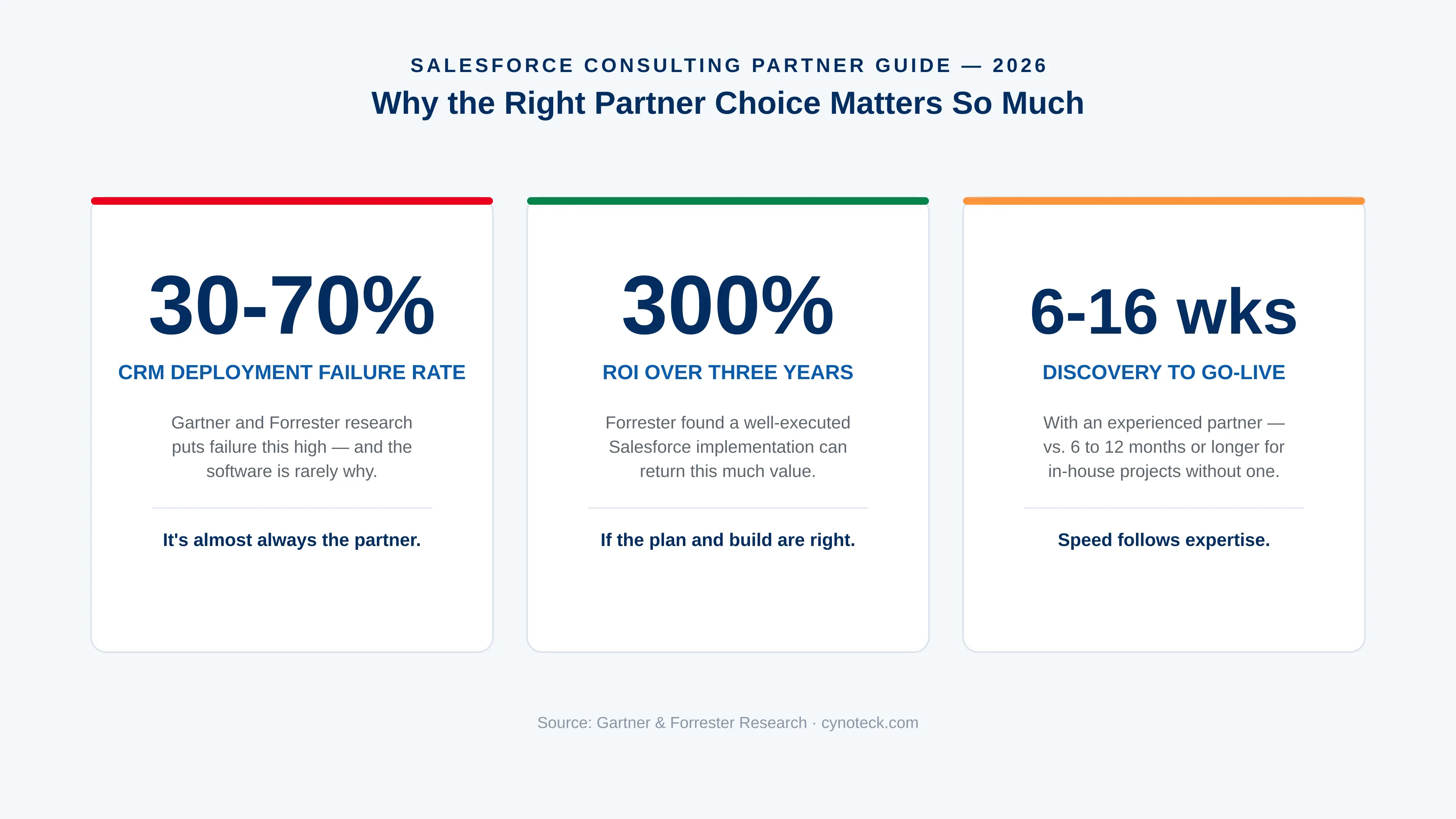
A Salesforce license is only as valuable as the configuration built on top of it. Forrester Research has found that a well-executed Salesforce implementation can return up to 300% ROI over three years, but that return depends entirely on getting the plan and the build right the first time.
The cost of choosing poorly rarely shows up on day one. It shows up months later, as licensing spend on features nobody uses, workflows that duplicate manual work instead of replacing it, and a system reps quietly avoid. Fixing a rushed implementation after the fact is almost always more expensive than paying for proper discovery and design up front.
There is also a compounding effect that is easy to underestimate. A poorly configured org does not just underperform. It actively resists future improvement, since every new feature or integration has to work around decisions made too quickly the first time. Businesses that choose carefully at the outset spend far less on rework two or three years down the line.
Salesforce consulting companies typically offer a bundle of related services rather than a single offering, and understanding the full scope helps you judge whether a proposal actually covers what your project needs.
Strategy and roadmap planning: assessing current processes and deciding which Salesforce Clouds and features actually fit the business, before any build begins
Implementation: configuring the org from scratch, or restructuring an existing one, covering objects, page layouts, permissions, and automation
Customization: extending the platform with Apex code, Lightning components, or custom logic when standard configuration cannot cover a workflow
Data migration: moving records from spreadsheets or a legacy CRM, with de-duplication and field mapping handled before go-live
Integration: connecting Salesforce to ERP, marketing, e-commerce, or finance systems through APIs, so data does not need to be re-entered by hand
User training and adoption support: role-based training and change management built into the rollout, not bolted on afterward
Managed services: ongoing support, monitoring, and optimization once the system is live, for businesses without the internal bandwidth to maintain it alone
A proposal that only covers implementation, with no mention of training or post-launch support, is worth questioning closely. The businesses that get the most value from Salesforce almost always treat the go-live date as the start of the relationship, not the end of it.
Related reading: Types of Salesforce Consulting Services Explained
Related reading: Benefits of Hiring Salesforce Consultants
Not every consulting company is built the same way. The table below breaks down the main categories you will encounter while researching partners.
Partner Type | Strength | Trade-off |
Boutique firm | Deep focus on a specific industry or Cloud, often more senior attention per project | Smaller bench, may have less capacity for very large programs |
Enterprise firm | Broad bench, capacity for large, complex, multi-region programs | Can be slower to start, more layers between you and the delivery team |
Onshore team | Time zone alignment and easier real-time collaboration | Typically higher hourly rates |
Offshore or nearshore team | Often more cost-effective for well-scoped work | Requires clearer documentation and more structured communication |
Independent freelancer | Lower cost for small, well-defined tasks | Single point of failure, limited specialization outside their core skill |
Related reading: Boutique vs Enterprise Salesforce Consulting Firms
Related reading: Onshore vs Offshore Salesforce Consulting
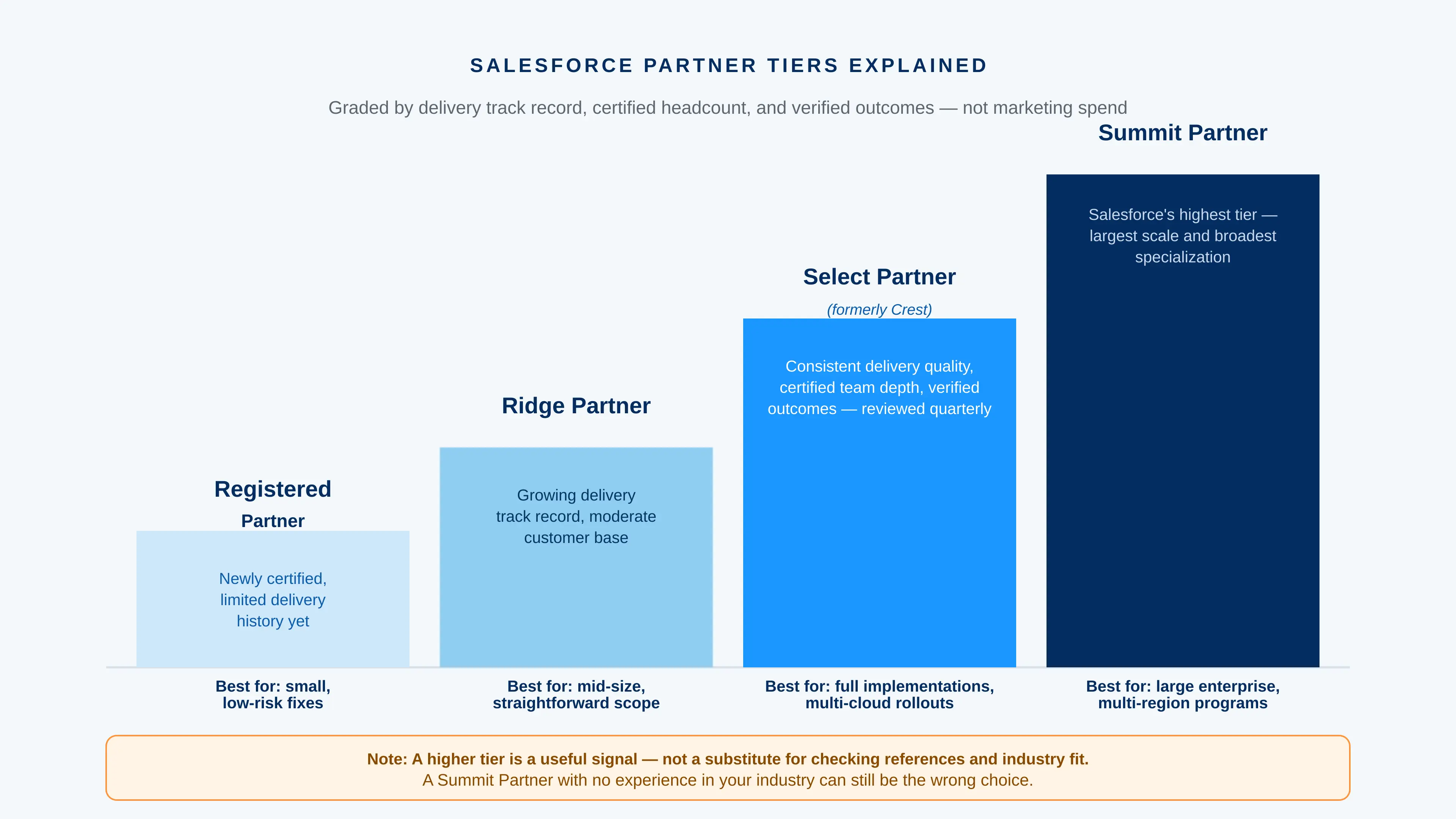
Salesforce itself grades its consulting partners into tiers based on delivery track record, certified headcount, and verified customer outcomes, not on how much a firm spends on marketing. Partner tier naming has shifted in recent years. The tier once known as Crest is now called Select Partner, sitting just below Summit, the program's highest level.
Partner Tier | What It Signals | Best Fit For |
Registered Partner | Newly certified with Salesforce, limited delivery history yet | Small, low-risk projects or a single specific fix |
Ridge Partner | Growing delivery track record, moderate customer base | Mid-size implementations with straightforward scope |
Select Partner (formerly Crest) | Consistent delivery quality, certified team depth, verified client outcomes, reviewed quarterly by Salesforce | Full implementations, multi-cloud rollouts, and ongoing managed services |
Summit Partner | Salesforce's highest tier, largest scale and broadest specialization | Large enterprise programs and complex, multi-region rollouts |
Note: A higher tier is a useful signal, but it is not a substitute for checking references and industry fit. A Summit Partner with no experience in your industry can still be the wrong choice for a specialized project. |
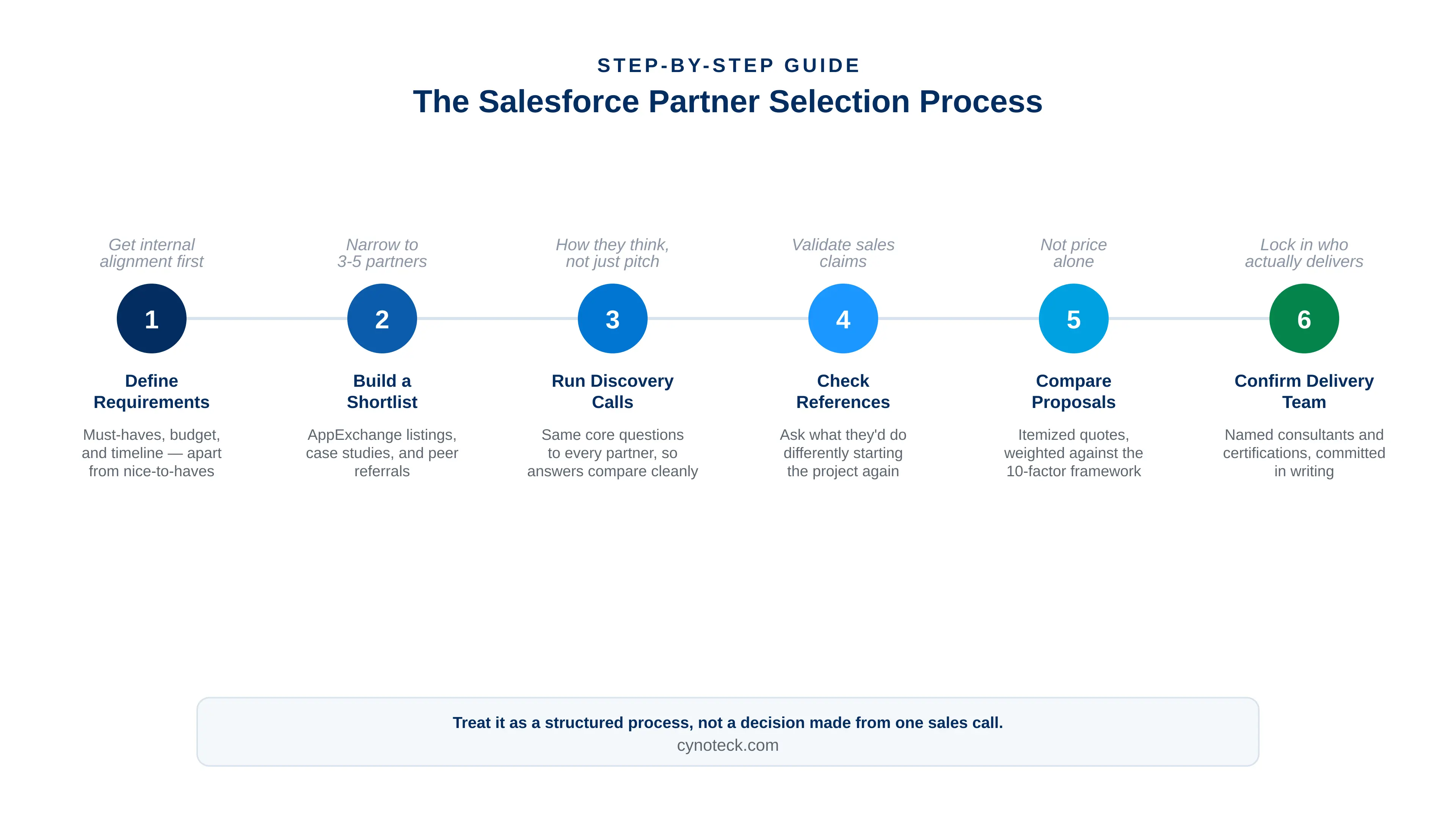
Choosing a partner works best as a structured process rather than a single decision made from a sales call. The stages below reflect how a careful selection typically plays out.
Objective: Get internal alignment on what the project actually needs to accomplish before talking to any partner. Activity: Document must-have requirements, budget range, and timeline separately from nice-to-have items. Best Practice: Involve the people who will actually use the system daily, not only IT and management.
Objective: Narrow the field to three to five partners worth a real conversation. Activity: Search Salesforce AppExchange partner listings, industry-specific case studies, and direct referrals from peers in your sector. Best Practice: Include at least one boutique and one larger firm to compare trade-offs directly.
Objective: Assess how each partner thinks about your problem, not just how they pitch their services. Activity: Ask each partner to walk through their discovery process in detail. Best Practice: Bring the same core questions to every call so responses are easy to compare.
Objective: Validate claims made during the sales process against real client experience. Activity: Call two or three references and ask specifically about communication, budget discipline, and whether they would rehire the firm. Best Practice: Ask references what they would do differently if starting the project again.
Objective: Evaluate cost, scope, and methodology side by side. Activity: Request itemized quotes rather than lump-sum numbers, so you can compare what is actually included. Best Practice: Weight proposals against the 10-factor framework above, not price alone.
Objective: Make sure the people who impressed you during sales are the people actually assigned to your project. Activity: Ask for named consultants and their certifications before signing. Best Practice: Get team commitments in writing as part of the contract.
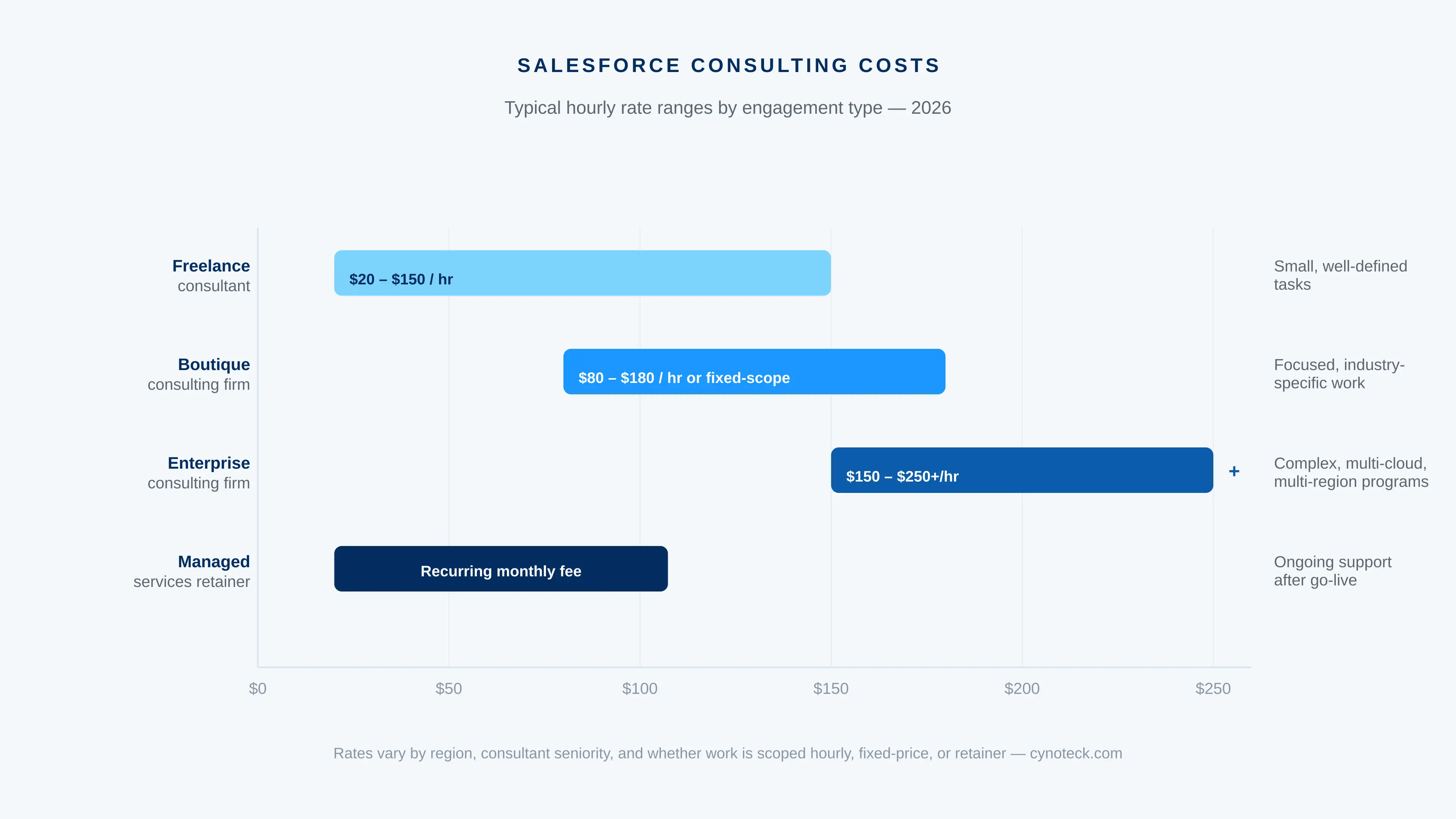
Cost is usually the first question businesses ask, and it depends heavily on partner type, project scope, and pricing model. Rates vary by region, the seniority of consultants assigned, and whether the engagement is scoped as hourly, fixed-price, or a retainer. For a full breakdown of what drives Salesforce implementation cost, including licensing, data volume, and customization scope, see our dedicated pricing guide.
Engagement Type | Typical Range | Best For |
Freelance consultant | $20-$150/hour | Small, well-defined tasks |
Boutique consulting firm | $80-$180/hour or fixed-scope | Focused implementations, industry-specific work |
Enterprise consulting firm | $150-$250+/hour or large fixed-scope | Complex, multi-cloud, multi-region programs |
Managed services retainer | Recurring monthly fee | Ongoing support after go-live |
Fixed-scope pricing tends to work best for a well-defined implementation, since it caps cost and keeps the partner focused on finishing efficiently. A retainer makes more sense once you are past go-live and need ongoing configuration changes, monitoring, and support rather than a single defined deliverable.
Related reading: Salesforce Consulting Cost Guide (2026)
Related reading: Salesforce Consulting Pricing Models Explained
Once you have a shortlist, the factors below are what actually separate a strong Salesforce consulting company from a risky one. Work through each one with every partner you seriously consider, rather than relying on a single conversation to cover everything.
Ask which specific consultants will work on your project and request their individual Salesforce certifications, such as Certified Administrator, Consultant, or Application Architect. A company-wide certification count means little if none of those people end up on your delivery team.
Registered, Ridge, Select, or Summit status reflects Salesforce's own review of a partner's delivery quality, verified customer outcomes, and certified headcount. It is a useful signal, though not a substitute for the rest of this list.
Ask for case studies or references from businesses similar in size and sector to yours. A partner with deep financial services experience is not automatically the right fit for a manufacturing rollout, even with a strong overall track record.
A structured discovery phase, with stakeholder interviews and process mapping, should happen before any configuration quote is given. A partner who jumps straight to a build estimate without asking detailed questions about your workflow is a warning sign, not efficiency.
Ask for two or three direct client references you can actually call, not just testimonials published on a website. A partner confident in their work will make this easy, and a real conversation reveals far more than a curated quote.
A strong proposal includes a clear, itemized quote for fixed-scope work, or a transparent hourly rate with no vague line items. Ask directly what happens if requirements change mid-project, since that is where surprise costs usually appear.
A documented, repeatable process for moving through discovery, design, build, testing, and training is a sign of a mature practice. An ad hoc approach that shifts project to project usually means outcomes will be inconsistent too.
Confirm who owns the relationship after go-live and what the response time is for critical issues. A partner who disappears once the contract closes leaves you exposed the first time something breaks.
Make sure the partner's reporting cadence and communication channels match how your team actually works. A firm that only communicates through formal weekly reports may not suit a team used to daily Slack updates, and the mismatch causes friction fast.
Confirm that the senior consultants who impressed you during the sales process are the same people named on the actual delivery team. It is a common and costly surprise when a strong sales pitch hands off to a much more junior delivery bench.
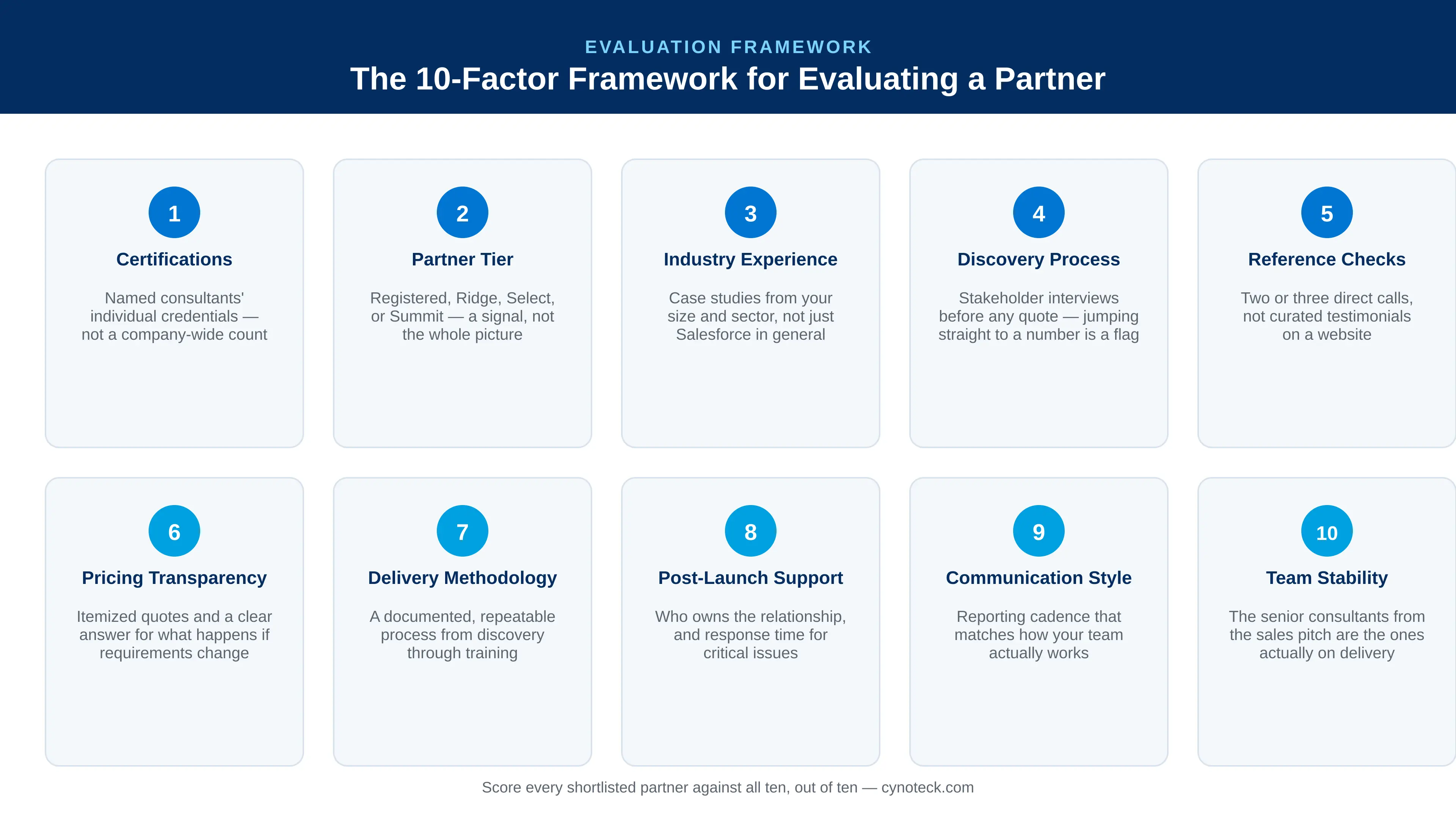
Pro Tip: Print this list and score each shortlisted partner against it out of ten. The scoring exercise itself often reveals gaps a single conversation would have missed. |
A simple scorecard makes comparing multiple proposals far less subjective than relying on gut feeling after each sales call.
Factor | Weight | Partner A | Partner B |
Certifications & tier | 20% | Score /10 | Score /10 |
Industry experience | 20% | Score /10 | Score /10 |
Discovery process quality | 20% | Score /10 | Score /10 |
Reference check results | 20% | Score /10 | Score /10 |
Pricing transparency & support | 20% | Score /10 | Score /10 |
A short list of pointed questions during the sales process reveals more than a polished pitch deck ever will. Ask these directly, and pay attention to how specific the answers are.
Who exactly will be working on our project, and are they the same people in this room today?
Can you walk us through your discovery process in detail, not just the high-level phases?
What does your team's certification and industry experience look like for a project like ours?
Can we speak directly with two or three references with comparable project scope?
What happens if our requirements change mid-project, and how is that priced?
What does support look like in the first ninety days after go-live?
How do you handle a project that starts falling behind schedule?
What tools do you use for project tracking, and how often will we see progress updates?
Vague or evasive answers to any of these are worth treating as seriously as a strong answer to the others.
Related reading: 10 Questions to Ask Before Hiring Salesforce Consultants
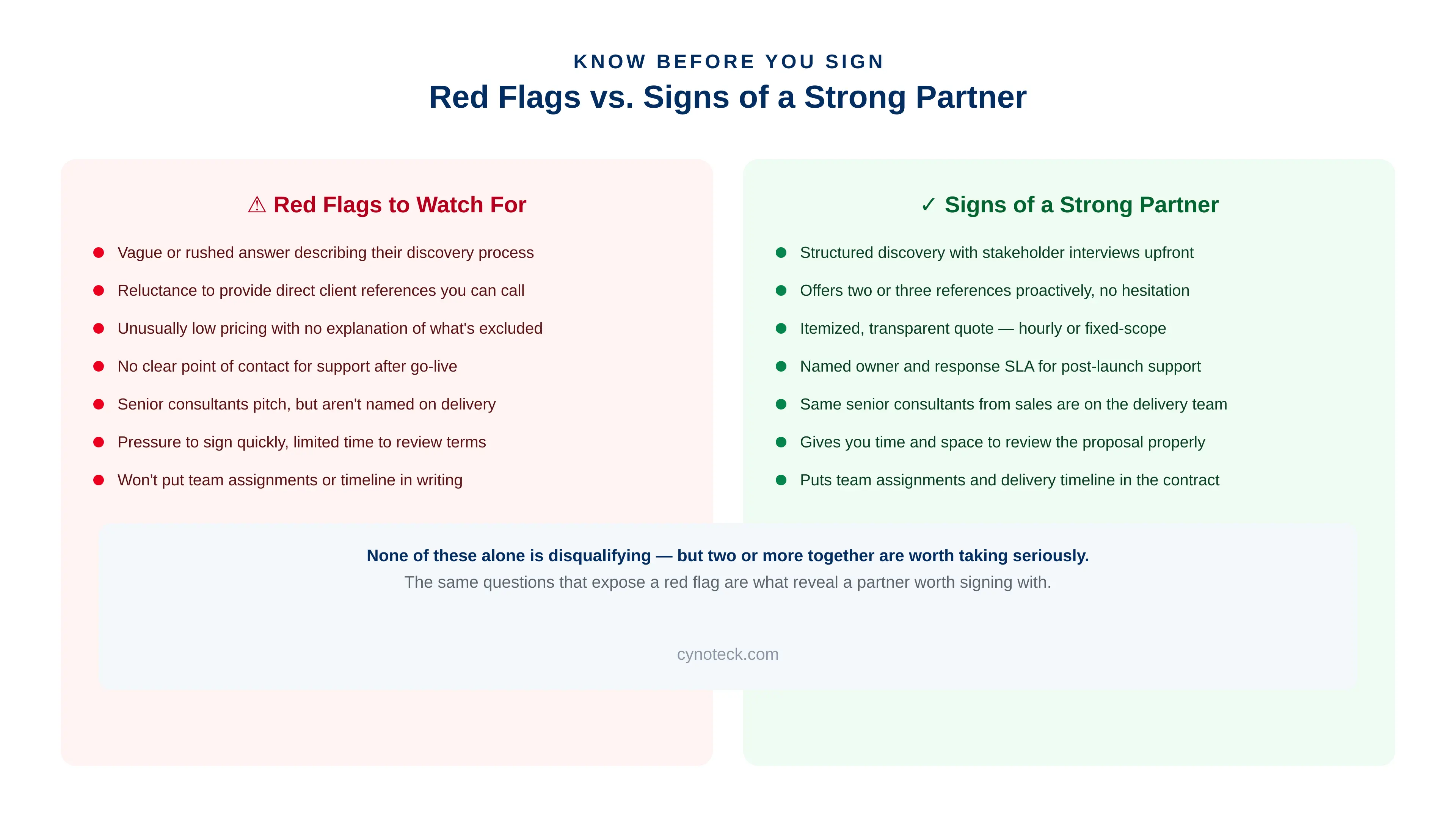
A few recurring warning signs show up across businesses that end up unhappy with a Salesforce partner. None of these alone is necessarily disqualifying, but two or more together are worth taking seriously.
A vague or rushed answer when asked to describe their discovery process in detail.
Reluctance to provide direct client references you can call yourself.
Pricing that seems unusually low with no clear explanation of what is excluded from scope.
No clear point of contact for support after go-live.
Senior consultants present during the sales pitch, but not named as part of the actual delivery team.
Pressure to sign quickly, with limited time given to review the proposal or contract terms.
An unwillingness to put team assignments or a delivery timeline in writing.
Related reading: Red Flags When Selecting a Salesforce Partner
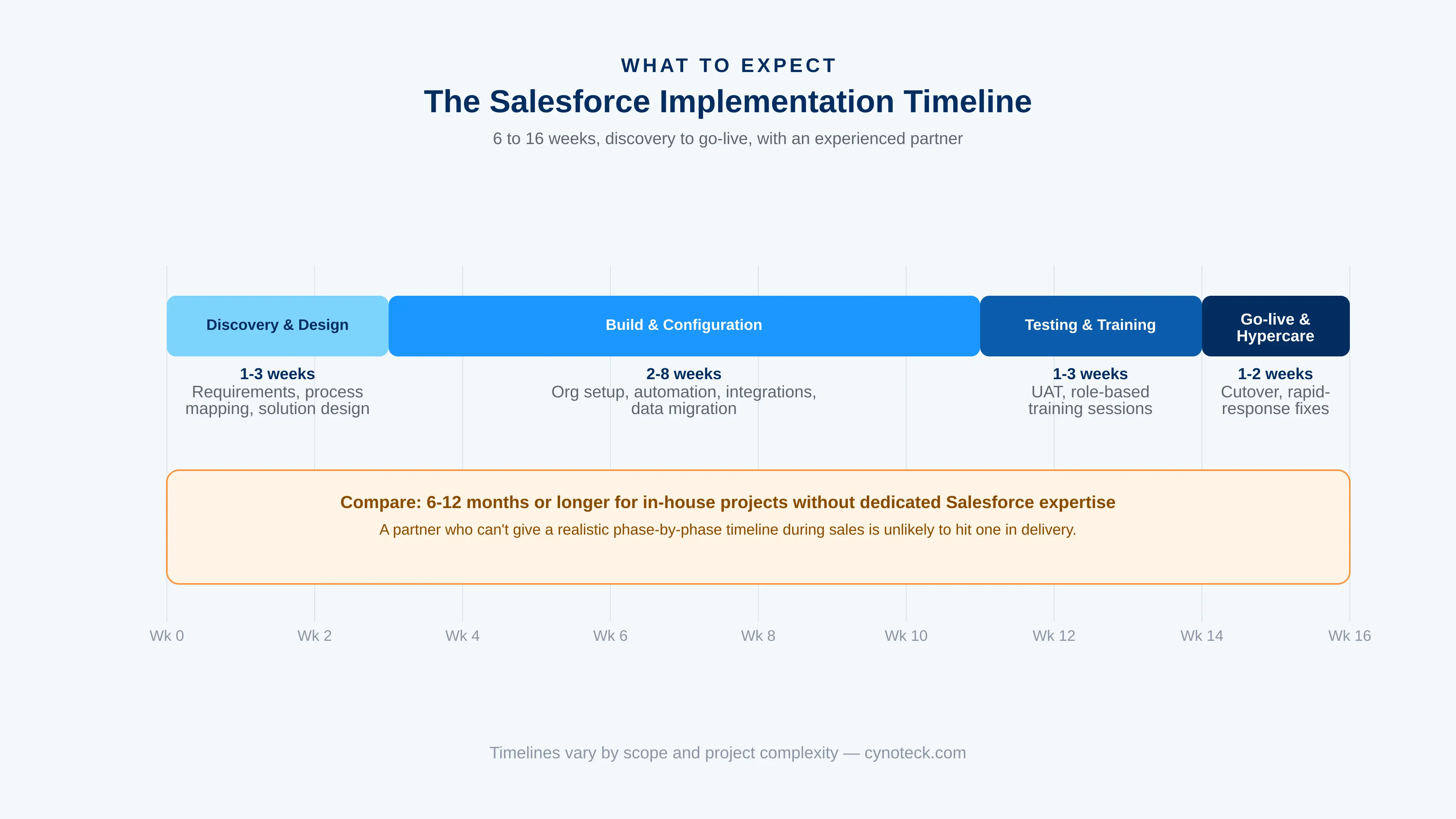
Timelines vary by scope, but most mid-size implementations with an experienced partner run 6 to 16 weeks from discovery to go-live, compared to 6 to 12 months or longer for in-house projects without dedicated Salesforce expertise. A partner who cannot give you a realistic phase-by-phase timeline during the sales process is unlikely to hit one during delivery.
Phase | Typical Duration | What Happens |
Discovery and design | 1-3 weeks | Requirements gathering, process mapping, solution design |
Build and configuration | 2-8 weeks | Org setup, automation, integrations, data migration |
Testing and training | 1-3 weeks | User acceptance testing, role-based training sessions |
Go-live and hypercare | 1-2 weeks | Cutover, close monitoring, rapid-response fixes |
Related reading: Salesforce Project Timeline: What to Expect
The relationship with a consulting partner should be judged on outcomes, not just on-time delivery. User adoption rates, report accuracy, time saved on manual tasks, and pipeline visibility are all better indicators of success than whether the project closed on the exact date in the statement of work.
Daily and weekly active user rates compared to total licensed seats
Time saved on manual data entry and reporting, measured before and after go-live
Forecast accuracy and how much leadership actually trusts the dashboards
Support ticket volume and resolution time once the system is in daily use
Related reading: Salesforce ROI: Measuring Consulting Success
A handful of patterns show up again and again across businesses that end up switching partners mid-project.
Choosing based on the lowest hourly rate instead of relevant experience and verified references.
Skipping reference calls because the case studies on a website looked convincing enough.
Assuming a higher partner tier alone guarantees the right fit for a specialized industry.
Not clarifying who owns support after go-live before signing the contract.
Treating the search as a one-time event instead of a long-term relationship as the business evolves.
Industry fit changes what "the right partner" means in practice. Asking for case studies specific to your sector, not just Salesforce experience in general, is one of the fastest ways to narrow a shortlist.
Financial Services: Look for fluency in compliance tracking, household relationships, and Salesforce Financial Services Cloud
Healthcare: Prioritize experience with patient and provider relationship tracking alongside industry data handling regulations
Manufacturing: Deep ERP integration experience matters more here than general Salesforce breadth
Nonprofit: Look for donor management and grant tracking experience rather than a traditional sales pipeline background
Technology and SaaS: Usage-based billing and renewal tracking experience is often more relevant than industry vertical depth
Retail: Commerce Cloud experience connecting online and in-store customer data is the differentiator to look for
Evaluating a Salesforce consulting company in 2026 increasingly means evaluating their AI readiness alongside their core Salesforce skills. Agentforce, Salesforce's AI agent platform, now handles complete workflows rather than simple automation, and a partner's experience with Data Cloud readiness, agent testing, and human oversight checkpoints has become a real differentiator, not a nice-to-have.
Ask whether the partner has hands-on Agentforce delivery experience, not just familiarity with the concept.
Ask how they approach Data Cloud readiness, since AI features are only as accurate as the data feeding them.
Ask what guardrails they put in place so AI agents stay within approved boundaries before touching live customer data.
Cynoteck is a Salesforce Select Partner, a status tied to proven delivery outcomes and verified customer success rather than marketing spend, and is ISO 27001 certified, so data governance follows a formally audited standard rather than an internal one. Delivery experience spans manufacturing, healthcare, financial services, and more, across Sales Cloud, Service Cloud, and beyond, so the first discovery conversation does not start from zero.
That breadth matters directly against the evaluation framework above. It means a prospective client can ask for references in their specific industry, confirm which certified consultants will actually staff the project, and get a transparent, itemized quote before committing, rather than taking any of it on faith.
The businesses that get the most value from Salesforce are rarely the ones with the biggest budget. They are the ones who chose a partner who understood their business first and the platform second. Talk to a Salesforce consultant today, or explore Cynoteck's Salesforce Consulting Services to see how the right partnership can change your outcome.
What is the difference between a Salesforce consulting company and a freelancer? A consulting company brings a full team spanning strategy, configuration, development, and support, with accountability backed by a contract. A freelancer is often more cost-effective for small, well-defined tasks but represents a single point of failure on larger projects.
How do I verify a Salesforce partner's certifications? Ask which specific consultants will work on your project and request their individual Salesforce certifications, rather than relying on the company's general certification count, which can include people not assigned to your work.
Is a higher Salesforce partner tier always better? A higher tier reflects a stronger overall delivery track record, but it does not guarantee the right fit for your specific industry or project size. Tier should be one factor among several, not the only one.
Should I choose an onshore or offshore Salesforce consulting partner? It depends on how much real-time collaboration your project needs and how well-documented your requirements already are. Onshore teams suit projects needing close, frequent collaboration, while offshore teams can work well for clearly scoped projects with strong documentation.
How long does it take to choose the right Salesforce consulting partner? Most businesses spend two to four weeks on research, discovery calls, and reference checks before selecting a partner. Rushing this stage is one of the most common reasons projects start on the wrong foot.
What is the biggest mistake businesses make when choosing a Salesforce partner? Prioritizing the lowest quoted price over relevant experience and verified references. A cheaper quote that leads to a rebuild months later almost always costs more than paying for the right partner the first time.
Can I switch Salesforce consulting partners mid-project? Yes, though it adds cost and time for a new partner to get up to speed on existing decisions. Thorough documentation from the original partner makes a mid-project switch considerably smoother if it becomes necessary.
Do I need a different partner for implementation versus ongoing support? Not necessarily. Many businesses prefer a single partner who handles both, since continuity of context reduces the risk of the finished system drifting from the original plan. Some do split the two deliberately for cost reasons.
 Outsource Salesforce Development or Build In-House Which is the Best for Your Business.webp)
Outsourcing Salesforce development vs. building an in-house Salesforce team: 2026 cost insights, salary comparisons, key benefits, challenges, and the best hiring model for your business growth.
We are more than just developers and consultants—we are your partners in navigating the digital landscape. Let us be the engine behind your next big success while you focus on your core vision.
Explore Opportunities!