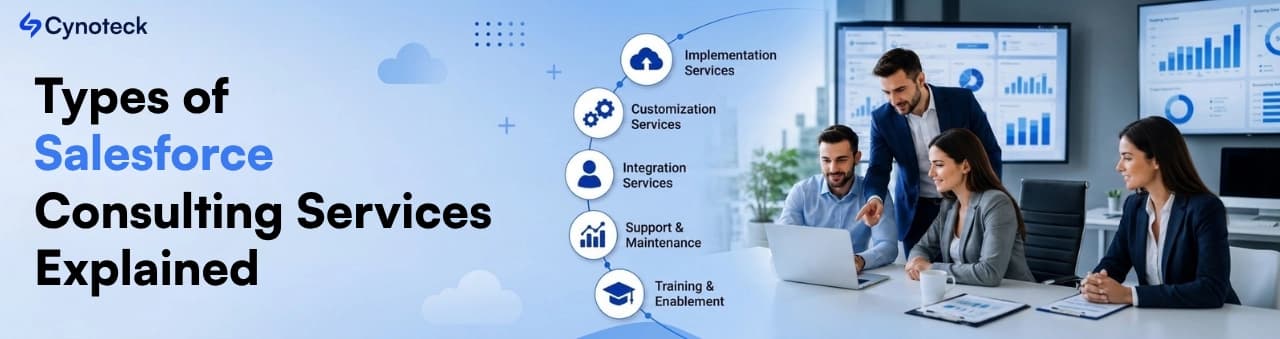
Types of Salesforce Consulting Services Explained
Ask ten different Salesforce partners what services they offer, and you'll get ten overlapping but slightly different lists: implementation, customization, integration, managed services, and so on. None of them tell you which one is relevant to your situation, since a list assumes you already know where you stand.
This guide organizes Salesforce consulting services around where you are in your Salesforce journey, so you can find the service that matches your real situation. It also covers cloud-specific consulting and a quick way to check you're asking for the right thing.
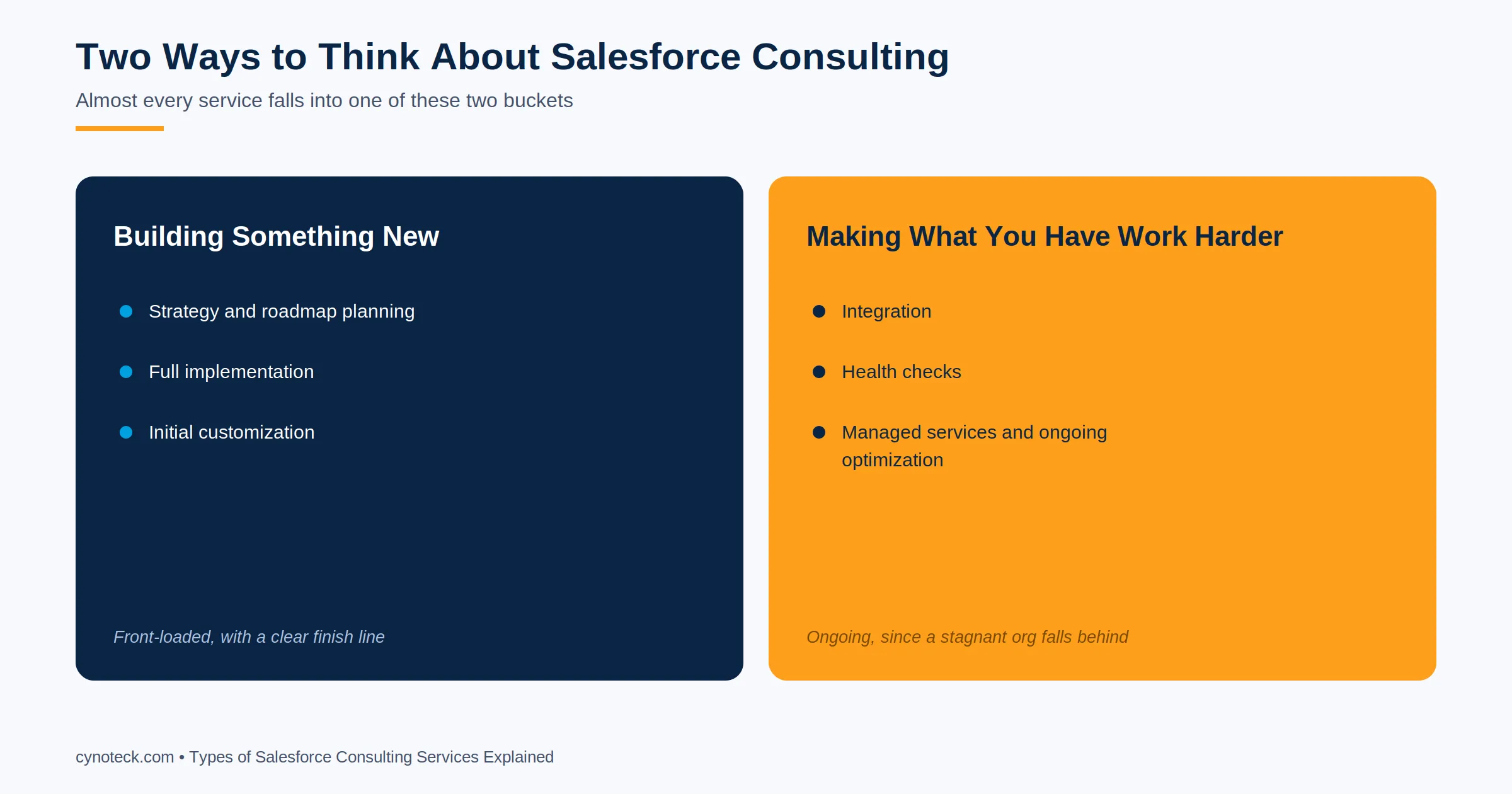
Almost every one of the Salesforce consulting services available today falls into one of two buckets: building something new, or making what you already have work harder. Building-something-new work includes strategy, implementation, and initial customization. It's front-loaded and has a clear finish line: the day you go live.
Making-what-you-have-work-harder work includes integration, health checks, managed services, and ongoing optimization. It doesn't really end, since a Salesforce org that stops improving tends to fall behind the business it's supposed to serve.
Here's why this distinction matters in practice. A business that just went live six months ago and is now struggling with adoption doesn't need another round of implementation.
They need someone to look at why the system isn't being used, which is optimization work, not a rebuild. Confusing the two often means paying for the wrong Salesforce consulting service entirely.
Note: Most businesses assume they need the first bucket when they need the second. If your org already exists but isn't working well, a health check usually costs less and tells you more than jumping straight to a new build. |
Every Salesforce consulting service fits somewhere in a business's journey with the platform, from the first decision to buy through years of ongoing growth. The four stages below break that journey down so you can find your exact starting point.
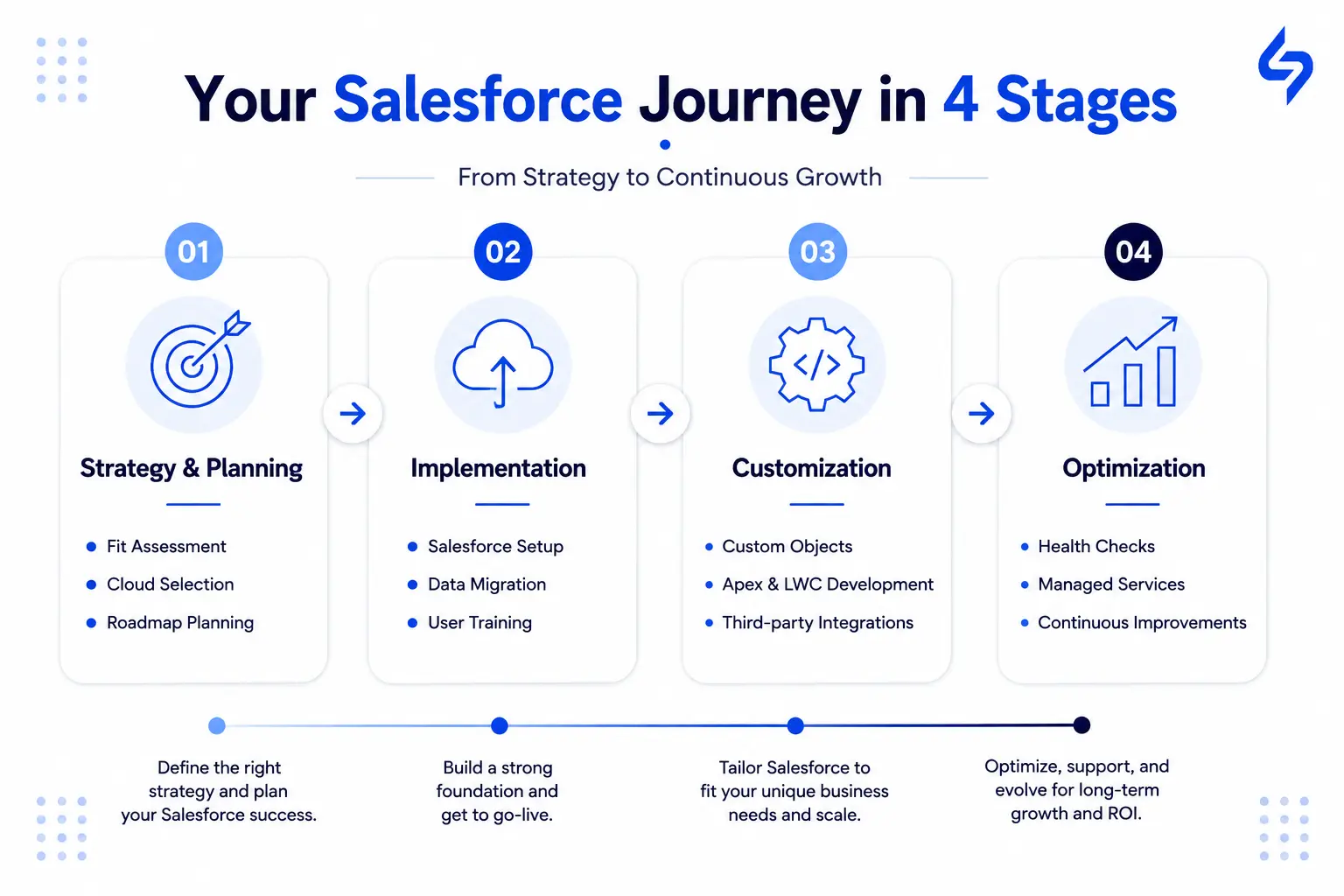
If you don't have Salesforce yet or you're not sure it's the right fit, this is where Salesforce consulting services begin.
Fit assessment: A short engagement to confirm Salesforce solves your problem, before you spend money on licenses.
Cloud selection: Deciding which Salesforce products you need, such as Sales Cloud or Service Cloud, instead of buying more than your business uses.
Roadmap planning: A phased plan for what gets built first, second, and later, so scope doesn't balloon on day one.
Who this is for: Businesses evaluating Salesforce for the first time, or ones considering a major expansion into a new cloud they haven't used before.
This stage is easy to skip, and skipping it is one of the more expensive mistakes a business can make. Buying licenses first and figuring out the plan later usually means paying for seats nobody uses.
Sometimes it means discovering months later that a different cloud would have fit better. A short assessment upfront, before any Salesforce implementation work begins, is inexpensive compared to the cost of redoing a build later.
Also, Read: What Is Salesforce Consulting?
Once you've decided to move forward, this stage covers the actual build and launch.
Implementation: Configuring the org from the ground up, based on your specific sales, service, or operational process.
Data migration: Moving records out of spreadsheets or a legacy CRM, cleaned up along the way instead of carried over as-is.
User setup and permissions: Getting the right people the right access from day one, not sorted out after something goes wrong.
Pro Tip: Ask any partner how they handle a launch date that falls near your busiest season. A good consultant will push back on timing before it becomes a problem, not after.
This is usually the largest single Salesforce consulting service a business buys, since it covers everything from the first configured field to the moment real users log in.
It's also where the quality of earlier discovery work either pays off or causes problems, since a rushed Stage 1 tends to surface as rework during Stage 2.
Also, Read: Salesforce Consulting Process: Step-by-Step Guide
Not sure which Salesforce consulting services fit your business? Get expert guidance to identify the right solution and avoid unnecessary costs.
Talk to Our Salesforce ExpertsThis is where a generic Salesforce setup turns into one built specifically around how your business operates.
Customization: Custom objects, fields, and page layouts that reflect your actual workflows, not a generic template.
Development: Custom code, such as Apex or Lightning Web Components, for logic that no-code tools genuinely can't handle.
Integration: Connecting Salesforce to your ERP, marketing platform, or support desk, so data moves automatically instead of by hand.
This stage is also where most businesses first bring in a technical consultant. That's someone focused on code rather than configuration, since the work here often goes beyond what declarative tools alone can do.
Salesforce customization specifically covers the middle ground: not a full custom build, but more than basic configuration. A validation rule is configuration. A custom pricing engine built around your exact discount structure is customization. Knowing which one your problem needs saves time in the first conversation with a consultant.
Also, Read: Salesforce Consulting vs Salesforce Implementation
Once you're live, the work doesn't stop; it just changes shape.
Managed services: ongoing, SLA-based support for fixes, small enhancements, and release management as Salesforce ships new features.
Health checks: a diagnostic audit of an org that's grown messy, producing a prioritized list of what to fix first.
Scaling support: adding a new cloud, a new business unit, or a new integration to an org that's already live, without breaking what already works.
Note: This is the stage most businesses underestimate. An org that worked perfectly at 20 users often needs real attention at 100, not because anything broke, but because the business changed shape around it. |
Managed services in particular are one of the more misunderstood Salesforce consulting services. It sounds like ongoing support for problems, when it's really about keeping pace with a fast-moving platform.
Salesforce ships new features on its own release schedule, several times a year, whether or not your org is ready to use them.
Also, Read: Salesforce Consulting Best Practices
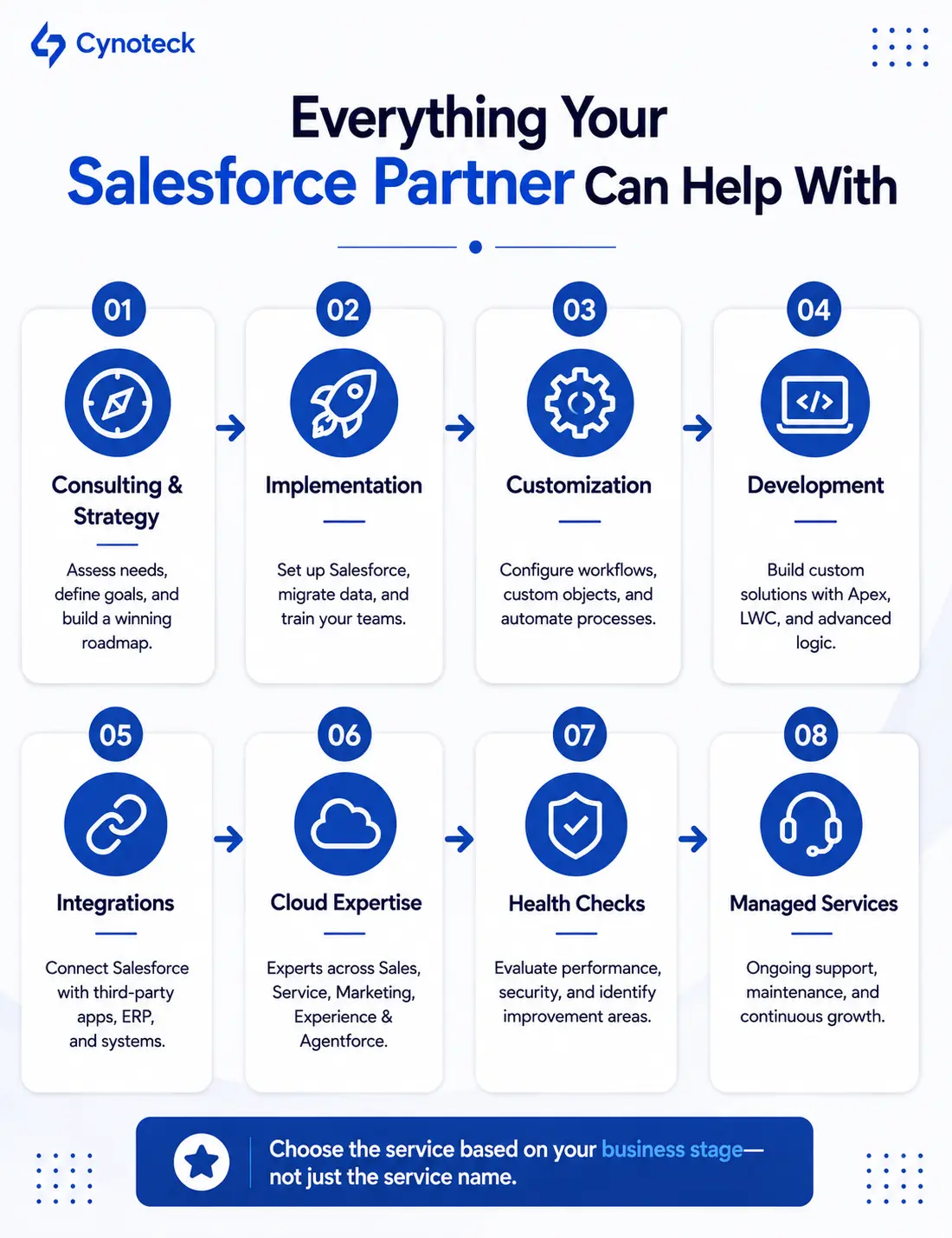
Here’s every one of these Salesforce consulting services, from the four stages above, in one table for quick reference.
Use this table to jump straight to a specific service, or to double-check where something you've already heard about fits.
Service | Which Stage | Best For |
Fit assessment | Stage 1 | Confirming Salesforce is the right platform before buying |
Roadmap planning | Stage 1 | Sequencing a multi-phase project realistically |
Implementation | Stage 2 | Building and launching a new org |
Data migration | Stage 2 | Moving off spreadsheets or a legacy CRM |
Customization | Stage 3 | Matching Salesforce to workflows templates don't cover |
Development | Stage 3 | Logic too complex for no-code tools |
Integration | Stage 3 | Connecting Salesforce to your other systems |
Managed services | Stage 4 | Ongoing support without a full-time hire |
Health checks | Stage 4 | Diagnosing a messy or underperforming org |
Different types of Salesforce services suit different budgets and timelines, which is exactly why matching your stage first, then picking the service, tends to work better than picking a service name off a list.
Beyond the four stages above, some Salesforce consulting services are specific to which Salesforce product you're using.
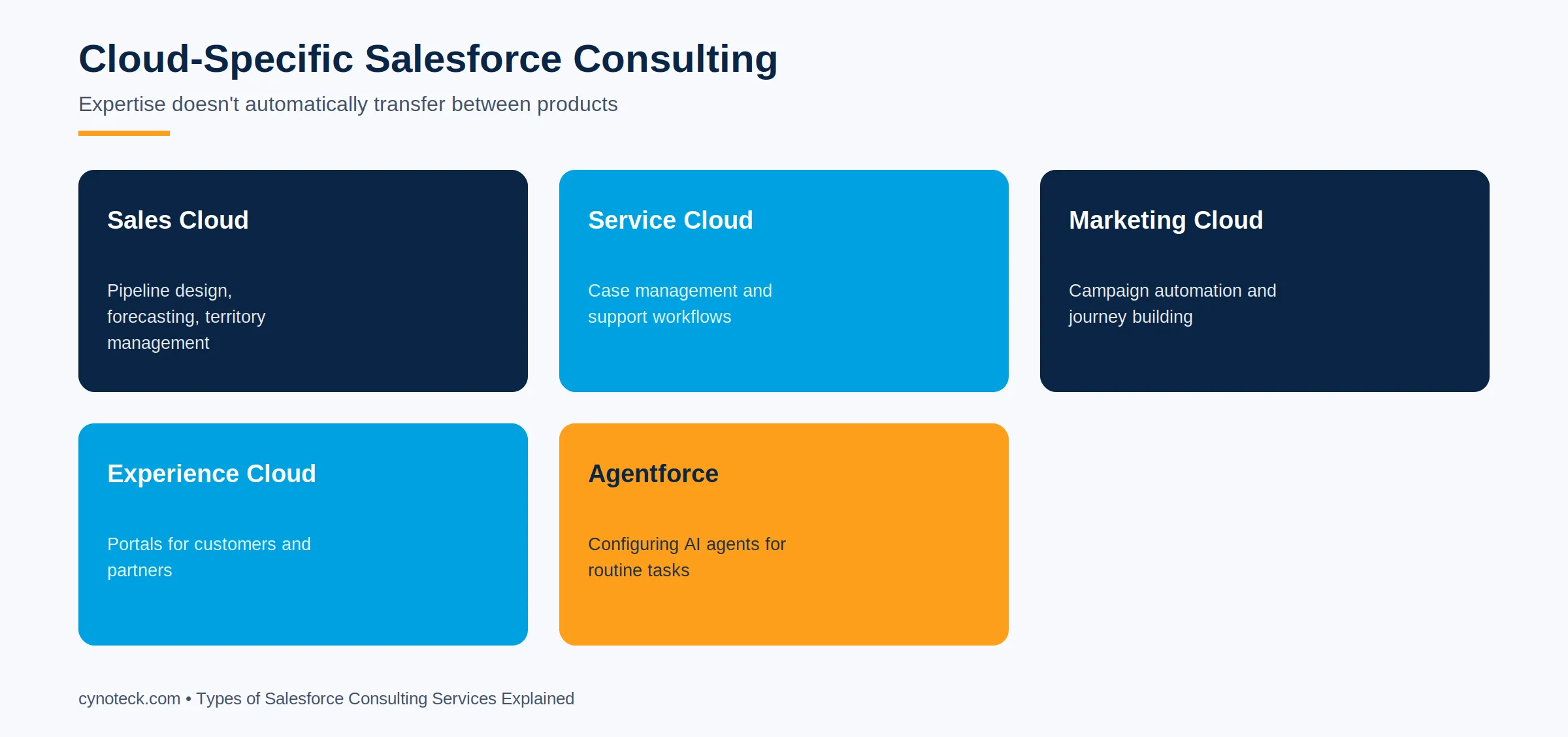
This matters because expertise doesn't automatically transfer between products, even within Salesforce itself.
Sales Cloud consulting: pipeline design, forecasting, and territory management for sales teams.
Service Cloud consulting: case management, support workflows, and customer service automation.
Marketing Cloud consulting: campaign automation, journey building, and audience segmentation.
Experience Cloud consulting: building portals for customers or partners to interact with your business directly.
Agentforce and AI consulting: configuring AI agents to handle routine tasks like lead follow-up or case triage.
A consultant experienced in one cloud isn't automatically equipped for another. If your project spans two or three clouds at once, that's worth asking about directly before you hire anyone.
Maximize your Salesforce investment with tailored Salesforce consulting services for Sales Cloud, Service Cloud, Agentforce, integrations, and custom business workflows.
Schedule a Free ConsultationThree questions narrow down which Salesforce consulting services you need, faster than reading a full list. Answer these honestly, and the right starting point usually becomes obvious.
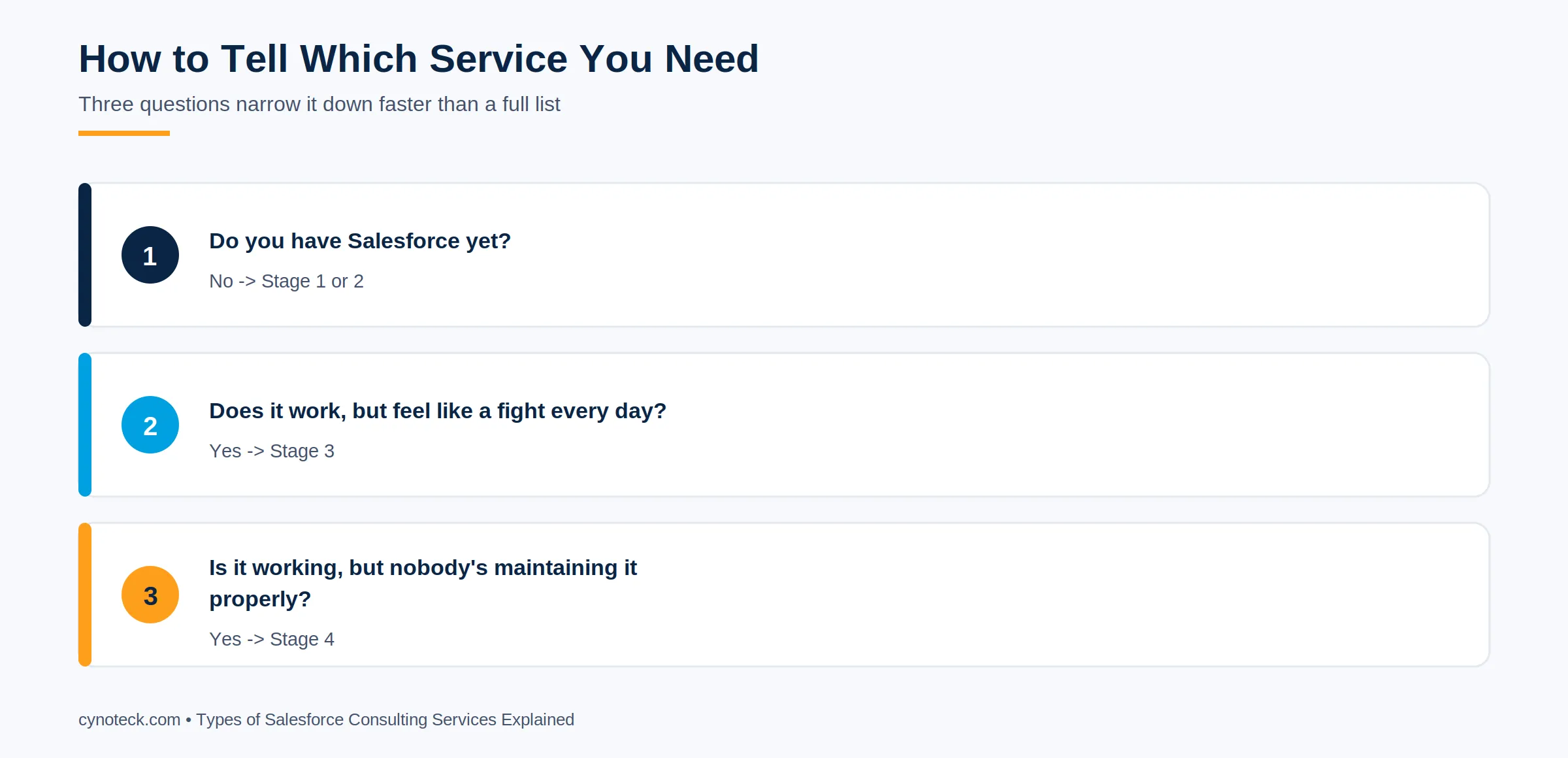
Do you have Salesforce yet? If not, you're in Stage 1 or 2.
Does it work, but feel like a fight every day? That's Stage 3, usually customization or integration.
Is it working, but nobody's maintaining it properly? That's Stage 4, usually managed services or a health check.
Pro Tip: If you're genuinely unsure, a health check is often the cheapest way to get a real answer. It tells you exactly which stage you're in, rather than guessing from a blog post.
Not every consulting partner uses the same names for the same Salesforce consulting services, which can make comparing quotes harder than it should be.
One partner's "optimization package" might be another's "managed services." One firm's "quick-start implementation" might skip the discovery work another firm includes by default. This isn't necessarily dishonest; it's just inconsistent language across the industry.
The fix is simple: ask what's included, in plain terms, rather than comparing service names side by side. Two quotes with different labels can cover nearly identical work, and two quotes with the same label can cover very different amounts of it.
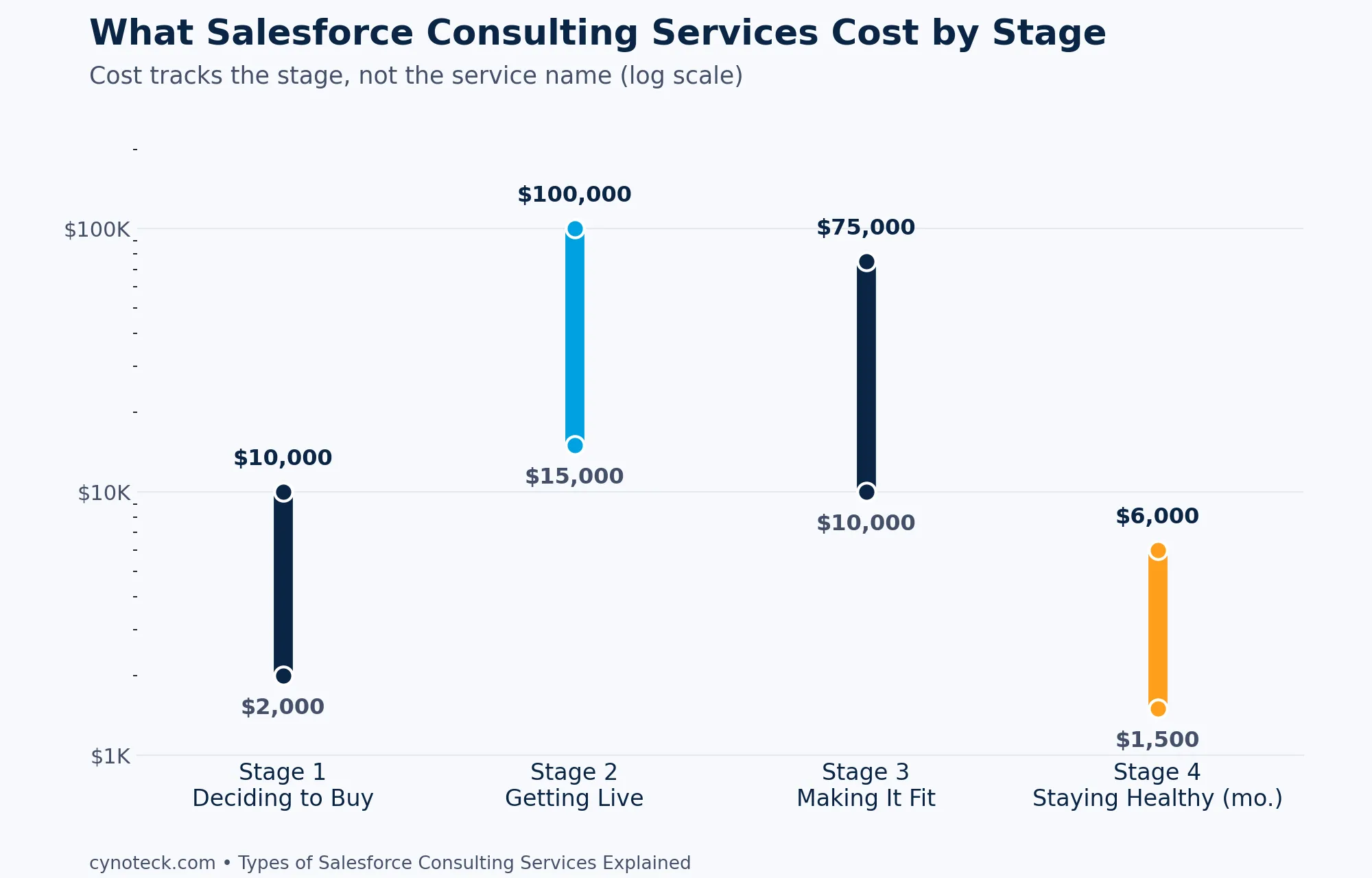
Cost tracks the stage, not the service name. Earlier-stage Salesforce consulting services are cheaper; later-stage work varies more with complexity.
Stage | Typical Cost Range |
Deciding whether and how to buy | $2,000 - $10,000 |
Getting live for the first time | $15,000 - $100,000+ |
Making it fit your business | $10,000 - $75,000 per project |
Keeping it healthy as you grow | $1,500 - $6,000/month ongoing |
Also, Read: Salesforce Consulting Cost Guide (2026)
Everything covered in this guide maps directly to services Cynoteck delivers, not just a framework for explaining the industry in general. Cynoteck is a certified Salesforce Select Partner with 500+ projects delivered across 15+ countries, a 90% client retention rate, and a 95% on-time deployment rate.
That track record also holds up on AgentExchange (Salesforce's marketplace, formerly AppExchange), where Cynoteck carries a 4.9 out of 5 CSAT score verified through independently audited client reviews, not a number we wrote ourselves.
Here's where each stage from this guide connects to a specific, live Cynoteck service:
Salesforce Consulting Services: Covers Stage 1, CRM strategy, roadmap planning, and Agentforce readiness assessment before you commit to anything.
Salesforce Implementation Services: Covers Stage 2, taking you from a documented plan to a live, working org.
Salesforce Customization Services: Covers the Stage 3 work of shaping a generic setup around your actual workflows.
Salesforce Integration Services: Also part of Stage 3, connecting Salesforce to your ERP, accounting, marketing, and other third-party tools.
Salesforce Development Services: The technical side of Stage 3, covering Apex, Lightning Web Components, and Agentforce agent configuration.
Salesforce Administration Services: Part of Stage 4, day-to-day management for businesses that don't need a full-time in-house admin.
Salesforce Support and Maintenance Services: Also Stage 4, ongoing monitoring, issue resolution, and platform optimization after go-live.
Salesforce Managed Services: Also Stage 4, for businesses that want end-to-end ownership of Salesforce health as they scale.
Partner with experienced professionals offering Salesforce consulting services to plan, implement, customize, and optimize Salesforce for long-term business growth.
Book a Free ConsultationNotice which stage you kept nodding along to while reading this. That's the real starting point, more useful than any service name on its own.
A short conversation about that specific stage will get you further than reading a second article on the topic.
Ans: They generally fall into four stages: deciding whether and how to buy, getting live for the first time, and making the system fit your business through customization and integration. The fourth stage is keeping it healthy as you grow, through managed services and health checks.
Ans: Implementation is one specific type of consulting service, focused on building and launching the org. Consulting is the broader term covering strategy, implementation, customization, and ongoing support together.
Ans: Customization typically uses Salesforce's no-code, declarative tools: custom fields, page layouts, and automation. Development means writing custom code, such as Apex, for logic that declarative tools genuinely can't handle.
Ans: Not necessarily, but experience matters. A consultant strong in Sales Cloud isn't automatically equally strong in Marketing Cloud. If your project spans multiple clouds, ask directly about experience in each one.
Ans: If your org already exists and mostly works, but something feels off, a health check is usually cheaper and more useful than jumping straight into a new build. It tells you specifically what's wrong before you spend money fixing it.
Ans: For some businesses, yes. For others, the two work best together: an in-house admin for daily changes, and managed services for specialized work or overflow capacity during busy periods.
Ans: Usually, yes. Most established consulting partners cover all four stages, though depth varies, so it's worth asking specifically about experience in the stage that matches your current situation.
Ans: It's rarely catastrophic, but it usually costs time. A common example is jumping straight into customization before a proper implementation is in place, which often means redoing part of the work once the underlying setup gets addressed properly.
 Outsource Salesforce Development or Build In-House Which is the Best for Your Business.webp)
Outsourcing Salesforce development vs. building an in-house Salesforce team: 2026 cost insights, salary comparisons, key benefits, challenges, and the best hiring model for your business growth.
We are more than just developers and consultants—we are your partners in navigating the digital landscape. Let us be the engine behind your next big success while you focus on your core vision.
Explore Opportunities!