What Does a Salesforce Consultant Do? What to Expect Before You Hire One (2026)

Summary: This guide explains exactly what a Salesforce consultant should deliver on your project, which type and experience level fits your situation, what to check before signing a contract, and what a normal working relationship looks like week to week. It's written from the buyer's side. |
If you're searching for a Salesforce consultant, you're probably past wondering what the role is in the abstract. You want to know what you're paying for: what tasks they'll handle, what you should expect at each stage, and how to tell a consultant doing the job well from one who isn't.
This guide answers that from the buyer's side. It covers what a consultant should deliver, which type and experience level fits your situation, what to check before you sign a contract, and what a normal working relationship looks like week to week.
A Salesforce consultant helps your business plan, configure, and run Salesforce so it matches how you operate, not the other way around.
Instead of jumping straight into configuration, a consultant should start by understanding your business problem, then design and build a Salesforce solution around it.
The role sits between your business and the technology. A good consultant understands your sales cycle, service workflows, or marketing operations well enough to ask the right questions, and has enough hands-on Salesforce knowledge to know what the platform can do declaratively, and when something needs a developer instead.
Also, Read: What Is Salesforce Consulting?
Whatever type of project you're running, here's what should show up on your side of the table if a consultant is doing the job properly.
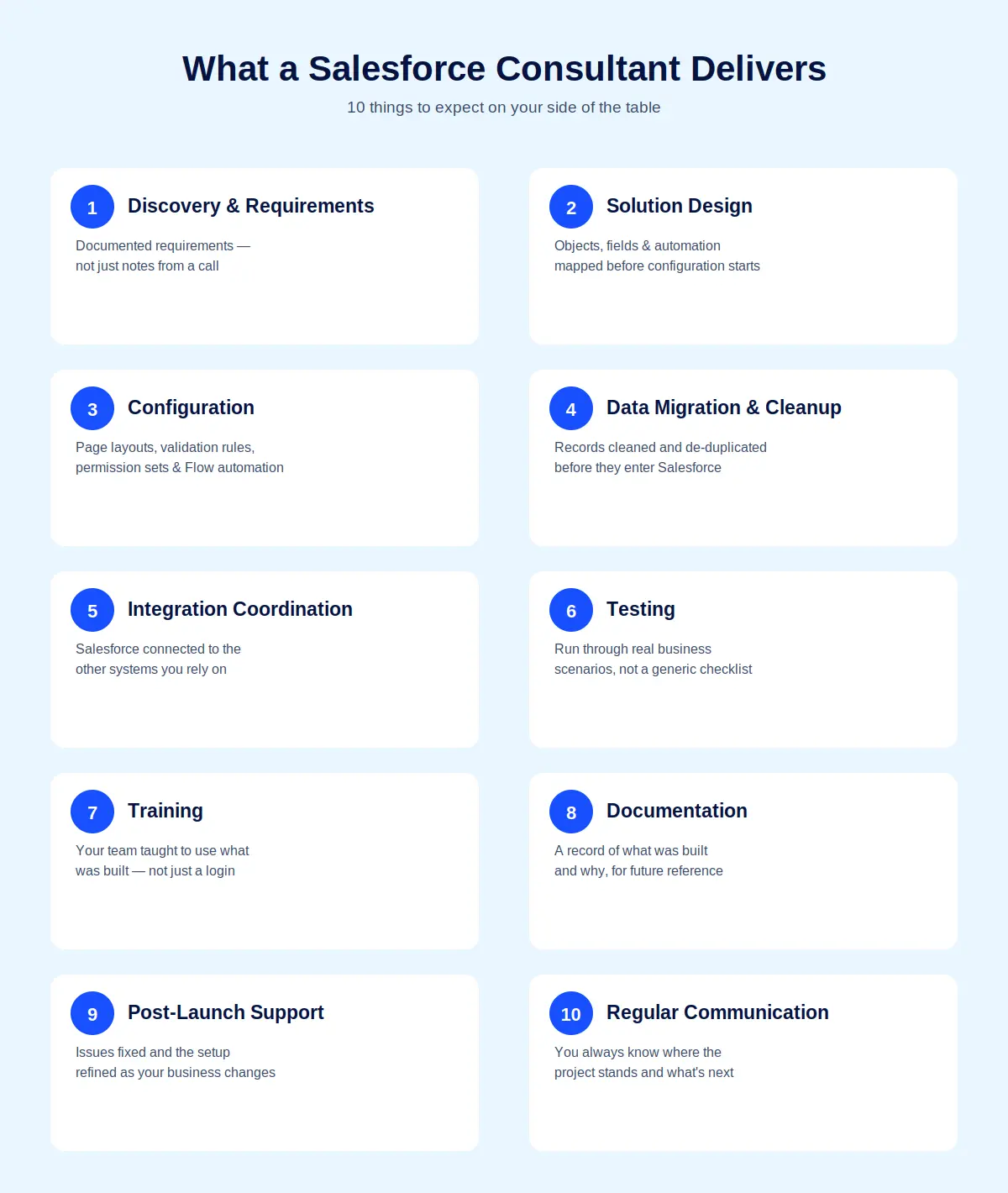
Discovery and requirements gathering: they meet with your stakeholders, understand your current processes, and hand you a documented list of what Salesforce needs to do, not just notes from a call.
Solution design: before any configuration starts, you should see how objects, fields, and automation will fit together, and have a chance to weigh in.
Configuration: page layouts, validation rules, permission sets, and Flow automation, built using Salesforce's standard tools wherever possible.
Data migration and cleanup: your records move from the old system or spreadsheet into Salesforce with duplicates and formatting issues cleaned up along the way, not carried over.
Integration coordination: they connect Salesforce to the other systems you rely on, either directly or by briefing a developer on exactly what's needed.
Testing: the new setup gets run through your real business scenarios before your team ever sees it, not just a generic checklist.
Training: your team gets taught how to use what was built, not just handed a login and a help article.
Documentation: you receive a record of what was built and why, so you're not dependent on one person's memory six months later.
Post-launch support: issues get fixed and the setup gets refined as your business changes, not abandoned the day after go-live.
Regular communication: you should always know where the project stands, what's next, and what you're waiting on.
Work with an experienced Salesforce consultant who understands your business, delivers practical solutions, and helps your CRM project succeed from day one.
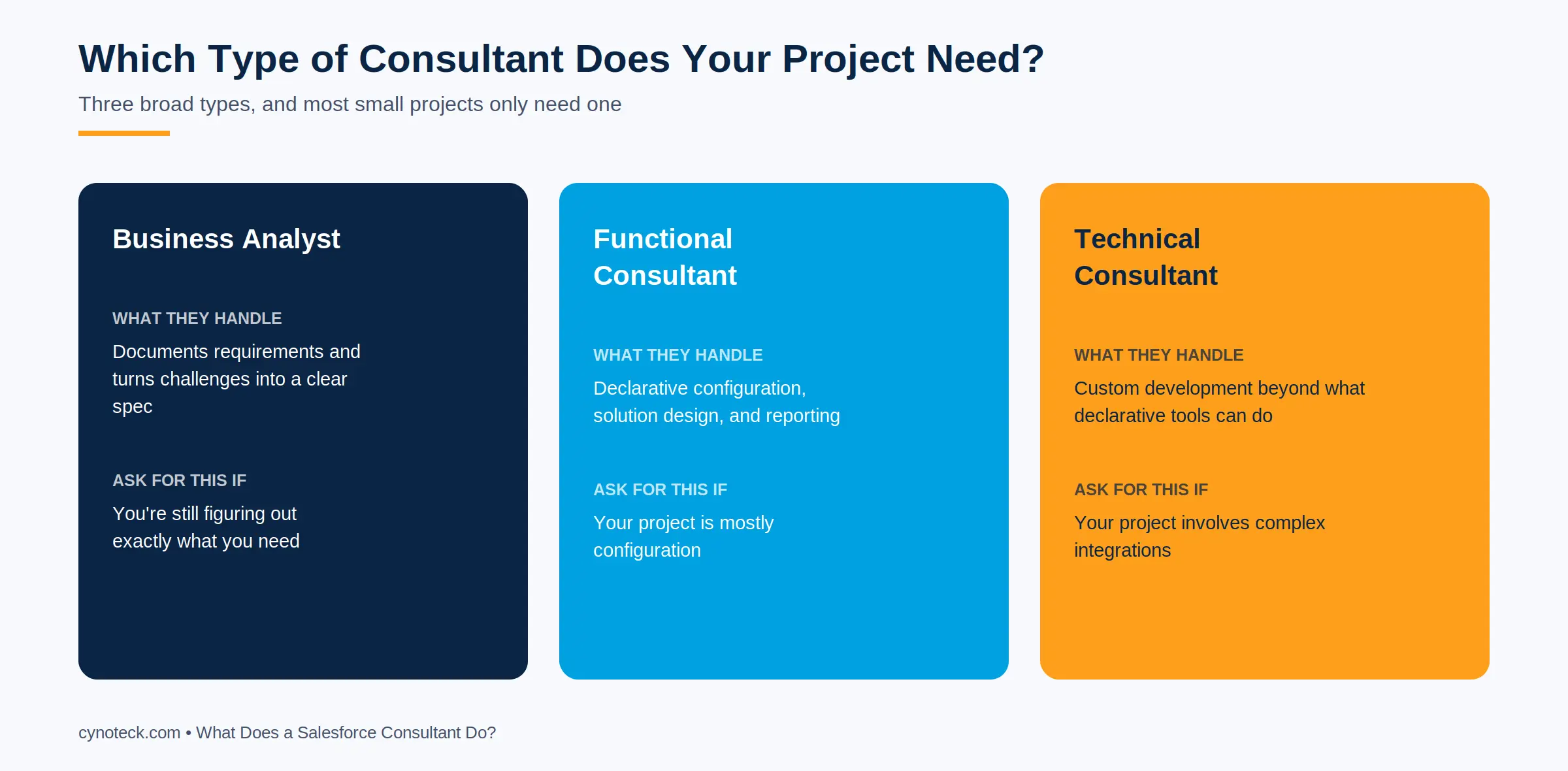
Talk to A Salesforce ExpertSalesforce splits consultants into three broad types, and knowing which one your project needs helps you evaluate a proposal before you sign off on it.
Type | What They Handle | Ask for This Type If... |
Business Analyst | Documents your requirements and turns business challenges into a clear specification. | You're early in the process and still figuring out exactly what you need. |
Functional Consultant | Declarative, low-code configuration, solution design, and reporting. | Your project is mostly configuration: process automation, page layouts, reports. |
Technical Consultant | Custom development and back-end changes beyond what declarative tools can do. | Your project involves complex integrations or custom logic. |
On smaller projects, one consultant often covers all three. On larger or multi-cloud projects, expect a small team instead, with a Business Analyst running discovery, a Functional Consultant owning configuration, and a Technical Consultant handling anything that needs custom code.
Note: If a proposal lists only one person for a large, technical project, that's worth asking about.
Also, Read: Types of Salesforce Consulting Services Explained
Consultants are generally grouped into three experience levels, and matching the level to your project matters as much as matching the type.
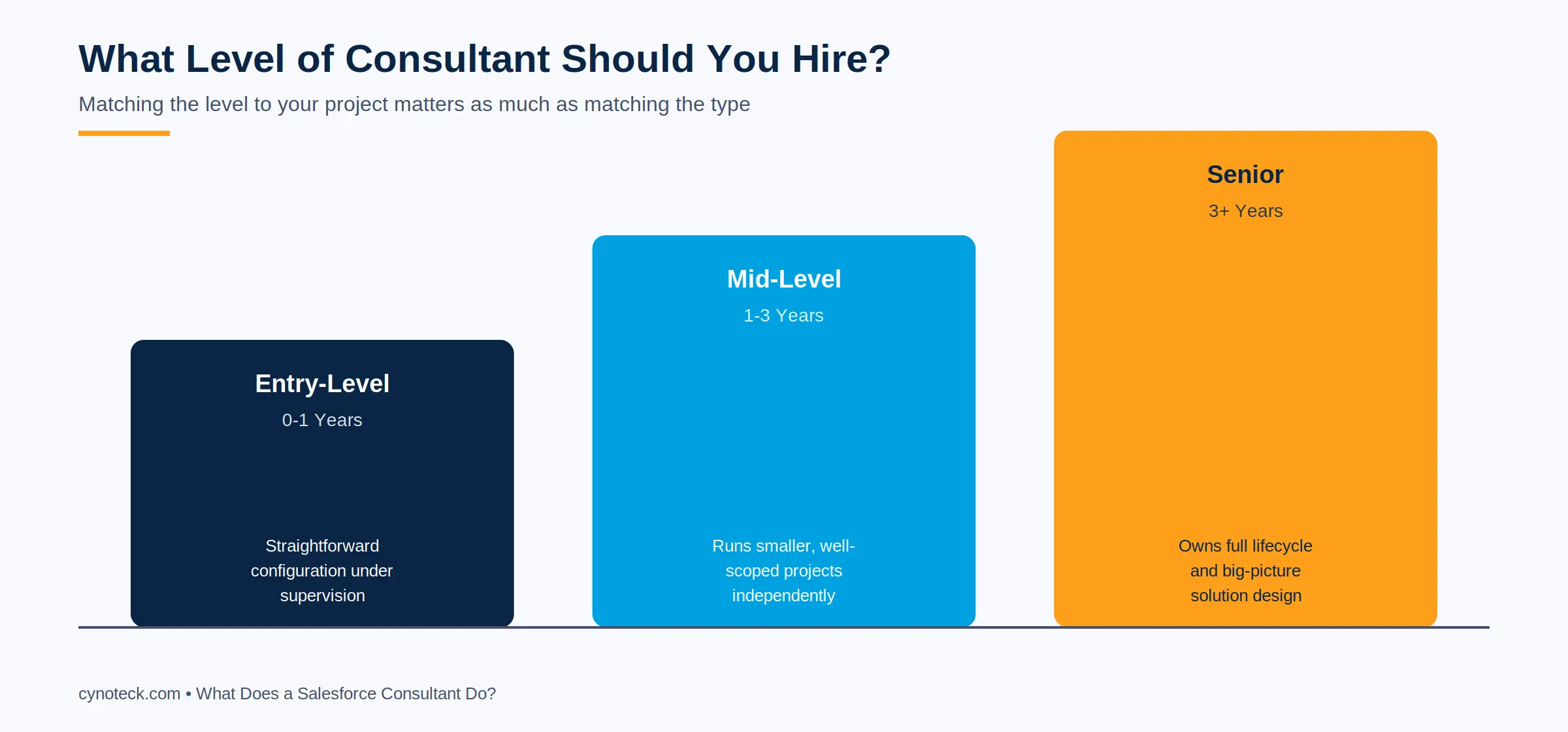
Usually called a build consultant. Fine for straightforward configuration tasks under supervision, such as field setup or simple automation. Should not be the only person on a project of any real complexity, and their work should be reviewed by someone more senior before it reaches your production org.
Can run a smaller, well-scoped project independently and lead requirement-gathering workshops. A solid fit if your requirements are already fairly clear and the project is a standard implementation rather than something highly custom.
Owns the full project lifecycle and the big-picture solution design, especially across multiple integrated systems. Worth the higher rate for complex, multi-cloud projects, or if you don't have an in-house Salesforce architect, since senior consultants typically control the data model and release management directly.
Choose the right Salesforce consultant based on your project scope, business goals, and technical requirements to avoid costly implementation mistakes.
Schedule a Free ConsultationChoosing the right Salesforce consultant is about more than checking certifications or years of experience. Focus on their technical expertise, communication style, and ability to understand your business goals, as these factors have the biggest impact on a successful Salesforce implementation.
Look for fluency in Salesforce platform fundamentals such as objects, Flow automation, and permissions, along with reporting and dashboards, integration and data concepts, and direct experience with the specific clouds your project touches, such as Sales Cloud or Service Cloud.
Pay attention in your first conversation. Do they ask about your business before pitching a solution? Look for communication that works for both your technical and non-technical stakeholders, evidence of project management discipline, and questions that dig into why you need something, not only what you're asking for.
A certification alone doesn't guarantee a great consultant, but asking about the right one for your project is a fast way to check they've been tested on the fundamentals you need.
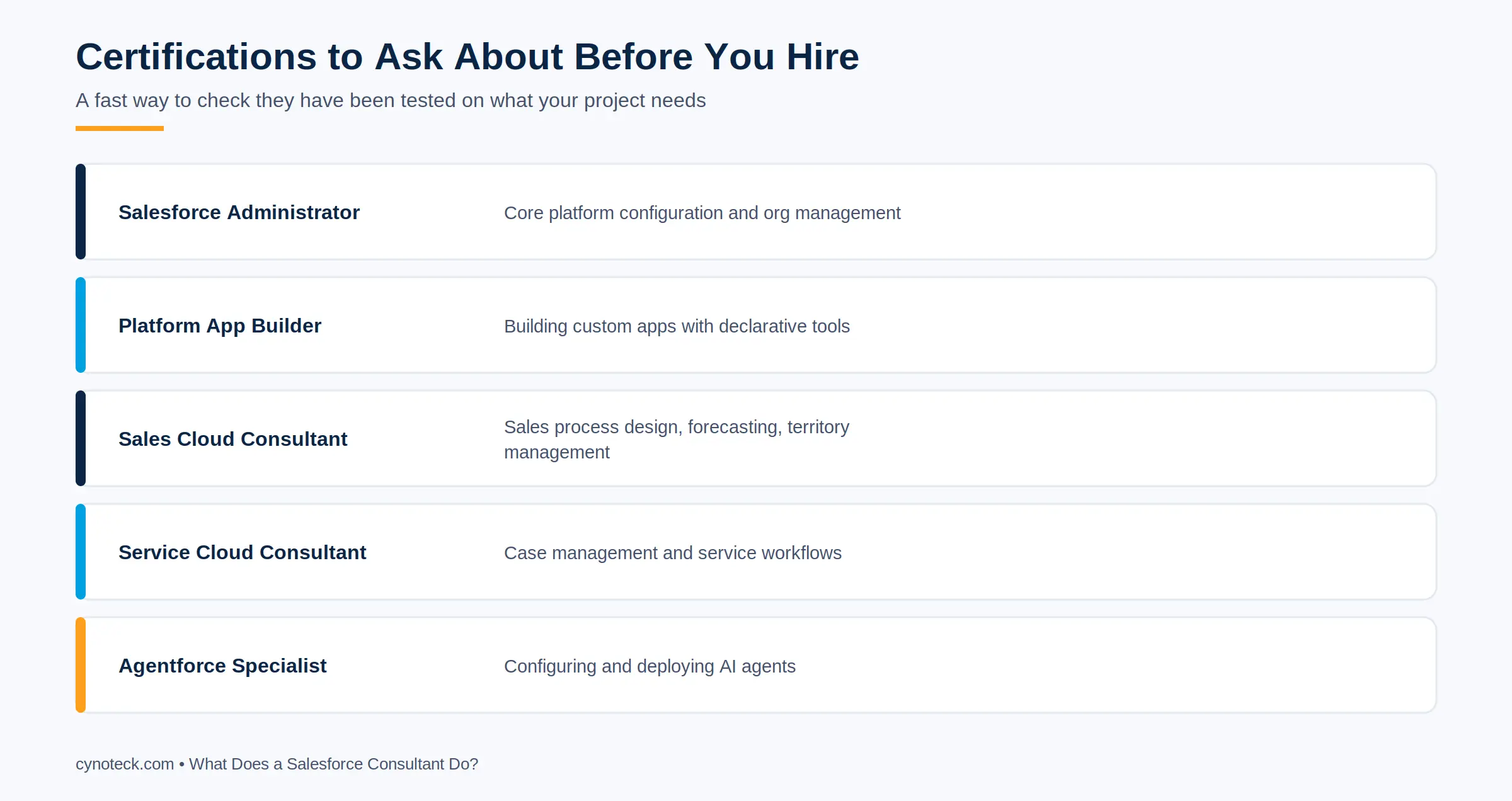
Certification | What It Signals |
Salesforce Administrator | A solid grasp of core platform configuration and day-to-day org management. |
Platform App Builder | Experience building custom apps using Salesforce's declarative tools. |
Sales Cloud Consultant | Depth in sales process design, forecasting, and territory management. |
Service Cloud Consultant | Depth in case management, support processes, and service workflows. |
Agentforce Specialist | Hands-on experience configuring and deploying AI agents within Salesforce. |
Pro Tip: If a consultant can't point to a certification relevant to your project type, ask what direct project experience they have instead.
These are standard on a well-run Salesforce project. If a consultant can't speak to most of these, it's worth asking how they plan to manage your project.
Sandboxes: test versions of your org used to build and test changes before they reach production.
Flow Builder and Data Loader: Salesforce's own tools for automation and bulk data changes.
DevOps tools such as Gearset or Copado: to move changes between environments safely and track what changed.
Project tools such as Jira or Asana: to track tasks, timelines, and deliverables you can see.
Communication tools such as Slack and Loom: for day-to-day check-ins and recorded walkthroughs of new features.
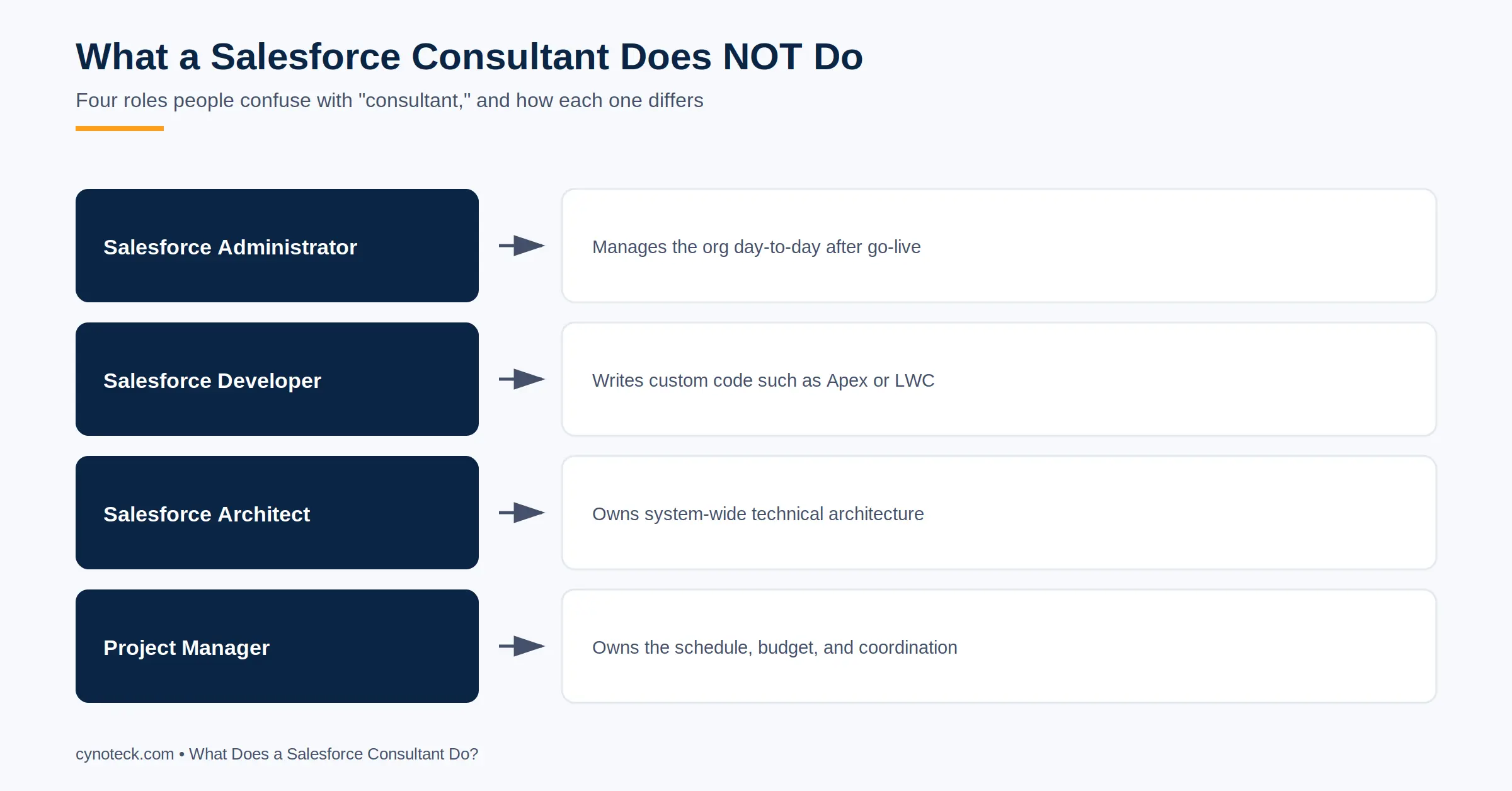
The consultant role overlaps with a few other Salesforce roles, which is a common source of confusion when scoping a project and agreeing on who's responsible for what.
Role | How It Differs from a Consultant |
Salesforce Administrator | Manages the org day-to-day after go-live. A consultant is usually more involved in initial design and major changes than daily upkeep. |
Salesforce Developer | Writes custom code such as Apex or Lightning Web Components. A consultant hands off requirements that go beyond declarative tools to a developer, unless they're also a technical consultant. |
Salesforce Architect | Owns system-wide technical architecture across multiple integrated systems. A consultant's solution design typically stays closer to a single project or cloud. |
Project Manager | Owns the schedule, budget, and cross-team coordination. A consultant contributes to the plan, but a dedicated PM usually owns it on larger engagements. |
Note: If you expect your consultant to also cover one of these roles, such as ongoing admin work after launch, that's worth clarifying in the contract rather than assuming it's included.
It helps to know what a normal working rhythm looks like once a consultant is on your project, so you can spot when something is off.
Most weeks include a short status check-in, so you always know what's in progress and what's blocked. Bigger milestones, such as a requirements workshop or a sandbox demo, get scheduled separately rather than folded into a status call.
When something is being built, you should be able to see it in a sandbox and test it yourself before it goes live, not just take the consultant's word that it works. Data migrations and larger changes usually come with a heads-up beforehand, not a surprise after the fact. Any time a decision affects cost, timeline, or scope, that should reach you directly instead of getting absorbed quietly into the project.
In 2026, expect AI to be part of the standard scope on most Salesforce projects, not a separate add-on you have to request.
A consultant should assess whether your data is clean enough for Agentforce, Salesforce's AI agent platform, to work accurately, define guardrails for what an AI agent can do without a human reviewing it, and train your staff to work alongside agents rather than only using standard Salesforce features.
Pro Tip: If AI is part of your project, ask whether your consultant holds the Agentforce Specialist credential, the same way you'd ask about Sales Cloud or Service Cloud certifications for those areas. |
Also, Read: The Complete Guide to Salesforce Consulting (2026)
"Can you walk me through a similar project you've delivered?" Listen for specifics, not just a list of clouds they've touched.
"Who exactly will be working on my project, and at what level?" A senior consultant in the sales pitch shouldn't turn into an entry-level consultant on delivery.
"What will I actually see at each stage?" A clear answer signals a structured process. A vague one is a warning sign.
"How do you handle a requirement that comes up mid-project?" This tells you how they manage scope, not just how they sell.
"What happens after go-live?" You want to know if support ends the day the project closes or continues.
Partner with a certified Salesforce consultant to plan, implement, and optimize Salesforce with confidence, transparency, and long-term business value.
Book a Free ConsultationNow you know what to expect. Cynoteck's certified Salesforce consultants cover business analysis, functional configuration, and technical development, so your project gets the right level of expertise at every stage, from discovery through post-launch support.
Ans: They handle discovery, solution design, configuration, integration coordination, testing, training, and post-launch support, so Salesforce actually fits how your business operates instead of forcing you to adapt to it.
Ans: A consultant typically focuses on designing and implementing new work, such as a new process or feature. A Salesforce administrator focuses on managing your org day-to-day after that work goes live.
Ans: If your project is mostly configuration, a functional consultant is enough. If it involves custom development or complex integrations, you'll also need a technical consultant, either on the same team or brought in for that part of the work.
Ans: Not necessarily. Functional consultants and business analysts often work entirely through Salesforce's declarative tools. If your project needs custom code, you'll want a technical consultant or developer involved as well.
Ans: It depends on your project. A Sales Cloud implementation benefits from a Sales Cloud Consultant certification, a service-focused project benefits from Service Cloud Consultant, and AI-related work benefits from Agentforce Specialist.
Ans: Timelines vary widely. A focused configuration project might involve a consultant for a few weeks, while a full implementation with integrations can run several months.
Ans: For smaller, well-scoped projects, yes. Larger or multi-cloud implementations usually need a small team covering business analysis, functional configuration, and technical development.
Ans: Increasingly, yes. As of 2026, most new Salesforce projects include some AI component, and you should expect your consultant to assess data readiness and set guardrails for AI agents as part of the standard scope.
Ans: Check whether you're getting documented requirements, sandbox demos you can test yourself, and regular status updates. If those deliverables are missing, or the assigned consultant keeps changing, raise it early rather than waiting until go-live.
 Outsource Salesforce Development or Build In-House Which is the Best for Your Business.webp)
Outsourcing Salesforce development vs. building an in-house Salesforce team: 2026 cost insights, salary comparisons, key benefits, challenges, and the best hiring model for your business growth.
We are more than just developers and consultants—we are your partners in navigating the digital landscape. Let us be the engine behind your next big success while you focus on your core vision.
Explore Opportunities!