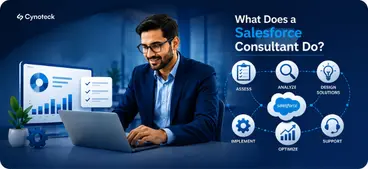
The Complete Guide to Salesforce Consulting (2026): Everything Businesses Need to Know
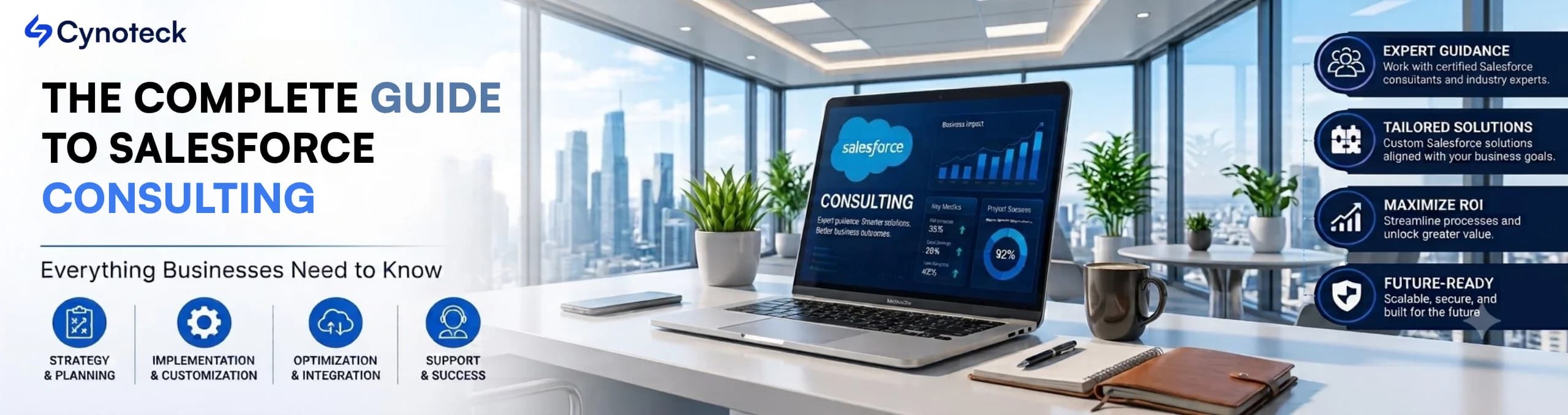
Summary: This guide explains what Salesforce consulting is and what a consultant does. It covers the full delivery process, the real benefits and challenges, and the trends shaping engagements in 2026, including Agentforce and Data Cloud. |
Most Salesforce projects do not fail because of the software. They fail because of decisions made before a single field gets built. Gartner and Forrester research puts CRM deployment failure rates between 30% and 70%, and the reasons repeat across industries: unclear requirements, weak change management, and a mismatch between what the business needs and what gets configured.
This guide breaks down what Salesforce consulting involves: what a consultant does, the full delivery process, the real benefits and challenges, and the trends shaping engagements in 2026, including Agentforce and Data Cloud. Read straight through, or jump to the section you need from the contents below.
Salesforce consulting is the practice of helping a business plan, configure, and run Salesforce in a way that matches how the business operates. A Salesforce consultant does not just install software. They study current processes, identify where Salesforce can remove manual work, and translate business goals into a working CRM setup inside the platform.
The objective is straightforward: make sure the technology serves the business, not the other way around. This means a consultant spends real time understanding sales cycles, service workflows, or marketing operations before touching configuration. A logistics company and a healthcare provider will use Salesforce differently, and a consultant's first job is recognizing that difference.
The business value shows up in three places. First, faster time to value, because the org (a company's individual Salesforce environment) gets built around real workflows instead of generic templates. Second, lower long-term costs, because a well-designed system needs fewer emergency fixes later. Third, higher adoption, because users get a tool that fits how they already work rather than one that forces new habits on day one.
Typical consulting engagements range from short strategy assessments that map out a roadmap, to full implementations that take an org live from scratch. Some go further into ongoing managed services that keep an existing org healthy long after launch. Some businesses bring in a consultant for a single project. Others keep one on retainer as Salesforce evolves alongside the business.
Note: It helps to separate this from Salesforce's own Professional Services team, which is Salesforce's in-house delivery arm and typically follows a standard, less flexible methodology. Independent consulting partners often provide more flexible engagement models, deeper industry specialization, and support that continues well after go-live. |
Related reading: What Is Salesforce Consulting?
Not every business needs a consultant at the same stage. The scenarios below are the most common triggers that push a business from managing Salesforce alone to bringing in outside expertise.
Scenario | What It Means for Your Business |
First-time Salesforce buyer | You are moving off spreadsheets or a legacy CRM and need the org built right from day one, not patched later. |
Post-implementation stall | Your org went live months ago, but adoption stayed low, and reports still do not match reality. |
Rapid growth | Headcount or deal volume has outgrown a setup that was fine for a much smaller team. |
Multi-cloud expansion | You are adding Service Cloud, Marketing Cloud, or another cloud to an org only ever configured for one. |
Platform update pressure | A major release, or a move off Salesforce Classic to Lightning, is exposing gaps in an older org. |
Merger or acquisition | Two businesses, often with two Salesforce orgs or one org and a spreadsheet system, need to run as one. |
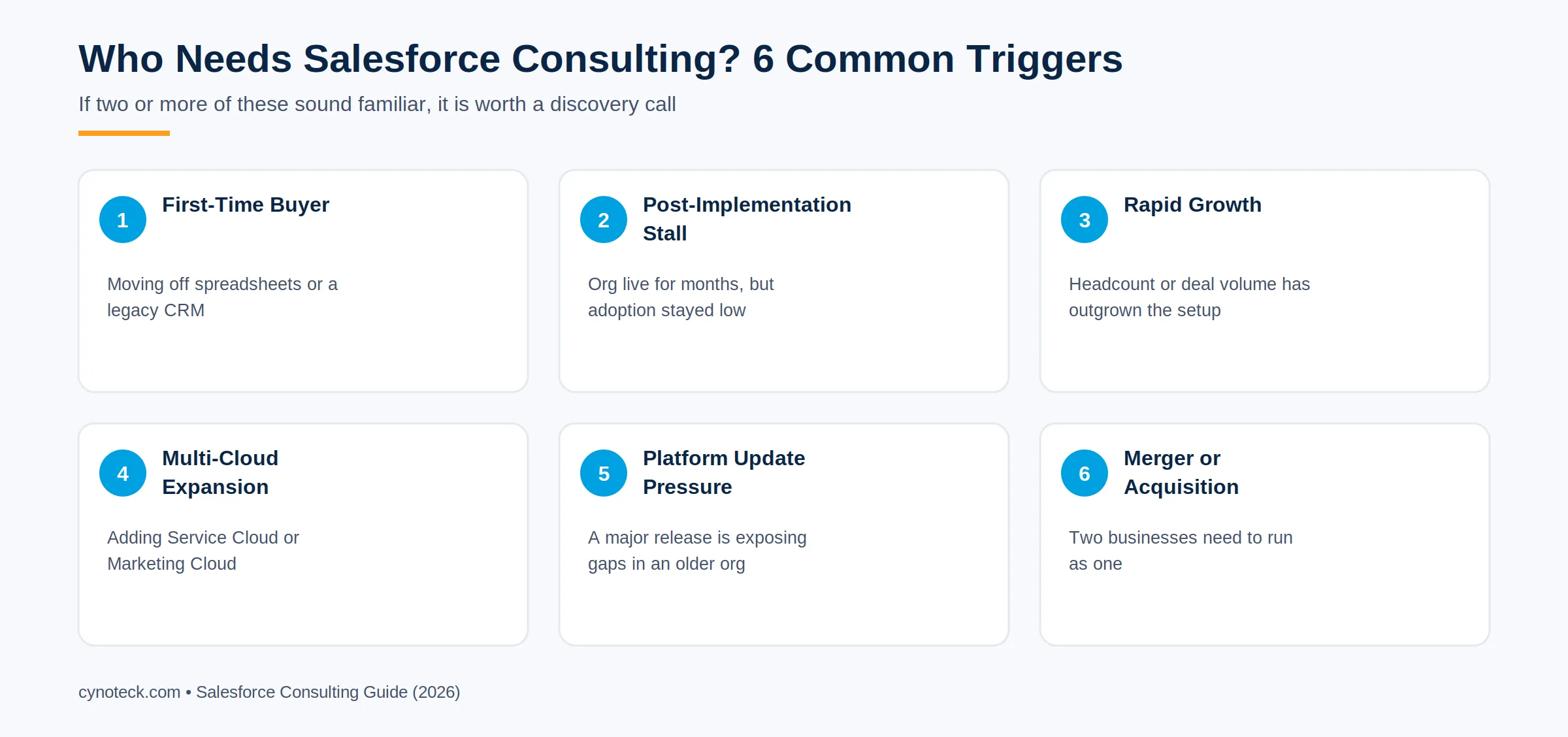
Pro Tip: If two or more of these sound like your situation, a short discovery call will tell you more in thirty minutes than another month of guessing.
Most businesses do not start a Salesforce project because they want new software. They start because something in daily operations is not working. Recognizing these problems is the first step toward understanding why consulting matters.
Manual processes: Sales and service teams still rely on spreadsheets and email threads to track work Salesforce could automate
Poor customer visibility: Different teams see different pieces of the customer relationship, with no shared view of the full picture
Low CRM adoption: Reps log in because they are told to, not because the system helps them close deals faster
Disconnected systems: Salesforce sits apart from the ERP, marketing platform, or support desk, forcing teams to copy data by hand
Data quality issues: Duplicate records, missing fields, and inconsistent formatting make reports impossible to trust
Inefficient sales operations: Deals stall in unclear stages, and managers cannot see where the pipeline stands
A Salesforce consultant addresses these problems at the root instead of patching symptoms. Low adoption, for example, is rarely a training problem alone. It is often a sign that the system was configured around IT convenience rather than how sales reps sell. A consultant redesigns the workflow first, then trains users on something that genuinely saves them time.
The same logic applies to data quality and disconnected systems. Instead of running one-off cleanup projects, a consultant builds validation rules, data governance standards, and integrations that prevent the mess from returning. This is why consulting engagements tend to pay for themselves. The upfront cost of doing discovery and design properly is small compared to the cost of rebuilding an org that was rushed the first time.
Related reading: Benefits of Hiring Salesforce Consultants
A Salesforce consultant's job spans the full life of a project, not just the technical build. Understanding each stage helps set realistic expectations for what an engagement involves.
Discovery comes first. The consultant meets with stakeholders across sales, service, and marketing to understand how the business currently operates and where the pain points sit. Requirement gathering follows, turning those conversations into a documented list of what the org needs to do.
From there, the consultant moves into solution architecture. This means designing how objects (types of records in Salesforce, similar to database tables) and automation will fit together before any configuration begins. Customization and implementation follow, where the consultant builds page layouts, Flow automation (Salesforce's tool for automating business processes), and reports that match the design.
Integration connects Salesforce to other systems the business relies on, such as an ERP or marketing platform, using APIs (connection points that let Salesforce talk to other systems). User training makes sure the people who use the system every day understand how it works and why it was built that way. Optimization continues after go-live, since a consultant's role does not end at launch. They monitor how the org performs, gather feedback, and refine the setup as the business changes.
Discovery → Requirements → Architecture → Customization → Implementation → Integration → Training → Optimization
Related reading: What Does a Salesforce Consultant Do?
Discover the right consulting strategy before implementation to reduce project risks, improve adoption, and achieve faster business results.
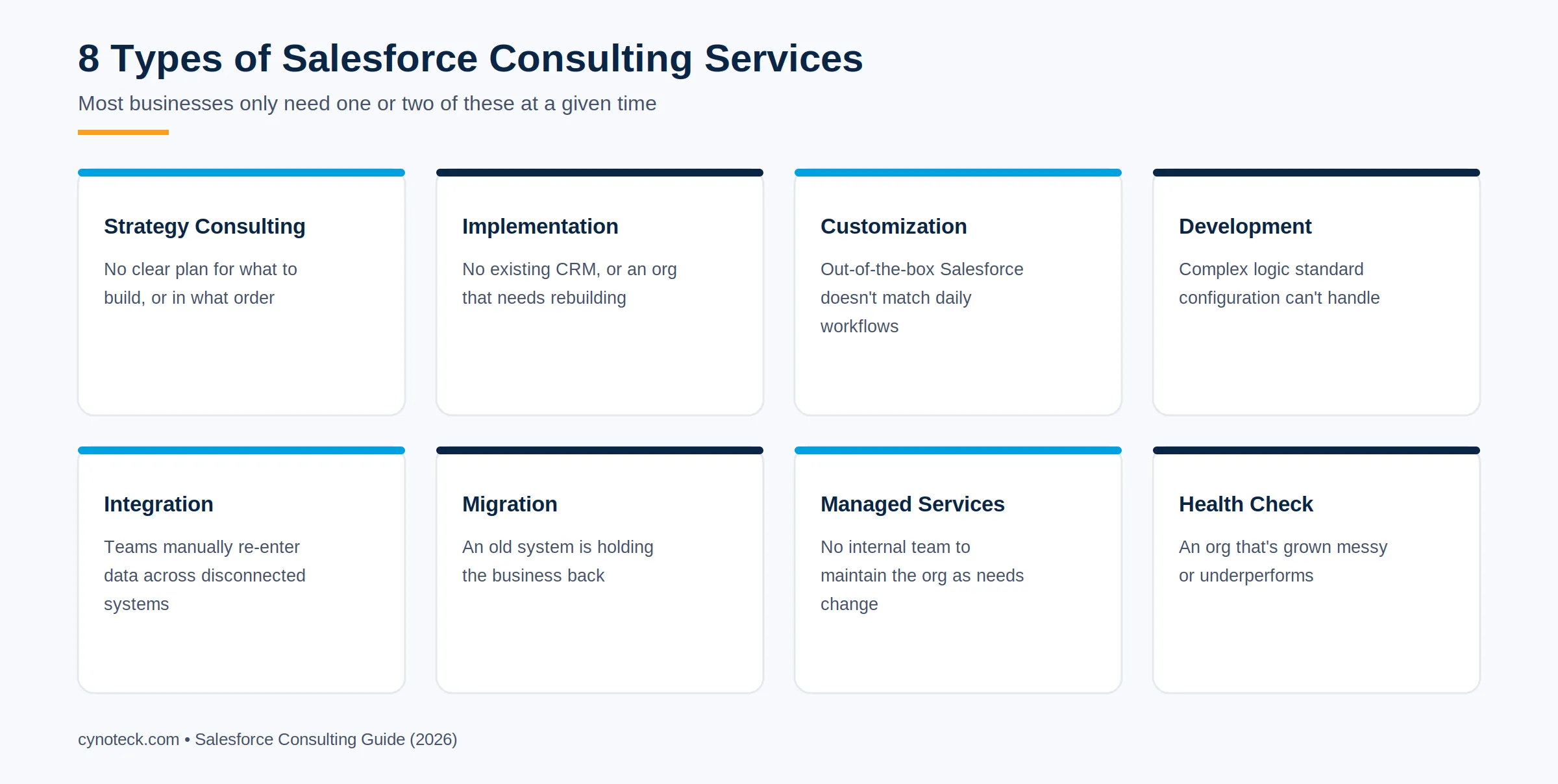
Schedule a Free ConsultationSalesforce consulting is not one service. It splits into distinct engagement types, each solving a different business problem. The table below breaks down what each one covers and the outcome a business should expect.
Service | What It Solves | Typical Deliverables | Expected Outcome |
Strategy Consulting | No clear plan for what to build or in what order | CRM roadmap, process maps, cloud recommendation | A prioritized plan that avoids wasted build time |
Implementation Consulting | No existing CRM, or an org that needs rebuilding | Configured org, migrated data, trained users | A live, working CRM aligned to business processes |
Customization Consulting | Out-of-the-box Salesforce does not match daily workflows | Custom objects, layouts, automation rules | A system that fits how the team already works |
Development | Complex logic standard configuration cannot handle | Custom Apex code, tested components, documentation | Functionality that matches unique business rules |
Integration | Teams manually re-enter data across disconnected systems | API connections, data sync rules, error monitoring | One accurate source of data across the business |
Migration | An old system is holding the business back | Migration plan, cleaned records, cutover schedule | A smooth transition without data loss or downtime |
Managed Services | No internal team to maintain the org as needs change | SLA-based support, release management, reporting | A healthy org that keeps pace with the business |
Health Check | An org that has grown messy or underperforms | Audit report, prioritized fix list, risk assessment | A clear view of what to fix first and why |
Related reading: Types of Salesforce Consulting Services Explained
Beyond the type of work involved, businesses also choose how they want to structure the relationship with a consulting partner. The right model depends on the size of the project and how much ongoing support the org will need.
A defined scope, timeline, and handoff. This model works well when the requirements are clear, and the business wants a fixed start and end point, such as a new implementation or a specific integration.
Ongoing hours each month for fixes, small enhancements, and general support. This model suits businesses that need continuous attention but do not have enough work to justify a full-time hire.
A Salesforce consultant embedded directly with the internal team for a defined period. This model works well when the business has its own roadmap but needs extra expertise to execute it.
Many businesses already have an internal admin handling day-to-day changes. The table below shows where each option tends to fit best.
Factor | In-House Admin | Salesforce Consulting Partner |
Day-to-day changes | Strong fit for small, routine updates | Available, but usually not the most cost-effective option for minor tweaks |
New implementations | Possible, but often slower without prior implementation experience | Brings a proven, repeatable delivery process |
Specialized work | Limited to the admin's own skill set | Access to development, integration, and architecture expertise as needed |
Peak workload | Can become a bottleneck during major projects | Scales up or down based on project demand |
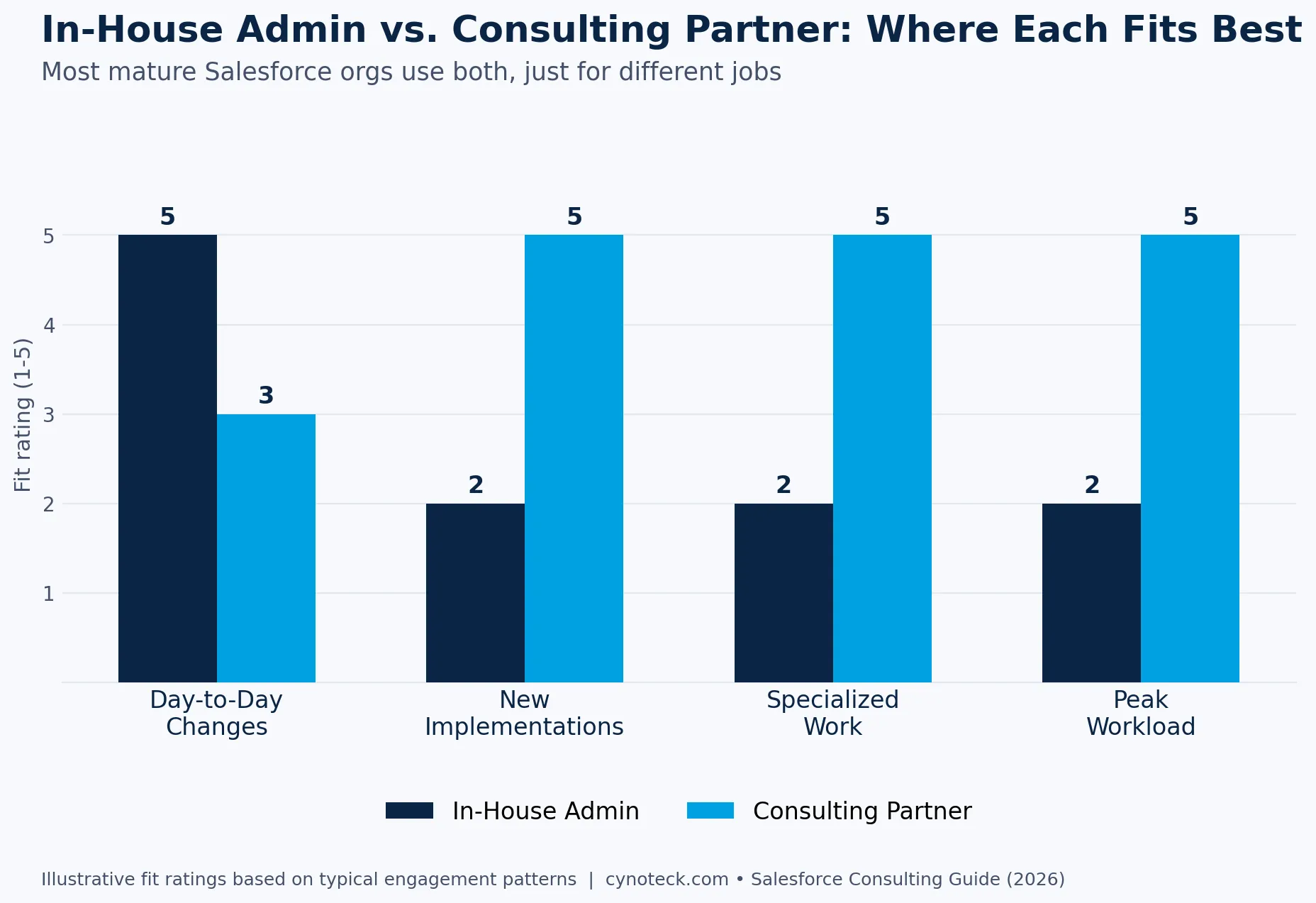
Note: These are not mutually exclusive. Most mature Salesforce orgs run on both: an in-house admin for daily changes, and a consulting partner for the work that needs deeper expertise. |
Related reading: Salesforce Consulting vs Salesforce Implementation: What's the Difference?
The process a consulting partner follows matters as much as the partner itself. A rushed or informal process is where most of the risk in a Salesforce project comes from. The eleven stages below reflect how a well-run engagement moves from first conversation to a fully optimized org.
Discovery → Requirements → Strategy → Design → Configuration → Customization → Integration → Testing → Training → Go-Live → Optimization
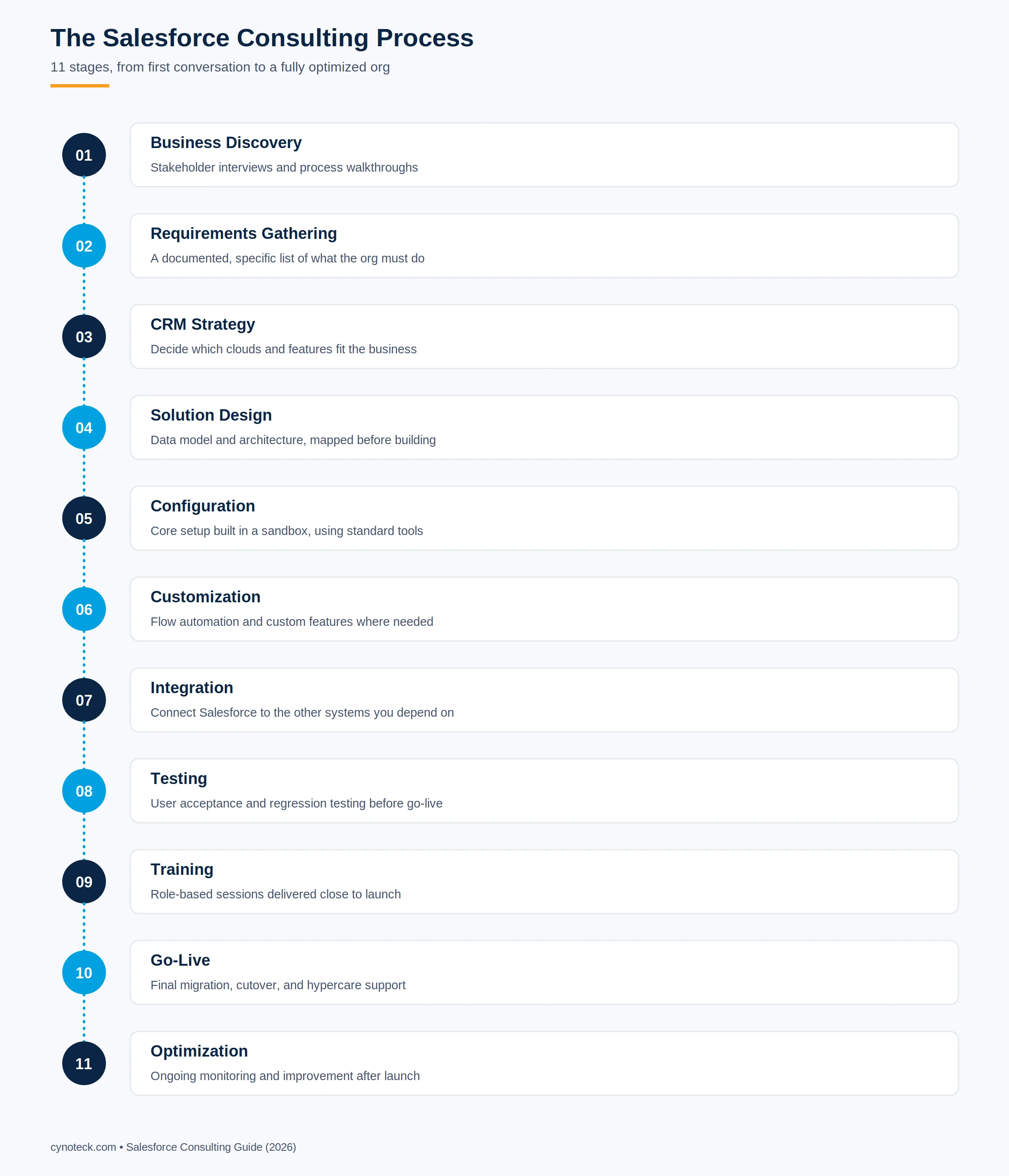
Objective: Understand current business processes and identify where Salesforce can add the most value.
Activities: Stakeholder interviews, process walkthroughs, review of existing tools and reports.
Deliverables: Discovery summary, list of pain points and priorities.
Best Practice: Involve frontline users, not only managers, since they know where the real friction sits.
Objective: Turn discovery findings into a documented, specific list of what the org must do.
Activities: Requirement workshops, process mapping, prioritization against business goals.
Deliverables: Requirements document, prioritized backlog.
Best Practice: Separate must-have requirements from nice-to-have ones early, so scope stays realistic.
Objective: Decide which Salesforce clouds, such as Sales Cloud or Service Cloud, and features fit the business.
Activities: Cloud evaluation, licensing review, roadmap planning.
Deliverables: CRM strategy document, phased roadmap.
Best Practice: Plan for growth. A strategy built only for today's headcount often needs a costly redesign within a year.
Objective: Design the data model and system architecture before any building starts.
Activities: Object and field design, automation planning, integration mapping.
Deliverables: Solution design document, data model diagram.
Best Practice: Review the design with both technical and business stakeholders before moving forward.
Objective: Build the core Salesforce setup using standard, declarative tools.
Activities: Creating objects, fields, page layouts, permission sets, and validation rules.
Deliverables: Configured sandbox org, a test version of Salesforce used before making live changes.
Best Practice: Build in a sandbox first. Never configure directly in the production org.
Objective: Extend the standard setup to match workflows that configuration alone cannot cover.
Activities: Flow automation, custom page layouts, Lightning components, Apex code where needed.
Deliverables: Custom features tested against real business scenarios.
Best Practice: Document every customization so future admins understand why it exists.
Objective: Connect Salesforce to the other systems the business depends on.
Activities: API setup, data mapping, sync testing between systems.
Deliverables: Working integrations, error handling, and monitoring rules.
Best Practice: Plan for what happens when an integration fails, not just when it succeeds.
Objective: Confirm the system works correctly before real users touch it.
Activities: User acceptance testing, regression testing, performance checks.
Deliverables: Test results, defect log, sign-off from business stakeholders.
Best Practice: Test with real business scenarios, not only isolated technical checks.
Objective: Prepare users to work confidently in the new or updated system.
Activities: Role-based training sessions, documentation, hands-on practice environments.
Deliverables: Training materials, recorded sessions, user guides.
Best Practice: Train close to go-live so the system is still fresh when users start using it daily.
Objective: Move the business from the old process to the new Salesforce setup.
Activities: Final data migration, cutover planning, hypercare support in the first days.
Deliverables: Live production org, go-live support plan.
Best Practice: Plan go-live around the business calendar. Avoid launching during a busy quarter close.
Objective: Improve the system continuously as the business and Salesforce itself evolve.
Activities: Usage monitoring, user feedback collection, release management for new features.
Deliverables: Optimization roadmap, periodic health checks.
Best Practice: Treat optimization as ongoing work, not a one-time cleanup after launch.
Related reading: Salesforce Consulting Process: Step-by-Step Guide
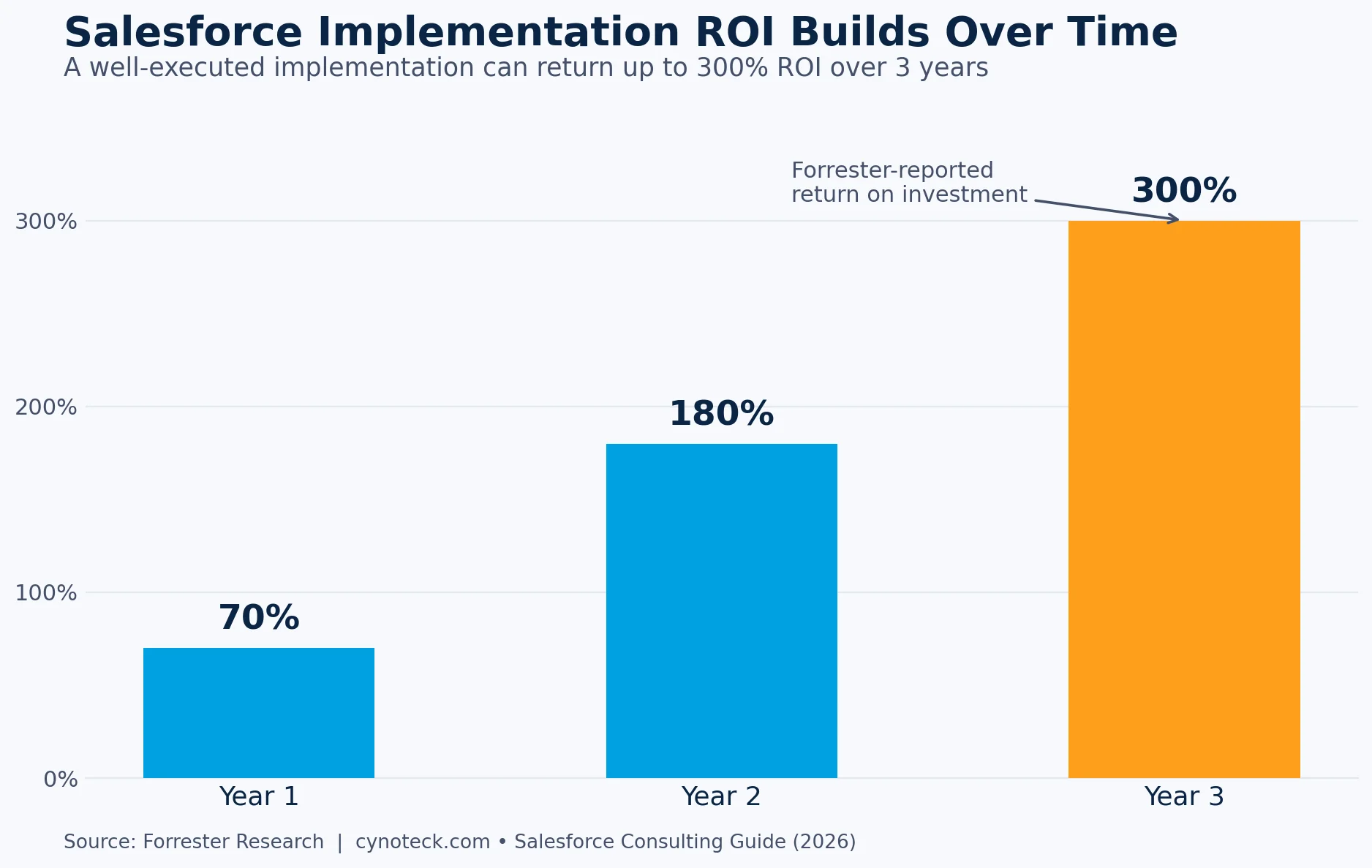
The value of Salesforce consulting is easiest to see in the outcomes it produces, not just the activities involved. Forrester Research has found that a well-executed Salesforce implementation can return up to 300% ROI over three years. The gap between reaching that return and falling short usually comes down to how the project was planned and delivered in the first place.
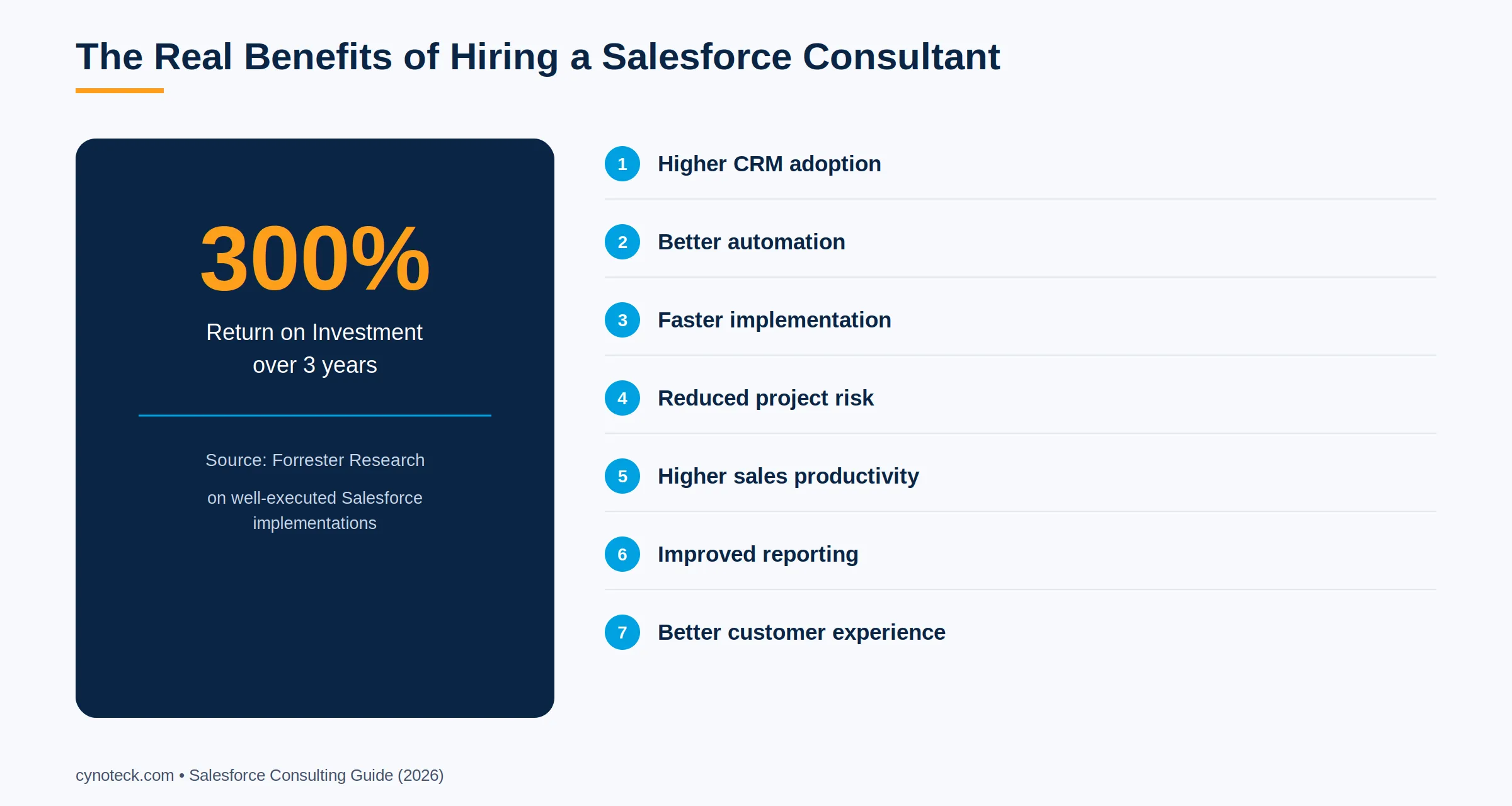
Higher CRM adoption: When a consultant designs workflows around how reps sell, login rates and daily usage climb because the system saves time instead of adding steps
Better automation: Consultants replace manual, repetitive tasks with Flow automation, cutting the hours teams spend on data entry and follow-up reminders
Faster implementation: A structured process with clear requirements avoids the rework that stretches timelines past the original plan
Reduced project risk: Following a proven delivery process catches gaps in requirements or data quality before they become expensive fixes after go-live
Higher sales productivity: Automated lead routing, task reminders, and pipeline visibility mean reps spend more time selling and less time managing their own tracking
Improved reporting: A clean data model and consistent field usage produce dashboards leadership can trust for forecasting
Better customer experience: Shared visibility across sales, service, and marketing means customers do not repeat themselves with every team they interact with
Partner with certified Salesforce consultants to streamline operations, improve productivity, and maximize long-term return on your CRM investment.
Talk to Our ConsultantsNo Salesforce project runs without friction. What separates a successful engagement from a stalled one is how a consultant anticipates and handles these challenges before they derail the timeline.
Challenge | Business Impact | Consultant Solution | Business Result |
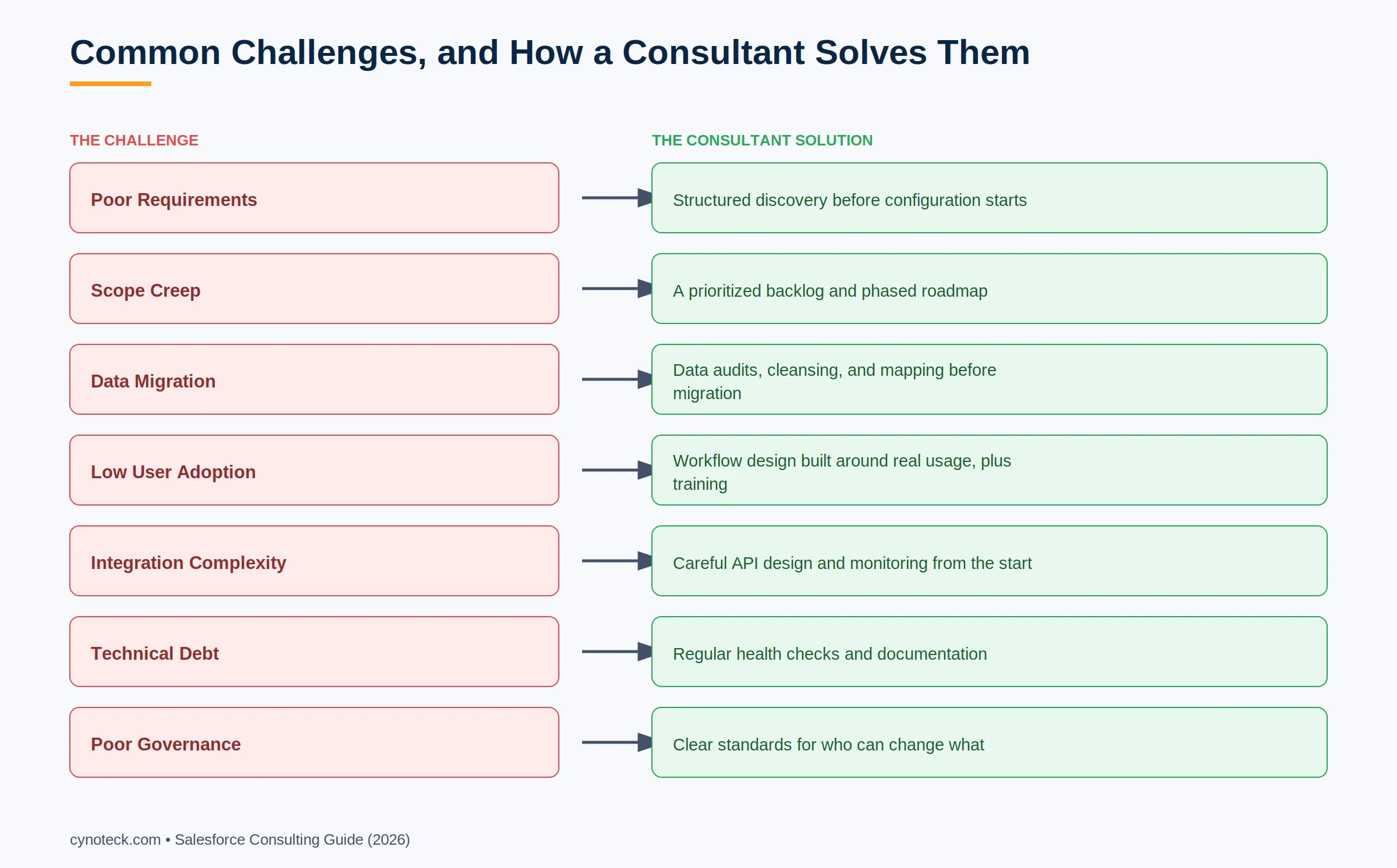
Poor Requirements | Teams build the wrong thing or discover gaps mid-project | Structured discovery and requirement workshops before configuration starts | Fewer surprises and a build that matches real needs |
Scope Creep | Timelines and budgets expand as new requests get added | A prioritized backlog and phased roadmap for future requests | Predictable timelines and on-schedule delivery |
Data Migration | Legacy data arrives duplicated or incomplete | Data audits, cleansing, and mapping before migration | Clean, trustworthy data from day one |
Low User Adoption | Reps avoid the system and revert to spreadsheets | Workflow design built around real usage, paired with training | Higher daily usage and accurate activity data |
Integration Complexity | Systems fall out of sync, creating conflicting records | Careful API design and monitoring built in from the start | Reliable data flow between connected systems |
Technical Debt | Old customizations pile up and slow future changes | Regular health checks and documentation of configuration | An org that stays maintainable as the business grows |
Poor Governance | Multiple admins make conflicting changes | Clear governance standards for who can change what | A stable org with changes tracked and controlled |
Note: A manufacturing company migrating from a legacy CRM, for example, often risks losing months of pipeline history if data mapping is rushed. A structured migration plan, run by an experienced consultant, prevents that loss before it happens. |
Related reading: Common Salesforce Consulting Challenges & Solutions
Executive sponsorship: Projects move faster and get better internal cooperation when a senior leader visibly backs the initiative and removes blockers
Business-first approach: Every configuration decision should trace back to a real business problem, not a feature that seemed interesting to build
Agile delivery: Breaking work into short cycles with regular reviews catches misalignment early, instead of waiting until the end to find a wrong turn
User involvement: Bringing frontline users into design sessions early means the finished system reflects how work gets done
Documentation: Recording why decisions were made, not just what was built, saves the next admin from guessing months later
Governance: Clear rules for who can change the org, and through what process, prevent conflicting updates from piling up
Role-specific training: Delivered close to launch, this gives users confidence instead of a one-time overview they forget within a week
Continuous optimization: Salesforce releases new features multiple times a year, so an org that stops improving after go-live falls behind quickly
Related reading: Salesforce Consulting Best Practices for Successful CRM Projects
Salesforce consulting looks different depending on the industry, since each sector brings its own workflows, terminology, and compliance requirements. The list below shows how the same platform gets configured in very different directions.
Financial Services: Consultants configure Salesforce Financial Services Cloud around compliance tracking, household relationships, and advisor workflows
Healthcare: Engagements focus on patient and provider relationship tracking while keeping data handling aligned with industry regulations
Manufacturing: Common work includes connecting Salesforce to ERP systems and managing complex, multi-stage sales cycles
Nonprofit: Consultants often build around donor management, grant tracking, and program outcomes rather than a traditional sales pipeline
Technology and SaaS: Projects tend to center on usage-based billing, renewal tracking, and integration with product and support platforms
Retail: Consulting work often connects Salesforce Commerce Cloud with in-store and online customer data for a single view of the shopper
Salesforce consulting itself is changing as the platform adds more AI capability. These are the trends shaping how consultants scope and deliver projects this year.
Agentforce is Salesforce's AI agent platform, and it now handles complete workflows: updating records, routing cases, and resolving service requests without a human at every step. In 2026, Salesforce also consolidated AppExchange (its marketplace for third-party apps and tools), Slack Marketplace, and Agentforce tools into a single unified marketplace called AgentExchange. This makes it easier for businesses to find AI agents, apps, and automation tools in one place.
An AI-ready consulting engagement typically includes:
A Data Cloud readiness assessment, since AI features are only as accurate as the underlying data feeding them
Agent testing and guardrails, so an AI agent's actions stay within approved boundaries before it touches live customer data
Employee training on how to work alongside AI agents, not only how to use standard Salesforce features
Human oversight checkpoints for higher-risk actions, so AI handles routine work while people stay in control of sensitive decisions
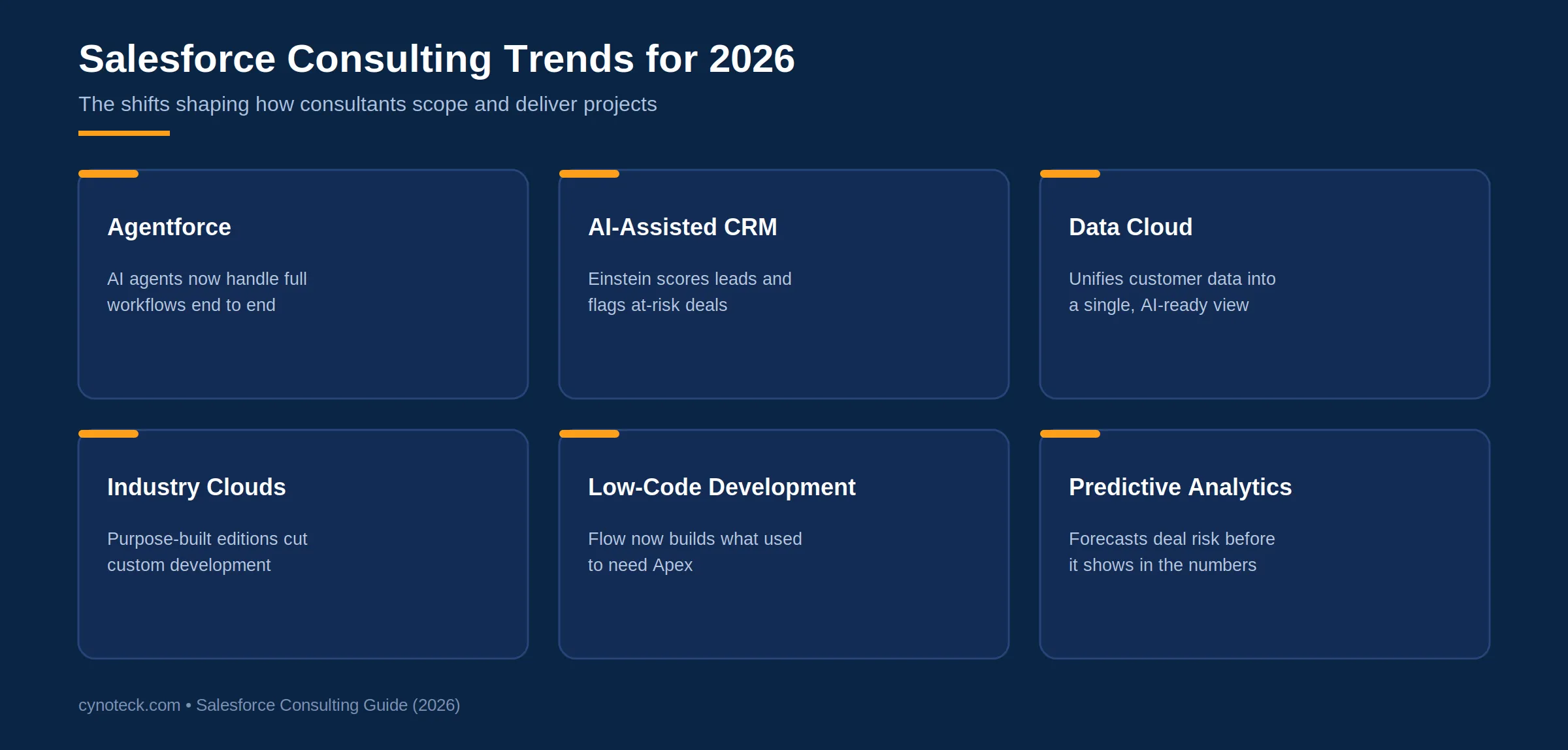
Beyond Agentforce, several other shifts are shaping engagements this year:
AI-Assisted CRM: Salesforce Einstein now scores leads, flags at-risk deals, and captures activity automatically, shifting reps from manual data entry toward higher-value selling work
Data Cloud: Salesforce's unified customer data platform is quickly becoming the foundation that Agentforce and other AI features depend on to work accurately
Industry Clouds: Purpose-built editions for sectors like financial services, healthcare, and manufacturing are reducing the custom development needed to match industry-specific workflows
Low-Code Development: More of what used to require custom Apex code can now be built declaratively through Flow, shortening timelines without sacrificing functionality
Hyperautomation: Businesses are combining Flow, Agentforce, and integrations to automate entire processes end to end, not just individual tasks in isolation
Predictive Analytics: Built-in forecasting tools help sales and service leaders anticipate outcomes, such as deal risk or case volume, before problems show up in the numbers
Prepare your Salesforce platform for AI, Agentforce, Data Cloud, and evolving business needs with expert consulting and implementation services.
Start Your Salesforce Journey NowA CRM project succeeds or stalls based on the partner running it, not just the platform underneath it. Cynoteck's consultants work across Sales Cloud, Service Cloud, and beyond, with delivery experience spanning manufacturing, healthcare, and financial services, so the discovery conversation does not start from zero.
Cynoteck is a Salesforce Select Partner, a status Salesforce awards based on delivery track record and customer success, not marketing spend. Paired with ISO 27001 certification, that means your data governance and project discipline both meet a standard set outside our own walls, not one we wrote ourselves.
Salesforce Select Partner, a status tied to proven delivery outcomes and customer success, verified by Salesforce
ISO 27001 certified, so your data governance meets a formal, externally audited security standard
Cross-cloud delivery, spanning Sales Cloud, Service Cloud, and beyond, not one narrow specialty
Cross-industry experience, including manufacturing, healthcare, and financial services, so your first meeting is not a crash course
The businesses that get the most from Salesforce are rarely the ones with the biggest budget. They are the ones who got the plan right before the build started. That is the difference a good consulting partner makes.
Talk to a Salesforce Consultant Today or explore our full Salesforce Consulting Services.
Ans: Salesforce consulting is the practice of helping businesses plan, build, and optimize their Salesforce CRM to match real business processes. It covers everything from strategy and implementation to ongoing support.
Ans: A Salesforce consultant guides a project from discovery through go-live and beyond. This includes requirement gathering, solution design, configuration, integration, training, and optimization.
Ans: Salesforce consulting services include strategy consulting, implementation, customization, development, integration, migration, managed services, and health checks. Each one addresses a different stage or need in a project.
Ans: Businesses typically bring in a consultant when starting a new implementation, or when an existing org has become inefficient or hard to maintain. Needing to integrate Salesforce with other systems is another common trigger.
Ans: Strong consultants combine Salesforce platform expertise with business analysis skills, clear communication, and experience translating business goals into working CRM configuration.
Ans: Salesforce consulting spans nearly every industry, including financial services, healthcare, manufacturing, technology, nonprofit, and retail. Each industry brings its own workflows and compliance needs.
Ans: A typical engagement moves through business discovery, requirements gathering, strategy, solution design, configuration, customization, integration, testing, training, go-live, and optimization.
Ans: Timelines vary by project scope. A focused implementation can take a few weeks, while a full multi-cloud rollout with integrations and custom development can take several months.
Ans: Salesforce's own Professional Services team delivers projects using a standard, in-house methodology built for scale across every customer. An independent consulting partner can usually move faster, tailor the approach to your specific industry, and stay involved well past go-live rather than handing off once the contract closes.
Ans: An in-house admin is valuable for day-to-day changes. Most businesses still bring in a consultant for the initial build, major redesigns, or specialized work like integrations and custom development that go beyond typical admin skills.
 Outsource Salesforce Development or Build In-House Which is the Best for Your Business.webp)
Outsourcing Salesforce development vs. building an in-house Salesforce team: 2026 cost insights, salary comparisons, key benefits, challenges, and the best hiring model for your business growth.
We are more than just developers and consultants—we are your partners in navigating the digital landscape. Let us be the engine behind your next big success while you focus on your core vision.
Explore Opportunities!