Benefits of Hiring Salesforce Consultants: 12 Reasons It Pays Off
Summary: This guide breaks down the concrete benefits of hiring a Salesforce consultant, the costs of different engagement types, and how to pick the right consulting company for your project. |
A retail business spends eight months configuring Salesforce in-house, only to find that reps still export data to spreadsheets because the setup never matched how the sales team works. A few weeks with the right consultant would have caught that mismatch before a single field was built.
This is the gap that the benefits of hiring a Salesforce consultant are meant to close. Salesforce is powerful, but power without the right configuration just means a more expensive way to do things the hard way.
This article expands on the benefits section of our complete Salesforce Consulting Guide and what a Salesforce consultant actually does. Moreover, you will also know the concrete benefits of hiring one over going it alone, what it costs, and how to choose a consulting company that will move the needle.
A Salesforce consultant studies how your business runs, then designs and configures Salesforce around that reality instead of a generic template. The best Salesforce experts spend real time in discovery before touching a single setting. Typical work includes:
CRM strategy and roadmap planning
Org configuration
Data migration from spreadsheets or legacy systems
Third-party integrations
Automation using Flow (Salesforce's tool for building automated business processes)
User training
Ongoing optimization after go-live
A Salesforce consulting company usually brings a full team to cover these areas, rather than a single generalist trying to cover them all. In short, a consultant's job is to make sure Salesforce fits the business, not the other way around.
Also, Read: What Does a Salesforce Consultant Do?
Salesforce implementations fail more often than most teams expect, largely due to scope creep, unclear requirements, and configuration that doesn't align with daily workflows.
None of this is a reflection on the platform itself. Salesforce is only as effective as the plan behind it.
Without a consultant, businesses often end up licensing features they never use. They also build workflows that duplicate manual work rather than replace it and then roll out a system that reps quietly avoid.
These problems are rarely visible until months in, when the cost of fixing them is far higher than the cost of getting it right at the start.
This is exactly where hiring Salesforce consultants earns back its cost. A second, experienced set of eyes on the plan catches these issues while they're still cheap to fix.
The value shows up in three areas: how quickly you go live, how much you get from your investment, and how well the system holds up as your business changes.
Maximize your Salesforce investment with expert consulting that improves user adoption, streamlines processes, and delivers measurable business results from the start.
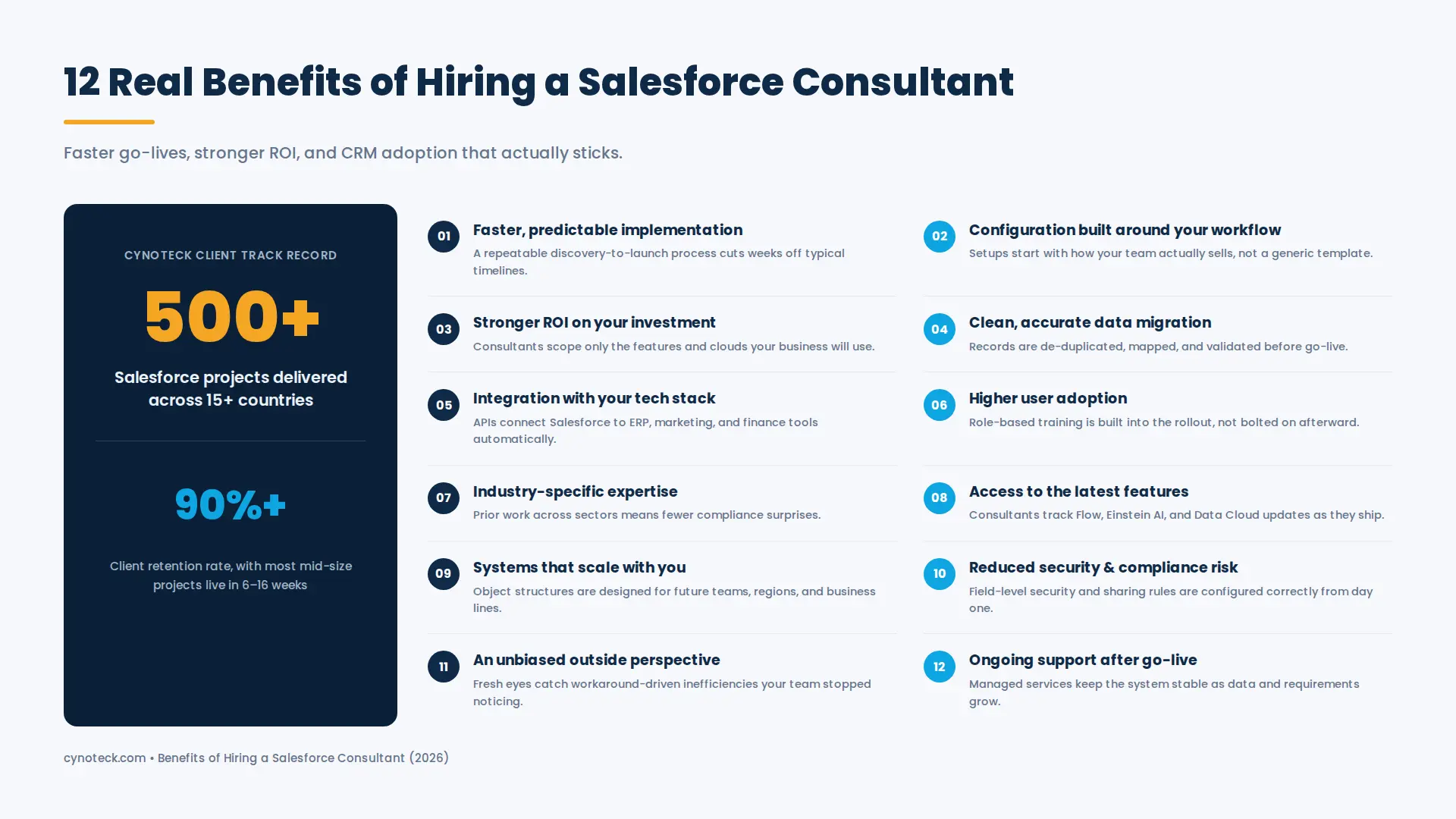
Talk to Our ConsultantsA Salesforce consulting company follows a repeatable delivery process: discovery, design, build, test, train, launch. That structure alone cuts weeks or months off a typical project, since the team isn't learning Salesforce and your business at the same time.
Generic Salesforce setups fail because no two sales cycles, service processes, or customer journeys look alike. Salesforce experts map your existing process first, then decide what standard configuration versus deeper customization the setup needs.
Salesforce licensing isn't cheap, and unused features are money left on the table. Consultants identify which cloud services and add-ons your business genuinely needs, so your budget goes toward capabilities you'll actually use.
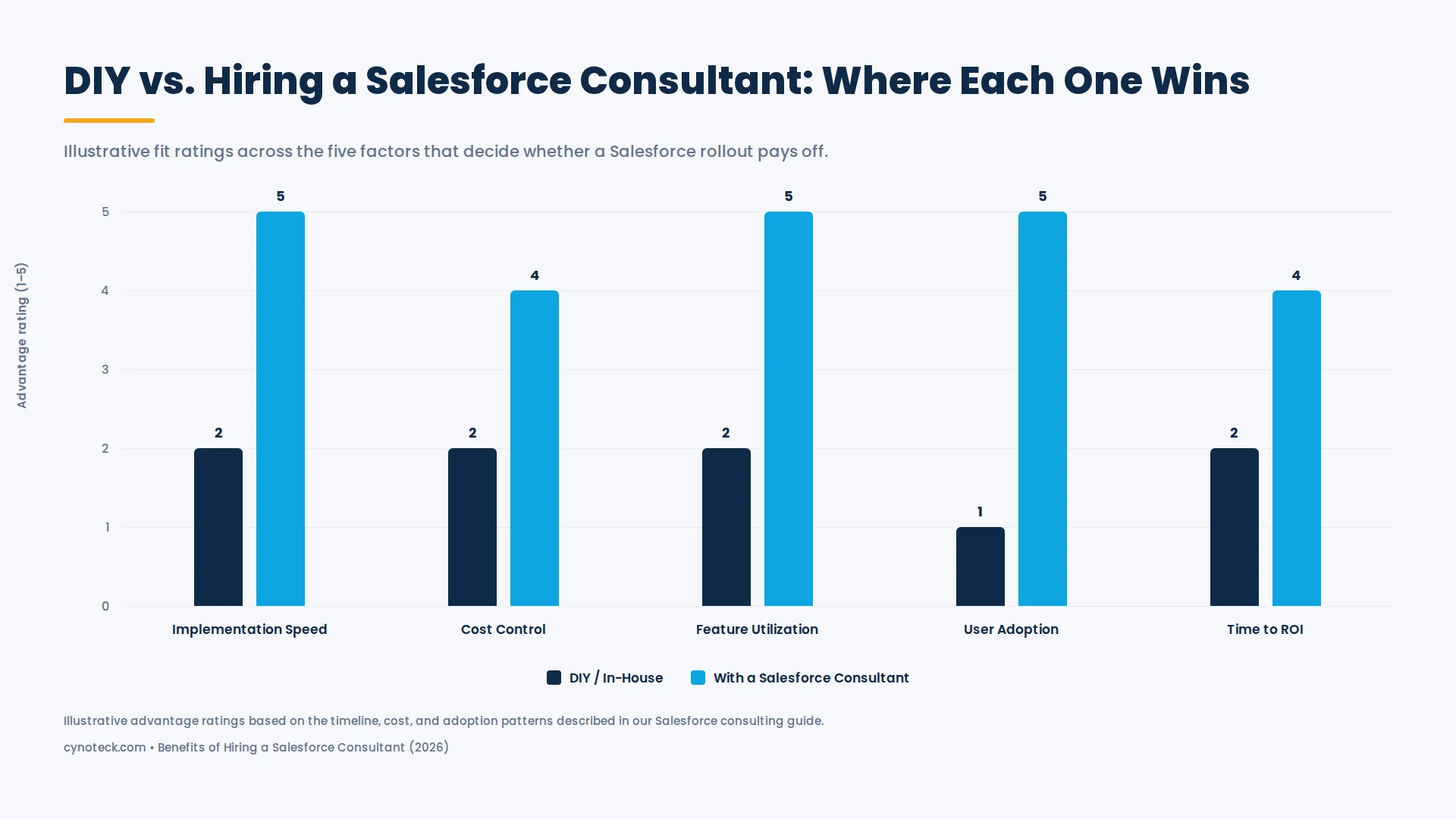
Factor | DIY / In-House Only | With a Salesforce Consultant |
Implementation timeline | 6 to 12 months, often longer | 6 to 16 weeks for most mid-size projects |
Cost overruns | Common, from rework and re-configuration | Controlled, scoped against a fixed plan |
Feature usage | Often 30-40% of licensed features used | Configured around actual workflows and adoption |
User adoption | Inconsistent without structured training | Built into the rollout plan from day one |
Time to first ROI | Delayed by trial and error | Accelerated through proven implementation patterns |
Moving customer records from spreadsheets or an old CRM is where many in-house projects go wrong. As part of a structured Salesforce implementation process, consultants de-duplicate records, map fields correctly, and validate the migration before go-live, so reports are trustworthy from day one.
Most businesses run Salesforce alongside marketing platforms, ERP systems, e-commerce tools, or finance software. A consulting company knows how to connect these systems via APIs, so data flows automatically rather than being re-entered by hand across five different tools.
A CRM nobody logs into is a wasted investment. Consultants build Salesforce user adoption strategies directly into the rollout, including role-based training and simplified interfaces for the fields each team needs. That's usually the difference between a system that sticks and one that quietly gets abandoned.
Experienced consultants have typically worked across healthcare, financial services, manufacturing, retail, and other sectors, so they already know common compliance requirements and pitfalls specific to your industry.
Salesforce ships major updates multiple times a year. Consultants stay current on new capabilities such as Flow automation, Einstein AI features, and Data Cloud tools, and can tell you honestly which updates are worth adopting now versus later.
A system built only for today's headcount often needs a costly rebuild in two years. Consultants design object structures and automation with future growth in mind, so adding new teams, regions, or business lines doesn't mean starting over.
Field-level security, sharing rules, and data access controls are easy to get wrong, especially in regulated industries. Consulting companies configure permissions correctly from the start and can advise on compliance requirements relevant to your sector.
Internal teams get used to workarounds and gaps in the current process, simply because they see them every day. An outside consultant has no such blind spot, and can flag inefficiencies your own team has stopped noticing.
A go-live date is the start of the relationship, not the end of it. Salesforce managed services, ongoing support for monitoring, updates, and fixes, keep the system running smoothly as your team, data volume, and requirements change.
Pro Tip: Notice how few of these 12 benefits are purely technical. Most come down to fit, adoption, and long-term direction, which is exactly the kind of judgment a generic template can't provide. |
Also, Read: The Complete Guide to Salesforce Consulting
The cost to hire a Salesforce consultant depends heavily on experience level, project scope, and engagement type. Here's a general breakdown to set expectations.
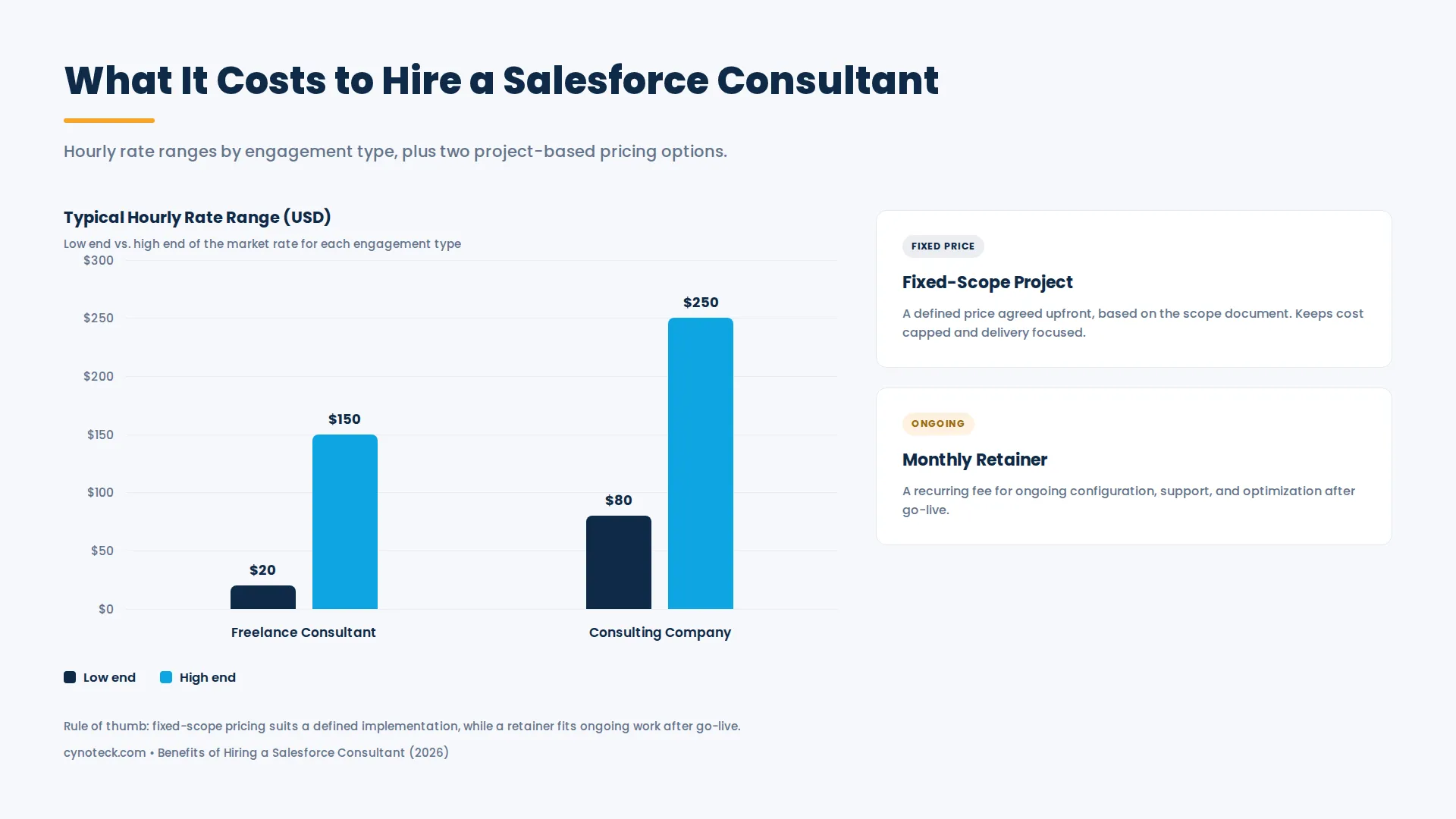
Engagement Type | Typical Cost Range |
Freelance consultant (hourly) | $20 to $150 per hour, depending on experience and region |
Consulting company (hourly) | $80 to $250 per hour for certified, agency-backed teams |
Fixed-scope project | A defined price agreed upfront, based on the scope document |
Monthly retainer | A recurring fee for ongoing configuration, support, and optimization |
Fixed-scope pricing tends to work best for a defined implementation project, since it caps your cost and keeps the consultant focused on finishing efficiently. A retainer makes more sense once you're past go-live and need ongoing configuration changes and support.
Also, Read: Salesforce Consulting Cost Guide (2026)
Not every Salesforce project needs a full consulting company. Here's how the three common options compare.
Factor | In-House Admin | Freelancer | Consulting Company |
Best for | Day-to-day changes and user support | Small, well-defined tasks | Full implementations and strategic projects |
Depth of expertise | Limited to one person's experience | Varies widely by individual | Team-based, spans multiple specialties |
Availability | Full-time, but a single point of failure | Limited, often juggling other clients | Backed by a team, more reliable coverage |
Accountability | Internal, informal | Limited, based on individual reliability | Contractual, with defined deliverables |
Cost structure | Fixed salary and benefits | Hourly, variable | Hourly, fixed-scope, or retainer options |
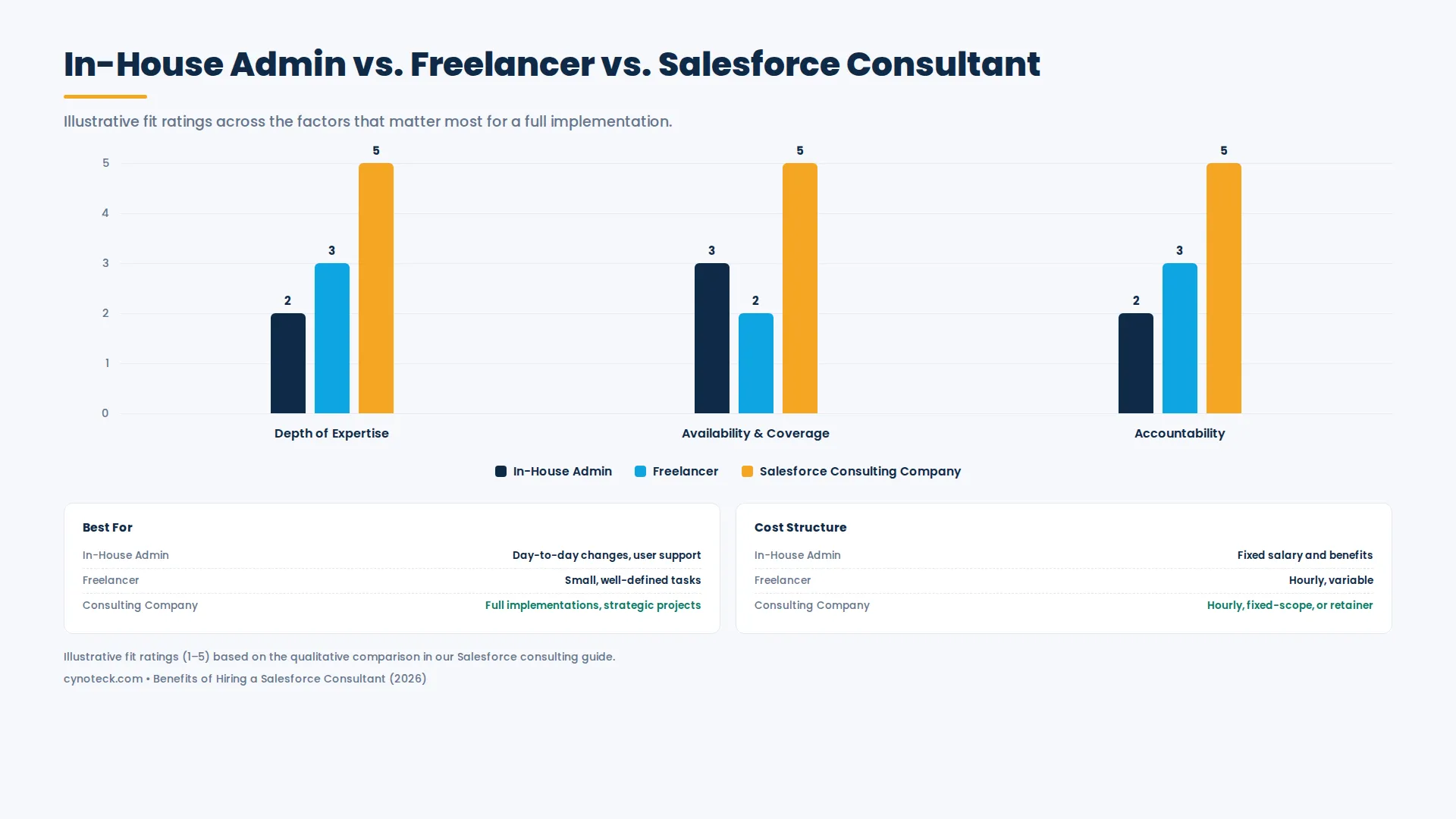
A single in-house admin is often enough to handle routine changes in a system that's already well configured. For a deeper look, go through our guide on outsource Salesforce work versus building an in-house team. A full implementation, a merger of two orgs, or a multi-cloud rollout is where a consulting company's breadth becomes worth the cost.
Compare your options with experienced Salesforce professionals and find the right engagement model for your business goals, timeline, and budget.
Schedule a Free ConsultationThe label "Salesforce expert" gets used loosely, so it helps to know what to check before signing a contract.
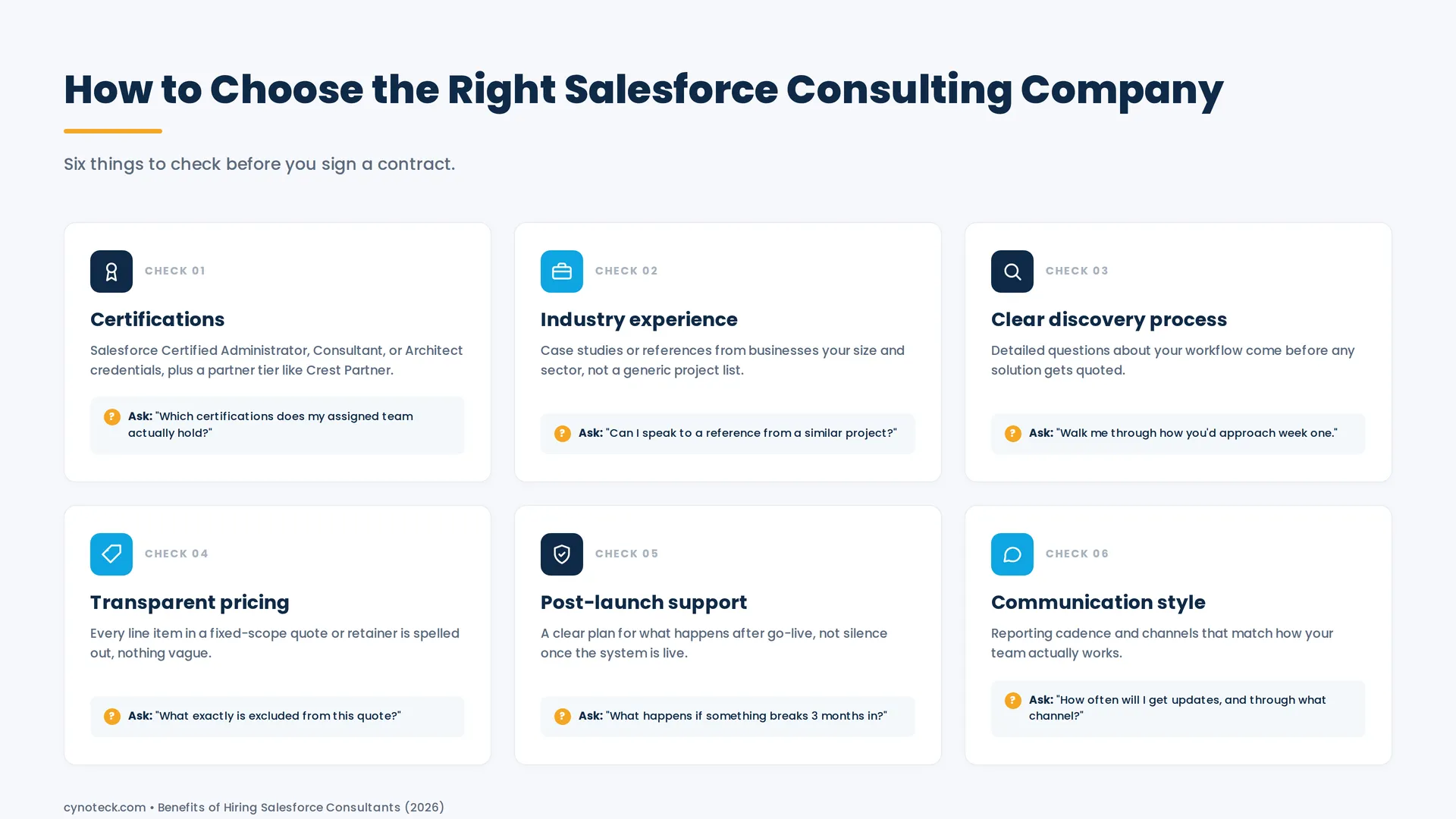
Certifications: Look for Salesforce Certified Administrator, Consultant, or Application Architect credentials, as well as a verified partner tier, such as Select Partner status.
Industry experience: Ask for case studies or references from businesses similar in size and sector to yours, not just a generic list of projects.
Clear discovery process: A good partner asks detailed questions about your workflows before quoting a solution, rather than jumping straight to a build estimate.
Transparent pricing: You should be able to see exactly what's included in a fixed-scope quote or retainer, with no vague line items.
Post-launch support: Confirm what happens after go-live. A partner who disappears once the system is live leaves you exposed the first time something breaks.
Communication style: Make sure their reporting cadence and communication channels match how your team likes to work.
Also, Read: Types of Salesforce Consulting Services Explained
A few recurring mistakes show up across businesses that end up unhappy with a Salesforce engagement.
Choosing based on the lowest hourly rate instead of relevant experience and case studies.
Skipping a proper discovery phase and jumping straight into configuration.
Assuming certifications alone guarantee real-world project experience.
Not clarifying who owns post-launch support before the contract is signed.
Treating the engagement as a one-time project instead of a long-term partnership as the business evolves.
Avoiding these mistakes is often the real difference between a Salesforce project that pays for itself and one that becomes a recurring headache.
Also, Read: Common Salesforce Consulting Challenges
Cynoteck is a certified Salesforce Select Partner with 500+ projects delivered across 15+ countries, a 90% client retention rate, and a 95% on-time deployment rate. That track record also holds up on AgentExchange, where Cynoteck has a 4.9 out of 5 CSAT score, verified by independently audited client reviews.
Here's how a few of the 12 benefits show up on a typical Cynoteck engagement:
Faster implementation: A discovery-first process that scopes the real workflow before any configuration starts, keeping most mid-size projects inside the 6-to-16-week range.
Higher adoption: Role-based training built into the rollout plan, not bolted on after go-live.
Ongoing support: A managed services team that already understands your data model, instead of a new vendor starting from zero.
Explore Cynoteck's Salesforce Consulting Services to learn how you can transform your business with the help of a Salesforce CRM consulting partner.
Work with certified Salesforce consultants who combine strategic planning, implementation expertise, and long-term support to help your CRM grow with your business.
Book a Free ConsultationAns: The biggest benefit is avoiding the trial-and-error cost of a self-led implementation. A consultant configures Salesforce around your actual workflow the first time, which saves both money and the time spent fixing a poor initial setup.
Ans: Costs vary by engagement type. Freelancers often charge less per hour than consulting companies, while fixed-scope projects and monthly retainers offer more predictable budgeting for larger or ongoing work.
Ans: A single in-house admin can usually manage routine changes on an already well-configured system. A full implementation, integration project, or multi-cloud rollout typically needs the broader expertise a consulting company brings.
Ans: Most mid-size implementations run 6 to 16 weeks with an experienced consulting team, compared to 6 to 12 months or longer for in-house projects without dedicated Salesforce expertise.
Ans: Salesforce Certified Administrator and Consultant credentials are a good baseline. For larger projects, look for Application Architect certifications or a verified Select Partner tier.
Ans: Yes. Many businesses bring in consultants for an org health check, ongoing managed services, or optimization work on a system that's live but underperforming, not only for new implementations.
 Outsource Salesforce Development or Build In-House Which is the Best for Your Business.webp)
Outsourcing Salesforce development vs. building an in-house Salesforce team: 2026 cost insights, salary comparisons, key benefits, challenges, and the best hiring model for your business growth.
We are more than just developers and consultants—we are your partners in navigating the digital landscape. Let us be the engine behind your next big success while you focus on your core vision.
Explore Opportunities!