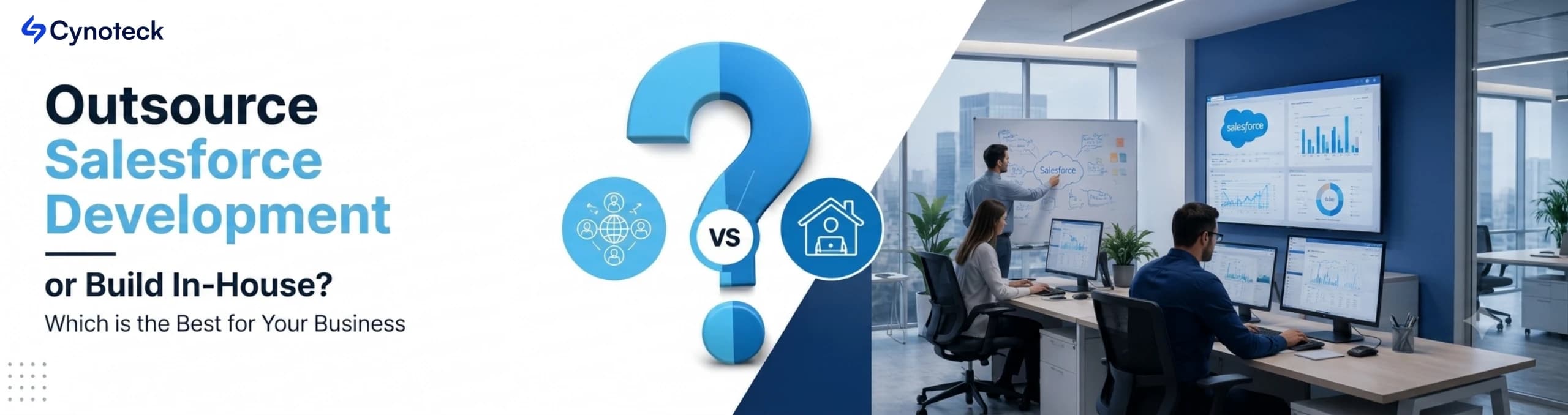
Outsource Salesforce Development or Build In-House? Which is the Best for Your Business
Summary: This guide compares outsourcing Salesforce development with building an in-house team, using real 2026 salary and pricing figures. It covers the true cost of each option, when each model works best, and how a hybrid approach can give you the strongest balance of control and flexibility. |
Every business running Salesforce eventually reaches a point where standard configuration stops being enough. Custom Apex code, Agentforce automation, and integrations with other systems all need developer time that a single admin cannot provide. At that point, the real question is whether to outsource Salesforce development to a specialist partner or build a team in-house. This guide walks through the true cost, the trade-offs, and a practical way to decide which path fits your business.
Factor | In-House Team | Outsourced Salesforce Development |
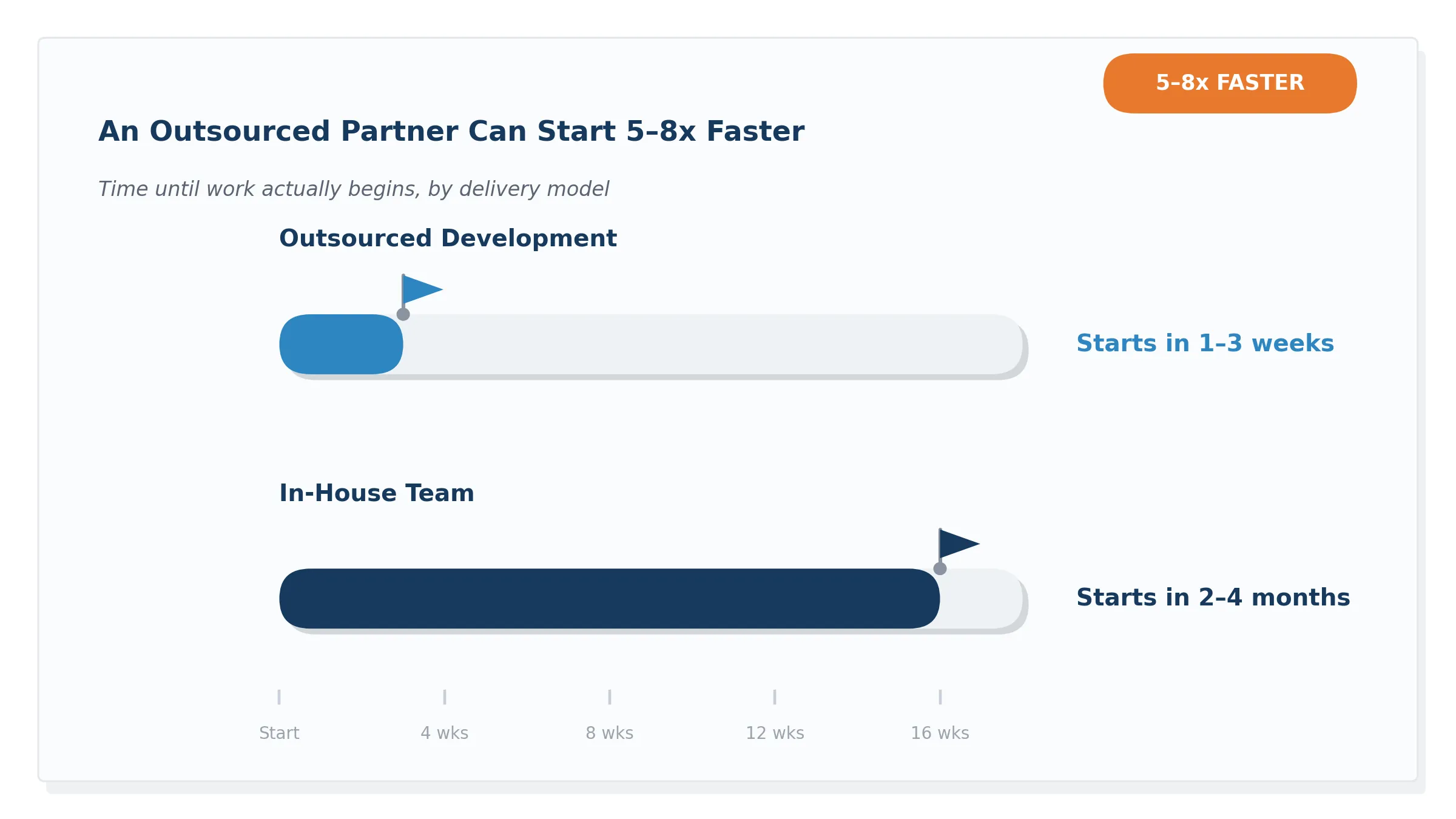
Time to start delivering | 2 to 4 months (hiring and onboarding) | 1 to 3 weeks |
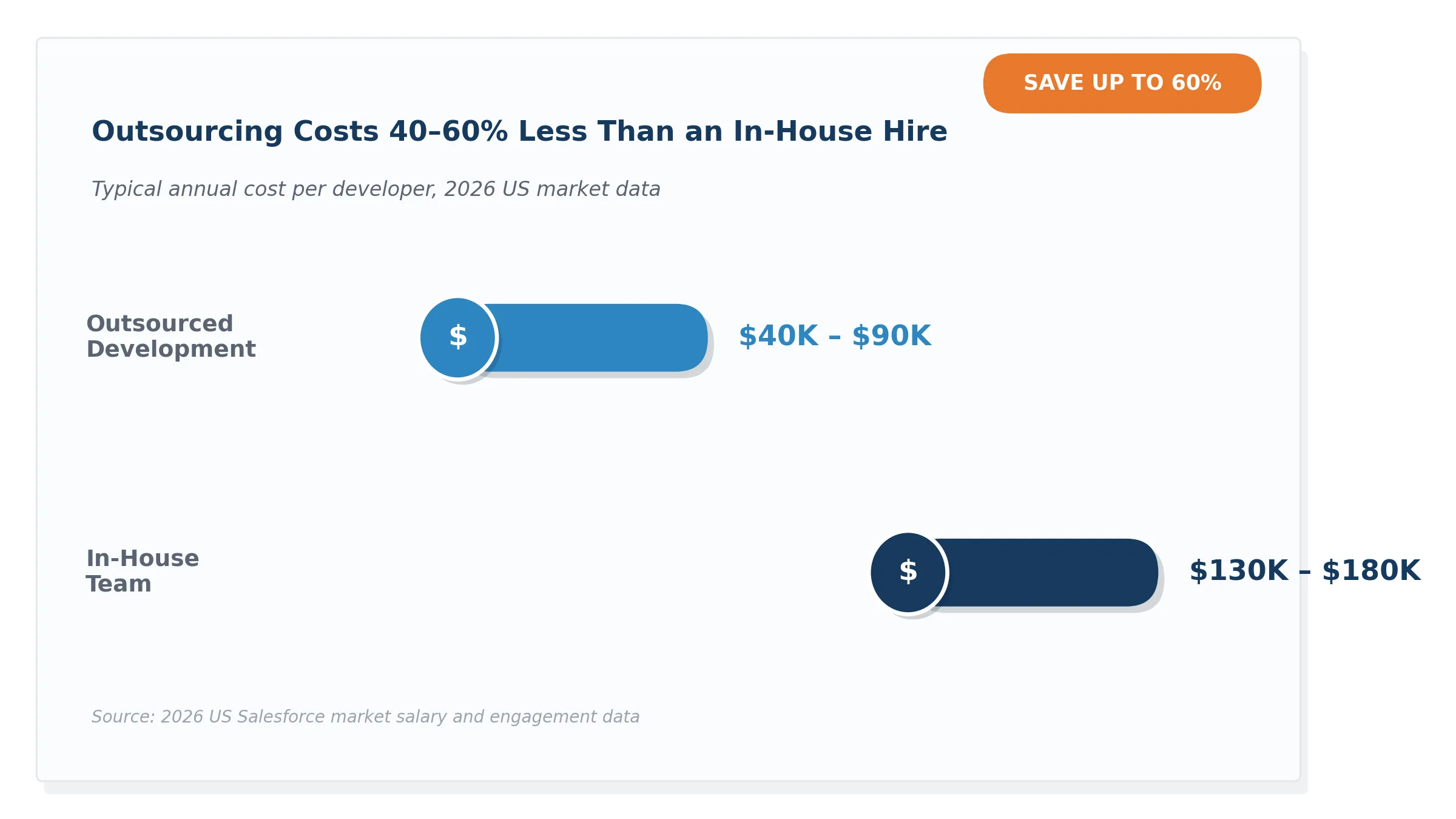
Typical annual cost (one US-based developer) | $130,000 to $180,000 with benefits and overhead | $40,000 to $90,000 depending on engagement model |
Access to specialized skills (CPQ, Agentforce, integrations) | Limited to who you can hire | Broad, available on demand |
Scalability | Slow, tied to hiring cycles | Fast, scale up or down as needed |
Best suited for | Large, complex orgs with continuous development needs | Growing businesses, project work, and teams that need speed |
This table is a starting point, not the full answer. For most mid-sized businesses, the real decision comes down to how much ongoing, unpredictable Salesforce work you generate each month. The sections below help you work that out.
Not sure which model fits your business? Get expert guidance to choose the most cost-effective Salesforce development approach.
Book a Free ConsultationOutsourcing Salesforce development means hiring an external company or specialist team to handle development work instead of employing full-time staff for it. This is not one arrangement. It covers four common models, and each one fits a different business situation.
Project-Based Engagement: You define a specific piece of work, such as building a custom quoting tool or migrating data from an old CRM, and the partner delivers it within an agreed scope, timeline, and price. This suits one-time initiatives with a clear finish line.
Dedicated Team Model: The partner assigns a set group of developers, admins, and a project lead who work only on your Salesforce org, often for months or years. It functions like an extension of your internal team, without the overhead of direct employment.
Staff Augmentation: You bring in one or two specialists, such as a Salesforce Apex developer, to fill a specific skills gap on your existing internal team. Control stays with your internal project manager while you add technical capacity where you need it most.
Managed Services: The partner takes ownership of ongoing support, maintenance, and small improvements to your org under an SLA, or service level agreement (a contract that sets response times and support commitments). This suits businesses with a stable org that need reliable upkeep rather than new builds.
Note: Most growing businesses start with one model and move between them as their needs change. A project-based engagement often turns into a dedicated team once the initial build proves its value. |
Pros | Cons |
Lower cost for most workloads, often 40% to 60% less than in-house | Less day-to-day physical proximity to the team |
Faster start, usually within one to three weeks | Success depends on the partner’s certifications and process |
Access to specialists across clouds, industries, and Agentforce builds | Requires a clear scope of work to avoid miscommunication |
Easy to scale the team size up or down as workload changes | Some knowledge sits with the partner rather than your staff |
Building an in-house Salesforce team means hiring and managing full-time employees who work only on your org. Depending on the complexity of your Salesforce environment, this team usually includes a combination of the following roles.
Salesforce Administrator: Handles day-to-day configuration: user management, permission sets, reports, and dashboards.
Salesforce Developer: Writes Apex code, Salesforce’s programming language for custom logic, and builds Lightning Web Components (LWCs), the framework used for custom interface elements.
Salesforce Solution Architect: Designs how different Salesforce clouds and outside systems connect and usually leads technical decisions on larger builds.
QA or Testing Specialist: Checks that new features work correctly before they go live.
Project Manager: Coordinates timelines, priorities, and communication between the Salesforce team and the rest of the business.
For a mid-sized company, this typically means three to five salaried employees, plus the management time required to keep them trained and current with Salesforce’s three annual platform releases.
Pros | Cons |
Deep, ongoing knowledge of your business and your org | Higher fixed costs, whether the workload is heavy or light |
Full internal control over data access and processes | Hiring and onboarding take two to four months |
Direct, same-time-zone collaboration every day | Turnover risk means losing configuration knowledge overnight |
Easier to align development with long-term company goals | Requires ongoing certification and training spend |
Factor | In-House Team | Outsourced Development |
Cost | Higher fixed cost regardless of workload | Variable, tied to actual work delivered |
Speed to start | Slower, limited by hiring timelines | Fast, teams can often start within weeks |
Scalability | Difficult to scale up or down quickly | Easy to adjust team size as needs change |
Expertise breadth | Limited to what you can afford to hire | Access to specialists across clouds and industries |
Security and compliance | Full internal control over data handling | Depends on the partner’s certifications and process |
AI readiness (Agentforce, Einstein) | Requires dedicated upskilling investment | Partners often bring existing AI implementation experience |
Maintenance and support | Requires internal coverage planning | Often included in managed service agreements |
Innovation pace | Limited by internal bandwidth and skill ceiling | Exposure to patterns from multiple client engagements |
Neither column wins outright. A business with constant, predictable development needs and strict data residency rules may value in-house control more than flexibility. A business with variable workload and a need for specialized skills, such as an Agentforce rollout, usually gets more value from outsourcing.
Cost is usually the first question decision-makers ask, and it is also where assumptions most often go wrong. A straight salary comparison misses several categories of spend that only appear after the hire is made. This is why we break the decision down into individual factors below, rather than a single blended number.
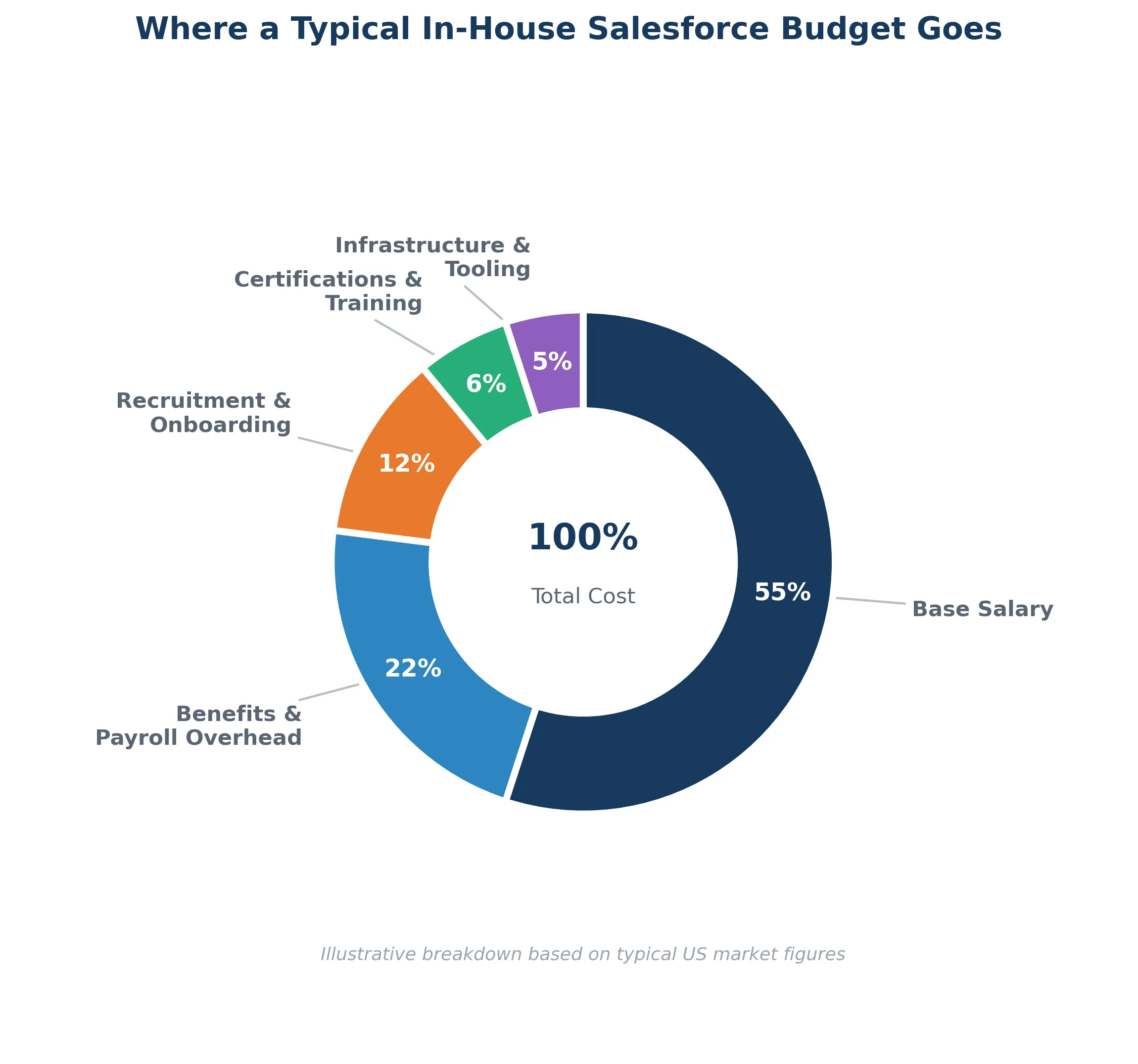
A straight salary comparison is where most businesses go wrong, because an in-house hire carries several layers of cost that never show up on a job offer. Here is what goes into the total, based on 2026 US market data:
Base salary: A Salesforce Developer earns between $93,000 and $150,000, with senior developers and architects reaching $150,000 to $190,000. A Salesforce Administrator typically earns $90,000 to $125,000.
Payroll tax, benefits, and overhead: Employer-side payroll taxes, health insurance, retirement contributions, and paid time off usually add 25% to 40% on top of base salary.
Recruitment and onboarding: Sourcing, interviewing, and onboarding a qualified developer commonly takes two to four months and can cost $15,000 to $25,000 in recruiter fees and lost productivity while the seat sits empty.
Certifications and training: Salesforce’s certification system includes more than 40 credentials. Keeping a team current, especially on newer capabilities like Agentforce, requires an annual training budget of $2,000 to $5,000 per employee.
Infrastructure and tooling: Sandboxes, development environments, and deployment pipelines add further cost before a single feature ships.
Turnover: This is the cost businesses underestimate most. When a Salesforce developer leaves, the knowledge of custom code and org configuration often goes with them, and the hiring cycle starts over from scratch.
By contrast, outsourced Salesforce development is typically priced based on project scope, a dedicated team retainer, or an hourly rate. Here is how that usually breaks down:
Hourly and retainer rates: Experienced offshore and nearshore teams commonly range from $25 to $65 per hour, depending on seniority and location.
No recruitment overhead: You are not paying for job postings, interview time, or an empty seat while a search runs.
No idle-time cost: In-house developers are paid the same in a quiet quarter as in a busy one. Outsourced engagements can usually scale down when demand drops.
Total savings: For predictable, high-volume work, outsourcing often brings total annual cost down by 40% to 60% compared to an equivalent in-house team.
Pro Tip: Before comparing prices, list every cost category separately: salary, benefits, recruitment, training, tooling, and expected turnover. Businesses that skip this step almost always underestimate the true cost of an in-house hire. |
Winner: Outsourced Development – for most workloads, the total cost runs well below that of an equivalent in-house hire once all expenses are counted.
Discover how the right Salesforce delivery model helps reduce costs, accelerate projects, and improve long-term business results.
Talk to Our ExpertsAn outsourced partner can typically start delivering work within one to three weeks, since the developers, environments, and project processes already exist. Building an in-house team takes two to four months once you include sourcing, interviewing, and onboarding, and that timeline can stretch further for niche skills like CPQ or Agentforce, where qualified candidates are harder to find.
Fixed deadlines: If a project has a hard launch date, the two-to-four-month hiring runway alone can make in-house hiring impractical.
Interim coverage: Some businesses start a project with an outsourced partner and transition to an in-house hire once that person is found, so work does not stall while recruiting continues.
Winner: Outsourced Development – speed is one of the clearest advantages of working with an established partner.
An in-house team is limited to the skills you can afford to hire and retain, and niche expertise such as CPQ (Configure, Price, Quote, Salesforce’s tool for complex sales quotes) configuration or Agentforce agent-building can be difficult to find in a single candidate. An outsourced partner usually has developers across CPQ, Agentforce, Einstein Analytics, and integration work already on staff, so you are choosing from an existing bench rather than starting a search from scratch.
Note: If your business needs one very specific, ongoing skill set rather than broad coverage, staff augmentation can bring in that single specialist without a full outsourcing engagement. |
Winner: Outsourced Development – broader bench strength almost always beats what a single company can hire on its own.
Outsourced teams can scale up for a major rollout, such as a multi-cloud implementation, and scale back down to a light support retainer once the work is done. In-house teams have a fixed headcount. Scaling them up means running a new hiring cycle, and scaling down means layoffs, which most businesses try to avoid and which can damage morale across the wider team.
Winner: Outsourced Development – flexibility to match team size to actual workload is a structural advantage of the model.
An in-house team gives you full internal control over who handles sensitive data, which matters most in regulated industries like healthcare or financial services, where every access point must be accounted for during an audit. Outsourced partners can meet the same standards, but this depends entirely on their certifications, contracts, and internal processes, so it is worth verifying rather than assuming.
Winner: In-House Team – for businesses with strict data residency or access requirements, direct control is hard to replace.
In-house developers build deep familiarity with your systems, your customers, and your internal processes over time. That context reduces the need to re-explain business logic on every project, and it often leads to better judgment calls on edge cases that a new outside team would need to ask about.
Winner: In-House Team – institutional knowledge compounds over the years in a way that project-based engagements cannot fully replicate.
Building Agentforce or Einstein AI capability in-house requires dedicated upskilling, since this is a newer skill set even among experienced Salesforce staff, and formal training paths are still maturing. Established outsourcing partners have already delivered several AI implementation projects for other clients, so they have worked through the common configuration and data-quality issues that come with a first Agentforce rollout.
Winner: Outsourced Development – existing, hands-on Agentforce experience is faster to access than training an internal team from scratch.
An in-house team is often the right call when your Salesforce org sits at the center of daily operations and needs constant, hands-on attention.
Continuous, high-volume development needs: Large enterprise orgs with frequent configuration changes benefit from developers who already understand the business context.
Strict regulatory requirements: Healthcare organizations managing Health Cloud under HIPAA, the US law governing protected health information, often prefer tighter internal control over sensitive data.
Long-term, growing investment: If your Salesforce footprint is set to expand for years, the consistency of a stable internal team can outweigh the higher fixed cost.
Heavy integration with proprietary systems: If your org connects tightly with custom internal software that outside developers would need months to learn, in-house staff already carry that context.
Outsourcing tends to make more sense when speed, cost efficiency, or specialized expertise matter more than day-to-day proximity.
Tight deadlines: A logistics company needing a fleet management integration within eight weeks does not have time for a three-month hiring process.
Fluctuating workload: A manufacturing company preparing for a CPQ rollout might need five developers for four months and only one afterward. Scaling an in-house team quickly is rarely practical.
Missing specific expertise: If your business needs Agentforce agent development or Einstein Analytics configuration and does not have time to build that skill internally, an experienced partner already has it on hand.
Budget pressure on fixed headcount: If leadership is hesitant to add permanent salary and benefit costs to the books, a scoped engagement delivers the same work without a long-term commitment.
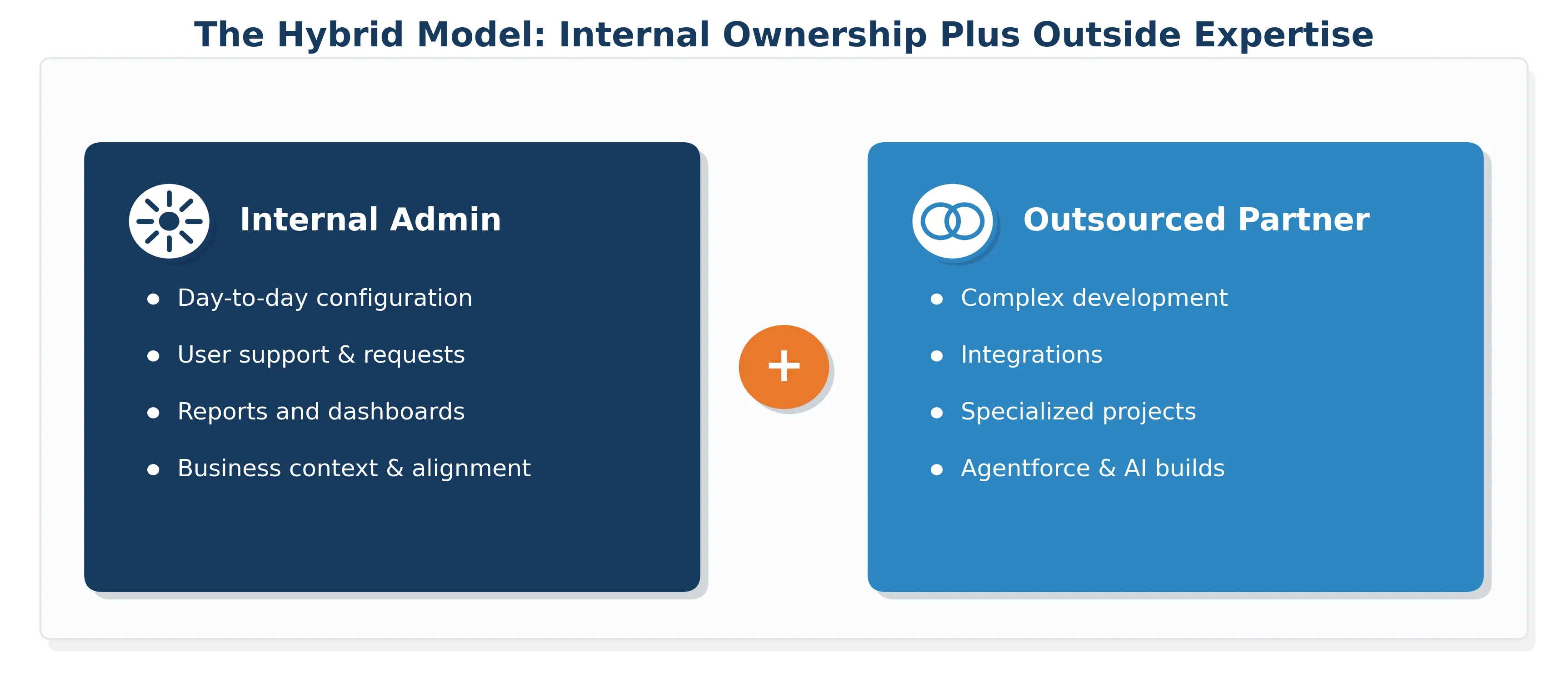
Many businesses do not choose one model exclusively. A hybrid approach keeps a small internal team, often one administrator, for day-to-day configuration and business alignment, while an outsourced partner handles complex development, integrations, and specialized projects.
This gives you a consistent internal point of contact who understands your business, while still giving you access to deeper technical bench strength when a project demands it. A company with an internal administrator managing user requests and reports, paired with an outsourced partner for quarterly feature releases, gets the benefits of both models at once.
Note: The hybrid model also tends to scale most naturally as a business grows. You add internal headcount only once the workload genuinely justifies a permanent hire, and you rely on your partner for everything else. |
Combine internal expertise with certified Salesforce professionals to create a flexible development team that grows with your business.
Discuss Your Project RequirementsHow much ongoing, predictable Salesforce development work does our business generate each month?
Do we have the budget and timeline to hire, onboard, and retain in-house Salesforce talent?
Are we entering a growth phase where our Salesforce needs will change significantly in the next 12 months?
Do we need specialized skills, such as CPQ, Agentforce, or complex integrations, that our current team does not have?
How sensitive is our data, and what compliance rules apply to who can access it?
What is our tolerance for ramp-up time versus needing work delivered quickly?
Do we have internal capacity to manage a development partner effectively?
What happens to our org’s stability if a key in-house developer leaves?
Are we prepared to invest in ongoing certification and training if we build in-house?
Would a hybrid model give us more flexibility than committing fully to one approach?
Answering these honestly, ideally with input from both finance and IT, points you toward the right model faster than comparing cost alone.
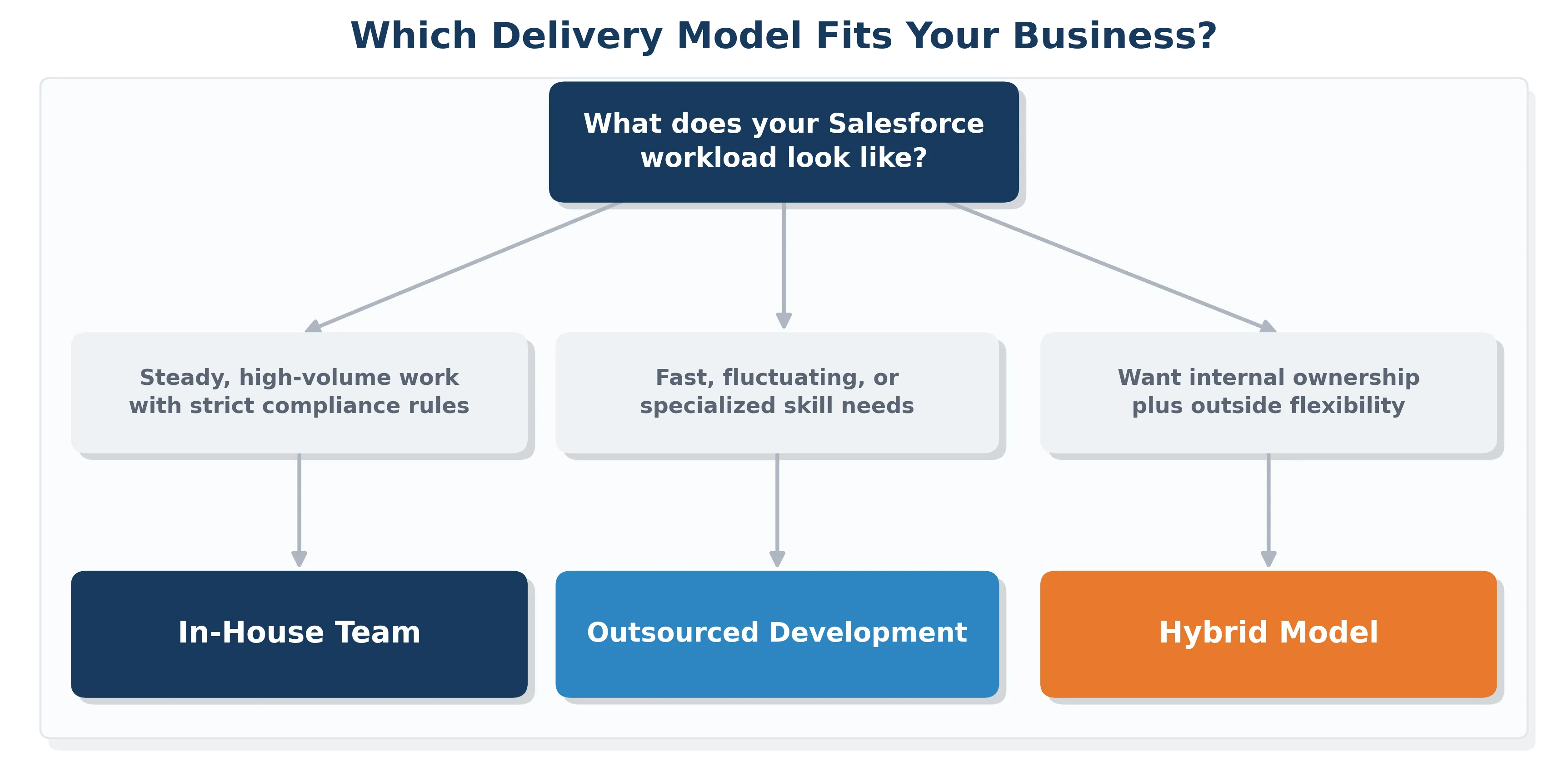
Your Situation | Recommended Model |
Steady, high-volume development needs and strict compliance rules | In-house team |
Fast-approaching deadline or limited hiring budget | Outsourced project-based team |
Fluctuating workload with occasional specialist needs | Outsourced dedicated team or staff augmentation |
Stable org needing reliable upkeep, not new builds | Outsourced managed services |
Growing business wanting internal ownership plus flexible capacity | Hybrid model |
Comparing only base salary against hourly rates: This misses the recruitment, benefits, and turnover costs that make in-house staffing more expensive than it first looks.
Outsourcing everything at once: This can strip away internal knowledge of how your own org is configured, creating dependency on a single vendor.
Choosing a partner on price alone: Skipping a review of certifications, industry experience, and client references. Cheap work that needs to be rebuilt later almost always costs more than paying fairly the first time.
Skipping a clear scope of work: This leads to scope creep and budget overruns, regardless of which delivery model you choose.
Choosing a Salesforce development partner is a bigger decision than picking a price. The wrong choice costs you rework, missed deadlines, and a Salesforce org that someone else will have to fix later. Here is what to check before you sign anything.
Step 1: Check Salesforce partner status
As of 2026, Salesforce runs a two-tier consulting partner program: Select Partner and Summit Partner, the higher tier.
Either designation signals independent vetting of certifications, client satisfaction scores, and delivery outcomes.
Step 2: Ask for relevant case studies
Look for examples from your industry and your specific Salesforce Cloud, whether that is Sales Cloud, Service Cloud, or Marketing Cloud.
Step 3: Review individual certifications
Check the credentials held by the specific developers who would work on your project, not just the company’s overall certification count.
Step 4: Ask about communication across time zones
This matters most if the team is offshore or nearshore.
Step 5: Request a clear engagement breakdown
You should know exactly what you are paying for before signing anything.
Note: A partner that asks detailed questions about your business goals, not just your technical requirements, is usually a stronger long-term fit than one that jumps straight to a quote. |
Cynoteck Technology Solutions is a Salesforce Select Partner and Microsoft Solutions Partner, with more than 250 certified professionals and 500-plus completed Salesforce projects. That standing reflects consistent delivery quality across Salesforce implementation, Salesforce customization, and custom Salesforce development work.
Businesses working with Cynoteck get:
Certified specialists across clouds: Developers and architects with hands-on experience in Sales Cloud, Service Cloud, CPQ, and Agentforce implementations.
Engagement models built around your workload: A dedicated team for an ongoing roadmap, or project-based support for a single integration, rather than a one-size-fits-all contract.
Hybrid-friendly delivery: A team that works alongside your existing internal Salesforce admins, filling development gaps without disrupting the staff you already have in place.
Whether you need a dedicated development team for an ongoing roadmap or a project-based partner for a specific integration, the goal is the same: matching the engagement to your actual workload rather than selling a larger contract than you need.
Partner with certified Salesforce experts to plan, develop, and scale solutions that align with your business goals and timeline.
Schedule a Free ConsultationThere is no single right answer between outsourcing Salesforce development and building an in-house team. The decision comes down to your workload predictability, budget structure, compliance requirements, and how quickly your Salesforce needs are likely to change over the next year. For many growing businesses, a hybrid model, keeping core ownership internal while outsourcing specialized or project-based work, delivers the strongest balance of cost, speed, and control.
If you are still weighing which model fits your business, a Salesforce audit can show exactly where your current setup stands and what level of support makes sense. Schedule a free consultation with Cynoteck to walk through your specific requirements and get a clear recommendation, not a generic sales pitch.
Ans: In most cases, yes. Outsourced development typically costs 40% to 60% less than an equivalent in-house team once salary, benefits, recruitment, and turnover costs are factored in, especially for project-based or fluctuating workloads.
Ans: Most partners can start delivering within 1 to 3 weeks, compared to 2 to 4 months for hiring and onboarding an in-house developer.
Ans: It can be, provided the partner adheres to strict data-handling protocols and holds relevant Salesforce certifications. Ask any potential partner for their security practices and compliance documentation before signing a contract.
Ans: Staff augmentation adds one or two specialists to your existing internal team under your management. A dedicated team is a full group assigned exclusively to your Salesforce org, managed by the outsourcing partner.
Ans: Yes. Many businesses use a hybrid model, keeping an internal admin for daily configuration while outsourcing complex development, integrations, or AI-related projects like Agentforce builds.
Ans: US-based Salesforce developers earn between $93,000 and $190,000 in base salary, depending on experience, with total employment cost often running 25% to 40% higher once benefits and overhead are included.
Ans: Look for Salesforce Certified Administrator, Platform Developer I and II, and role-specific credentials such as CPQ Specialist or Agentforce certifications, depending on your project needs.
Ans: Not if the engagement is structured correctly. A clear scope of work, regular reporting, and documented org configuration keep you informed and in control, regardless of who is doing the development.
Ans: Usually not. A hybrid model often costs less than a full in-house team while still providing more continuity than pure outsourcing, since you only add internal headcount where it is truly justified.
Ans: If your org requires continuous, high-volume development and your compliance rules demand tight internal control over data access, an in-house team is usually worth the investment.
Ans: Retail, logistics, manufacturing, and financial services businesses with seasonal or project-driven workloads tend to see the strongest return from outsourcing, since demand for development work changes throughout the year.
Ans: Yes. Experienced Salesforce development partners typically have hands-on Agentforce experience across multiple client engagements, which is often easier to access than building that skill set from scratch internally.
 Outsource Salesforce Development or Build In-House Which is the Best for Your Business.webp)
Outsourcing Salesforce development vs. building an in-house Salesforce team: 2026 cost insights, salary comparisons, key benefits, challenges, and the best hiring model for your business growth.
We are more than just developers and consultants—we are your partners in navigating the digital landscape. Let us be the engine behind your next big success while you focus on your core vision.
Explore Opportunities!