AI in Retail and E-Commerce: 8 Practical Use Cases for 2026
TL;DR
AI in retail and e-commerce uses computer vision, machine learning, and generative AI to predict demand, answer customer questions, personalize shopping, detect fraud, and reduce manual work in store operations. This guide covers 8 practical AI use cases that help retailers and e-commerce businesses make better use of data they may already have.
- The eight use cases include product discovery, demand planning, customer support, fraud detection, store operations, pricing, product content, and returns.
- Most AI use cases depend on clean product, order, and inventory data, so connect your systems before implementing AI.
- AI adoption in retail and e-commerce is growing quickly. According to NVIDIA's 2026 survey, 91% of retail and CPG respondents were using or assessing AI.
Imagine an online store with 3,000 products: its best-selling jacket sells out on Friday, but 400 units of last season’s coat sit in the warehouse. Meanwhile, the support inbox fills with “Where is my order?” emails. Still, the traces of these problems remain in your data.
If you run a store, an online shop, or the operations behind one, you have likely heard that AI can fix these problems. However, businesses need clarity on where AI fits and what data each idea needs.
This guide covers eight AI use cases in retail and e-commerce. We provide solutions for each problem, the data requirements, a safe first step, and the risk to watch for.
What Is AI in Retail and E-Commerce?
AI in retail and e-commerce includes machine learning, computer vision, natural language processing, and generative AI, helping retailers forecast demand, automate service, personalize offers, and run stores. Moreover, it enables supply chains to have less manual work and more automated tasks. For retail and e-commerce, AI identifies patterns in your sales, product, customer, and inventory data. Thereafter, it recommends an action or takes one.
Why AI Is Becoming Important in Retail and E-commerce
First, AI adoption in retail and e-commerce is mainstream: NVIDIA’s third annual State of AI in Retail and CPG survey found that 91% of respondents were using or assessing AI. 89% of respondents also said AI helped increase annual revenue, and 95% said it helped cut costs.
Second, shopping is changing: McKinsey estimates that agentic commerce, where AI agents shop for customers, could orchestrate up to $1 trillion of US B2C retail revenue by 2030. It also puts the global figure at $3 trillion to $5 trillion, according to the agentic commerce research.
Third, the pressure is real: Retailers expect shoppers to return 15.8% of yearly sales in 2025, worth $849.9 billion, according to the National Retail Federation.
Which Sections Matter Most for Your Role?
Businesses care about different problems depending on their role; some focus on sales and customer experience, while others manage stock, daily operations, costs, or technology. The table below helps you decide what you need according to your role and why it matters to you. It also explains how each use case can help your business and where you should start.
Your role | Start with | Why it matters to you |
Owner, CEO, or founder | Use cases 2, 3, and 6, then "Which use case should you start with?" | Clear costs, quick wins, and a simple way to choose |
E-commerce or marketing leader | Use cases 1, 3, and 7 | Better conversion, faster support, and better listings |
Operations or supply chain leader | Use cases 2, 5, and 8 | Fewer stockouts, smoother stores, and fewer returns |
Finance or risk leader | Use cases 4 and 6, then the risk table | Less fraud and safer pricing |
CTO or IT lead | The data table and the risk table | What to connect, clean, and secure first |
Table 1. Where each reader should start.
What Are the Best AI Use Cases in Retail and E-Commerce?
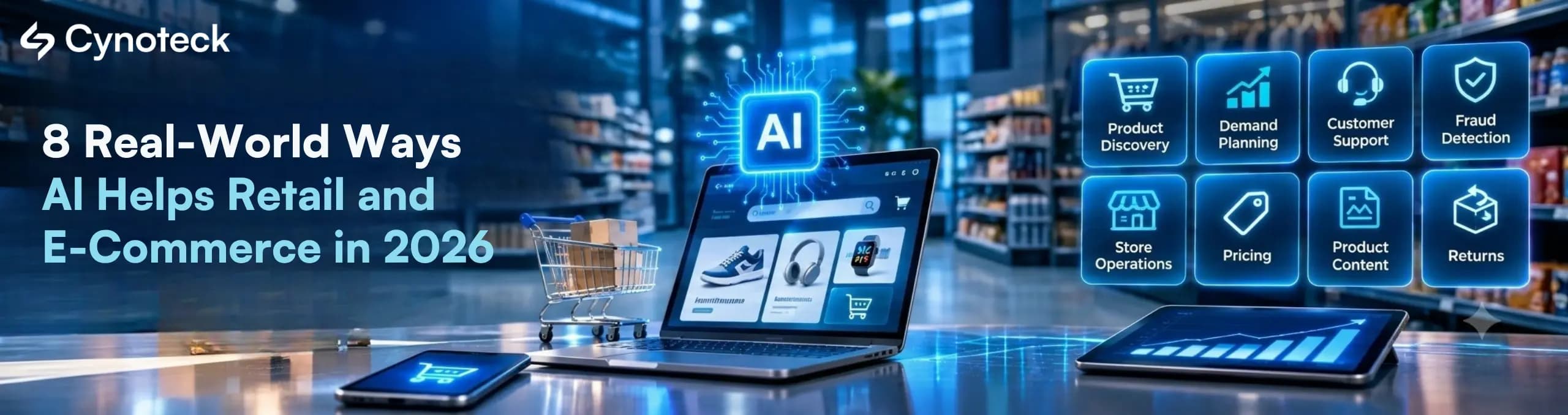
AI can help retail and e-commerce firms improve product recommendations, support customers, handle stock, detect fraud, and manage returns. There are eight practical AI use cases for retail and e-commerce organizations, depending on their business goals and requirements.
The table below explains what each use case does, which problem it solves, what data it needs, and how difficult it is to get started.
# | Use case | Problem it solves | Data it needs | First-step difficulty | Likely owner |
1 | Product discovery | Shoppers can't find the right item | Catalog, browsing, and order history | Medium | E-commerce or marketing |
2 | Demand forecasting | Stockouts and overstock | SKU-level sales, stock, promotions, lead times | Medium to high | Operations or merchandising |
3 | Customer support | Long queues and repeat questions | Help articles, policies, order data | Medium | Support or customer experience |
4 | Fraud detection | Chargebacks and fake returns | Transactions, devices, return history | Medium to high | Finance or risk |
5 | Store operations | Empty shelves and shrink | Camera feeds, shelf layouts, POS, stock | High | Store operations |
6 | Dynamic pricing | Margin pressure | Price history, competitor prices, costs | Medium to high | Merchandising or finance |
7 | Product content | Slow, uneven listings | Product attributes, images, brand rules | Low to medium | E-commerce or content |
8 | Returns management | High return costs | Return reasons, order and fit data | Medium | Operations or customer experience |
Table 2. Eight AI use cases in retail and e-commerce, with the data each one needs.
1. How Does AI Improve Product Discovery and Recommendations?
AI improves product discovery and recommendations by studying what buyers browse, buy, and skip. Then it ranks products and search results to match each person's needs. If shoppers can’t find the right item fast, they leave. Therefore, it matters a lot. Meanwhile, the generic “best seller” search result shows everyone the same thing.
Data you need: You need a clean product catalog with good attributes, browsing and order history, and a way to recognize the same customer across channels. If you run a mobile app for your store, you have to include that data too.
Start small: Start with adding recommendations to product and cart pages, and compare results with your current ranking for a few weeks. Our AI team builds recommendation systems for the retail and e-commerce industry around this kind of data.
Watch for: Go through the new products with no history, a bias toward bestsellers, and consent rules for tracking shoppers.
2. How Does AI Help With Demand Forecasting and Inventory Planning?
By learning from sales history, promotions, seasonality, and supplier lead times, AI forecasts demand for each product and location. As a result, you buy and stock closer to what you are selling. Moreover, 64% of NVIDIA’s respondents reported more supply chain challenges than a year earlier, which makes it important.
Data you need: SKU-level sales history, your promotion calendar, current stock, supplier lead times, and return rates are required. Moreover, seasonal items need a year or more of history, because the model has to see each season at least once.
Start small: Begin with forecasting your top 100 products or a single category. Then, proceed with comparing the AI forecast with your planner’s numbers. Our machine learning development services cover this kind of predictive work.
Watch for: You must watch for messy sales data, brand-new products, and one-off events like a viral post.
3. How Does AI Improve Customer Support in E-Commerce?
To improve customer support in E-commerce, AI chatbots and agents answer routine questions, check order status, start returns, and escalate more complex issues to a person. The common retail support questions include order status, shipping, and returns, so they are a good place to start.
Data you need: You need help-center articles, shipping and return policies, past support tickets, and secure access to order data to start with AI to improve customer support in E-commerce.
Start small: Begin by listing your top 10 customer questions and automate those first, with a clear handoff to a person. For one project, we built a Salesforce-based AI agent that cut calls to human agents by 80%. If you are looking for development, see our AI chatbot development services and our guide to what enterprise AI chatbots cost.
Watch for: You must watch for wrong answers, state rules, and missing handoffs that may require telling customers they are talking to an AI chatbot.
4. How Does AI Detect Fraud and Reduce Payment Risk?
AI analyzes each login, order, and return for fraud risk by comparing it with patterns from past transactions, behavior, and devices. This is also important for returns, as about 9% of returns are fraudulent, according to the NRF report.
Data you need: If you are looking for AI to detect fraud and reduce payment risk, you need data, such as transaction history, chargeback records, device and location signals, and return history.
Start small: Initially, you can run the model in “flag only” mode. The model flags risky orders and sends them for human review but does not block any orders automatically.
Watch for: The most important things to watch when implementing AI to detect fraud and reduce payment risk are false declines that turn away good customers, and privacy rules for the signals you collect.
5. How Does AI Run Smarter Store Operations?
Computer vision and sensors spot empty shelves, count foot traffic, flag checkout problems, and prevent loss. It helps stores to avoid manual work and identify everything automatically. If you run physical stores, shelves matter, since that is where you win or lose most of your revenue.
Data you need: The data includes shelf layouts, camera feeds, POS data, and live inventory for applying AI to run smarter store operations. You need accurate stock data, as it matters a lot; otherwise, AI can see a gap but can’t tell why it exists. To see how it works in practice, read our guide to computer vision for business problems.
Start small: To run smarter store operations with AI, start with one aisle or store. Then, compare product availability on shelves before and after the pilot.
Watch for: You must watch for shopper privacy, clear signage, and hardware costs that can outrun the benefits.
6. How Does AI Support Dynamic Pricing and Promotions?
AI analyzes demand, competitor prices, stock levels, and your margin rules to recommend price and promotion changes. AI support for dynamic pricing and promotions helps businesses protect margins without confusing shoppers.
Data you need: Price history, sales at each price point, competitor prices, product costs, and stock levels are essential when starting with AI support for dynamic pricing and promotions.
Start small: First, start with one category to let AI recommend changes. You also need one person to approve each change and track profit margin and sales.
Watch for: You have to set limits on how much and how quickly prices can change, as sudden price fluctuations can reduce customer trust.
7. How Does Generative AI Help with Product Content and Catalog Quality?
Generative AI helps businesses with product content and catalog quality by drafting product titles, descriptions, and tags. Computer vision, meanwhile, checks product photos. As a result, new items reach customers faster. Moreover, good product listings help AI shopping agents understand what you sell.
Data you need: You require product attributes and specs, images, brand voice guidelines, and examples of your best listings. This will speed up your process and improve catalog quality.
Start small: Begin with one category, and have a person review every draft of product titles, descriptions, and tags. If you want more details, our generative AI services can set this up.
A real example shows the scale. A US luxury handbag reseller received hundreds of seller photos every day, and each one needed review and pricing. So Cynoteck built a machine learning pipeline that checks image quality, recognizes brands, and predicts prices. According to our luxury reseller case study, manual review and pricing effort fell by 70 to 80%, onboarding became about 60% faster, and pricing became three times more consistent. Only flagged items need a person.
Watch for: You must look for risks such as invented specs in generated text, copyright issues, and a drifting brand voice once your product content is drafted.
8. How Does AI Reduce Returns and Automate Post-Purchase Work?
AI helps businesses to identify why customers return their products. Moreover, it helps users choose the right size and speeds up the refund and return process. The NRF report also shows retailers expect customers to return 19.3% of online sales.
Data you need: You need the reason for the returns, order and product data, and size and fit information. Moreover, you have to keep each customer’s return history.
Start small: Analyze each return and identify its reason. Then, find the products with the most returns and try simple fixes, like adding a better size guide.
Watch for: You have to make sure not to treat every customer who returns a product as suspicious. Also, ensure AI does not lead to unfair decisions.
What Data Do You Need Before You Start With AI?
To start with AI, you require clean product, order, customer, inventory, and support data. You also need your systems to share that data. So, you must check for the common blockers that usually come from disconnected systems. You have to connect all your systems if your CRM, ERP, and store platform aren't connected.
Data type | Where it usually lives | Use cases that need it | Common problem |
Product catalog | Store platform or PIM | 1, 6, 7 | Missing or inconsistent attributes |
Orders and customers | CRM, ERP, store platform | 1, 3, 4, 8 | Duplicate records across systems |
Inventory and suppliers | ERP or warehouse system | 2, 5 | Stock counts that lag reality |
Transactions and payments | Payment provider | 4 | Limited fraud labels |
Support tickets and help content | Helpdesk | 3 | Outdated articles |
Images and video | Cameras, product photos | 5, 7 | Poor quality and no tags |
Table 3. The data behind each use case.
Not sure where you stand? Our AI readiness checklist helps you find the gaps. You can also read what AI services a business needs to match tools to problems.
Which AI Use Case Should You Start With?
You should start with the business problem that costs you the most and has the cleanest data. For more clarity on choosing the right AI use case for your business, you can go through the table below.
If your biggest problem is... | Start with | First number to track |
Stockouts and overstock | Demand forecasting (2) | Forecast accuracy and stockout rate |
A long support queue | Customer support (3) | Resolution rate and response time |
Low conversion | Product discovery (1) | Conversion rate and revenue per visit |
Margin pressure | Dynamic pricing (6) | Gross margin |
Slow product onboarding | Product content (7) | Time to list |
High returns | Returns management (8) | Return rate |
Chargebacks and fake returns | Fraud detection (4) | Chargeback rate and false declines |
Empty shelves and shrink | Store operations (5) | On-shelf availability |
Table 4. Match your problem to a first AI project.
Then keep the pilot small. In July 2024, Gartner predicted that teams would abandon at least 30% of generative AI projects after proof of concept by the end of 2025. It also cited weak data, thin risk controls, rising costs, and unclear business value. So a narrow pilot with one metric avoids most of those traps.
How long does a pilot take? In our AI solution delivery approach, you see a working prototype within three to four weeks. Read our guide to the generative AI project timeline to know how long a full project may take. If you are not sure whether to start with planning or development, read our AI consulting vs. AI development guide.
What Is Agentic Commerce, and Should You Prepare for It?
Agentic commerce is a new way of shopping where AI agents help people search for products, compare options, and even place orders and complete purchases on their behalf. A study from McKinsey’s 2026 stats suggests that 21,000 customers indicate that many organizations are not ready for this change. Moreover, NVIDIA’s survey found that 47% of retail and consumer goods companies are using or exploring agentic AI, and 20% are already using it.
You do not need to rebuild your store to adapt to that change. As per our recommendation, you must start by keeping your product information, stock levels, and prices accurate. Also, keep your return policies and platforms clear, and share information securely with agentic AI development services.
What Risks Should You Manage When Using AI in Retail?
The main risks are privacy, wrong or biased outputs, unfair pricing, and weak security that you need to manage when using AI in the retail and e-commerce industry. Here, this table shows each risk, what it looks like, and a practical fix for each one.
Risk | What it looks like | What to do |
Privacy | Tracking shoppers without clear consent | Collect only the data you need, and follow state privacy rules |
Wrong answers | A chatbot misstates your return policy | Ground answers in approved documents, and add a human handoff |
Biased results | Recommendations favor only bestsellers | Test results across customer groups |
Pricing errors | Prices swing sharply overnight | Set limits, and require approval for large changes |
Security | Payment or customer data exposure | Limit access, encrypt data, and follow payment security standards |
Disclosure | Customers can't tell they're talking to a bot | Label bots clearly, and ask counsel which state rules apply |
Table 5. Common AI risks and practical fixes.
Rules change quickly, so ask your legal team what applies in the states where you sell.
How Does Cynoteck Help Retail and E-Commerce Teams Use AI?
We start with your business problem, then choose the technology. That means we look at your goals, your data, and your systems before we recommend a model. Our AI services and solutions cover AI consulting and strategy, machine learning, generative AI, chatbots, computer vision, and process automation.
We also connect AI to the systems you already use, including Salesforce and Microsoft Dynamics 365. That matters because AI only helps when it can read your orders, customers, and inventory. For retail-specific work, see our retail and e-commerce solutions.
Frequently Asked Questions
What is AI in retail and e-commerce?
AI in retail and e-commerce is the use of machine learning, generative AI, and computer vision to forecast demand, personalize offers, and automate service. Also, it helps reduce manual work in stores. In simple terms, AI identifies patterns in your data and then recommends or takes an action.
What are the most common AI use cases in retail and e-commerce?
The most common AI use cases in retail and e-commerce are product recommendations, customer support chatbots, demand forecasting, fraud detection, dynamic pricing, store operations, product content, and returns management. Your use case depends on your biggest business problem and your data.
How much data do I need to start with AI in retail?
It depends on the use case you are going to start with. Forecasting needs enough sales history to show seasonal patterns, often a year or more. Support chatbots need good help articles and return policy data. Therefore, you must start by checking which data you already have.
Is AI only for large retailers?
No. Smaller retailers can also start with one focused AI use case, including product content or support automation. When beginning, start with a narrow scope, measure one number, and scale only after the pilot shows results.
How long does it take to see results from AI in e-commerce?
AI in e-commerce can take three to four weeks to deliver a working prototype, according to our delivery approach. However, complete projects can take longer, depending on integrations and data quality. Understand the AI project timeline by exploring our generative AI project timeline guide.
What is agentic commerce?
Agentic commerce allows customers to research, compare, and even order something on their behalf. McKinsey reports that it could orchestrate up to $1 trillion of US B2C retail revenue by 2030.
Will AI replace my retail or support team?
No. AI reduces manual work, such as repetitive tasks; however, people handle exceptions and judgment. For example, in our luxury reseller project, only flagged items need a person to review them. That frees staff for higher-value work.
What does AI for e-commerce cost?
The [cost of AI in retail and e-commerce] (https://www.cynoteck.com/blog-post/cost-of-ai-in-retail-and-ecommerce) depends on scope, integrations, and security needs. Our guide to enterprise AI chatbot costs shows how those factors affect a budget, and a short discovery call gives you a firmer range.
Explore comprehensive blogs, best practices, and insights from our technology experts.

 What Al Services Does a Business Actually Need in 2026.webp)

10 Proven Benefits of Custom CRM Software for Modern Businesses (2026)
Discover the top 10 benefits of custom CRM software development for modern businesses. Learn how tailored CRM solutions improve efficiency, enhance customer relationships, and drive business growth.
 How Much Does It Cost to Build an Enterprise AI Chatbot in 2026.webp)
How Much Does It Cost to Build an Enterprise AI Chatbot in 2026?
Integrations, HIPAA and state privacy rules, and conversation complexity drive what US companies pay for enterprise AI chatbots. Includes budget ranges, an offshore partner checklist, and a payback calculation using BLS wage data.

A Quick Intro to Artificial Intelligence (AI) & Its Components
What is Artificial Intelligence? Artificial intelligence (AI) is intelligence demonstrated by machines, which makes it possible for machines to learn from experience, adjust to new inputs and perform human-like tasks.
Turning expertise into action for your business.
We are more than just developers and consultants—we are your partners in navigating the digital landscape. Let us be the engine behind your next big success while you focus on your core vision.
Explore Opportunities!