AI Readiness Checklist: How to Know If Your Business Is Ready for AI
Quick Summary: A business is AI-ready when it has a clear problem for AI to solve, an executive owner driving the initiative, clean and accessible data, infrastructure that can support AI workloads, proper security controls, and a workforce trained and willing to use the tools. Most companies fail on data and people readiness, not on the AI technology itself. |
Most businesses today can buy and install AI tools without much difficulty. Far fewer can make those tools deliver value. The technology itself almost never causes that gap. In most cases, it comes down to a lack of organizational readiness.
AI is everywhere right now. Every company seems to be testing it, talking about it, or worried about falling behind because of it. Many jump in without checking if they are ready, and that is how you end up with failed pilots, wasted budgets, and tools nobody uses.
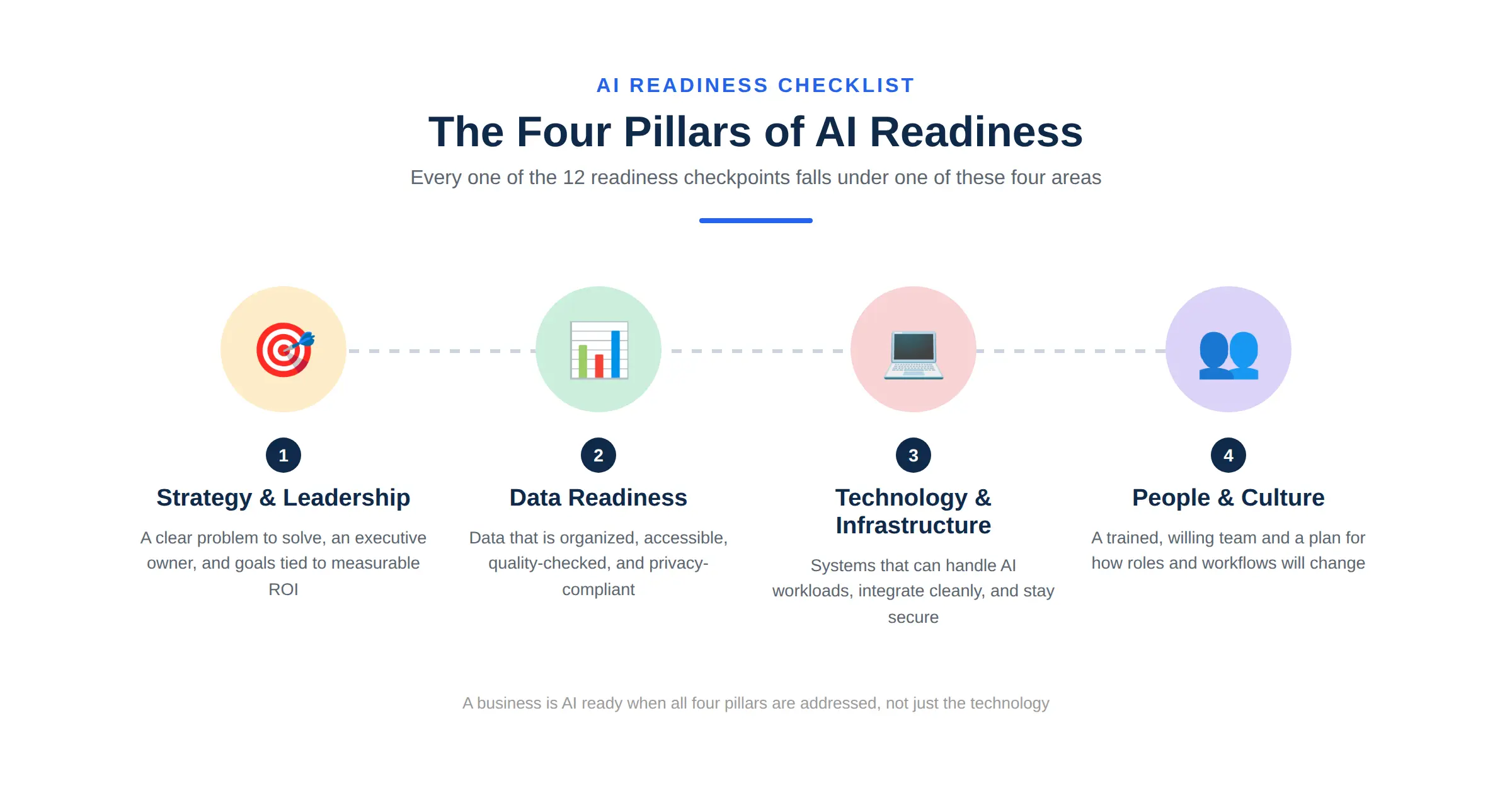
Being AI-ready does not mean having the biggest budget or the most advanced technology. In simple terms, it means your business has the right foundation in its data, its systems, and its people to get real value from AI instead of just experimenting with it. This guide walks through a practical 12-point checklist you can use to evaluate your own business, organized into four areas: strategy, data, technology, and people.
The evidence is consistent across the research firms that track enterprise AI adoption. Getting a company to start using AI has become the easy part. Turning that early adoption into measurable business value is where most organizations still struggle.
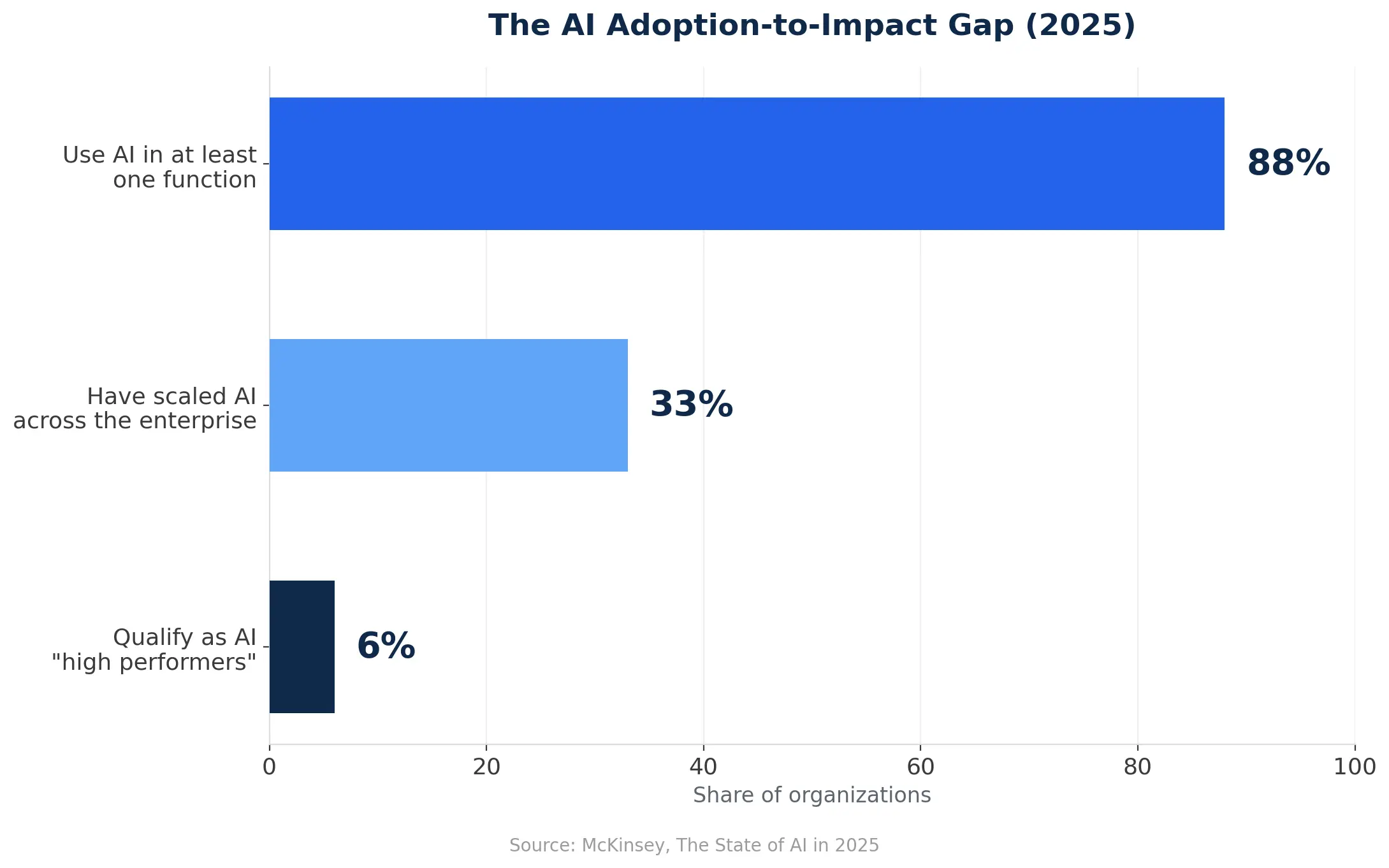
According to McKinsey's 2025 State of AI survey, 88 percent of organizations now use AI in at least one business function. Yet only about a third have managed to scale AI across the enterprise, and just 6 percent qualify as high performers reporting a meaningful impact on earnings. Separately, about 39 percent of respondents report any enterprise-level earnings impact from AI, and most of those put the figure below 5 percent.
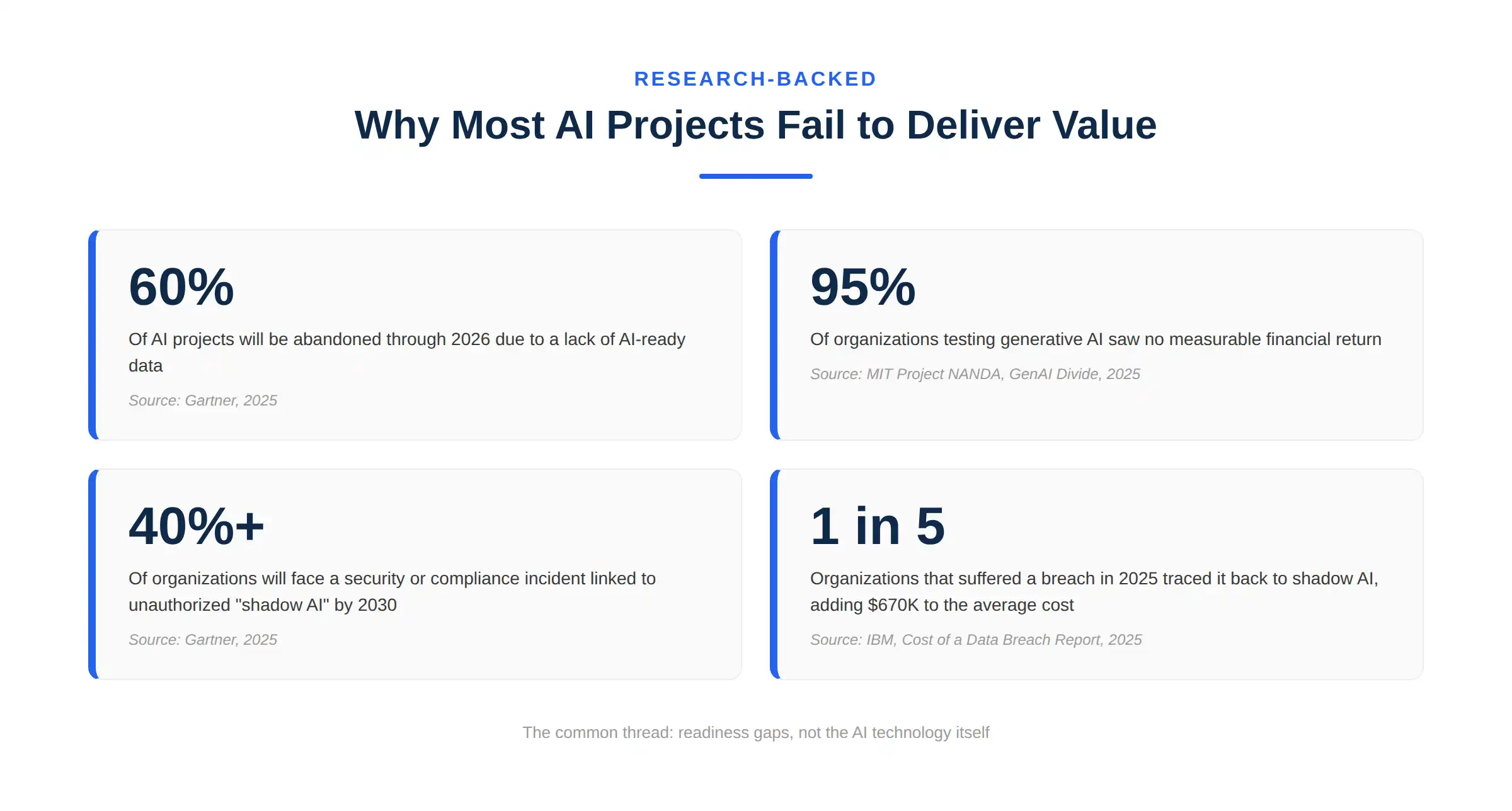
The pattern shows up again in how AI projects get built. Gartner predicts that through 2026, organizations will abandon 60 percent of AI projects that are not supported by AI-ready data, with 63 percent of organizations either lacking or unsure whether they have the right data management practices in place. Separately, MIT's Project NANDA found in its 2025 "GenAI Divide" research that roughly 95 percent of organizations testing generative AI saw no measurable financial return, with only a small minority successfully moving pilots into production.
Note: These figures describe the same underlying problem from different angles. Adoption is no longer the bottleneck. Readiness is. |
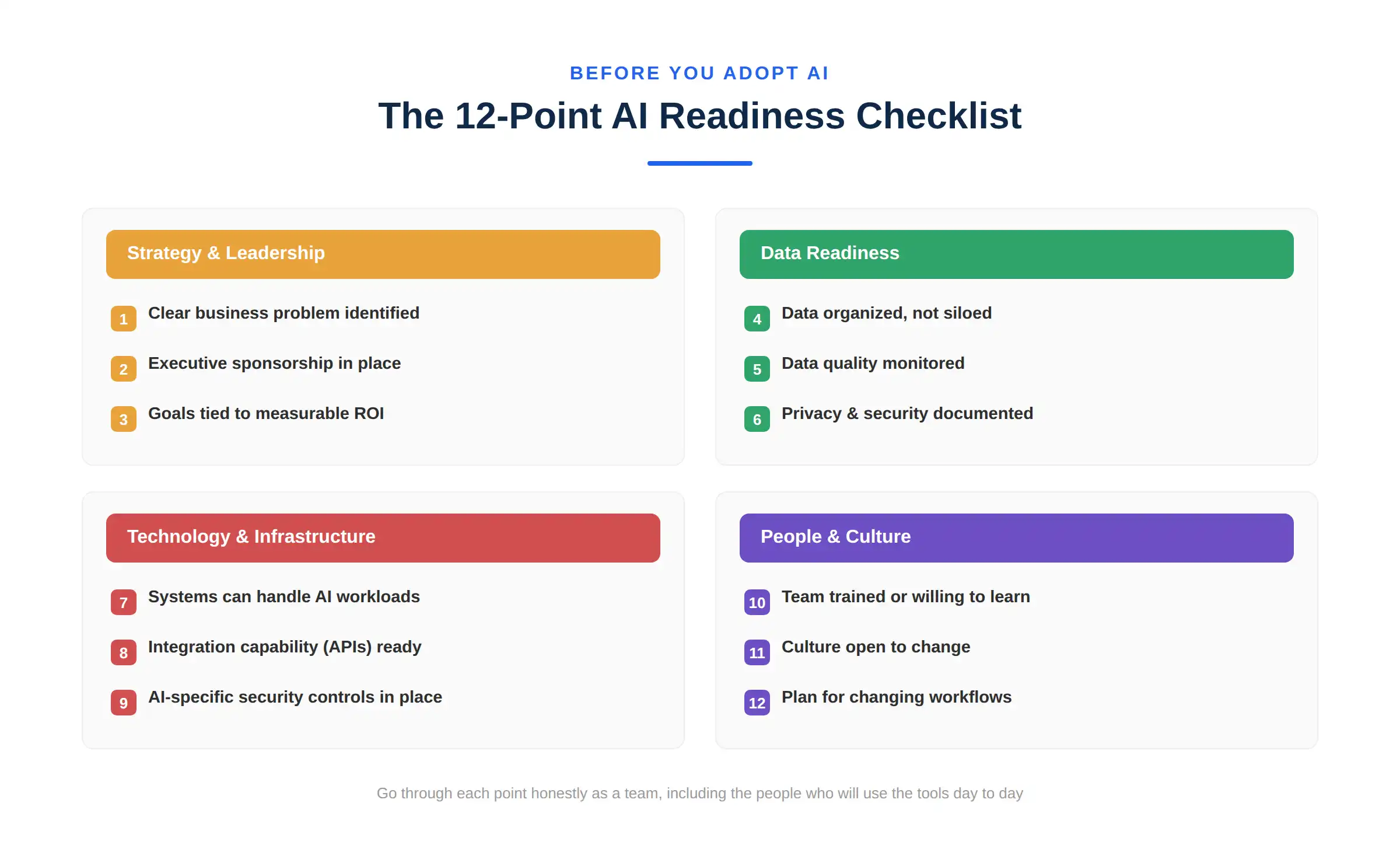
Here is the checklist before walking through each point in detail. Go through it honestly with your team, including the people who will use the tools day-to-day, not just leadership.
Strategy & Leadership | Data Readiness |
1. Clear business problem identified | 4. Data organized, not siloed |
2. Executive sponsorship in place | 5. Data quality monitored |
3. Goals tied to measurable ROI | 6. Privacy and security documented |
Technology & Infrastructure | People & Culture |
7. Systems can handle AI workloads | 10. Team trained or willing to learn |
8. Integration capability (APIs) ready | 11. Culture open to change |
9. AI-specific security controls in place | 12. Plan for changing workflows |
Assess your strategy, data, technology, and people to identify the gaps that could prevent your next AI project from delivering results.
Assess Your AI ReadinessStrategy and leadership gaps are usually the reason AI initiatives never get past the pilot stage. Per McKinsey's research above, only about 39 percent of organizations report any enterprise-level earnings impact from AI, and most stalled efforts share the same root cause: no clear owner and no clear problem to solve.
Don't adopt AI just because it is trendy. Before bringing in any tool, your team should be able to state the specific problem you are trying to fix, such as slow customer response times, repetitive manual work, or inconsistent reporting. Once the problem is clear, it becomes much easier to judge whether AI is the right solution, and which type of AI tool fits the job.
AI projects touch multiple departments at once, from IT to operations to customer service. So they need a senior leader who can align these teams, approve budgets, and make decisions quickly when issues come up. Without a clear owner, AI initiatives often lose momentum after the initial excitement fades and quietly stall somewhere between planning and execution.
Before starting any AI project, decide exactly how you will measure its success. This could be a percentage reduction in support ticket resolution time, a specific cost-saving target, or increased employee productivity. Without clearly defined goals, it becomes difficult to tell whether the project delivered real value or whether it should be expanded, adjusted, or stopped.
Data is where most AI projects quietly fail. Gartner's prediction of 60 percent project abandonment cited above is specifically tied to data readiness, not model quality or budget.
Most AI tools are only as useful as the data they can reach. If your customer data sits in one system, your sales data in another, and your support records somewhere else with no connection between them, AI only ever sees part of the picture. Before adopting AI, identify where your important data lives and make sure you can access or share it across systems. For Salesforce environments specifically, a Data Cloud readiness assessment is built to uncover exactly this, since AI features are only as accurate as the data feeding them.
Data quality problems such as duplicate records, missing fields, or outdated entries do not just cause minor inconveniences with AI; they actively produce misleading or incorrect results. Since AI systems learn patterns directly from the data you give them, feeding them messy data teaches them the wrong patterns. A structured data readiness audit before any AI build starts is one of the more reliable ways to catch this early.
Before any data is used in an AI system, your business should have clear, written answers to a few key questions. What data are you allowed to use under your existing privacy policies? Who is responsible if something goes wrong? How is sensitive information, like customer or employee records, protected during processing?
Even well-designed AI strategies stall when the underlying technology cannot support them, or when it opens the door to new security risks nobody planned for.
Note: Gartner predicts that by 2030, more than 40 percent of organizations will face a security or compliance incident linked to unauthorized, unapproved AI tools, often called shadow AI. This is not a hypothetical risk. IBM's 2025 Cost of a Data Breach report found that one in five organizations that suffered a breach in the past year traced it to shadow AI, and those incidents cost roughly $670,000 more on average than breaches without it. |
AI tools, especially ones that process large volumes of data or run frequent analyses, need enough computing power and storage to function well. This does not always mean you need brand-new infrastructure. Many businesses can meet these needs through cloud-based AI services without heavy upfront investment. What matters is checking, not assuming, whether your current setup can support the workload you plan to add.
AI tools rarely work well in isolation. They usually need to pull data from your existing software and sometimes push results back into it, which requires APIs or similar integration methods. If your current systems are old, disconnected, or were never built to share data with outside tools, this can become one of the biggest hidden blockers in an AI project. Agentic AI systems in particular depend on this kind of integration to act reliably across your existing tools rather than in isolation.
AI introduces security risks that traditional cybersecurity measures may not fully address. AI outputs can expose sensitive data, and attackers may try to manipulate AI systems with malicious inputs. Before adopting AI, make sure you have controls in place to protect sensitive information, monitor AI usage, and reduce these AI-specific risks.
Technology and data problems are usually fixable with time and budget. People problems take longer to fix, and most businesses underestimate them.
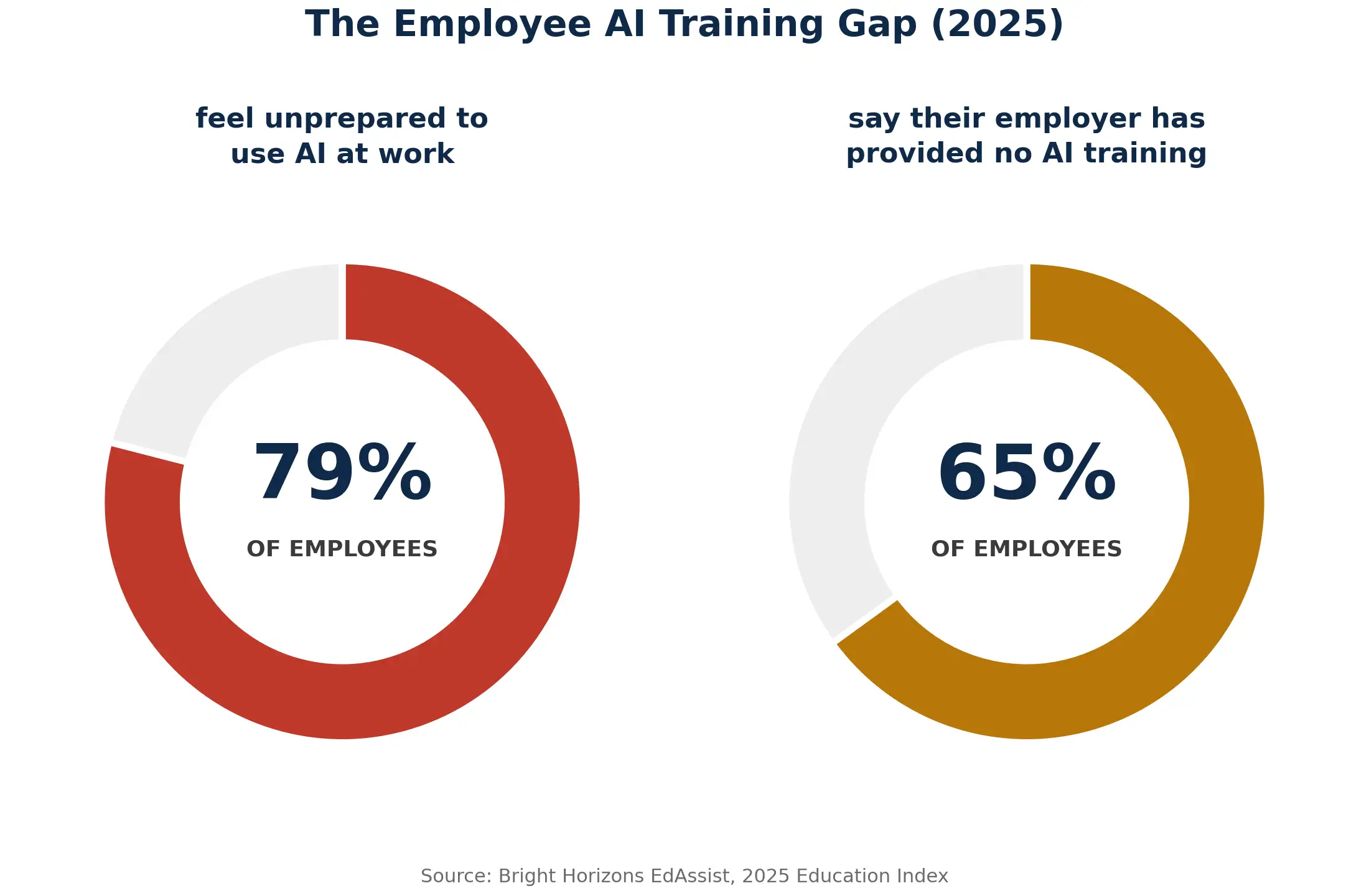
Note: According to the 2025 Bright Horizons EdAssist Education Index, 79 percent of employees say they are not prepared to use AI in their daily work, and 65 percent say their employer has not provided any AI training at all. |
AI tools are only effective if employees know how to use them and trust their outputs. Before implementing AI, make sure your team has access to training and is genuinely willing to learn new ways of working, not just told to figure it out on their own.
AI adoption is rarely smooth. AI projects often require testing, learning, and continuous improvement before they deliver the results you expected. Organizations that encourage employees to experiment, learn from mistakes, and adapt to new ways of working are far more likely to adopt AI successfully.
Implementing AI is rarely just about introducing a new tool. It often changes how employees perform daily tasks, automates repetitive work, and can shift responsibilities across teams. Businesses that plan for these changes in advance and communicate them clearly to employees usually experience a smoother transition and less resistance than those that introduce AI without preparing their workforce.
Turn your checklist results into a practical action plan covering data quality, integration, security, infrastructure, and workforce readiness.
Build Your AI Action PlanYou do not need a "yes" on all 12 points to get started with AI. However, the more gaps you have across these four areas, the higher the risk of running a failed pilot.
A practical way to use this checklist is to go through all 12 questions honestly, together with your team. If you are weak in Strategy and Leadership, address that area first, since nothing else on this list matters much if there is no clear problem to solve or no clear owner driving the effort. If you are weak in Data Readiness, expect any AI tool you adopt to underperform, no matter how capable that tool is on its own. Gaps in Technology and People are usually the most fixable of the four, and they typically just require dedicated time and a clear plan to close.
Pro Tip: Fix readiness gaps in this order: Strategy and Leadership first, Data Readiness second, then Technology and People in parallel. Fixing data or technology before you have a clear business problem and an executive owner usually just means redoing the work later. |
AI readiness is not something you check once and forget. It is worth revisiting this checklist every few months, since your data, your systems, and your team will all continue to evolve.
☐ Clear business problem AI can solve
☐ Executive sponsorship secured
☐ AI strategy tied to measurable goals
☐ Data accessible across systems
☐ Data quality monitored
☐ Privacy and security policies documented
☐ Systems can handle AI workloads
☐ Integration capability exists
☐ AI-specific security controls in place
☐ Employees trained and willing to learn
☐ Culture open to change and experimentation
☐ Plan in place for role and workflow changes
Working through this checklist on your own is a strong first step, but closing the gaps it uncovers, especially around data and integration, usually benefits from a partner who has done it before. Cynoteck is a Minneapolis-based technology consulting firm, certified across Salesforce and Microsoft platforms, that works with businesses on exactly this kind of readiness work: data audits, AI and Agentforce implementation, and custom generative AI advisory and development. If you want a second opinion on where your business stands, that is a conversation worth having before you commit budget to an AI rollout.
AI readiness is not a one-time test you pass or fail. It is a practical, ongoing check across four areas- strategy, data, technology, and people- that determines whether an AI investment turns into real value or another abandoned pilot. The research is consistent: the businesses seeing real returns are not the ones with the biggest budgets; they are the ones that closed these readiness gaps before they scaled.
If you want a structured, honest assessment of where your business stands today, Cynoteck's team can walk you through this checklist and help you build a plan for whatever gaps it uncovers.
Work with AI experts to uncover readiness gaps, strengthen your data foundation, and prepare your business for successful AI adoption.
Book a Free ConsultationAns: Work through the 12-point checklist above across strategy, data, technology, and people. A business doesn't need a perfect score to start, but significant gaps in data readiness or executive sponsorship strongly predict a failed pilot.
Ans: Research points to data readiness as the single biggest factor. Gartner predicts 60 percent of AI projects will be abandoned through 2026 due to a lack of AI-ready data, and MIT's Project NANDA found roughly 95 percent of generative AI pilots produced no measurable financial return.
Ans: No. AI readiness is about having the right foundation, clean data, clear goals, defined ownership, and a willing workforce, rather than the size of your technology budget. Many businesses can meet infrastructure needs through existing cloud services without major upfront investment.
Ans: Shadow AI refers to employees using AI tools the organization never approved or reviewed. Gartner predicts more than 40 percent of organizations will face a security or compliance incident linked to shadow AI by 2030, and IBM found it already contributes to a meaningful share of data breaches today.
Ans: Every few months. Your data, systems, and team all continue to change, and a readiness gap in one quarter can close, or a new one can open, well before your next major AI decision.

What is Artificial Intelligence? Artificial intelligence (AI) is intelligence demonstrated by machines, which makes it possible for machines to learn from experience, adjust to new inputs and perform human-like tasks.
We are more than just developers and consultants—we are your partners in navigating the digital landscape. Let us be the engine behind your next big success while you focus on your core vision.
Explore Opportunities!
 What Al Services Does a Business Actually Need in 2026.webp)