How Custom Mobile Apps Improve Customer Experience in Retail & E-Commerce
More and more retail and e-commerce sales now happen on a phone screen instead of in a store or on a desktop browser. A business without a mobile app is simply missing from where a growing share of its customers already are, and a business with a generic, poorly built one is often not much better off. This is why building a mobile app has become a core decision for retail and e-commerce businesses, not an optional add-on.
This guide explains why mobile apps have become essential for retail and e-commerce businesses, what it means to build one custom to your business, and how that custom build improves customer experience through personalization, checkout, loyalty, and real-time inventory. You will also find real cost ranges and a framework for choosing the right development partner.
Retail and e-commerce businesses need a mobile app because customer behavior has shifted to mobile-first shopping. Customers browse, compare, and buy on their phones far more often than on a desktop, and a business without a strong mobile presence loses that traffic to competitors that do.
In simple terms, your customers are already shopping on their phones, whether or not your business has an app built for it. If they cannot do that comfortably through you, they will do it through a competitor, a marketplace app, or a mobile browser experience that is harder to convert into a sale.
A mobile app changes the relationship with a customer in ways a website alone cannot:
Direct access – An app icon on a customer's home screen keeps your business visible every time they unlock their phone, unlike a website they have to search for or remember.
Faster repeat purchases – Saved details, order history, and one-tap reordering make it easier for existing customers to buy again.
Real-time engagement – Push notifications for restocks, order updates, and offers reach customers instantly, something email and SMS struggle to match.
Better data on customer behavior – Apps capture browsing and purchase patterns more reliably than websites, which helps a business understand what customers actually want.
Competitive necessity – In most retail categories, competitors already offer an app. Not having one puts a business at a disadvantage before a customer even compares products.
A custom mobile app built around your specific business, meaning your product catalog, your customers, your existing systems, and how your operations actually work, instead of a generic template shared across many different businesses.
A custom mobile app:
Built around your catalog – A custom app reflects how your specific products are organized, priced, and displayed, not a generic product-grid template.
Connected to your real systems – It integrates with the inventory, CRM, or payment systems your business already uses, instead of forcing you to adapt to a third-party platform's structure.
Designed around your customers – Features like personalization, loyalty, and checkout are shaped by how your actual customers shop, not a one-size-fits-all shopping flow.
Owned by your business – You control the roadmap, the branding, and future feature decisions, rather than depending on updates from an off-the-shelf app provider.
Custom mobile apps naturally fit your business better than a shared template and improve your customer experience, which helps you to grow your business faster.
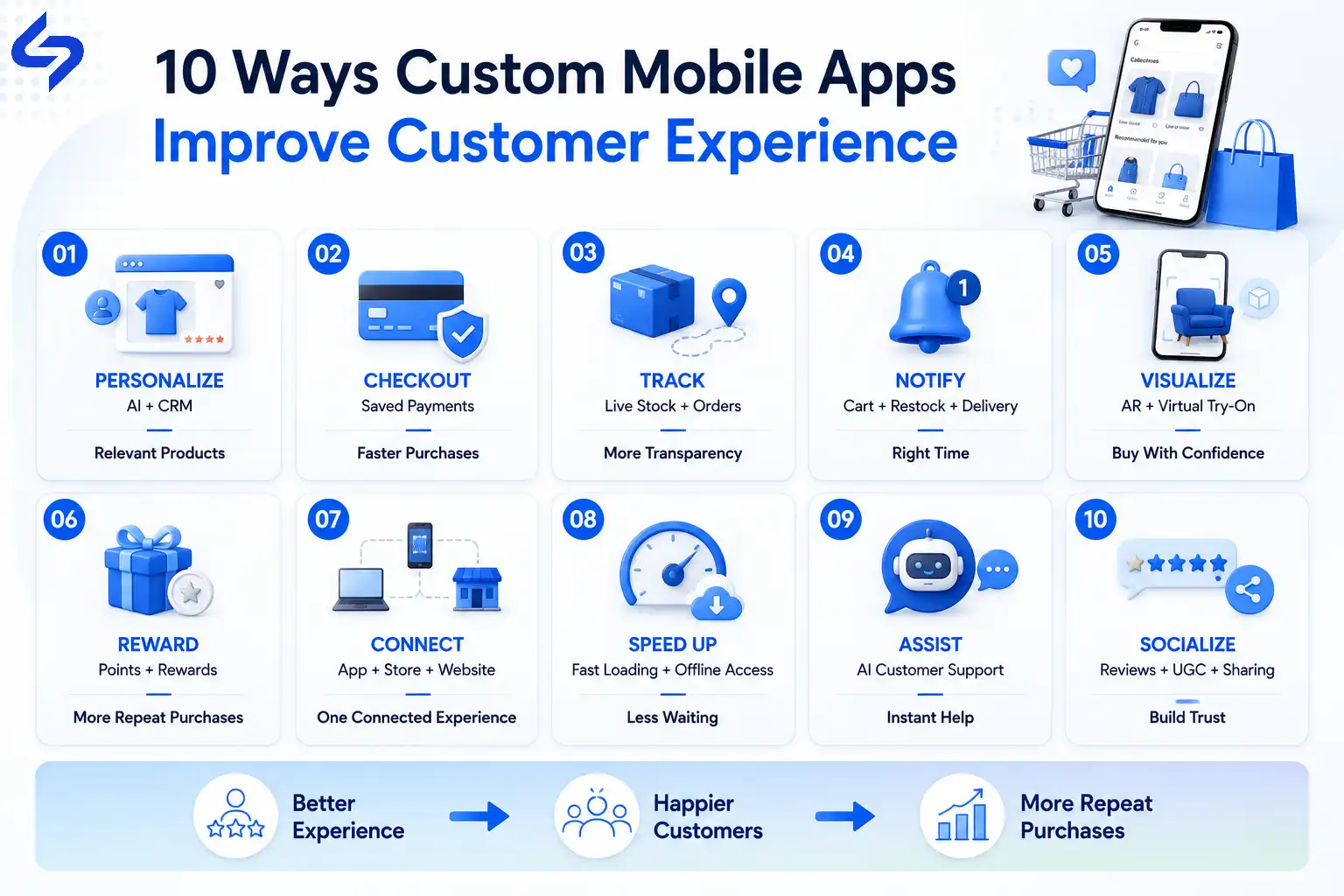
With the help of AI-powered recommendation and CRM features, custom mobile apps use customer data, past purchases history, and browsing behavior to show each shopper a different, more relevant version of your catalog instead of the same generic homepage for everyone.
Custom Apps also help customers in:
Smarter recommendations – Suggested products based on purchase and browsing history, not just "customers also bought."
Personalized search results – Search results that adjust based on size, style, or brand preferences a customer has shown before.
Dynamic homepage content – Different customers see different featured products, based on their own shopping patterns.
Custom apps reduce cart abandonment by making checkout faster and easier, with saved payment details and multiple payment options.
Checkout is the stage where a difficult and confusing process directly leads to lost sales.
Saved payment methods – Returning customers complete a purchase in seconds, not minutes.
Multiple payment options – Digital wallets, buy-now-pay-later, and local payment methods built in based on your actual customer base.
Guest checkout – Removing forced account creation, which is a common reason customers abandon a cart entirely.
Few things frustrate customers more than ordering a product, receiving a confirmation, and then finding out that it is actually out of stock.
With Inventory Management System (IMS) and Order Management System (OMS) integration, custom apps show accurate stock levels and real-time order updates, helping customers know what is available and where their order is. This helps you to keep the product availability and order status up to date.
Live stock visibility – Product pages reflect actual warehouse or store inventory, not a cached number from hours ago.
Real-time order tracking – Customers see exactly where their order is, reducing "where is my order" support tickets.
Buy online, pick up in store – Real-time inventory makes it possible to safely offer in-store pickup without overselling.
Custom apps send targeted, relevant push notifications, such as restock alerts or abandoned cart reminders, instead of generic blasts that customers learn to ignore.
Push notifications only work when they feel relevant. A custom app can trigger notifications based on actual customer behavior rather than sending the same message to every user.
Abandoned cart reminders – Timed messages that bring customers back to complete a purchase they started.
Restock alerts – Notify only the customers who specifically wanted a sold-out item.
Order and delivery updates – Real-time status updates that reduce anxiety and support requests.
Augmented reality features let customers preview furniture in their space or try on products virtually, which reduces uncertainty and returns for visually driven categories.
This feature matters most for categories like fashion, beauty, and home goods, where customers hesitate to buy without seeing how something looks in real life.
Virtual try-on – Customers preview makeup, glasses, or clothing before purchasing.
Room visualization – Furniture and home decor apps let customers see products in their own space.
Reduced return rates – Fewer surprises after delivery means fewer returns and refund requests.
A loyalty program built directly into a custom app feels like a natural part of shopping, rather than a separate card or app customers have to remember to use.
Loyalty programs work best when customers do not have to think about them. A custom app can track and reward activity automatically.
Automatic point tracking – Points accumulate and display in real time as customers shop.
Personalized rewards – Offers based on a specific customer's purchase history rather than a blanket discount.
Tiered membership – Visible progress toward the next reward tier keeps customers engaged over time.
Custom apps keep the online and in-store experience connected, so a customer's cart, loyalty points, and preferences follow them whether they shop on their phone or in person.
Customers do not think in terms of "online" and "in-store." They expect one continuous relationship with your brand, and a custom app makes that possible.
Unified cart – Items added on the app appear when a customer logs in on the website, and vice versa.
Cross-channel loyalty – Points earned in-store show up in the app immediately.
Consistent pricing and promotions – The same offers apply everywhere, avoiding customer frustration over channel-specific pricing.
A well-built custom app keeps working in poor network conditions and loads quickly, which matters directly to how long customers stay before giving up.
Speed and reliability are customer experience features, even though they are invisible when done well.
Offline browsing – Customers can browse previously loaded content without a live connection.
Fast load times – Optimized native or cross-platform performance keeps product pages loading quickly.
Reliable checkout under weak signal – Critical for customers shopping on mobile data in areas with inconsistent coverage.
AI chat features handle common questions instantly, such as order status or return policies, while routing more complex issues to a real support agent.
Customers expect an immediate answer to simple questions. A custom app can resolve these without making a customer wait for a human agent.
Instant order status – Automated answers to the most common support question in retail.
Guided returns and exchanges – Step-by-step in-app flows instead of a phone call or email.
Smart escalation – Complex issues are routed to a live agent only when needed.
Letting customers share products, post reviews, or shop directly from social content inside the app keeps the discovery-to-purchase journey in one place instead of scattering it across platforms.
Social proof and easy sharing directly influence purchase decisions, especially for younger shoppers.
In-app reviews and ratings – Social proof shown at the exact moment a customer is deciding to buy.
Shareable product links – Customers can share items with friends without leaving the app.
User-generated content – Photos and videos from real customers displayed alongside product listings.
Retail and e-commerce businesses that invest in a well-built mobile app typically see measurable gains in repeat purchases and a meaningful drop in cart abandonment.
Retail mobile apps built around inventory accuracy, fast checkout, and real-time order tracking help stores get 35-45% more repeat customers and reduce shopping cart abandonment by 30%.
These are not abstract design improvements. Each of the ten features above maps directly to one of these outcomes: personalization and loyalty drive repeat purchases, while faster checkout and accurate inventory reduce abandonment.
A basic retail catalog app typically costs $30,000 to $60,000, a mid-market e-commerce platform runs $60,000 to $150,000, and an enterprise retail platform with AR, AI, and multi-vendor support can range from $150,000 to $350,000 or more.
App Tier | Estimated Cost | Timeline | Typical Features |
Basic retail catalog app | $30,000 – $60,000 | 3–5 months | Product browsing, cart, basic checkout |
Mid-market e-commerce platform | $60,000 – $150,000 | 5–9 months | Personalization, loyalty, push notifications, payment integrations |
Enterprise retail platform | $150,000 – $350,000+ | 8–14 months | AR try-on, AI recommendations, multi-vendor support, omnichannel sync |
Inventory sync with existing ERP systems and GDPR-compliant data handling for international customers are the two most common cost additions beyond this baseline. For a full breakdown of what drives mobile app costs up or down across every category, our complete mobile app development cost guide covers this in detail, including a dedicated section on e-commerce and retail pricing.
Look for a development partner with direct retail or e-commerce experience, a clear process for connecting the app to your existing inventory and payment systems, and a track record of measurable customer experience improvements, not just app store launches.
Retail-specific experience – A partner who understands inventory sync, payment compliance, and seasonal traffic spikes will avoid costly mistakes a generalist might not anticipate.
Platform strategy guidance – A good partner explains whether native development, cross-platform, or a hybrid approach fits your specific catalog and budget, rather than defaulting to one option.
Integration capability – Your app needs to connect cleanly with your existing CRM, inventory, and payment systems, not operate as an isolated system.
Post-launch support – Retail apps need ongoing updates for new features, security patches, and seasonal campaigns long after the initial launch.
At Cynoteck, our mobile app development team builds custom retail and e-commerce apps using React Native, Flutter, and native iOS and Android development, choosing the right stack based on your catalog size, budget, and integration needs rather than a one-size-fits-all template.
Launching a direct copy of the website – A mobile app should be designed around how people shop on a phone, not a shrunken version of desktop pages.
Ignoring inventory accuracy – A beautiful app still fails if customers repeatedly order out-of-stock items.
Overloading the checkout flow – Every extra step or required field at checkout increases the chance a customer abandons the purchase.
Treating loyalty as an afterthought – Bolting on a loyalty feature after launch is harder and less effective than designing it into the core experience from the start.
Skipping performance testing under real conditions – An app that works well on office WiFi can fail badly on a customer's mobile data during a sale event.
Retail and e-commerce customers now expect to shop, track, and engage with a business primarily on their phones, which is why a mobile app is no longer optional.
A custom app is built around your own products, customers, and business systems instead of using a generic template. This allows the app to provide a better experience with faster checkout, accurate stock information, and more relevant product recommendations.
If you are ready to explore what a mobile app built specifically for your retail or e-commerce business could look like, our team can walk through your catalog, systems, and customers to map out the right approach.
Talk to our mobile app development team about your retail or e-commerce app.
Costs typically range from $30,000 for a basic catalog app to $350,000 or more for an enterprise platform with AR, AI recommendations, and multi-vendor support, depending on features and integration complexity.
Because a large and growing share of shopping now happens on mobile phones. Without an app, that traffic goes to competitors who offer one, and a business misses the repeat-purchase and engagement benefits an app makes possible.
Treating the mobile app as a smaller version of the website, rather than designing checkout, navigation, and product discovery specifically around mobile shopping behavior.
Yes. Custom mobile apps are commonly built to sync with an existing e-commerce backend, inventory system, or CRM rather than replacing it, so the business keeps its current infrastructure while gaining a purpose-built mobile experience.
A basic app typically takes 3 to 5 months, a mid-market platform takes 5 to 9 months, and an enterprise-grade platform with advanced features can take 8 to 14 months or more.

Mobile healthcare apps improve patient care by enabling remote monitoring, timely reminders, secure data access, better communication, and cost-efficient healthcare services through mHealth technology.
B2B apps help businesses streamline operations, enable on-the-go access to data, improve client engagement, support omnichannel sales, and drive scalable revenue by simplifying complex business workflows.
How LLMs, computer vision, predictive analytics, and AI agents are reshaping mobile apps — plus the business problems they solve, industry use cases, and how to choose the right tech for your app.
We are more than just developers and consultants—we are your partners in navigating the digital landscape. Let us be the engine behind your next big success while you focus on your core vision.
Explore Opportunities!