AI Consulting vs. AI Development: What's the Difference and Which Do You Need First?
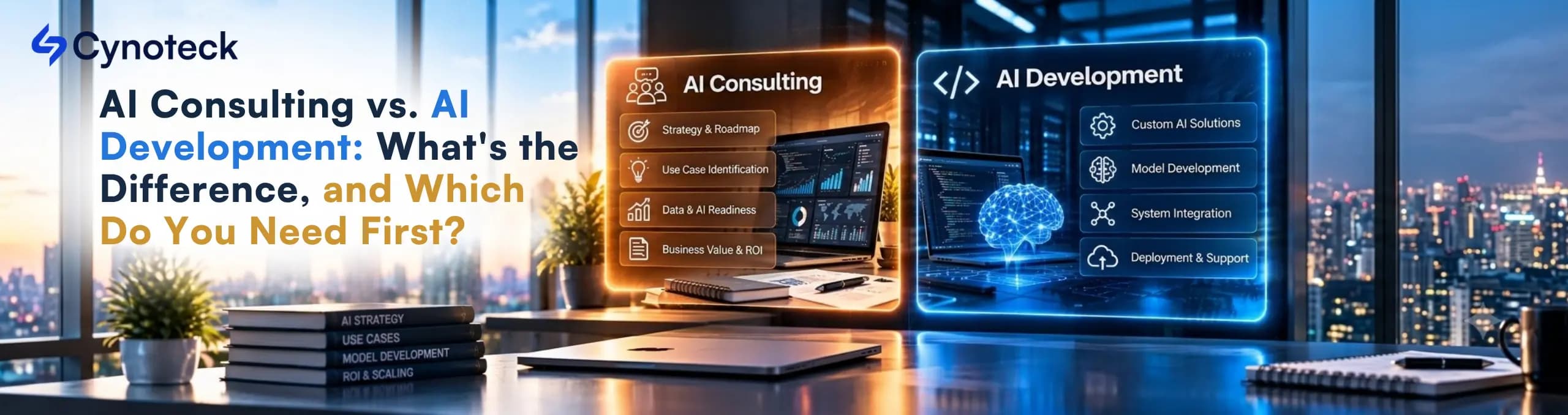
AI consulting vs. AI development comes down to one question: do you already know exactly what to build? AI consulting helps you decide what to build, whether to build it, and what must be ready first. AI development builds, tests, launches, and supports the AI system. Start with consulting if you cannot state the problem, the success metric, and the data source in writing. Otherwise, you can start with development.
If you are looking for AI help, you will keep meeting two terms: AI consulting and AI development. They sound alike, and many teams use them as if they mean the same thing. They do not. One helps you decide. The other helps you deliver.
This guide explains both services in plain language. You will see what each one includes, what you receive, how they differ, and which one fits your business first. You will also see how Cynoteck delivers AI consulting and development services as one connected process.
AI consulting is a planning service. It helps you decide which AI use case to pursue, whether to build it, and what must be ready first.
Think of it as the work you do before you spend money on a build. An AI consultant studies your goals, processes, and data. Then the AI consultant tells you where AI can help, where it cannot, and what to do first. AI consulting suits businesses that are new to AI, that have several possible use cases, or that need leadership approval and a budget.
AI consulting answers questions such as these:
Which of our problems should AI solve first?
Is our data good enough to support it?
Should we build a custom system, use a ready-made tool, or wait?
What will it cost, and what should we get back?
Which rules and risks apply to us?
A good engagement works in a set order. It starts with the problem, then the success measure, then the data, and then the approach. Each answer shapes the next one. By the end, you should hold these deliverables.
Deliverable | Question it answers | What good looks like |
Prioritized use-case list | Which problems are worth solving first? | One-sentence statements with an activity, an expected result, and a reason it matters |
Success metric and baseline | How will we know it worked? | A business metric with today's number, not model accuracy alone |
Data readiness assessment | Do we have usable data? | An inventory of sources, access, quality, and gaps, with owners |
Feasibility finding | Can AI do this task at the quality we need? | A judgment from technical staff, ideally backed by a small test |
Build-or-buy recommendation | Should we build custom, configure a ready-made tool, or wait? | Options compared on capability, data, skills, and cost |
Risk and governance review | Which rules and risks apply? | A risk classification, named owners, and controls mapped to a framework |
Roadmap and pilot plan | What happens next, in what order, with what budget range? | Phases, decision points, owners, and an effort range |
Each item is something you can read, check, and act on.
AI development is the building service. It turns an approved plan into a working AI system and keeps that system running.
It covers more than the AI model itself. In practice, data work, integration, and testing often take most of the effort. That is why a build needs data engineers and software engineers as well as AI engineers.
Phase | What happens | What you receive |
Data preparation | Clean, structure, label, and secure your data | A reliable data set the model can learn from |
Build | Develop the model, language-model application, or agent | A working AI component tested on your real data |
Testing | Validate with real users and real scenarios | Confirmation that it works in your environment |
Integration and deployment | Connect to your CRM, ERP, and other systems; launch with monitoring | An AI system running inside your daily tools |
Monitoring and improvement | Track quality; retrain or adjust as your data changes | A system that stays accurate over time |
AI development covers many types of solutions. Examples include generative AI services, AI chatbot development services, machine learning development, and agentic AI development services.
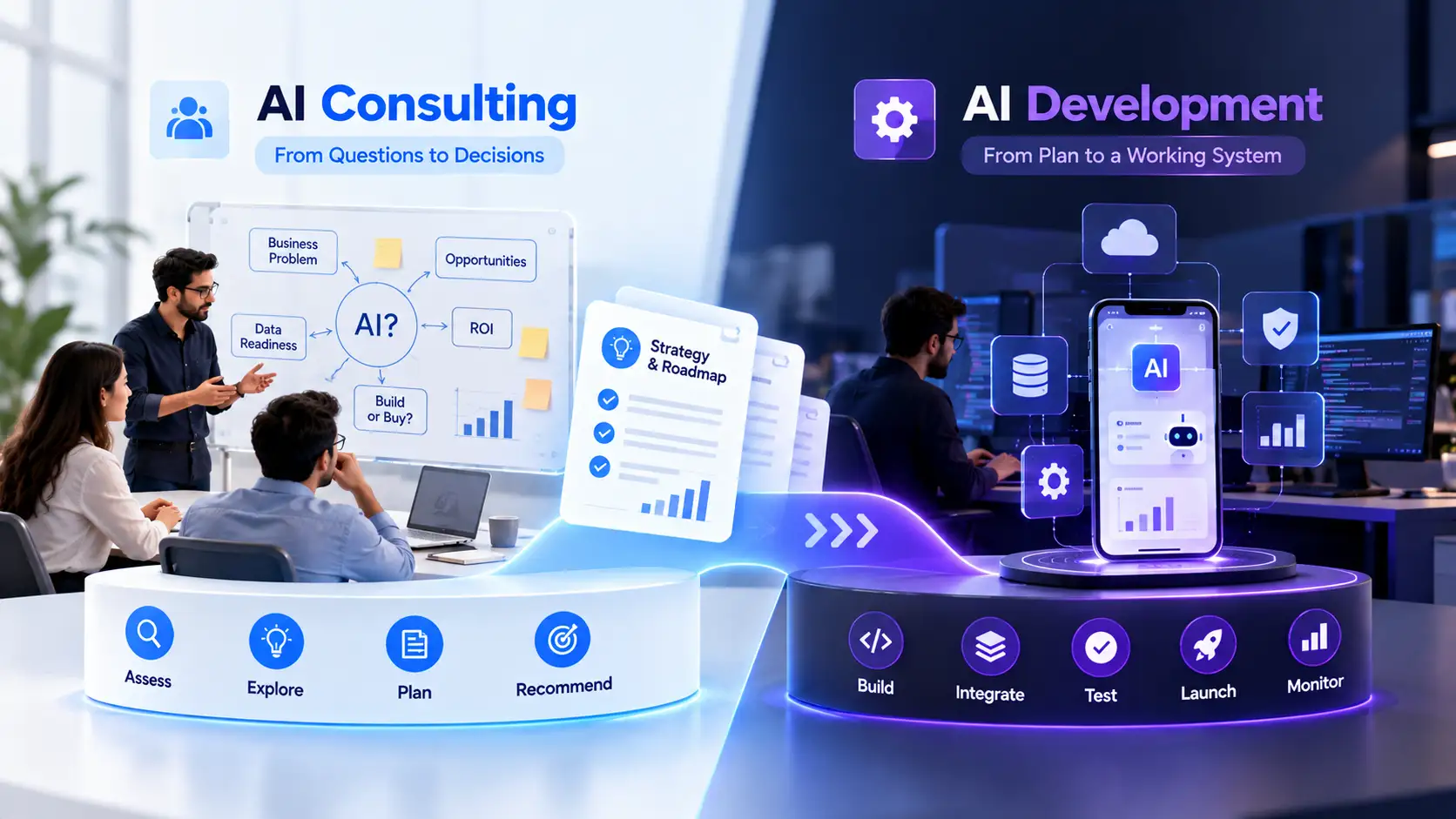
AI consulting produces decisions and plans. AI development produces a working system. So consulting answers "what and why," while development answers "how."
People often call both "AI services," which is why they mix them up. Still, they answer different questions, need different people, and end at different points.
Dimension | AI consulting | AI development |
Core question | What should we build, and should we build it at all? | How do we build it, launch it, and keep it working? |
Typical starting point | A business problem or a vague AI goal | An approved use case, metric, and data source |
Main outputs | Ranked use cases, business case, data review, build-or-buy advice, roadmap | Working model or agent, integrations, tests, launch, monitoring |
Who does the work | AI consultants, analysts, and technical advisors | Data engineers, AI engineers, software engineers, and testers |
Success is | A decision you can act on, backed by evidence | A system that meets agreed criteria in production |
Ends when | You can approve, change, or stop the project | The system is live and someone owns its upkeep |
Risk if skipped | You build the wrong thing | You never launch, or it breaks in production |
Typical shape | Fixed scope, shorter | Phased, longer, continues after launch |
Here is a simple way to remember it. If your next step is a decision, you need consulting. If your next step is a launch, you need development.
Hire an AI consultant first if you cannot state the problem, the success metric, and the data source in writing. Hire an AI development company first if you can, and if the use case is narrow, low-risk, and well understood.
Use this scorecard before you choose a starting point. Answer yes or no to each question. It is a simple heuristic we suggest, not an industry standard.
# | Question | Why it matters |
1 | Can you describe the problem in two sentences without naming a technology? | A clear problem is the first item in our AI readiness checklist |
2 | Can you name one success metric and today's baseline? | Without a baseline, you cannot prove value |
3 | Is your data ready: do you know where it lives, and can you access it? | Data readiness is the second area in our checklist |
4 | Has a technical expert judged that AI can do this task? | Not every problem suits AI |
5 | Have you compared building with buying or configuring a ready-made tool? | Custom work is not always the best answer |
6 | Do you know who will use the output and how it fits their workflow? | Models that miss the workflow go unused |
7 | Have you checked which rules apply, such as privacy, industry rules, or the EU AI Act? | Rules shape the design |
8 | Is someone named to own the system after launch? | AI systems need monitoring and upkeep |
If you answer no to any of questions 1 through 4, start with consulting. If you answer no only to questions 5 through 8, development can start, but make those items part of the first phase. If you answer yes to all eight, an AI development company can start right away.
Real situations rarely match a checklist exactly. So here are common ones. They are illustrative examples, not client case studies.
Situation | Start with | Why |
"We know AI could help, but we don't know where" | Consulting | You need ranked use cases and a business case |
"We want an AI assistant on our support page" | Development, with a short scoping phase | The use case is narrow and well understood |
"Leadership wants an AI roadmap and a budget" | Consulting | The output is a decision and a funding case |
"Our pilot worked, and now we need production and integrations" | Development | The problem is validated, and the work is engineering |
"We work in health, finance, or hiring" | Consulting first, then development | Risk classification shapes the architecture |
"We have a validated use case but no ML team" | Development, with a plan for ownership | You need a build team and a post-launch owner |
For a shorter rule of thumb, see our guide to the types of AI services a business needs. To see how ready your business is across strategy, data, technology, and people, work through our 12-point checklist.
You can skip a separate consulting engagement when the use case is narrow, the risk is low, and you can answer the scorecard in writing. Even then, plan a short scoping phase inside the build.
Skipping is reasonable in these cases:
The task is common and well understood, such as answering routine support questions.
A ready-made tool might already do the job, and you can test it cheaply.
A technical lead on your team can judge feasibility and own the system.
The data is accessible, and a wrong answer carries low risk.
A pilot has already proven the value, and you need production engineering.
Skipping a separate engagement does not skip the thinking. For example, our case study on a Salesforce AI support agent began with a scoping-style step. The team mapped which queries consumed the most agent time, such as order status and account details, and built around those first. It also extended the client's existing Salesforce setup instead of rebuilding it. The case study reports a move from concept to live deployment in six weeks, and it describes this scoping as part of the project. For the ready-made versus custom question on one platform, see Agentforce versus custom AI agents.
Starting with the right service saves you money, time, and effort, because each one goes only into work that moves your project forward. A wrong start can go two ways. You can build before you know what to build, or you can plan for months when you were ready to build.
Money is the first thing a right start protects. A build is usually the highest cost in an AI project. It pays for data preparation, model or agent development, testing, and integration. If the idea turns out to be weak, you learn that after most of the money is gone. A short consulting phase usually costs far less than a build, and it can reshape or stop a weak idea before the build begins.
The same logic works in reverse. Suppose you already have a validated use case, a clear metric, and accessible data. A separate consulting phase then adds cost without adding new answers. Going straight to development saves that spend. Rework is the third cost. Building on an unclear problem or messy data often means redoing the work once the real requirements appear. The right start keeps you from paying twice.
The right start also saves time. Wrong starts create false starts. A build without a clear metric, data access, or owner stalls while people argue about those basics. Likewise, a long planning phase for a use case you already understand delays a launch you could have made. The right start puts you on the step that moves you forward. A clear scope also speeds delivery. In our Salesforce AI support agent case study, the team mapped the busiest query types first and then built around them. The project went from concept to live deployment in six weeks. A consulting roadmap also helps with approvals, because use cases, timelines, and success metrics give leadership what it needs to say yes faster.
Not sure which service you need? Our AI readiness checklist can help you choose between consulting and development.
Finally, the right start saves effort. AI projects draw on your own team. People explain the process, find the data, review outputs, and test the system. A wrong start wastes that effort. Your team may prepare data for a use case that gets dropped. They may also sit through workshops for a decision they already made. The right start asks for the right effort at the right time. Consulting needs your decision-makers and process owners. Development needs your data owners and testers. Because each phase asks for different people, a clear start lets you plan their time.
Here is the difference in one view.
Wrong start | Right start | |
Money | You pay for a build on a weak idea, or for planning you did not need | Spend goes to the step that adds new answers |
Time | False starts, stalled builds, or a delayed launch | You move straight to the step that unblocks you |
Effort | Your team prepares data and joins workshops for work that goes nowhere | Each person's effort goes into the phase where it counts |
Rework | You redo work once the real requirements appear | You build once, on a clear problem and clean data |
Risk | A pilot that stalls or delivers no usable result | A project with a clear problem, metric, and owner |
In short, the right first service does not make AI cheaper by itself. It makes sure you spend money, time, and effort only where they count.
Cynoteck helps you choose by starting with your situation, not with a fixed package. In a free consultation, our team reviews what you are trying to solve, suggests a practical approach, and tells you whether to start with consulting or with development. You do not have to commit to anything.
Our AI development process is a seven-step roadmap. It prioritizes business value, reliable execution, and scalability. It also aims to reduce risk, speed up adoption, and fit your existing systems. Our AI consulting services cover steps 1 and 2: discovery and AI strategy. Our AI development services cover steps 3 to 7, including integration and support. So you can enter the roadmap at the step that matches what you already know.
Cynoteck reports 500+ projects delivered and clients in 15+ countries. Our AI work has covered healthcare, veterinary technology, e-commerce, B2B media, and customer support. The table shows seven AI projects, with the results each case study reports.
Project | What we built | Result reported in the case study |
A conversational agent that guides patients through product setup and treatment over SMS and WhatsApp, with handoff to live agents | Call volume for product-usage issues fell by about 70%, and time to feel confident with the product fell by 45% | |
A voice agent inside a veterinary platform that fills in prescriptions as the vet speaks, tested in real clinics | 98% accuracy and 60% less post-consultation admin time | |
A generative AI system connected to Salesforce, with custom prompts for four types of legal documents | Manual review effort fell by 80%, with 96% accuracy in the first month and a 0.5% error rate | |
An AI agent for account, shipping, and order queries, built after stakeholder workshops and a roadmap | Routine queries automated, with smart escalation of complex cases to human agents | |
An AI agent that extends the client's existing Salesforce setup | Calls to human agents dropped by 80% | |
A machine learning pipeline that checks image quality, recognizes the brand, and predicts a price from historical resale data | Only flagged items go to a human for review | |
Machine learning email categorization, with an admin screen that non-technical staff can update | Manual effort dropped by 90% |
Look closely at how these projects began. Three of the case studies describe a discovery or workshop step before the build. For the voice agent, we mapped the full consultation flow first. For the Agentforce agent, we ran stakeholder workshops and built a roadmap. For the Salesforce agent, we identified which queries used the most agent time. That is consulting work inside a development project, and it is why you do not always need a separate engagement.
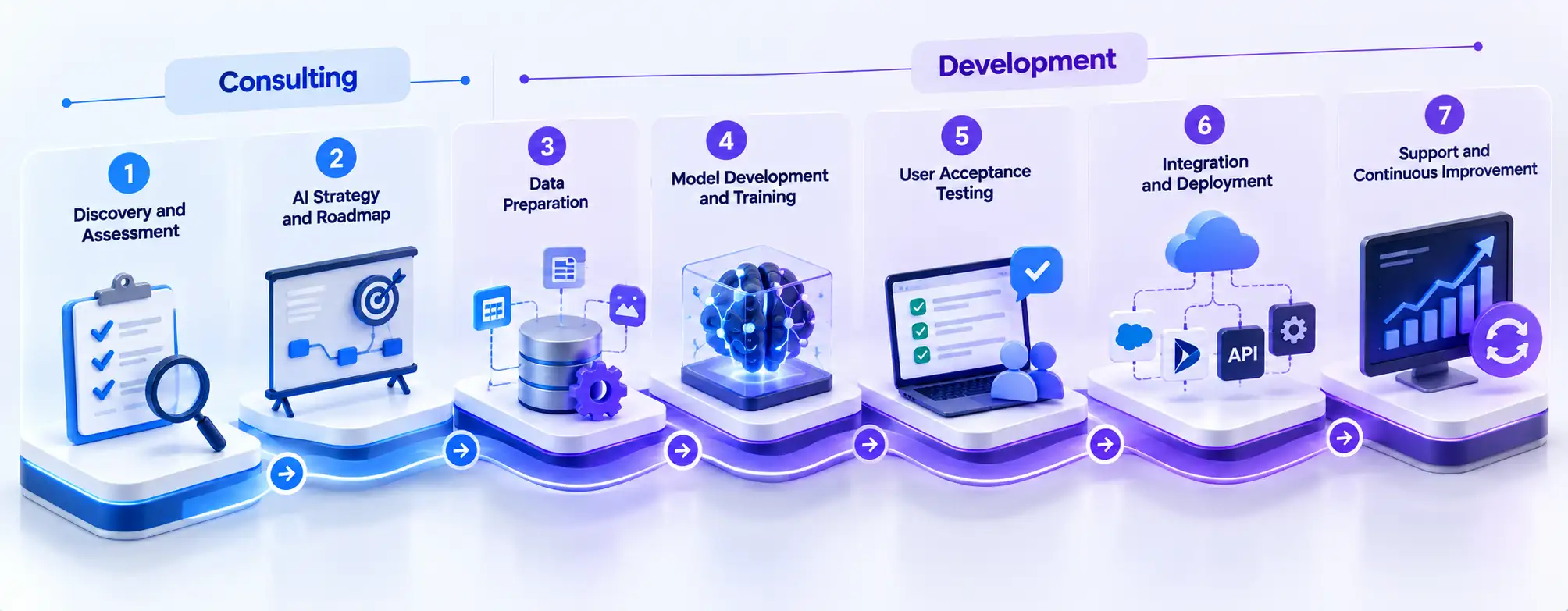
Our AI development process has seven steps, from discovery to continuous improvement. Each step builds on the one before it.
Step 1: Discovery and assessment (consulting). Before any build starts, we review your business goals, data quality, challenges, existing systems, and workflows. This shows where AI can deliver the results you expect.
Step 2: AI strategy and roadmap (consulting). We define use cases and select the right AI approach. You receive a structured roadmap with timelines, resources, and success metrics, so you have full clarity before development begins.
Step 3: Data preparation (development). We clean, organize, and structure your data, including feature engineering and labeling. High-quality data leads to better model performance and reliable results.
Step 4: Model development and training (development). We build and train models on your real business data, not on ideal test scenarios. So the model performs under actual operating conditions before deployment.
Step 5: User acceptance testing (development). Before full deployment, we validate the solution with real users and real business scenarios. This confirms it works in your environment and reduces risk.
Step 6: Integration and deployment (development). We connect the solution to your CRM, ERP, APIs, and internal tools. We then deploy with monitoring and logging on platforms such as Salesforce and Microsoft Dynamics 365.
Step 7: Support and continuous improvement (development). AI systems change as your data changes. So we monitor, retrain, and optimize models to keep them accurate as your business grows.
We follow a security-first approach, and we list ISO 27001 security compliance and ISO 9001 quality management. We also build around your current stack, whether that is Salesforce, Dynamics 365, or a custom platform. To find your starting step, speak with our AI strategy and development team.
Bring a short description of the problem, the outcome you want, and the data and systems involved. If you do not have these yet, that is a sign you may need consulting first, and that is fine. Use the list below to prepare for your first discovery call.
What to bring | Why it helps | If you do not have it yet |
The problem in two sentences | It shows quickly whether AI is a fit | Start with consulting, and we will frame it with you |
The outcome you want and today's baseline | It defines what success means | Consulting can help you set the measure |
The data you have and where it lives | It shows whether a build can start | A data review is part of consulting |
The systems it must work with, such as CRM or ERP | It shows the integration work | Share what you use today, and we will map it |
The rules that apply to you | It shapes security and design | A risk review is part of consulting |
Who will own the system after launch | AI systems need upkeep | We can define this in the roadmap |
Your timeline and a budget range | It helps scope the phases | A rough range is enough to start |
Consulting is usually shorter and bounded, because it produces decisions and plans. Development usually costs more and runs longer, because it produces and maintains a working system.
No standard price exists for either, so the drivers are easier to compare than the totals.
Cost driver | In consulting | In development |
Scope | Number of use cases and stakeholders | Number of features, users, and channels |
Data | Depth of the data review | Volume, quality, and labeling work |
Technical depth | Whether an engineer tests feasibility | Model or agent complexity and testing depth |
Risk and compliance | Scope of the governance review | Security controls and audit needs |
After delivery | Usually ends at handoff | Monitoring, retraining, and support |
Timelines follow the same logic. Consulting ends when you decide. Development ends when the system is live, and then it continues as upkeep. For the build side, see our guide on AI development cost.
The AI consulting vs. AI development choice depends on what you already know. If you can state the problem, the metric, and the data, you are ready to build. If you cannot, a short consulting phase is the cheaper way to find out.
So to talk to an AI strategy advisor, book a free consultation with our AI consulting services team. We'll tell you plainly whether to start with consulting or with development, and what a practical first step looks like for your business.
Not always. You need an AI consultant if you cannot state the problem, the success metric, and the data source in writing. If you can, and the use case is narrow and low-risk, you can often go straight to an AI development company with a short scoping phase.
A good AI consulting engagement delivers a prioritized use-case list, a success metric, a data readiness assessment, a feasibility finding, a build-or-buy recommendation, a risk review, and a roadmap.
It includes data preparation, building the model or agent, testing with real users, integration with your systems, deployment, and ongoing monitoring and retraining.
Yes. Cynoteck offers AI consulting, development, integration, and automation. You can start with consulting, or you can start with development if you already have a clear plan.
It is a plan that lists which use cases to pursue, in what order, with what resources, timelines, and success metrics. A useful roadmap also says what you should not build yet.
It can be, in a short and focused form. A small business has less room for a failed build, so a brief scoping phase can reduce that risk. Narrow use cases, however, may not need a separate engagement.
A proof of concept is a small test that shows whether an idea works on real data. Engineers usually build it, even when consultants design it. Cynoteck's work runs from the initial proof of concept to fully deployed AI systems.
It depends on scope, and no standard duration exists. A focused engagement ends when you can make a decision. Ask for a fixed list of deliverables with dates.
Not always. A narrow chatbot on a well-understood task can often start with development. A project that touches sensitive data, regulated decisions, or several systems benefits from a consulting phase first.
AI systems change as your data changes. So the system needs monitoring, retraining, and tuning to stay accurate. Plan for an owner and a budget for this work before launch.
What is Artificial Intelligence? Artificial intelligence (AI) is intelligence demonstrated by machines, which makes it possible for machines to learn from experience, adjust to new inputs and perform human-like tasks.
We are more than just developers and consultants—we are your partners in navigating the digital landscape. Let us be the engine behind your next big success while you focus on your core vision.
Explore Opportunities!
 What Al Services Does a Business Actually Need in 2026.webp)