![[object Object]](/_next/image?url=%2FServices%2FSalesforce%2FBrands%2Flava.png&w=256&q=75)
![[object Object]](/_next/image?url=%2FServices%2FSalesforce%2FBrands%2Fmicrosoft.png&w=256&q=75)
![[object Object]](/_next/image?url=%2FServices%2FSalesforce%2FBrands%2FAlta.png&w=256&q=75)
![[object Object]](/_next/image?url=%2FServices%2FSalesforce%2FBrands%2FJLL.png&w=256&q=75)
![[object Object]](/_next/image?url=%2FServices%2FSalesforce%2FBrands%2Fblood.png&w=256&q=75)
We offer machine learning development services and build custom machine learning solutions that work in production. From data pipeline setup and model training to system integration and ongoing monitoring, our team covers the full ML development lifecycle for businesses across multiple industries.
Book a Free ConsultationPartnering with Cynoteck transformed how we support our patients. The AI health assistant they built for Beck Health reduced our call center load while delivering faster, more personalized responses. We’ve seen clear improvements in patient engagement and efficiency.
- Clinton Beck
Beck Health
We have delivered 25+ machine learning projects across multiple industries in the US, UAE, and India. Each one was scoped around a business problem with a defined success metric, not a vague mandate to "add AI." Below are the numbers we report to clients, not the ones we pick for a headline.
Every project has a defined business metric agreed upon before development begins. We track it in production, not in a test environment.
Every ML solution we design is built with role-based access, audit logging, and end-to-end encryption capabilities from the project's beginning.
Our team reviews SLA-backed tracking, accuracy, and retraining cycles in every engagement, providing continuous support even after solution deployment.
ML Projects Delivered
Industries Served
Countries Served
Client Retention Rate
As a machine learning development company, we ensure each engagement starts with a scoping call, during which we assess your data, workflows, and compliance environment. Only then do we recommend which services apply. The eight areas below cover the most common needs across the industries we serve.
Before starting the ML development process, we look into: Is machine learning the right tool for your business requirements? Our team reviews your existing data for quality, volume, and label coverage. Moreover, we map your workflows to identify where a trained model can replace manual steps and where a simple rule-based approach works better. Your team will receive a written report that includes estimated data requirements, a recommended approach, a governance framework, and a development roadmap with timelines.

Choosing the wrong technology for a machine learning project costs more than money. It costs time, accuracy, and often the entire project. We do not build every solution on the same stack. Our machine learning development team selects tools based on your data environment, infrastructure requirements, performance targets, and compliance obligations. Below are the core technology areas and specific tools we use across our machine learning development services in production.

A large language model, or LLM, is the reasoning core behind language-based AI systems. Think of it as the part that reads, understands, and responds like a trained analyst would. We work with GPT, Claude, Gemini, and LLaMA, choosing the right one based on your cost, data sensitivity, and accuracy needs.

NLP teaches software to understand what people mean, not just what they type. A basic system sees the word "cancel." An NLP model knows "I want to cancel" and "how do I stop my plan" mean the same thing. We use LangChain, LlamaIndex, and LangGraph to build pipelines for classification, entity extraction, and support automation.

This is the foundation of every predictive and forecasting system we build. We train models using TensorFlow, PyTorch, Scikit-Learn, XGBoost, and LightGBM, chosen based on your data and accuracy needs. We track every experiment with MLflow and monitor performance drift with Weights and Biases so accuracy problems surface early.

An orchestration framework is what lets multiple AI components work as one system. Without it, each model works in isolation. We build coordination layers using AutoGen, LangChain, and CrewAI. One component gathers data, another evaluates it, a third produces the output, and a fourth checks it against your business rules.

We support cloud-native, hybrid, and on-premises setups based on your data residency and compliance needs. For MLOps management, we use AWS SageMaker, Azure ML, and Google Vertex AI with CI/CD pipelines and live dashboards. A healthcare provider and a retail business have very different infrastructure needs, and we design accordingly.

Most enterprise data is not just text. It includes images, scanned documents, voice input, and structured spreadsheet data. We build computer vision models for defect detection, document parsing, and visual search using OpenCV, YOLO, and PyTorch-based architectures, selected based on your latency and accuracy requirements.
Most projects stall because the data is not in good enough shape before development starts. We run a free data readiness audit before recommending any build. You get a clear picture of what your data supports, what gaps need to be closed, and what is achievable in a first phase.

A pre-planned approach is necessary if you want a smooth deployment of machine learning solutions. We cover everything step-by-step in our machine learning development roadmap. We can keep projects on track and mitigate risks by following a phase-wise approach to ML model development.
The tools and frameworks used are selected for stability and performance. This ensures that every solution remains reliable, scalable, and easy to maintain as your business grows.
 Python
 R
R SQL
SQL JavaScript
 TypeScript
We perfectly understand that each business environment, data structure, and risk tolerance is different. Therefore, our team first analyzes your specific requirements by industry, such as healthcare, education, retail, and services. Below is the core industry we focus on for machine learning solutions development services.

The retail industry requires solutions around inventory, personalization, and pricing. Our team develops forecasting models according to the business's requirements. We build models that fetch POS data, seasonal patterns, and external signals to reduce overstock and stockouts. Moreover, our recommendation-based solutions use session behavior and purchase history to increase average order value. In addition, we provide dynamic pricing models that adjust prices based on demand, inventory levels, and competitor signals.

For the healthcare industry, we build HIPAA-compliant ML solutions for clinical documentation support, patient risk categorization, prior authorization automation, and appointment demand forecasting. Each solution we design includes end-to-end encryption, role-based access controls, and full audit logging on every model decision. Healthcare teams reduce administrative work and get a system they can audit.

The media and entertainment business requires personalization at scale to show the right content to the right user at the right moment without manual curation. To meet their business requirements, we build recommendation solutions that understand individual viewing and listening behavior. Moreover, the preferences are updated in real time, helping improve retention and the overall user experience.

Our machine learning development team focuses on two categories: valuation and lead management for the real estate industry. We build valuation models that combine listing, historical, and macroeconomic data to produce reliable estimates at scale. Also, we build scoring models that prioritize incoming inquiries by conversion likelihood and automatically route high-intent buyers to the right sales representative with full context.

As a machine learning development company, we build demand forecasting models for service scheduling, resource allocation, and workforce planning. Also, we cover the development of customer classification models to identify high-value customers, analyze risks, and service escalation candidates from interaction data. If human handling is required in any case, the ML solution routes it with the full conversation history attached.

The utilities industry produces large volumes of sensor, billing, and usage data, but most of it is still not yet used for predictive decision-making. We build ML models for energy-usage forecasting, equipment-failure prediction, billing-anomaly identification, and outage detection. With these solutions, businesses can reduce maintenance costs, improve grid reliability, and lower call-center volume by automatically resolving common queries.
Machine learning only creates value when it delivers clear, measurable results. These examples show how our ML deployments improve accuracy, speed, and decision-making across real business workflows. Each outcome reflects practical impact, scalability, and consistent performance in production environments.

A luxury eCommerce reseller struggled with high volumes of product images. Manual review slowed operations, caused pricing inconsistencies, and delayed product listings, impacting efficiency and revenue growth.
We built a machine learning solution for image classification and pricing optimization. It evaluates image quality, identifies product attributes, and predicts data-driven prices, integrating seamlessly into existing workflows.
Manual effort reduced by 70–80%, pricing became more consistent, and product onboarding accelerated by 60%. The solution improved efficiency, reduced delays, and enabled faster, reliable product listings.
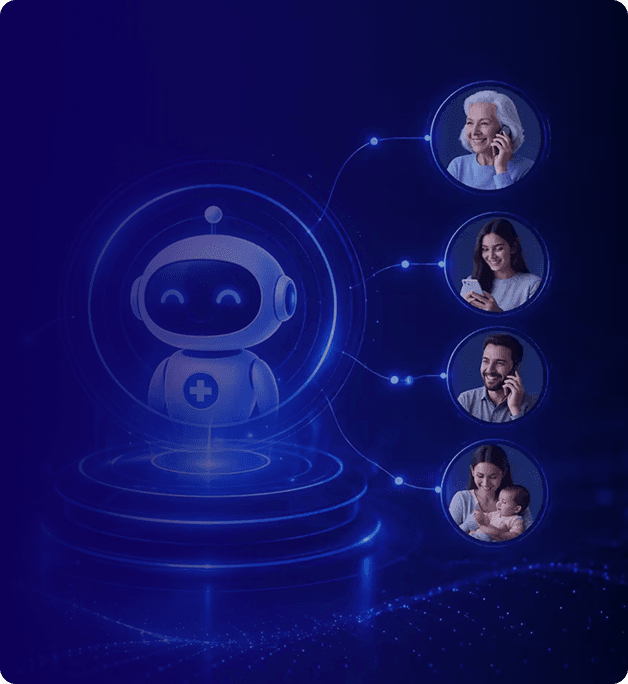
Patients struggled to use medical devices without guidance, leading to increased support calls. Static documentation failed to help, and rising call volumes impacted service quality and operational efficiency.
We developed a machine learning-driven conversational assistant that delivers personalized guidance, adapts to patient needs, and provides real-time support across multiple communication channels.
Support queries reduced by 70%, while product adoption improved by 45%. The solution enhanced patient experience, reduced call center load, and improved overall service efficiency.
Our commitment to excellence and innovation has earned recognition from industry leaders. We maintain certifications demonstrating our expertise and dedication to quality standards.We hold ISO 27001 security compliance, and multiple mobile development excellence awards from renowned technology organizations
App Development 2022

ISO 27001 Security Compliance

ISO 9001 Quality Management

Discover Megazine Top App Developers

Leadership Excellence Award
Top AI Development Award

Clutch Top App Developers

GoodFirm Top MobileApp Developers
Techreviewer Top Software Development Company
Selected Firm Top Software Development Company

GoodFirm Top Software Development Company

Techreviewer Top Web Design Company
Most ML projects fail due to poor data preparation, unclear business goals, or a model that never integrates with the systems that need it. Our machine learning development process is built to prevent exactly those failures.
We assess data readiness and write a feasibility report before any code is written or budget is committed.
Each project has a defined set of business metrics before sprint one. We report against it in production.
Our models are tested on real data, integrated into live systems, and monitored after deployment.
Every engagement includes SLA-backed monitoring, scheduled retraining, and monthly performance reports.
We bring specific knowledge in retail, healthcare, real estate, media, services, and utilities.
Microsoft Solutions Partner and Salesforce Partner status means clean integrations with the platforms you already use.
In our machine learning development services, we ensure that security is built into every machine learning solution from the start. Our team implements end-to-end encryption, secure API credential management, role-based access controls, and audit logging. Moreover, we provide documented security standards and compliance aligned with requirements for regulated industries. This documentation ensures transparency, secure production rollout, and readiness with your IT and compliance teams before deployment.

DRDP

GDPR

HIPAA

Play Store

iOS
NIST
OWASP

PIPEDA
W3C

ISO 9001:2015

ISO 27001

Working with Cynoteck has been one of the most rewarding partnerships we’ve experienced. From day one, every function: project management, ui/ux, programming, AI, DevOps, and qa, delivered consistently above and beyond what we expected. This wasn’t a vendor relationship; it genuinely felt like an extension of our own team, fully invested in the outcome.
UNS Noor
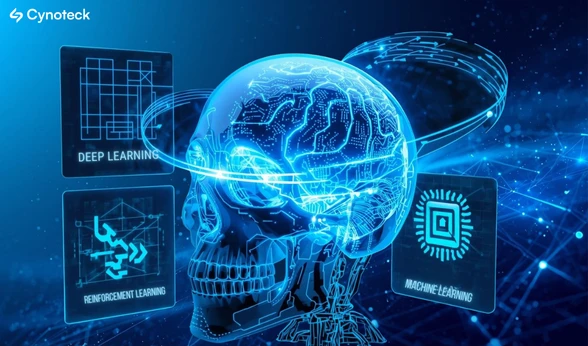
What is Artificial Intelligence? Artificial intelligence (AI) is intelligence demonstrated by machines, which makes it possible for machines to learn from experience, adjust to new inputs and perform human-like tasks.
Regular software follows rules that a developer writes explicitly. If the rule covers the situation, the software handles it. If it does not, it fails or does nothing. Machine learning is different because the software learns its own rules from data. A spam filter built with rules needs a developer to add each new spam pattern. A spam filter built with machine learning identifies new patterns on its own because it has learned what spam looks like from thousands of examples. For businesses, this means machine learning handles tasks where the patterns are too complex or too variable to capture in written rules.
Let's evaluate your data landscape, identify your highest-impact ML use cases, and design a machine learning solution that delivers consistent, measurable results in production, integrated with Salesforce, Dynamics 365, or your existing enterprise systems.
Book a Free Machine Learning Consultation




 What Al Services Does a Business Actually Need in 2026.webp)