What Is Agentic AI and How Does It Actually Work?
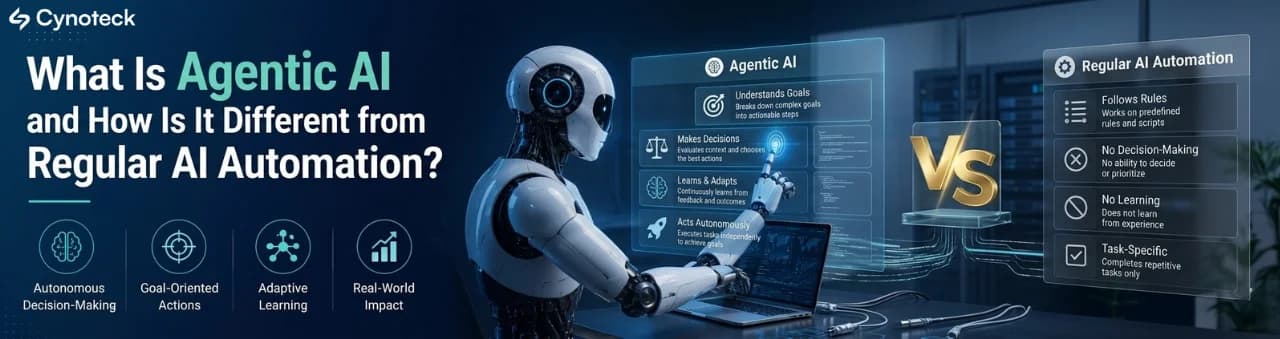
Summary: Agentic AI is an AI system that can plan and complete multi-step tasks on its own, without human direction at every step. It is different from chatbots (which only respond) and RPA (which only follows fixed scripts). This guide explains how it works, what an agentic CRM is, where it is being used, and how it differs from the automation tools you may already use. |
Your customer service team handles hundreds of tickets a day. Most follow the same pattern: check the order, check the account, apply the right policy, send a reply. Your team is good at it. But they are spending hours on tasks that do not need a human decision at every step.
That is the exact problem agentic AI was built to solve. Right now, in 2026, it has moved from early-adopter technology into something businesses across every industry are putting into production. This guide explains what agentic AI is, how it works, and how it differs from the automation tools you may already use.
Agentic AI is an autonomous AI system that receives a goal, plans the steps to reach it, acts across your business tools and data, and adjusts when something does not go as expected, all without a human directing every move.
The word "agentic" comes from agency, meaning the ability to act independently. Most AI tools you already use wait for you to ask something and give you one answer. Agentic AI takes initiative. It works through a problem step by step, uses the tools it has access to, and keeps going until the task is done.
Think of it this way: a standard AI assistant is like a capable search engine. You ask, it answers. Agentic AI is more like handing a goal to a trained team member and trusting them to figure out the steps, make the right calls, and come back with the work complete.
Note: This is different from asking "what does agentic mean in AI" as a dictionary question. In practice, "agentic" simply describes any AI system that can act on your behalf, not just respond to you.
Cynoteck builds and deploys AI agents on Salesforce Agentforce. In 30 minutes, we can show you exactly where it fits, and what your first use case could look like.
Book a Free 30-Minute ConsultationAgentic AI works by running a continuous loop. It perceives a trigger, plans the steps needed, takes action across your systems, and checks its own results before deciding what to do next. This loop is what allows it to complete a multi-step task without a human directing each step. |
Every agentic AI system runs on this same four-step loop. Understanding it is the clearest way to see what makes it different from every automation tool that came before it.
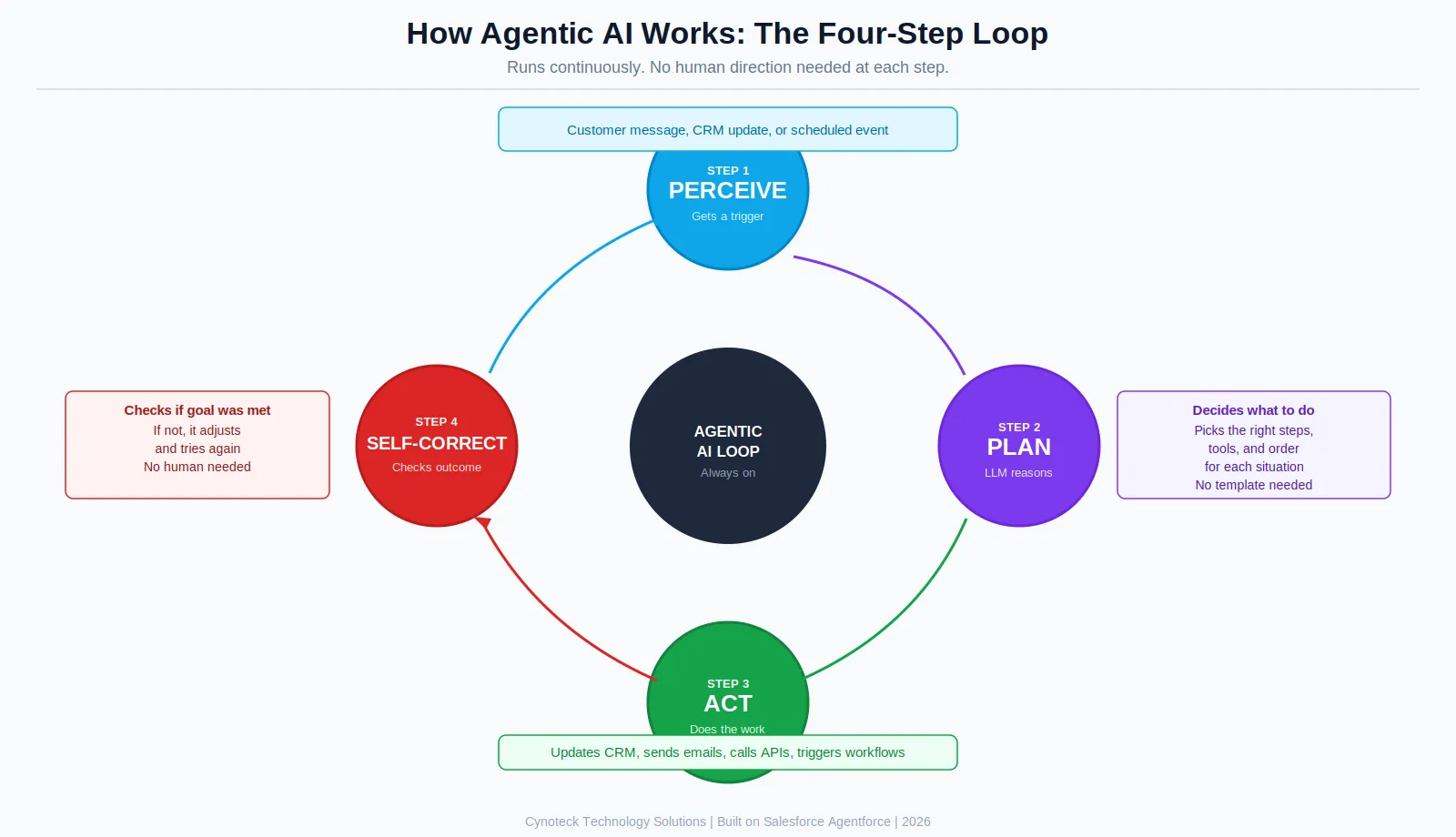
The agent receives its starting point. This could be a customer message, a new CRM record, a scheduled trigger, or a data change in your systems. Unlike a chatbot that only reacts when you type something, an agentic AI can monitor for triggers and start working before a human notices the situation.
The agent uses a large language model (LLM), the same type of technology behind ChatGPT and similar tools, as its reasoning engine. It works out what needs to happen, in what order, and which data sources or tools to use. It reasons through the specific situation in front of it, not a template written months ago.
The agent does the work. It might look up a CRM record, send an email, update a field, call an API, or trigger a workflow. It can interact with multiple systems inside a single task without stopping to ask for permission at each step.
After acting, the agent checks whether the outcome matched the goal. If something does not go as expected, it adjusts and tries again. This feedback loop is what allows agentic AI to handle real-world complexity that scripted automation cannot touch.
Pro Tip: This planning-and-self-correction loop is what separates agentic AI from chatbots and RPA. A scripted bot breaks the moment something unexpected happens.It adjusts its plan and keeps going instead.
Quick Answer: An AI agent is a single tool built for one specific task. Agentic AI is the broader system that coordinates several agents together to complete a full workflow. |
An AI agent is a single, specialized unit built to handle one specific type of task. One agent might qualify inbound leads. Another might handle order status queries. Each works within a narrow scope.
Agentic AI is the broader system that coordinates multiple agents to complete a complex workflow. It decides which agent to call, with what data, in what order, and combines everything into a result that serves the original goal.
To give you a concrete example: one agent reads a customer complaint. A second checks the order history. A third decides whether a refund applies. Agentic AI is the system that connects all three and delivers the final response. Most enterprise platforms today, including Salesforce Agentforce and Microsoft Copilot Studio, use this full orchestration approach.
As of Q4 FY2026, Salesforce had closed more than 29,000 Agentforce deals, up 50% quarter-over-quarter. It had also processed nearly 20 trillion tokens. That work converted into more than 2.4 billion agentic work units, meaning moments where the AI delivered real, completed work rather than just a response. That scale makes it clear this is no longer a proof-of-concept technology.
An agentic CRM is a customer relationship management system with AI agents built directly into it, so the system can plan and complete tasks on its own instead of only storing data for a human to act on.
Your CRM already holds your customer records, deal history, and support tickets. In a standard CRM, a person still has to read that data and decide what to do with it. In an agentic CRM, an agent reads the same data and takes the next step itself: logging a call, updating a deal stage, or drafting a follow-up email.
This is why platforms like Salesforce Agentforce matter so much right now. They turn the CRM from a system of record into a system that can also act. The data does not move anywhere new. What changes is who, or what, acts on it first.
Note: An agentic CRM does not remove your team from the process. It removes the repetitive middle step, so your team spends their time on the calls and decisions that genuinely need a person.
Here is the honest comparison across the three most common approaches, without any marketing spin.
Traditional Automation | RPA | Agentic AI | |
How it works | Fixed rules and scripts set in advance | Mimics human clicks inside software interfaces | Reasons through tasks and acts autonomously |
Data it handles | Structured, predictable inputs only | Structured, repetitive inputs in stable interfaces | Structured and unstructured: emails, documents, conversations |
When something changes | Fails or produces wrong output | Breaks, requires a developer fix | Adapts its plan and self-corrects |
Human input needed? | At setup and every exception | At setup and every exception | Minimal: escalates only when genuine judgment is needed |
Best suited for | Predictable, never-changing tasks | Screen-based, rule-bound legacy processes | Complex, exception-heavy, multi-step workflows requiring judgment |
Can it learn from outcomes? | No | No | Yes: it refines its approach based on results |
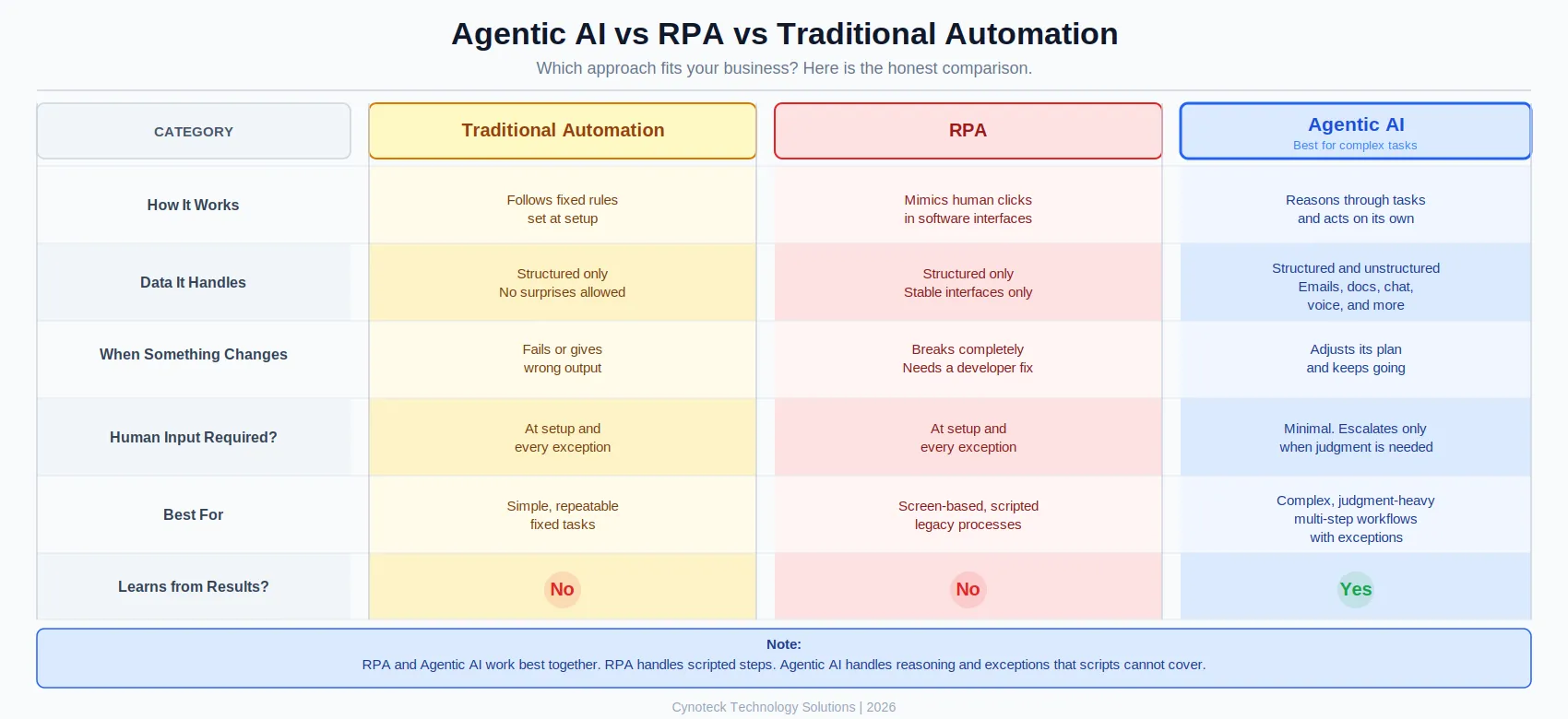
The practical rule is straightforward. If your process is a completely fixed sequence with no exceptions, traditional automation or RPA will serve you well and cost you less. If your process involves judgment calls, unstructured data, or context-dependent decisions, agentic AI is the right fit.
Note: Agentic AI does not replace RPA. The most effective enterprise deployments in 2026 combine both. RPA handles the scripted parts. It handles the reasoning and exception management that scripts cannot cover.
There is a better way to handle the exceptions your scripts cannot cover. Talk to our Agentforce team and we will show you how to bridge the gap, without starting from scratch.
Talk to Our Agentforce TeamAgentic AI is not a future concept. It is running in production across industries in 2026. Here is an example of what it looks like day to day.
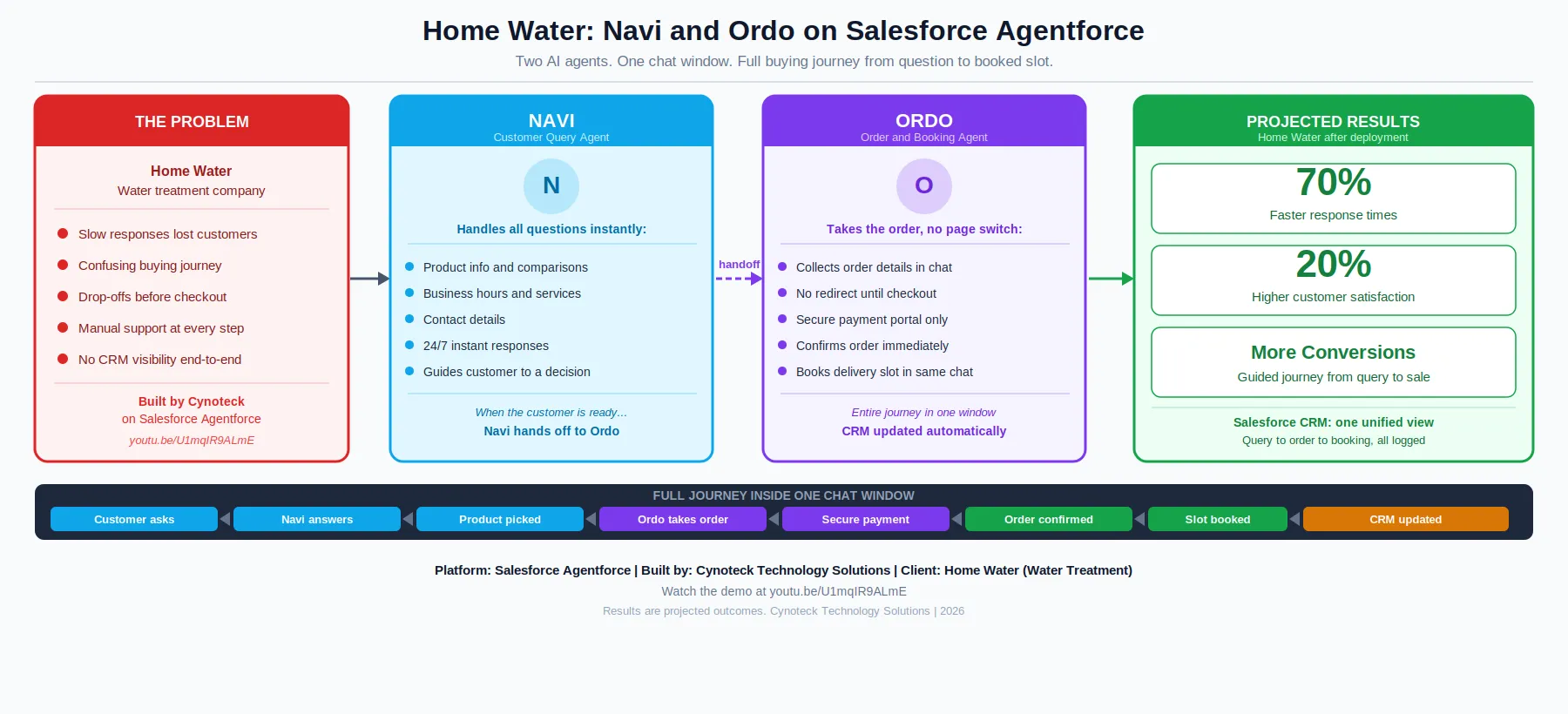
Home Water, a water treatment company, faced a challenge that many product businesses recognize. Customers were dropping off because they could not get quick answers about products, and the buying journey required too many steps across too many touchpoints. Delayed responses meant lost sales. A confusing purchase process meant customers gave up before they converted.
We built two purpose-built AI agents on Salesforce Agentforce to solve both problems at once.
Navi handles all incoming customer queries. A customer asks about a specific water treatment product; Navi responds instantly with detailed product information, comparisons, and recommendations tailored to their needs. Questions about business hours, service coverage, and contact details are all answered without a human agent involved. Navi does not just answer; it guides the customer through the product range until they are ready to make a decision.
Ordo takes over the moment the customer is ready to buy. Ordo collects all order details directly in the chat interface, without requiring the customer to navigate to a separate page or restart the journey. The only redirection occurs at checkout, where the customer is sent to a secure payment portal to complete the transaction. After payment, the customer can book their preferred installation or delivery time slot directly in the same chat window, without switching systems or waiting for a callback.
The entire journey, from the first question to the confirmed booking, happens in a single conversation.
The results the client can expect from this deployment are measurable. Response times are projected to drop by up to 70%. Customer satisfaction is expected to rise by up to 20%. Product conversions are set to increase as customers move through a guided, frictionless buying journey rather than an unguided one that previously required human intervention at multiple steps.
Because Navi and Ordo are built natively on Salesforce Agentforce, every interaction is logged and connected to the client's CRM. This means the sales team has a complete view of every customer, from the first query through to the order and the post-purchase booking, all in one place, with no manual data entry and no information lost between systems.
In this YouTube video, you can see Navi and Ordo in action in this walkthrough video. It shows exactly how the two agents hand off between each other inside a single chat interface, from product query to completed order and slot booking.
Agentic AI applications span nearly every department that handles repeatable, multi-step work, including customer service, sales, order fulfillment, finance, IT support, and content operations.
Here are the most common applications businesses are running in production right now.
Customer service: Agents resolve tickets end-to-end, from reading the message to updating the CRM to sending the reply, escalating only when a human judgment call is needed.
Sales operations: Agents qualify leads, update deal records, and schedule follow-ups without a rep manually touching the CRM.
Order and fulfillment: Agents take an order from the first question to a confirmed booking, as shown in the Navi and Ordo example above.
Finance and collections: Agents chase overdue invoices, flag anomalies, and route exceptions to a human for approval.
IT and internal support: Agents triage internal tickets, reset access, and escalate only the cases that need a person.
Content operations: Agents draft first-pass content, route it for approval, and publish once approved, rather than only generating a draft and stopping there.
Note: The common thread across every one of these applications is repetition plus judgment. If a task happens often and requires a small decision each time, it is a strong candidate for agentic AI.
Three things changed at roughly the same time, and together they moved agentic AI from an interesting concept to production reality.
The reasoning layer became reliable: Large language models matured in 2024 and 2025 to the point where their planning and judgment are consistent enough for supervised enterprise use. Earlier models were not trustworthy enough for real business decisions.
Enterprise platforms embedded it: Salesforce Agentforce, Microsoft Copilot Studio, and Google Vertex AI Agents brought agentic capabilities to tools businesses already use. You no longer need a custom AI engineering team to get started.
Early results are measurable: Businesses that deployed in 2024 and 2025 published real outcomes: faster case resolution, lower cost per interaction, higher lead conversion without added headcount. The conversation has shifted from "should we explore this?" to "how fast can we start?"
The numbers confirm the pace. According to Mordor Intelligence's 2026 market report, the agentic AI market was valued at $6.96 billion in 2025. It is estimated to reach $9.89 billion in 2026, growing at a rate of 42.14% per year through 2031. Gartner's August 2025 press release projects that 40% of enterprise applications will include embedded task-specific AI agents by the end of 2026, up from less than 5% in 2025. According to McKinsey's State of AI 2025 report, 62% of organizations are already experimenting with AI agents. Another 23% are actively scaling agents in at least one business function.
On the Salesforce side, the Q4 FY2026 earnings report confirms Agentforce revenue reached $800 million, up 169% from a year earlier, with 29,000 deals closed. More than 60% of Agentforce and Data 360 bookings in Q4 came from existing customers buying more, not new customers signing up. This shows that companies already using the technology are choosing to expand it rather than pull back.
There is a lot of noise around this topic. Getting the following wrong leads to either the wrong investment or missing something that could genuinely help your business.
It is not a smarter chatbot: A chatbot waits for input and returns a response. Agentic AI acts across your systems: it looks things up, updates records, sends messages, and triggers workflows. The difference is not how it communicates. It is what it actually does.
It does not run without limits: Responsible deployments run with defined guardrails, escalation paths, and human checkpoints for high-stakes decisions. Autonomy within defined boundaries is the practical model, not unchecked operation.
It will not replace your whole team: It takes on high-volume, repeatable, decision-heavy tasks that drain your team's time. Most deployments allow teams to handle more volume with the same headcount, rather than reducing team size.
It is not plug-and-play: A successful deployment requires clean data, clear process definitions, proper system integration, and ongoing monitoring. The technology is more accessible than it was two years ago, but implementation still requires proper planning.
It is not suited to fixed-rule, structured-input tasks: If a process never changes and never has exceptions, traditional automation or RPA will do the job for less cost. Agentic AI earns its place for tasks that require judgment calls or unstructured data, not for simple, repeatable data entry.
Note: On accuracy: agentic AI grounded in your own business data through Retrieval-Augmented Generation (RAG) draws answers from your CRM records and documented processes, not from a generic internet knowledge base. RAG is the method of connecting an AI system to your own data so it can answer questions accurately about your specific company, products, and records. Enterprise platforms include a trust layer that filters agent outputs before they reach your customers.
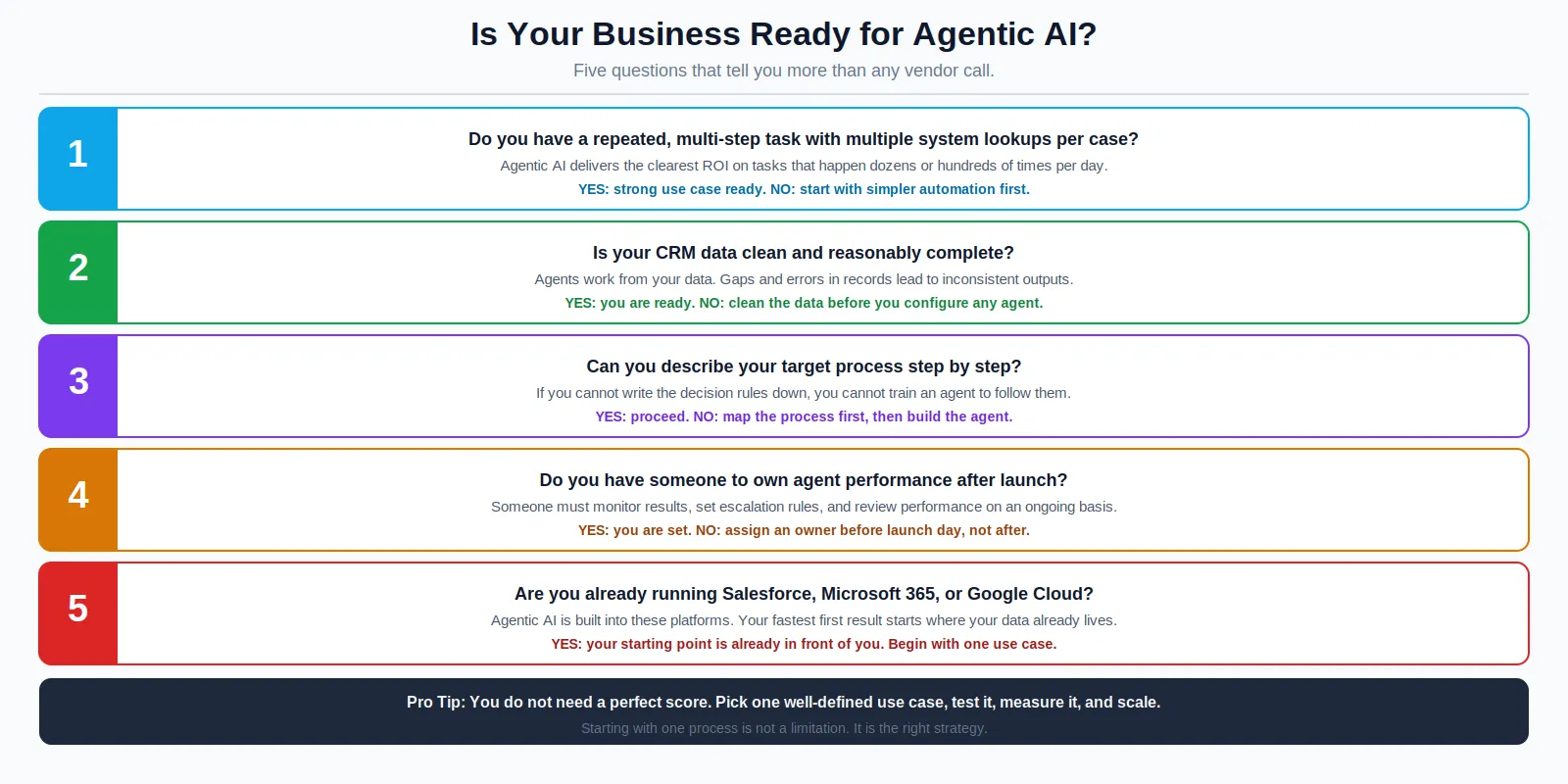
Before talking to any vendor, run through these five questions. They will tell you more than any sales call.
This is your starting point. Agentic AI delivers clear ROI on tasks that happen dozens or hundreds of times per day. A single use case that repeats constantly is more valuable than ten occasional ones.
Agents work with the data they have access to. Incomplete or inconsistent records produce inconsistent results. Data quality is a prerequisite, not a nice-to-have.
If you cannot write down the decision rules that govern a process, you cannot configure an agent to follow them. Process clarity must come before agent configuration.
Someone needs to monitor results, define escalation rules, and review performance regularly. Agents need ongoing oversight, not just a launch day.
If you are running Salesforce, Microsoft 365, or Google Cloud, you likely already have access. The fastest path to your first result almost always starts with the platform your business already runs on.
Pro Tip: You do not need a perfect score to get started. Pick one well-defined use case, run it in a controlled environment, measure what happens, and scale from there. Starting with one process is not a limitation. It is the right strategy.
If you answered YES to two or more of those questions, you are ready to start. Cynoteck is a Salesforce Select Partner. We identify your highest-impact use case and get you to your first result fast.
Get Your Free Agentic AI ConsultationAgentic AI is not a better chatbot, nor is it a replacement for your team. It is a different way of using AI, one where the system handles the multi-step, judgment-intensive work that currently slows your team down and limits how far your business can scale.
Businesses that figure out their first well-defined use case now will have a measurable head start over those who wait. For most businesses already on Salesforce, the starting point is closer than you think. Agentforce is already built into the platform. The data is already there. The first use case is usually identified in the first conversation.
At Cynoteck, we build and deploy agentic AI solutions on Salesforce Agentforce for businesses across sales, service, and operations. As a Salesforce Select Partner, we have taken companies from their first proof of concept to full production deployment. Book a free 30-minute consultation with our AI team. We will identify your highest-impact starting point and give you an honest view of what is possible in your environment.
Ans: Agentic AI is an AI system that takes independent action to complete a multi-step task. You give it a goal, and it plans the steps, works across your business systems, checks its own work, and adjusts if something goes wrong. It is different from a chatbot, which only answers questions, and from basic automation, which only follows a fixed script.
Ans: "Agentic" comes from the word agency, meaning the ability to act independently. In AI, it describes a system that can take action on your behalf, such as updating a record or sending a message, rather than only generating a response for you to act on yourself.
Ans: Generative AI creates content such as text, summaries, or emails. It responds to a prompt and gives you an output. Agentic AI acts on that output. It does not just draft an email. It decides who to send it to, sends it, updates the CRM record, and schedules the follow-up. Generative AI is a capability that is often used as a tool within a larger workflow.
Ans: RPA (Robotic Process Automation) follows a fixed script and breaks when anything changes. Agentic AI reasons through tasks, handles unstructured data like emails and documents, adapts when conditions change, and coordinates across multiple systems without every step being scripted in advance. RPA works best for predictable, structured processes. It is built for complex workflows that involve judgment, context, and exceptions.
Ans: An agentic AI platform is enterprise software that provides the tools to build, deploy, and manage AI agents without building the underlying AI technology yourself. Salesforce Agentforce, Microsoft Copilot Studio, and Google Vertex AI Agents are examples. They give you the reasoning engine, the connections to your business systems, and the guardrails, so your team can configure an agent rather than engineer one from scratch.
Ans: The key feature that separates agentic AI from other AI tools is that it can complete multi-step tasks toward a goal, within defined safety guardrails, rather than only summarizing information or answering a single question.
Ans: No. Fixed-rule, structured-input tasks are better suited to traditional automation or RPA, which are cheaper and simpler for that kind of work. Agentic AI is built for the opposite case: tasks with judgment calls, exceptions, or unstructured data such as emails and documents.
Ans: Accuracy depends on how the agent is built and what data it is connected to. When grounded in your own business data through Retrieval-Augmented Generation (RAG), the agent draws answers from your actual CRM records and policies, not generic internet knowledge. Enterprise platforms also include trust layers that filter agent responses before they reach your customers or update your records.
Ans: Financial services teams use it for loan processing, fraud detection, and collections. Retail businesses use it for order management and returns. Healthcare organizations use it for appointment scheduling and patient query routing. Manufacturing teams use it for inventory management and field service coordination. The common factor across all of them is high-volume, multi-step workflows that previously required human decisions at every stage.
Ans: Costs vary significantly based on the platform, use case complexity, and integration requirements. Businesses already on Salesforce or Microsoft 365 often have core platform access included in their licenses. The main costs are implementation time, integration development, and ongoing monitoring. A well-scoped first use case can typically be deployed in four to eight weeks with a specialist partner. The right starting question is not the total cost but the cost per transaction compared to the manual alternative.
Ans: Zapier and similar tools follow pre-defined trigger-and-action rules. If A happens, do B. There is no reasoning, no judgment, and no ability to handle exceptions. Agentic AI reads the context of each situation, decides what steps are needed, acts across multiple systems, and adjusts if something does not go to plan. Workflow automation tools are excellent for simple, predictable processes. It handles the complex ones that require decisions along the way.
What is Artificial Intelligence? Artificial intelligence (AI) is intelligence demonstrated by machines, which makes it possible for machines to learn from experience, adjust to new inputs and perform human-like tasks.
We are more than just developers and consultants—we are your partners in navigating the digital landscape. Let us be the engine behind your next big success while you focus on your core vision.
Explore Opportunities!
 What Al Services Does a Business Actually Need in 2026.webp)