What AI Services Does a Business Actually Need in 2026?
Summary: "AI services" covers a lot of different work, from strategy advice to custom chatbot builds, which makes the category confusing. This guide sorts the main types of AI services into plain categories, explains what each one solves, and gives you a simple way to work out which ones your business needs first. |
"AI services" gets used to describe very different things. One company means strategy advice. Another means building a custom chatbot. A third means automating a warehouse with machine learning.
This guide clears that up. You'll see the main categories of AI services, what each one does, and how to tell which ones your business needs right now.
An AI service is professional work that helps a business plan, build, connect, or run artificial intelligence. This differs from an AI tool, which you use directly, like a chatbot app or a CRM's built-in AI feature.
Think of it this way. A tool is the thing itself. A service is the work a partner does around it: figuring out where AI fits, building something custom, connecting it to your systems, and keeping it accurate once it's live.
In practice, AI services usually cover four kinds of work:
Strategy and planning: Working out which AI use cases are worth pursuing and in what order.
Custom development: Building a model, chatbot, or AI agent designed around your data and your process.
Integration: Connecting AI to the systems you already run, like your CRM or your internal databases.
Support and optimization: Monitoring accuracy after launch and adjusting as your data or needs change.
Most businesses need more than one of these at once. That's why the category feels so broad.
The main types are AI consulting, generative AI development, machine learning development, agentic AI development, AI chatbot development, and AI integration or automation. Most projects use two or three of these together.
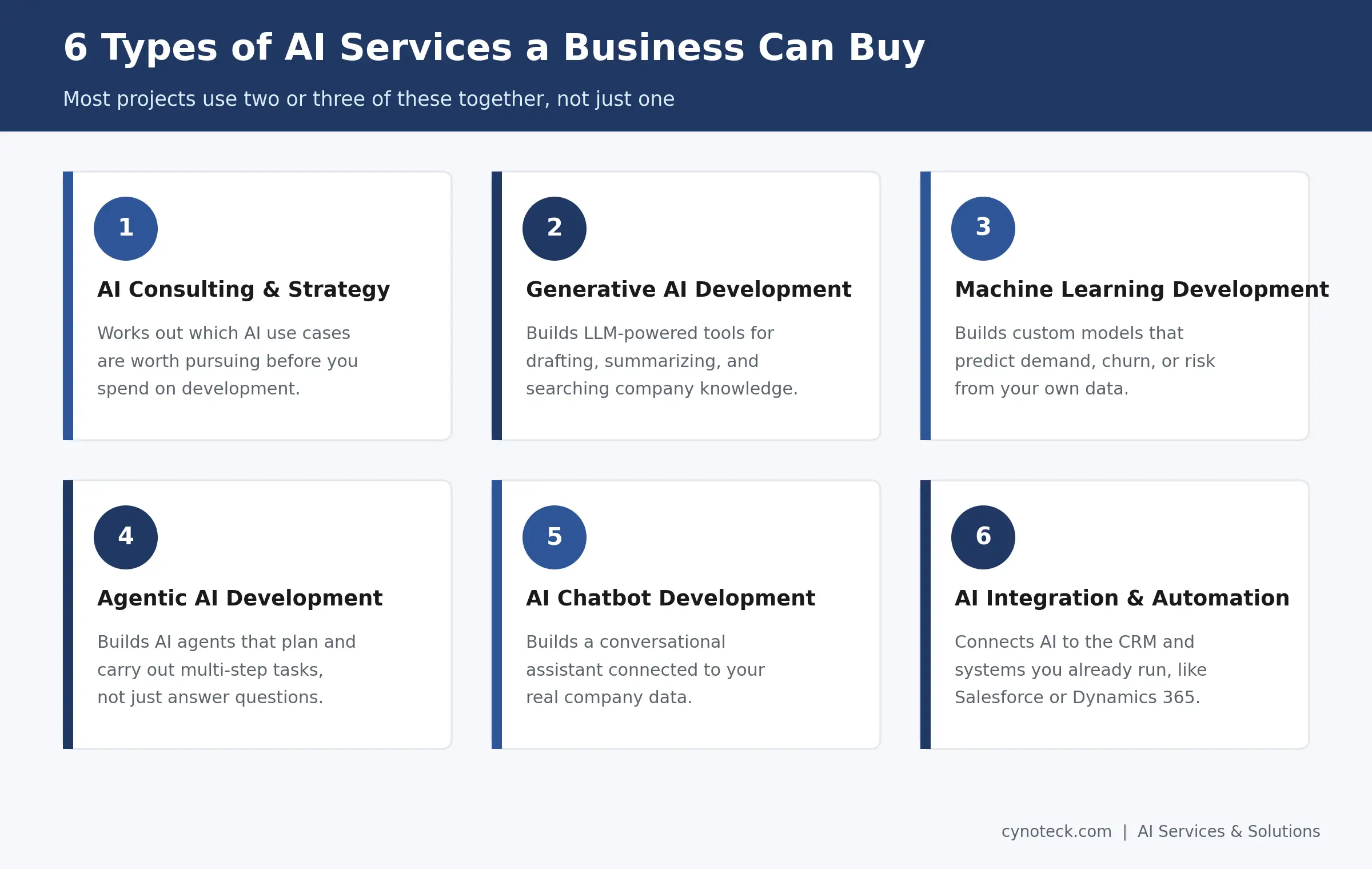
Here's what each one covers:
AI consulting and strategy: Helps you work out which AI use cases are worth the investment before you spend on development. A consultant reviews your data, your processes, and your goals, then builds a prioritized plan.
Generative AI development: Builds tools powered by large language models (LLMs), the technology behind ChatGPT and Claude, so your team can draft content, summarize documents, or search company knowledge in plain language. Generative AI services cover this work from strategy through to deployment. If you want the fundamentals first, our guide to what generative AI is a good place to start.
Machine learning development: Builds custom models that predict outcomes, such as demand, customer churn, or fraud risk, using your own historical data. This is a different discipline from generative AI, since it predicts rather than creates. Machine learning development is the service to look at here.
Agentic AI development: Builds AI agents, which are systems that can plan a task and carry it out across several steps on their own, rather than just answering a single question. Agentic AI development services cover agent design, human oversight, and integration.
AI chatbot development: Builds a conversational assistant for customer support, sales, or an internal help desk that connects to your real company data instead of giving generic answers. AI chatbot development services is the relevant page.
AI integration and automation: Connects AI tools to the systems you already run, like Salesforce or Microsoft Dynamics 365, so AI works with your real data instead of sitting next to it, disconnected from daily work.
Pro Tip: A chatbot is only useful once it's connected to your CRM. Integration only works if the underlying model is built or configured correctly. This is why these services are usually bought as a set, not as single items. |
Start with consulting if you're not yet sure which AI use case is worth pursuing. Or, if you already know the use case and need it built, start with development.
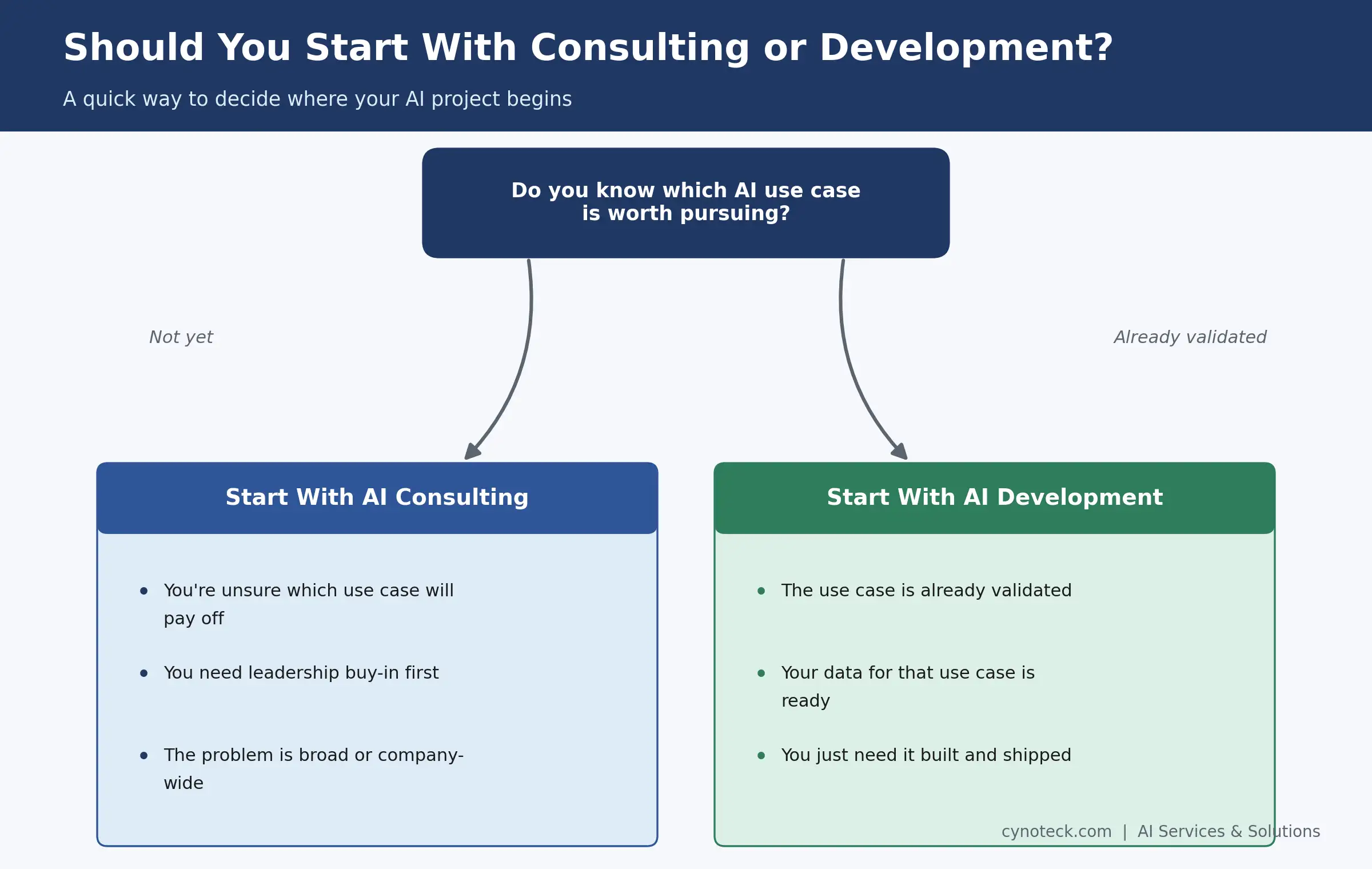
Start with... | If... |
AI consulting | You're unsure which use case will pay off, or you need leadership buy-in first |
AI development | The use case is already validated, your data is ready, and you need it built |
This is why consulting almost always comes first for larger or more complex projects. Skipping it is the most common reason AI projects stall. A team hires developers, builds something impressive, and later finds it doesn't solve a problem anyone had.
Note: If your use case is narrow and well understood, such as "add a chatbot to our support page," you can often move straight to development. Broader questions, such as "how should AI change our operations," need consulting first. |
Talk to an AI strategist for 30 minutes. We'll tell you honestly whether you need consulting first or you're ready to move straight to development.
Talk to an AI Strategy ExpertThe use cases with the fastest payback are usually tied to a task your team already does manually every day, not a brand-new capability you've never had before. Here's where AI services tend to pay off fastest:
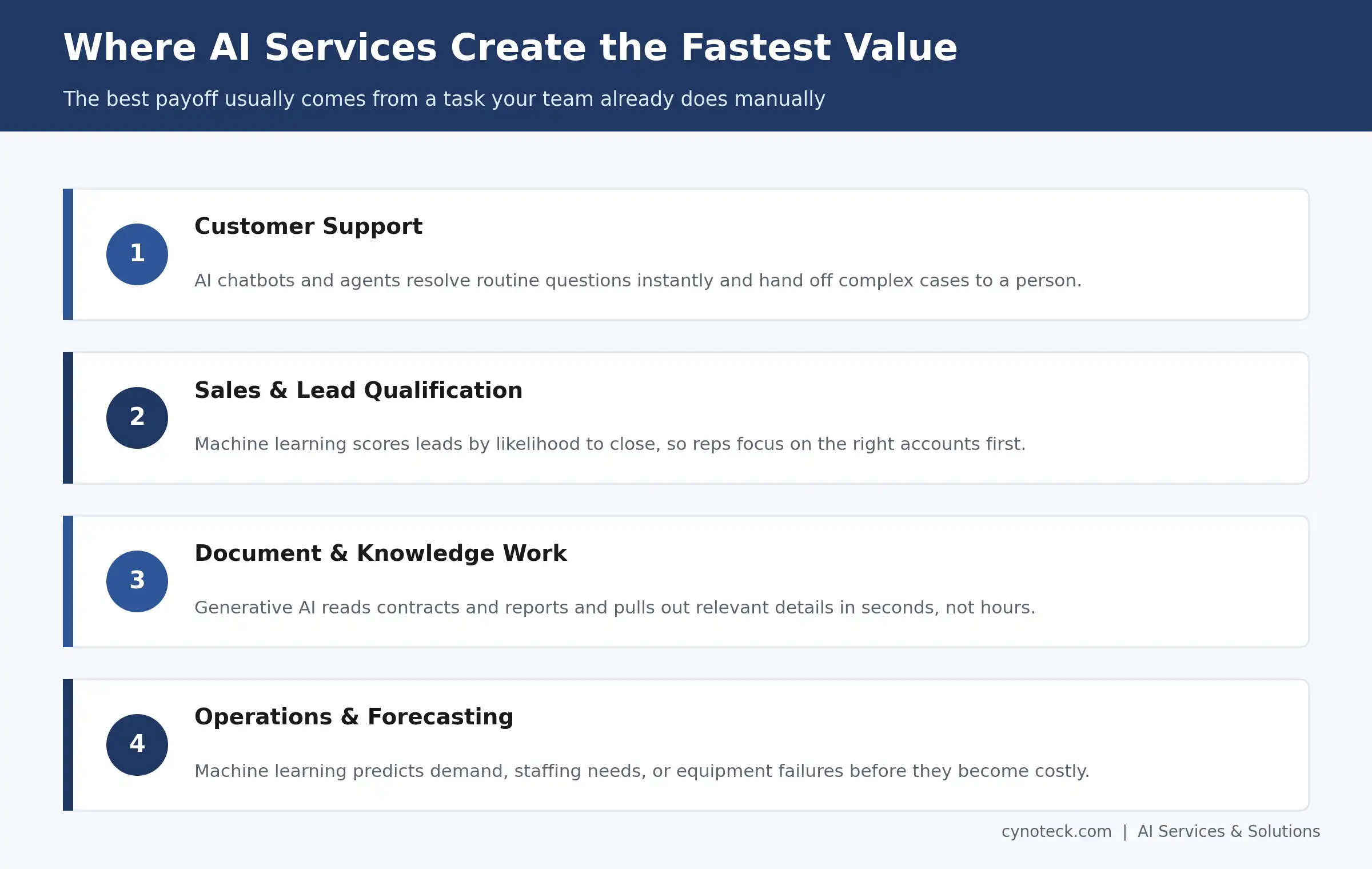
Customer support: AI chatbots and agents resolve routine questions instantly and hand off complex cases to a person, cutting response time without sacrificing service quality.
Sales and lead qualification: Machine learning models score leads by how likely they are to close, so your team spends time on the right accounts first.
Document and knowledge work: Generative AI reads contracts, reports, or long email threads and pulls out the relevant details in seconds instead of hours. Our piece on AI-powered legal document review walks through a real version of this.
Operations and forecasting: Machine learning predicts demand, staffing needs, or equipment failures before they become bigger problems.
Sales is another area where this shows up quickly. Our breakdown of AI for sales goes deeper into how lead scoring and forecasting change a sales team's day-to-day work.
Note: The mistake to avoid is chasing an AI use case because it sounds impressive rather than because it fixes a real bottleneck. The second kind shows up in your numbers. |
Off-the-shelf AI tools are usually enough for common, generic tasks. Custom AI makes sense when your process, data, or compliance needs are specific to your business.
Off-the-shelf tools are often the right call when:
The task is common across most businesses, like drafting marketing copy or transcribing meetings.
You don't have proprietary data that would meaningfully improve the result.
Speed matters more than a perfect fit.
Custom AI is worth the investment when:
Your data, workflow, or industry rules are specific enough that a generic tool gives shallow or inaccurate results.
You need the AI connected directly to your CRM, ERP, or other internal systems.
Data ownership and security requirements rule out sending information to a third-party tool.
Many businesses use both. A generic tool for internal drafting, and a custom AI service for anything touching customer data or a core process.
AI integration connects a model, chatbot, or agent to the CRM data you already have, such as Salesforce or Microsoft Dynamics 365, so it can read, update, and act on real records instead of working from scratch each time.
In Salesforce, this usually runs through Agentforce, Salesforce's own AI agent platform, which can read CRM records and take actions like qualifying a lead or drafting a follow-up email. We cover this in detail in our complete guide to Salesforce Agentforce. In Microsoft Dynamics 365, the equivalent is Copilot Studio, which connects AI to CRM data and Power Automate workflows.
This is the layer most competitor content skips, but it's often the difference between an AI tool that feels genuinely useful and one your team stops opening after the first week. A chatbot that can't see your actual customer record isn't much more useful than a search bar.
Every Salesforce and Dynamics 365 setup is different. Walk through your specific environment with an AI integration specialist.
Book a Free ConsultationA focused pilot, such as one chatbot or one prediction model, typically runs from a few weeks to a couple of months. A broader initiative with multiple integrations takes longer and costs more, because integration and data preparation usually take more time than the AI model itself.
Cost depends heavily on scope: how much of your data needs cleaning, how many systems you're connecting to, and whether you're building from scratch or configuring an existing model. As a result, giving one number for every business would be misleading. If cost planning is your main question right now, that deserves its own detailed breakdown rather than a rough estimate here.
Check for experience with a problem similar to yours, clear data security practices, examples of finished work, and a plan for what happens after launch, not just during the build.
Before you sign with an AI services company, check:
Relevant experience: Have they solved a problem like yours before, or is this their first attempt at your use case?
Data security practices: How is your data stored, who can access it, and does their process meet your compliance requirements?
Proof of finished work: Can they show a real example, not just describe their process?
Post-launch support: Who monitors accuracy after launch, and what happens if the model's performance drifts over time?
A clear scope and cost estimate: Vague pricing is one of the most common sources of AI project disputes.
Pro Tip: Ask what happens if the first version doesn't work as expected. A partner with a clear answer has done this before. A partner without one hasn't. |
You're ready if you can name one specific problem AI would solve, you have someone who owns the decision, and your data for that problem is reasonably accessible, even if it isn't perfect.
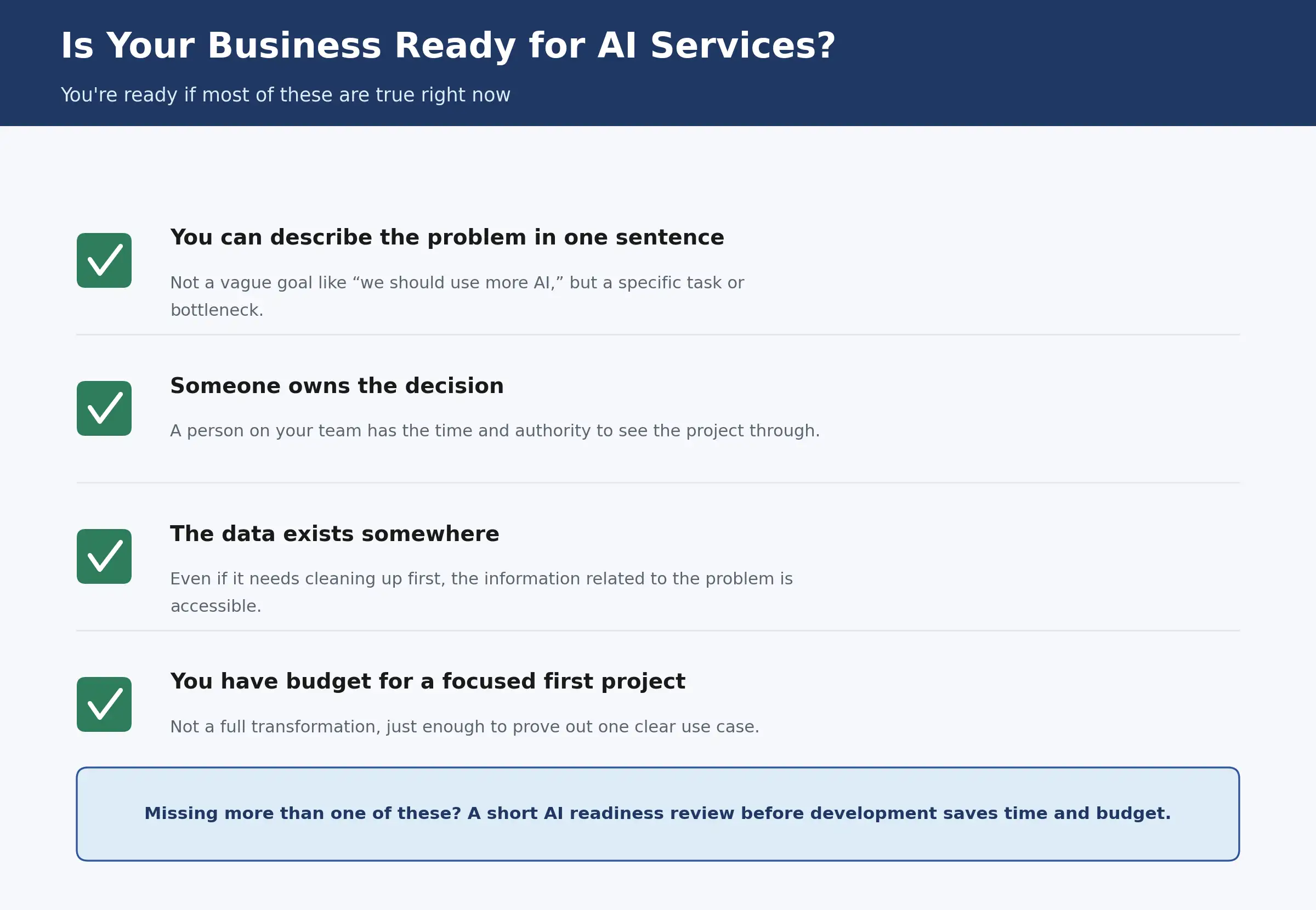
Signs you're ready to start:
You can describe the problem in one sentence, not a vague goal like "we should use more AI."
Someone on your team owns the decision and has time to be involved.
The data related to that problem exists somewhere, even if it needs cleaning up first.
You have budget for a focused first project, not a full transformation.
If you're missing more than one of these, a short AI readiness review before development saves far more time than it costs.
AI services cover a wide range of work. Still, the decision usually comes down to a few questions: what problem are you solving, do you need consulting or development first, and does the result need to connect to systems you already use? Once you can answer those, the right service becomes obvious.
If you're not sure where your business fits yet, Cynoteck's AI Services and Solutions team offers a free AI Service Assessment. It's a straightforward 30-minute conversation to help you figure out where to start, with no obligation to move forward.
See how Cynoteck approaches AI projects, real examples, security practices, and what happens after launch.
Request a Free AI ConsultationAns: AI consulting helps you decide which AI use case is worth pursuing and builds a plan around it. AI development is the technical work of building, training, and deploying that solution.
Ans: Small businesses benefit too, usually starting with a narrower scope, such as one chatbot or one automation, rather than a company-wide AI strategy.
Ans: Yes. AI integration connects new AI tools, agents, or chatbots to your existing CRM data so they can read and act on real records instead of working in isolation.
Ans: A focused pilot project can show measurable results within a few weeks to a couple of months. Broader initiatives with multiple systems involved take longer.
Ans: Building something technically impressive that doesn't solve a real business problem. This is the most common reason AI projects get built but never adopted.
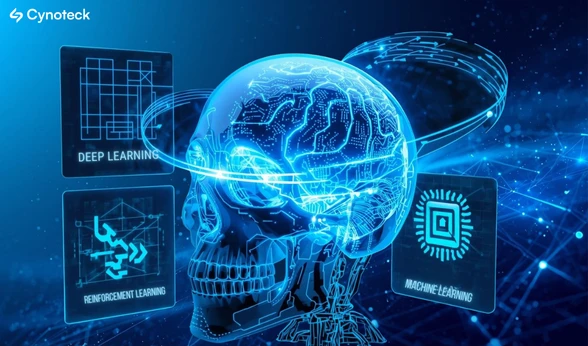
What is Artificial Intelligence? Artificial intelligence (AI) is intelligence demonstrated by machines, which makes it possible for machines to learn from experience, adjust to new inputs and perform human-like tasks.
We are more than just developers and consultants—we are your partners in navigating the digital landscape. Let us be the engine behind your next big success while you focus on your core vision.
Explore Opportunities!
 What Al Services Does a Business Actually Need in 2026.webp)