Salesforce Partner Tiers 2026: Select vs. Summit Explained
Quick Summary: Salesforce retired its old four-tier partner structure (Base, Ridge, Crest, Summit) in March 2026 and replaced it with two tiers: Select and Summit. Select confirms proven, baseline delivery capability. Summit is the highest tier, reserved for partners with verified outcomes across broader competencies, especially Agentforce and Data Cloud. Tier is a useful first filter, but the actual delivery team assigned to your project matters more than the label on the company's homepage. |
If you searched for Salesforce partner tiers recently, you may have come across outdated terms like Gold, Platinum, Crest, or Ridge. In simple terms, those labels no longer exist. In March 2026, Salesforce made its biggest partner program change in over a decade, and much of the online content about Salesforce partner levels has not yet caught up.
This guide explains what changed, what Select and Summit mean today, how Salesforce now evaluates its consulting partners, and how to use partner tier correctly, and incorrectly, when deciding who to hire for your Salesforce project.
A Salesforce partner is a company that Salesforce has reviewed and approved to sell, set up, customize, and support the Salesforce platform for other businesses. Partners are not Salesforce employees. They are independent consulting firms listed on Salesforce's AppExchange marketplace that make their living helping other companies get real value from their Salesforce investment. For a broader look at what this work actually involves, see our Salesforce Consulting Guide.
This is why the partner you choose matters so much. Salesforce builds and sells the software, but it does not set it up for most customers. That work falls to its partner ecosystem, and partners are already involved in most Agentforce projects today. In other words, partner quality is not a minor detail. It is usually the single biggest factor in whether your Salesforce investment pays off.
A typical Salesforce consulting partner offers services such as:
Implementation: Setting up a new Salesforce org, or restructuring an existing one
Customization: Extending the platform with custom code, Lightning components, or business logic
Development: Building custom applications and features on the Salesforce platform
Integration: Connecting Salesforce to your ERP, finance, marketing, or e-commerce systems
Data migration: Moving records from spreadsheets or an old CRM safely and accurately
Optimization: Improving an existing org's performance, adoption, and reporting accuracy
Managed services: Ongoing support, monitoring, and configuration changes after launch
AI and Agentforce services: Setting up and governing Salesforce's AI agent platform
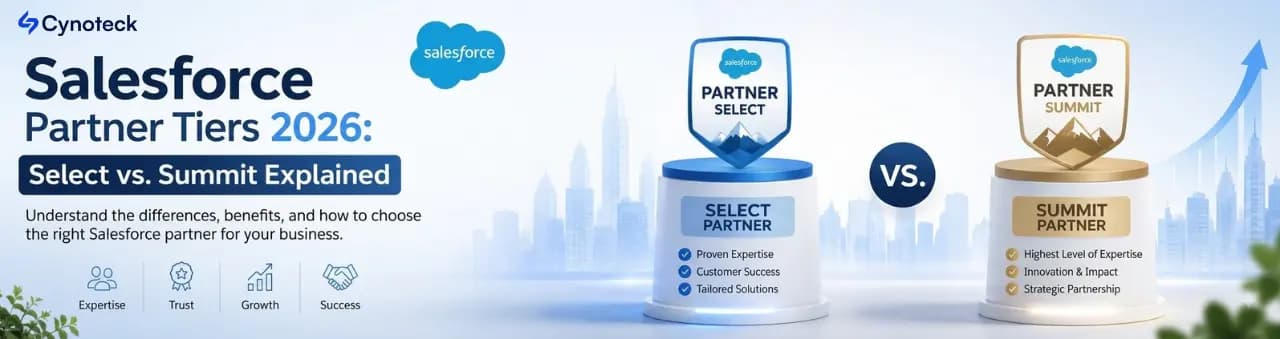
As of March 2026, Salesforce's Consulting Partner Program recognizes exactly two partner tiers: Select and Summit. This replaced a four-tier structure that many older articles and partner websites still reference.
Factor | Select Partner | Summit Partner |
Partner level | Proven delivery tier, meeting Salesforce's program standards | Highest tier, reserved for top-performing partners aligned to strategic growth |
Typical specialization | Core implementation, focused product or industry competencies | Broader, deeper competency portfolio, often across multiple clouds |
Evaluation basis | Certifications, completed projects, and CSAT scores within relevant competencies | Same criteria, at a higher verified bar, with emphasis on Agentforce and Data Cloud delivery |
Best suited for | Clearly scoped implementations and focused projects | Complex, multi-cloud, or large-scale AI-driven transformation programs |
What buyers should verify | Relevant competencies, references, and industry experience | The same, plus verified Agentforce delivery history for AI-heavy scopes |
This table reflects how Salesforce publicly describes its tier structure as of mid-2026. Individual partner capabilities still vary widely within each tier, which is why the rest of this guide focuses on how to evaluate a partner, not just which tier they sit in.
On March 2, 2026, Salesforce officially announced a restructuring of its Consulting Partner Program, built around what it calls the shift to the "Agentic Enterprise." In its own announcement, Salesforce confirmed it was moving to a simplified two-tier structure, consolidating the previous four tiers into Select and Summit and cutting the underlying credential system from roughly 170 legacy badges down to 28 core competencies. This change is significant enough that much older content about Salesforce partner tiers, including many currently ranking articles, now describes a structure that no longer exists.
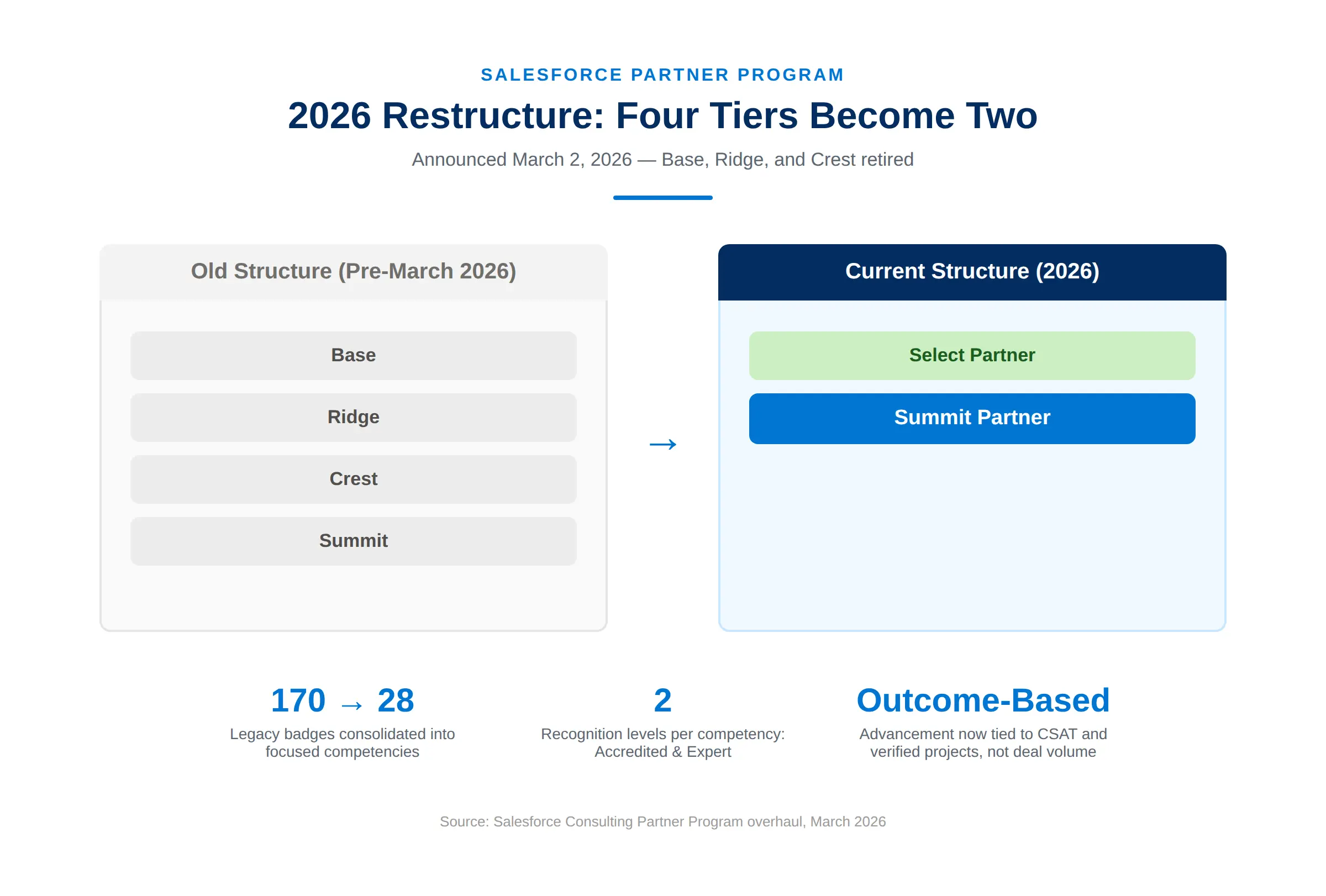
What Changed | Old Structure (Pre-March 2026) | Current Structure (2026) |
Partner tiers | Four tiers: Base, Ridge, Crest, and Summit | Two tiers: Select and Summit |
Credentials | Roughly 170 legacy certification badges | 28 core competencies aligned to real buying patterns |
Advancement model | Points-based, largely tied to certification volume and deal count | Outcome-based: CSAT scores, verified completed projects, and competency certification |
Recognition levels | Single badge per specialization | Two levels per competency: Accredited and Expert |
Program name for specializations | Navigator framework | Competency framework |
If a consulting firm is still marketing itself as a "Gold Partner," "Platinum Partner," or "Crest Partner," that label reflects Salesforce's older program and is not a currently recognized designation. Some firms have not yet updated their marketing, so it is worth asking directly what their current Select or Summit status is rather than trusting an older badge on a website.
The safest way to check any partner's actual current status is to look them up directly on Salesforce AppExchange, where tier, competencies, and CSAT data are maintained by Salesforce itself, not by the partner.
A Salesforce Select Partner is a consulting firm that Salesforce has verified as a proven delivery partner meeting the program's core performance standards. It is the entry- and mid-level tier in the current two-tier structure, replacing the former Base and Ridge tiers.
In practice, Select status tells you a partner has demonstrated real, verified delivery capability rather than simply signing up for the program. It does not, by itself, confirm depth in your specific industry, your specific Salesforce Cloud, or complex AI and integration work. For a clearly scoped implementation with a defined set of requirements, a well-matched Select Partner can deliver excellent results, often at a more accessible cost than a Summit-tier firm.
What buyers should still check: the Select label alone does not tell you which of the 28 competencies a specific partner holds, at what recognition level, or whether their project history matches your industry. Those details still need to be verified directly.
A Salesforce Summit Partner is the highest tier in Salesforce's current Consulting Partner Program, reserved for top-performing partners Salesforce describes as aligned to strategic growth. Summit status requires verified customer outcomes, high CSAT scores, and demonstrated competency in the areas Salesforce is prioritizing most right now, particularly Agentforce and Data Cloud delivery.
Summit differs from Select mainly in the depth and breadth of verified delivery evidence required. Where Select confirms baseline, proven capability, Summit confirms a track record across a wider range of competencies, typically including complex, multi-cloud, or AI-driven engagements. Several Salesforce partners describe Agentforce and Data Cloud competencies as central to achieving and maintaining Summit status under the current program.
It is worth noting that Salesforce has not published one single, exhaustive public checklist listing every requirement for Summit status, and the specifics of how AI competency is weighted are still being clarified as the transition rolls out through 2026. Treat Summit as a strong signal of verified delivery depth, not as a guarantee that a specific team is right for your specific project.
For buyers, Summit status matters most when the project itself is complex: multiple Salesforce Clouds, significant custom development, heavy integration work, or an AI-first initiative built around Agentforce. For a simpler, single-Cloud implementation, Summit status is not a requirement, and a strong Select Partner with the right industry background may be the more cost-effective, equally capable choice.
Summit sits above Select on every measure that matters: broader competencies, a higher CSAT bar, deeper experience with Agentforce and Data Cloud, and typically higher hourly rates. Select is the better fit for clearly scoped, single-Cloud projects. Summit is the better fit for complex, multi-cloud, or AI-heavy transformations.
The table below compares Select and Summit across the factors that matter most to a buyer. Where a factor genuinely depends on the individual partner rather than the tier itself, it should be called out directly, since the tier alone should never be the deciding factor.
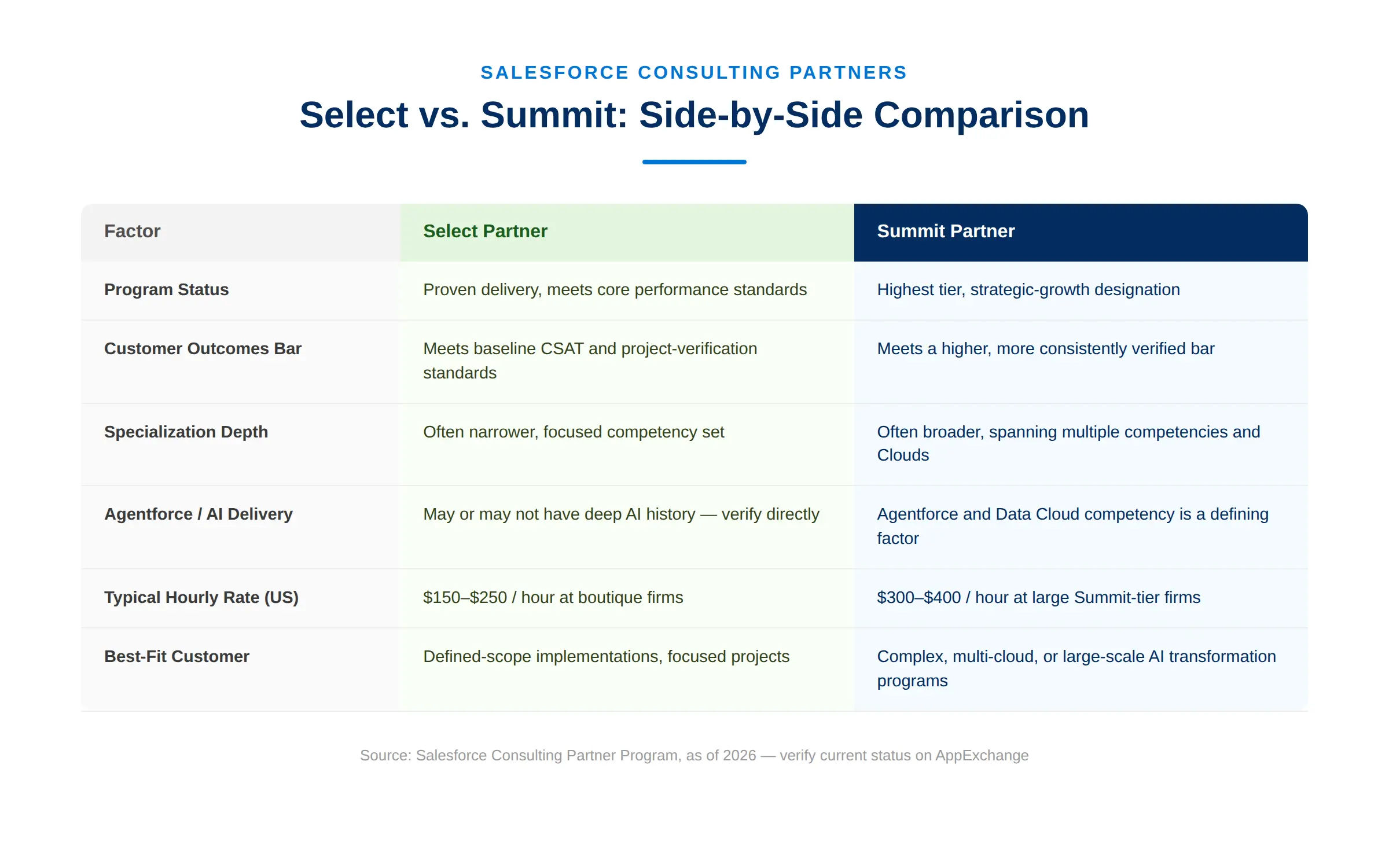
Factor | Select Partner | Summit Partner |
Program status | Proven delivery, meets core performance standards | Highest tier, strategic-growth designation |
Typical certifications | Varies by partner and competency, verify directly | Varies by partner and competency, verify directly |
Customer outcomes bar | Meets Salesforce's baseline CSAT and project-verification standards | Meets a higher, more consistently verified bar across competencies |
Specialization depth | Often narrower, focused competency set | Often broader, spanning multiple competencies and Clouds |
Enterprise-scale experience | Varies by partner, should be verified before engagement | More commonly associated with large or complex programs, but still varies by partner |
Agentforce / AI delivery | May or may not have deep AI delivery history; verify directly | Competency in Agentforce and Data Cloud is a defining factor at this tier |
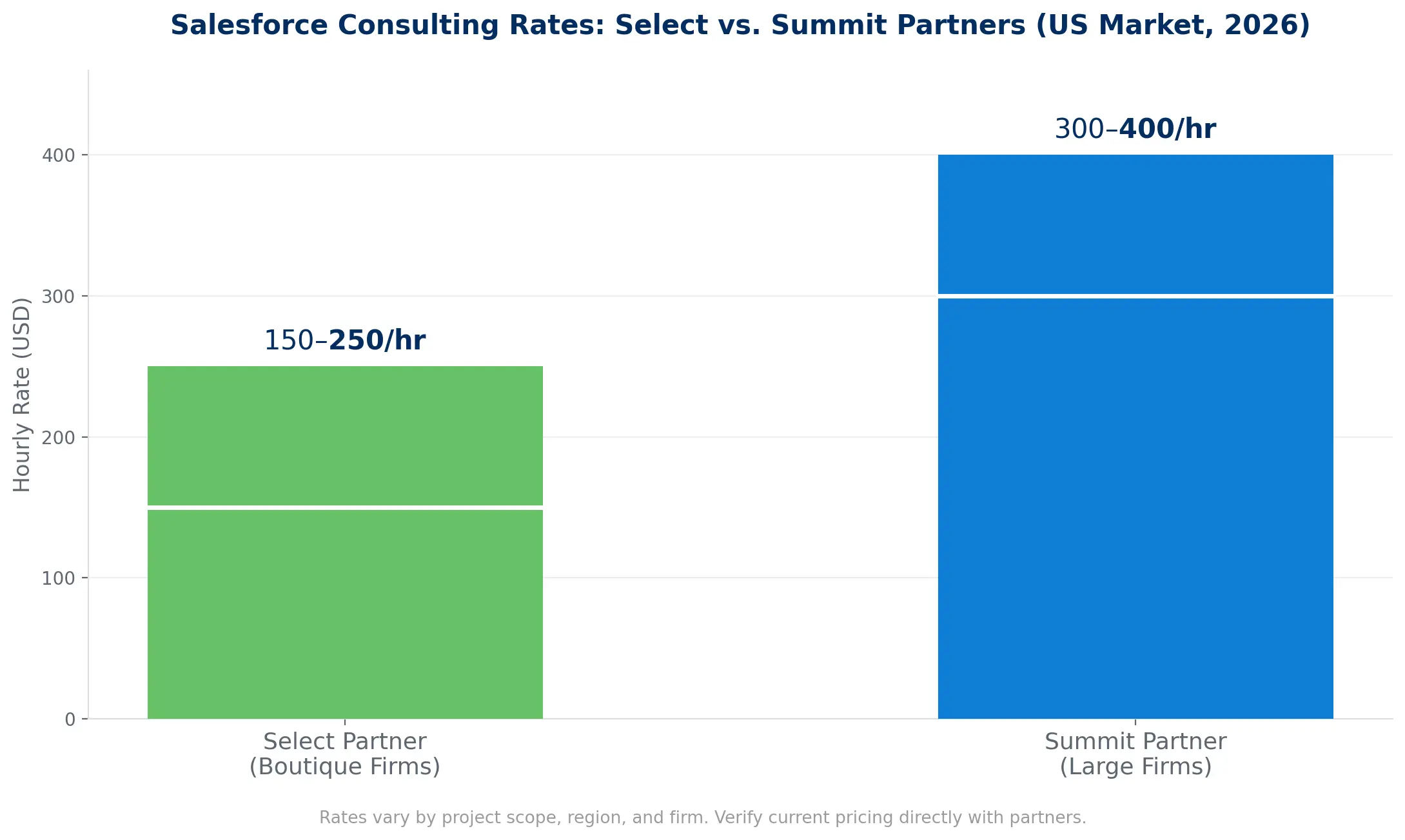
Typical hourly rates (US market) | Roughly $150 to $250 per hour at boutique firms | Roughly $300 to $400 per hour at large Summit-tier firms |
Best-fit customer | Defined-scope implementations, focused projects | Complex, multi-cloud, or large-scale AI transformation programs |
If you want to see how specific firms stack up against these factors, our guide to top Salesforce consulting companies in the USA profiles both Select and Summit partners side by side. For a fuller breakdown of what drives project cost beyond the hourly rate, see our guide to Salesforce implementation cost.
Compare Salesforce partners based on competencies, certifications, project experience, and business fit to avoid costly mistakes and choose with confidence.
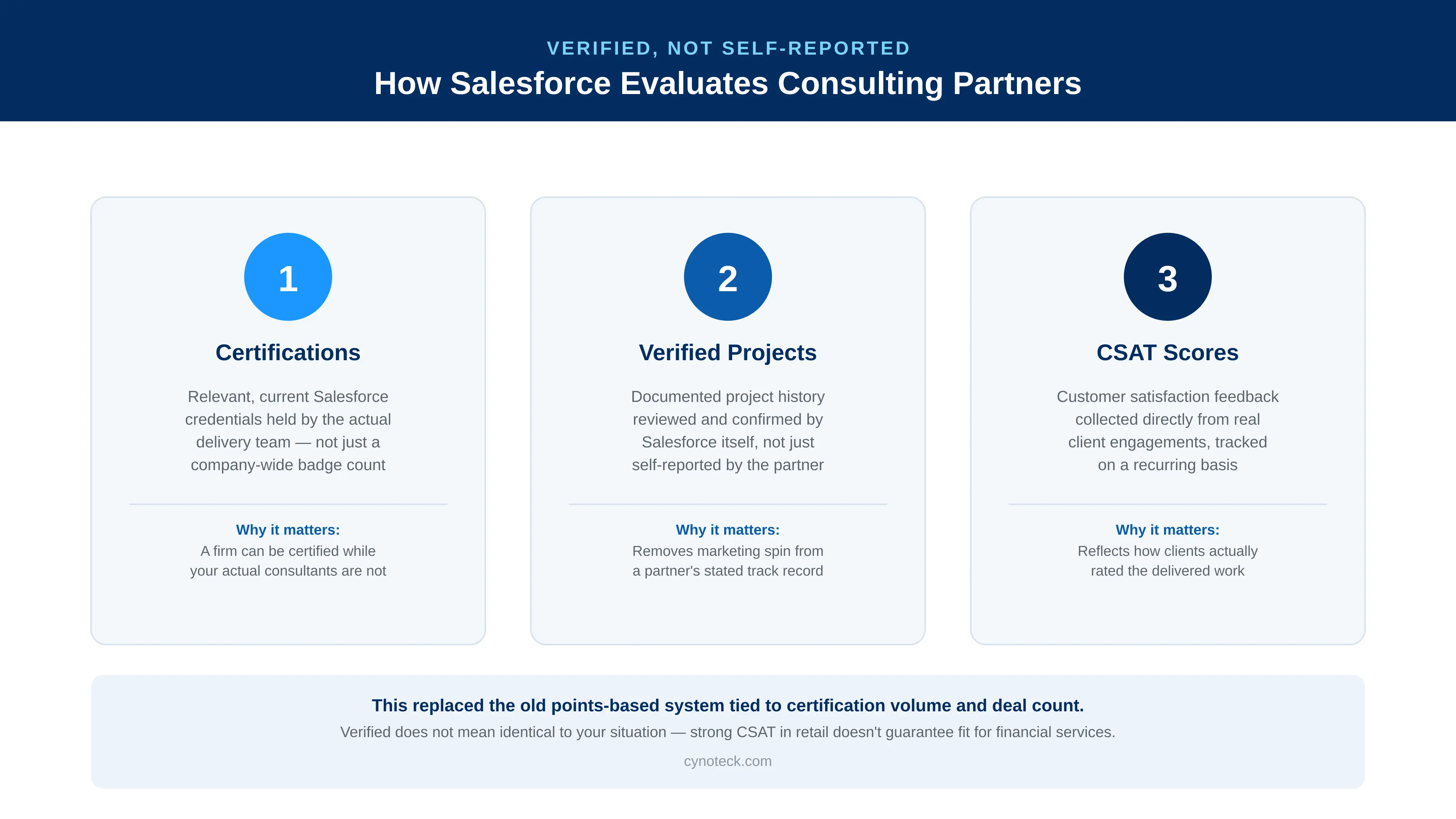
Talk to Our Salesforce ExpertUnder the current program, Salesforce evaluates partners mainly on three measurable factors rather than certification volume or deal count alone:
Certifications: Relevant, current Salesforce credentials held by the partner's actual delivery team
Completed, verified projects: Documented project history reviewed and confirmed by Salesforce, not just self-reported
Customer satisfaction (CSAT) scores: Direct feedback collected from real client engagements
This matters to buyers for a simple reason. It means a partner's public tier and competency badges are no longer just a marketing claim. They reflect data Salesforce itself has checked, which is a stronger signal than a testimonial on a partner's own website. That said, verified does not mean identical to your situation. A partner with strong CSAT scores in retail implementations is not automatically the right fit for a complex financial services compliance project.
Note: Salesforce reassigns tier and competency status on a recurring basis, not just once. A partner's badge reflects their standing as of their last review, so it is worth confirming the date on their AppExchange listing rather than assuming it is permanent. |
Competencies are how Salesforce now measures and displays a partner's specific area of expertise. They replace the older Navigator framework and its roughly 170 legacy badges with 28 focused competency areas. Each competency reflects real buying patterns: specific Clouds, specific industries, and increasingly, specific AI capabilities.
Within each competency, a partner can hold one of two recognition levels:
Accredited: Demonstrated capability in that competency area
Expert: Scaled delivery excellence, backed by multiple verified client outcomes
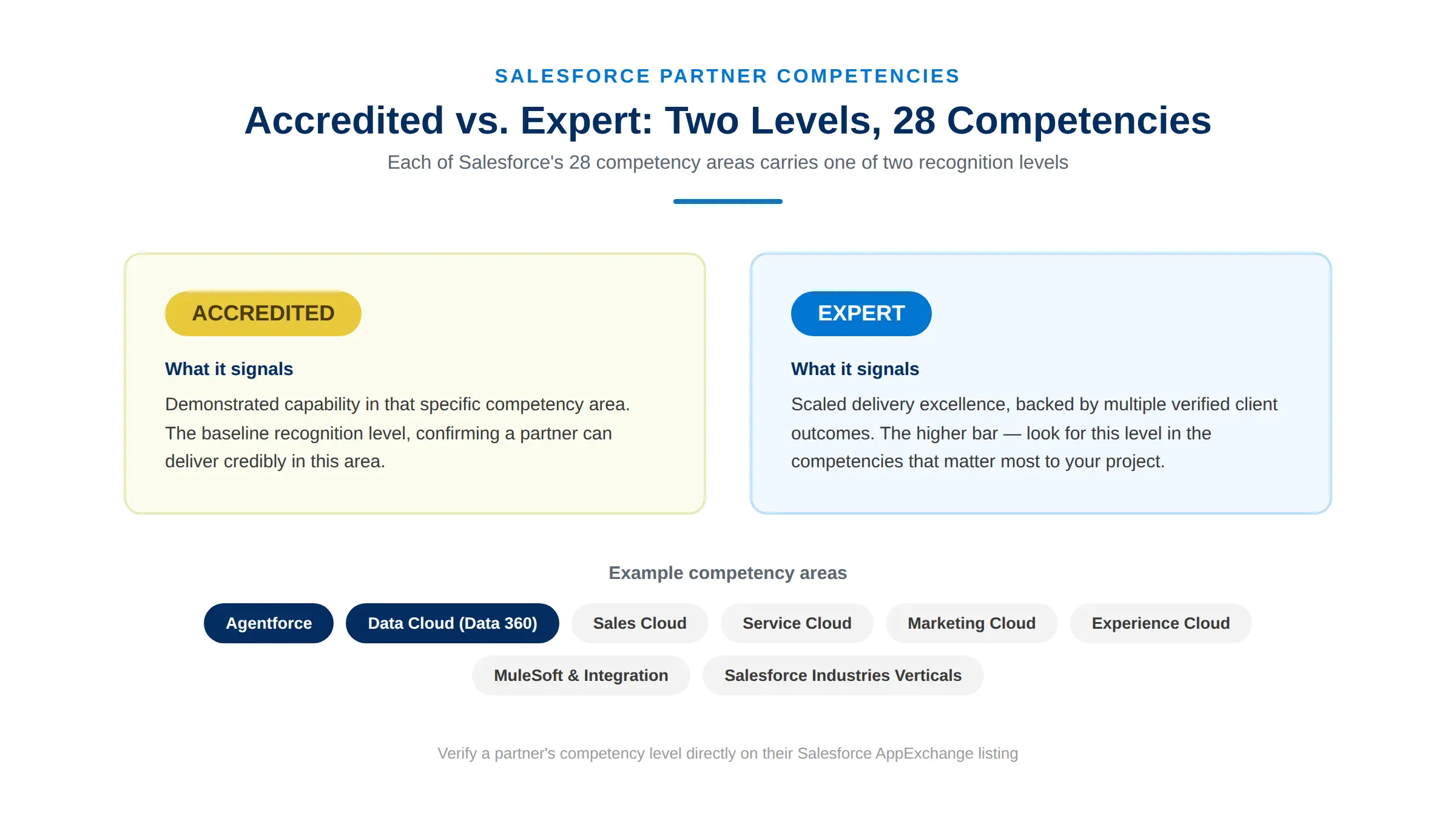
Example competency areas include Agentforce, Data Cloud (branded as Data 360), Sales Cloud, Service Cloud, Marketing Cloud, Experience Cloud, MuleSoft and integration, and specific Salesforce Industries verticals. A partner's competency profile, visible on their AppExchange listing, is a far more useful evaluation signal than tier alone, because it tells you specifically what they have proven they can deliver, not just that they meet a general bar.
Pro Tip: When you look up a partner on AppExchange, check which competencies they hold at the Expert level, not just which ones appear on their profile. Accredited and Expert are not interchangeable signals. |
Not necessarily. Tier is a genuine signal of verified program standing, but it is not a substitute for evaluating the specific team that will work on your project.
A Summit Partner with no experience in your industry, or with its strongest specialists already tied up on other engagements, can still be the wrong choice for your specific project. Meanwhile, a strong Select Partner with deep, verified experience in your exact use case can outperform a larger Summit firm that treats your project as a smaller, lower-priority engagement in its pipeline.
Factors that matter alongside tier include:
Relevant project experience in your specific industry and use case
The certifications and competencies held by the actual assigned delivery team, not just the company as a whole
Salesforce-verified project history and independently collected customer reviews
Technical architecture, integration, and data migration experience matched to your scope
Agentforce or AI delivery expertise, specifically if your project involves it
Post-launch support model and communication style
Project methodology and how clearly it is documented
This is one of the most important practical points buyers miss. Partner tier answers the question "has this company met a verified bar?" Your actual outcome depends on a different question: "will the specific people assigned to my project meet that bar for my specific problem?" You need answers to both before you sign anything.
Evaluate the actual delivery team, industry expertise, and project history to ensure your Salesforce investment is backed by proven capabilities.
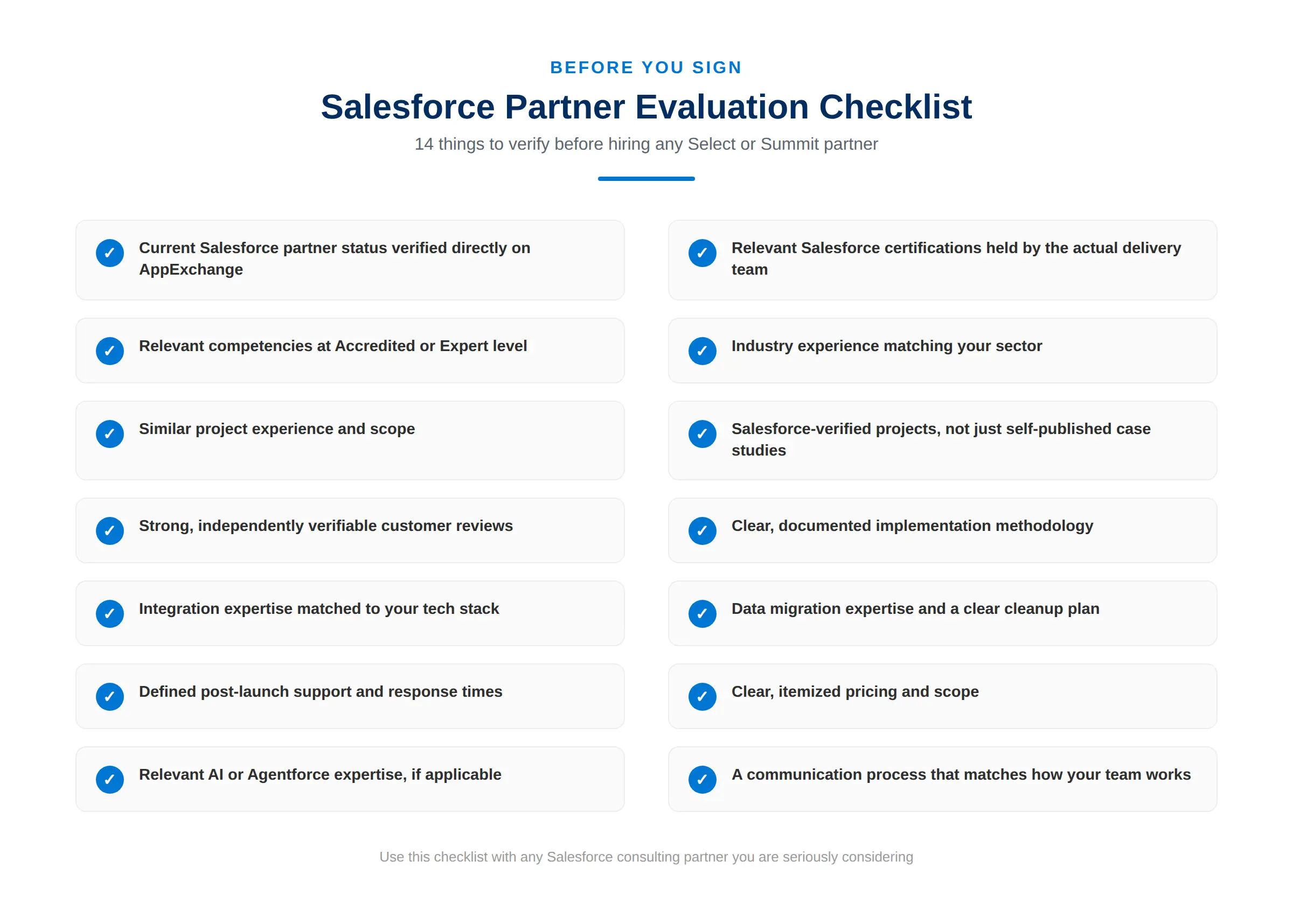
Get Expert GuidanceUse this checklist with any partner you are seriously considering.
☐ Current Salesforce partner status verified directly on AppExchange
☐ Relevant Salesforce certifications held by the actual delivery team
☐ Relevant competencies at Accredited or Expert level
☐ Industry experience matching your sector
☐ Similar project experience and scope
☐ Salesforce-verified projects, not just self-published case studies
☐ Strong, independently verifiable customer reviews
☐ Clear, documented implementation methodology
☐ Integration expertise matched to your tech stack
☐ Data migration expertise and a clear cleanup plan
☐ Defined post-launch support and response times
☐ Clear, itemized pricing and scope
☐ Relevant AI or Agentforce expertise, if applicable to your project
☐ A communication process that matches how your team works
Summit is not automatically the right answer for every business. The right tier depends on the shape of your project.
The project has a clearly defined scope
You need a specific, well-contained Salesforce implementation
The partner shows strong, relevant specialization and project experience
Your project does not require broad enterprise transformation or heavy AI delivery
Your organization has complex, multi-cloud Salesforce requirements
Large-scale digital transformation is involved
The project requires enterprise architecture-level planning
Significant integration or data complexity exists across systems
Agentforce or Data Cloud delivery is a core part of the scope
Regardless of tier, the actual capabilities of the individual team assigned to your project matter more than the tier label on the company's homepage. Use tier as a first filter, not a final decision. For the full list of factors to consider beyond tier, our guide to choosing a Salesforce implementation partner covers the rest of the evaluation.
If you are comparing Salesforce consulting partners, tier is only one part of the evaluation. Experience, verified projects, certifications, industry expertise, and delivery capabilities should all factor into your decision.
Cynoteck is a Salesforce Select Partner, founded in 2008 and headquartered in Minneapolis, Minnesota, with additional offices in Dehradun, India, and Dubai, UAE. In more than 16 years on the platform, Cynoteck has completed 500-plus Salesforce projects and logged over 500,000 person-hours across Sales Cloud, Service Cloud, Agentforce, and more, with a team of 250-plus certified professionals. Its fully owned delivery model covers strategy, implementation, customization, integration, data migration, training, and long-term managed services under one accountable team.
If you want help evaluating your options or planning a Salesforce implementation, Cynoteck's Salesforce Consulting Services team can walk you through your requirements, goals, and roadmap.
Review your shortlisted Salesforce partners with experienced consultants and gain clarity before committing to a long-term implementation partner.
Book a Free ConsultationSalesforce's shift from four partner tiers to two, Select and Summit, is more than a naming change. It reflects a real shift toward outcome-based, evidence-verified practices over badge-collecting, with Agentforce and Data Cloud competency now central to what separates the two tiers. Use tier as your first filter, then verify the specific delivery team, certifications, and references behind it before you sign anything.
If you would like a second set of eyes on a partner you are evaluating, or want to talk through your Salesforce roadmap, Cynoteck's Salesforce consulting team is happy to walk through your requirements and goals.
Ans: Salesforce currently recognizes two consulting partner tiers: Select Partner and Summit Partner. This replaced the previous four-tier structure of Base, Ridge, Crest, and Summit following a program overhaul announced in March 2026.
Ans: A Select Partner is a Salesforce consulting firm verified as a proven delivery partner meeting the program's core performance standards. It is the entry and mid-level tier under the current two-tier structure.
Ans: A Summit Partner is the highest tier in Salesforce's current partner program, reserved for top-performing firms with verified customer outcomes, high CSAT scores, and demonstrated competency in priority areas like Agentforce and Data Cloud.
Ans: Summit is currently the highest tier in Salesforce's Consulting Partner Program.
Ans: Summit requires a higher, more consistently verified bar across competencies, customer outcomes, and CSAT scores, with particular emphasis on Agentforce and Data Cloud delivery. Select confirms solid, proven baseline delivery capability without that same depth requirement.
Ans: The Crest tier, along with Base and Ridge, was retired in March 2026 when Salesforce consolidated its four-tier structure into the current two-tier Select and Summit system.
Ans: No. Gold and Platinum are older, informal naming conventions that predate Salesforce's current official program and are not recognized designations today. A firm still marketing itself this way in 2026 has likely not updated its site to reflect its current status.
Ans: Salesforce evaluates consulting partners mainly on three measurable factors: relevant certifications, completed and verified projects, and customer satisfaction (CSAT) scores, replacing the older points-based system tied to certification volume and deal count.
Ans: Competencies are Salesforce's current framework for showing specific partner expertise, replacing the older Navigator badge system. There are 28 core competencies, each with two recognition levels: Accredited and Expert.
Ans: Yes, as one of several factors. Tier reflects a verified program standing, but it should be combined with checks of industry experience, the delivery team's actual certifications, references, and relevant competencies before choosing a partner.
Ans: Look up the firm directly on the Salesforce AppExchange, where current tier, competencies, and CSAT data are maintained by Salesforce rather than self-reported by the partner.
Ans: Use a structured framework: verify current tier and competencies, check Salesforce-verified projects and references, confirm the actual delivery team's certifications and industry experience, and evaluate methodology, integration expertise, and post-launch support before signing.
 Outsource Salesforce Development or Build In-House Which is the Best for Your Business.webp)
Outsourcing Salesforce development vs. building an in-house Salesforce team: 2026 cost insights, salary comparisons, key benefits, challenges, and the best hiring model for your business growth.
We are more than just developers and consultants—we are your partners in navigating the digital landscape. Let us be the engine behind your next big success while you focus on your core vision.
Explore Opportunities!