What Is Salesforce Agentforce? A Complete Guide for 2026
Summary: Salesforce Agentforce is an AI platform built inside Salesforce that lets you set up AI agents to handle real work such as answering customer questions, updating records, and closing routine tasks on their own. This guide explains what Agentforce is, how it works, what it costs, and how to know if your business is ready for it. |
If you use Salesforce and keep hearing the word "Agentforce," you are not alone. Salesforce has rebuilt much of its product line around it in 2026, and the marketing language can make it hard to understand what the product actually does. This guide breaks down Agentforce in simple terms: what it is, how it works, what it costs, and whether it is the right fit for your team.
Question | Simple Answer |
What is it? | An AI platform inside Salesforce that runs autonomous AI agents |
Who is it for? | Businesses already using Salesforce Enterprise Edition or higher |
What does it do? | Answers customer questions, updates records, and completes tasks without a human handling every step |
How is it priced? | Consumption-based, using Flex Credits, starting around $500 per 100,000 credits |
How fast can you launch it? | A focused first agent can go live in a few weeks |
Do you need developers? | No. Agents are built using Agent Builder, a low-code tool |
Salesforce Agentforce is an AI platform built directly inside Salesforce. It lets you create AI agents that complete entire tasks on their own, not just answer questions.
This is the main difference between Agentforce and older tools like chatbots. A chatbot answers a question and stops there. An Agentforce agent reads the situation, checks your Salesforce data, decides what to do, takes the action, and confirms the result. If it cannot finish the job, it hands the case to a person along with a full summary of what it has already tried.
Salesforce first introduced Agentforce in 2024. By 2026, it has become the center of the entire Salesforce product line. Sales Cloud, Service Cloud, and Marketing Cloud have all been rebuilt around it, with Sales Cloud even being renamed Agentforce Sales earlier this year.
Pro Tip: If your team already uses Salesforce daily and your data is reasonably clean, Agentforce is usually faster to set up than people expect. The bigger project is almost always fixing messy data, not building the agent itself. |
Put another way, Agentforce matters because Salesforce has moved from being a system you log into to a system that can act on your behalf. This is a real shift in how CRM software works, not just a new feature.
Salesforce reported that Agentforce closed 29,000 deals and reached $800 million in annual recurring revenue by early 2026, with 2.4 billion work units completed across customers, according to Salesforce's Q4 FY2026 earnings report. That is a large number of businesses already relying on it for real tasks, not pilots.
For this reason, understanding Agentforce is no longer optional if you run a business on Salesforce. Your competitors are likely already using it to answer support tickets faster, qualify leads around the clock, and cut down the manual work your team currently does by hand.
Every Agentforce agent runs on something called the Atlas Reasoning Engine. Think of it as the decision-making brain behind every agent you build.
Here is what happens, step by step, when an Agentforce agent handles a task:
Step 1: Read the situation – The agent reads the incoming request and pulls relevant Salesforce data, such as account history, open cases, and past interactions.
Step 2: Build a plan – Instead of following one fixed script, the agent works out the right sequence of actions for this specific situation.
Step 3: Take action – The agent carries out the plan using Salesforce Flows, Apex code (Salesforce's programming language for custom logic), or other configured tools.
Step 4: Check the result – The agent reviews whether the outcome matches the goal. If it does not, it adjusts and tries again.
Step 5: Escalate when needed – If the task falls outside what the agent can handle, it hands off to a human with a complete summary, not a blank ticket.
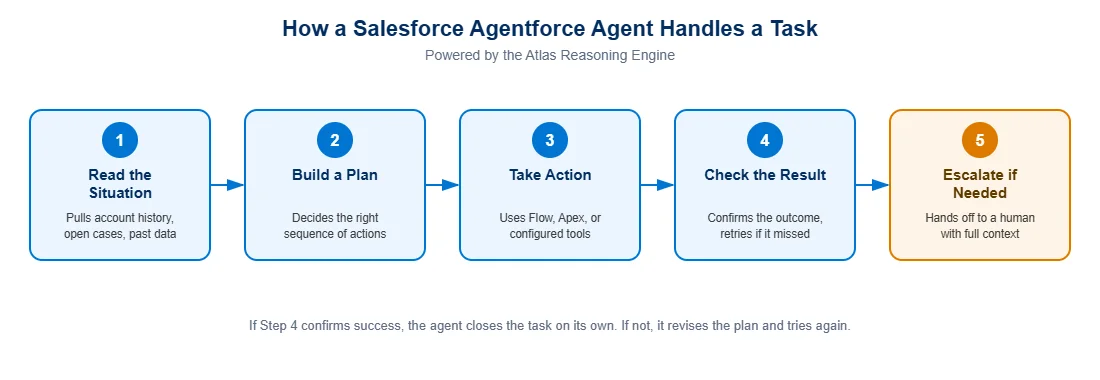
This is why Agentforce can handle more variation than older automation tools like Flow or Process Builder. Those tools follow a fixed path. An Agentforce agent adjusts its approach based on what it finds.
Note: In 2026, Salesforce rebuilt this engine to cut the number of AI model calls needed before the first response, which reduced platform-wide response times by roughly 70%. This is why real-time voice and chat agents are now practical at scale, something that was not true a year ago. |
Explore practical Agentforce use cases, implementation strategies, and best practices to achieve measurable business results faster.
Schedule a Free ConsultationSalesforce has organized Agentforce into products based on the part of the business it supports. Here are the ones you are most likely to run into:
Agentforce Sales – Helps sales reps prioritize deals, get next-best-action suggestions, and enrich CRM records with outside data automatically.
Agentforce Service – Answers customer questions and resolves support cases without a rep handling every step.
Agentforce Marketing – Drafts campaign briefs, builds audience segments, and keeps brand voice consistent across every asset an agent creates.
Agentforce Commerce – Helps online shoppers find products using natural conversation instead of rigid keyword search.
Agentforce IT Service – Deploys specialized agents to handle employee IT requests inside Slack, Microsoft Teams, or a help desk.
Agentforce Operations – Automates back-office work such as invoice processing, approvals, and loan underwriting across multiple systems.
Agentforce Voice – Runs real-time voice conversations with live transcription, and lets a human take over mid-call when needed.
You do not need every product. Most businesses start with one, usually Agentforce Service or Agentforce Sales, and expand once the first agent proves its value.
Before an agent can run, you configure three things inside Agent Builder. Understanding these three pieces makes the rest of Agentforce much easier to follow.
Topics – These set the scope of what an agent is allowed to handle, such as order management or billing questions. If a request falls outside an agent's assigned topics, it will not attempt to answer it.
Actions – These are tied to topics and define what the agent can actually do, such as looking up an order or updating a case. Actions are built on Flow, Apex, or MuleSoft APIs that already exist in your org.
Guardrails – These are the rules that state what an agent cannot do, and when it must hand a case to a person instead of continuing on its own.
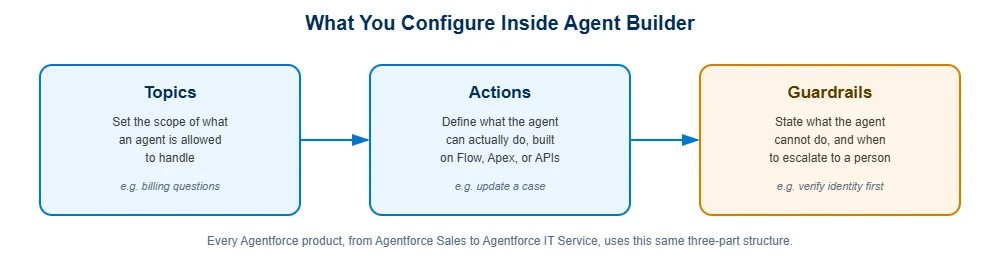
To build a working agent, you typically define its purpose, assign the topics and actions it needs, and set guardrails for escalation. This is the same three-part structure Salesforce uses across every Agentforce product, from Agentforce Sales to Agentforce IT Service.
Pro Tip: Start with narrow topics and a short list of actions. Agents with too much scope on day one are harder to test and more likely to give inconsistent answers. |
A handful of features do most of the work behind every Agentforce agent. Here are the ones worth knowing before you start planning:
Agent Builder – A low-code workspace where you configure agents using plain language and visual tools instead of writing code.
Atlas Reasoning Engine – The decision-making layer explained above, responsible for planning, acting, and self-correcting.
Einstein Trust Layer – Salesforce's built-in security boundary. This means the AI model does not retain your data, sensitive information gets masked automatically, and every agent action is logged for audit purposes.
Data 360 – Salesforce's unified data platform, formerly called Data Cloud, which gives agents real-time access to customer information without copying data out of your existing systems.
Multi-Agent Orchestration – Lets specialized agents hand off to each other so one customer conversation can be resolved end to end, even when it touches sales, service, and billing.
Agent Script – A way to define strict, ordered steps for tasks that must happen in a specific sequence, such as verifying identity before discussing account details.
No. A chatbot follows scripted conversation flows and can only answer questions it was specifically trained to handle. An Agentforce agent reasons through a situation, decides what action to take, and actually completes the task, such as issuing a refund or rescheduling an appointment, rather than just describing how to do it.
To put it simply, a chatbot tells you what to do next. An Agentforce agent does it for you.
Agentforce is priced based on usage rather than a flat number of seats. This is one of the most common sources of confusion for businesses evaluating it for the first time.
Plan | Cost | What You Get |
Foundations (Free) | Included with Enterprise Edition | 200,000 Flex Credits plus Agent Builder access |
Flex Credits | $500 per 100,000 credits | Pay-as-you-go, roughly $0.10 per standard action |
Add-on License | $125 per user, per month | Unlimited Agentforce use plus embedded Tableau |
Agentforce 1 Edition | $550 per user, per month | Full bundle including license, credits, and Data 360 access |
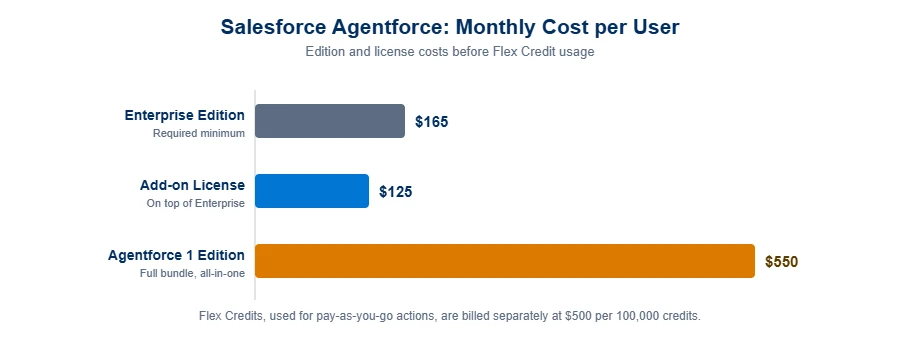
Two costs catch most buyers off guard. First, Agentforce requires Enterprise Edition ($165 per user, per month) or Unlimited Edition at a minimum. It does not run on Professional Edition, and there is no workaround. Second, full functionality often requires Data 360 licensing on top of your Flex Credit spend.
If you're budgeting for Agentforce alongside other Salesforce work, our guide on How Much Does Salesforce Customization Cost in 2026? breaks down pricing by project size.
Note: Always confirm current pricing directly with Salesforce or a certified partner before budgeting, since consumption-based pricing changes more often than traditional per-seat licensing. |
If you evaluated Agentforce in 2024 and walked away unimpressed, it is worth another look. Here is what is genuinely different now:
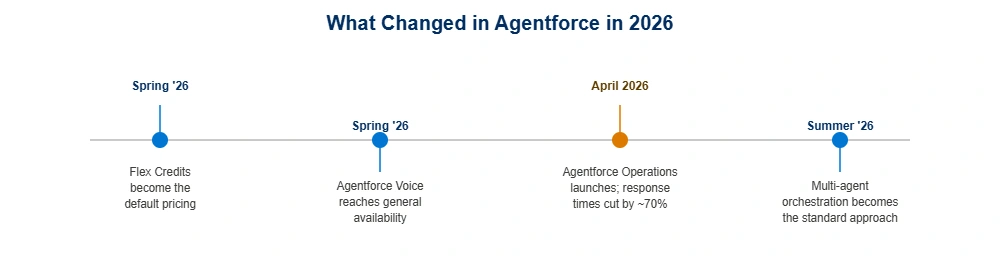
Pricing moved to Flex Credits by default, replacing the earlier flat $2-per-conversation model with cost control at the individual action level.
Agentforce Voice reached general availability, meaning real-time voice agents are now live in production, not just in pilot programs.
Response times dropped by around 70% after Salesforce rebuilt the underlying reasoning engine, making real-time use cases practical for the first time.
Multi-agent orchestration became the standard approach, replacing single large agents with smaller, specialized agents that hand off to one another.
Agentforce Operations launched in April 2026, extending agents into back-office processes like collections, underwriting, and supply chain coordination.
Numbers from real deployments give a more honest picture than marketing claims. According to Salesforce's published customer results:
Wiley, an educational publisher, saw a 40% improvement in case resolution compared to its previous chatbot, along with $230,000 in documented cost savings.
Engie, an energy utility, now resolves 83% of customer queries without a human agent involved.
Grupo Falabella, a Latin American retailer, resolves 60% of WhatsApp customer inquiries autonomously.
Cynoteck has built a Salesforce Agentforce agent for A Water Treatment Solutions Provider.
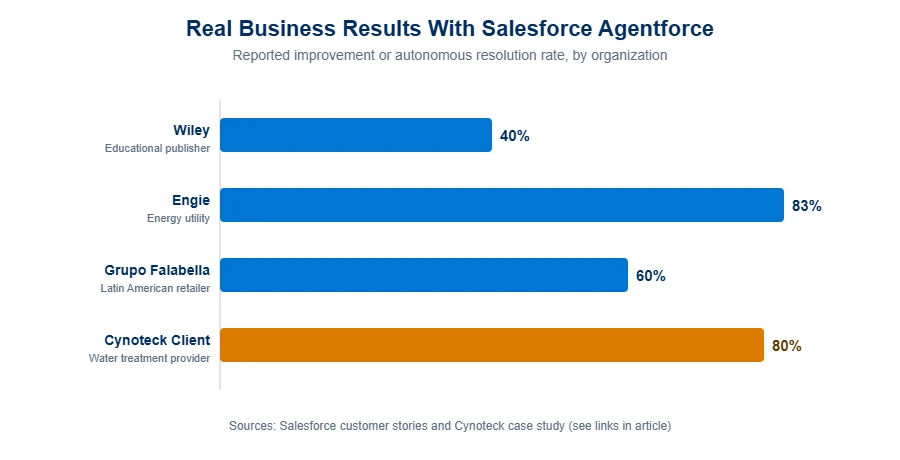
Independent implementations tell a similar story. Cynoteck built a Salesforce Agentforce agent for a growing water treatment solutions provider whose support team could not keep pace with rising inquiry volumes. The agent was built directly on the client's existing Salesforce Flows, so it handled order tracking, account updates, and shipping queries on its own, while passing more complex or sensitive conversations to a human. The project went from concept to live in six weeks, and calls to human agents dropped by 80%, freeing the support team to focus on the interactions that genuinely needed a person. You can read the full breakdown in this Salesforce Agentforce case study.
Across all Agentforce customers, Salesforce reports that 84% saw improved customer satisfaction, and businesses reported a 34% average productivity gain from combining agentic and generative AI tools, according to Salesforce's Agentforce metrics page.
Agentforce is not limited to one type of business. It is built to work anywhere Salesforce already runs, which includes:
Financial services for loan underwriting, account queries, and collections outreach.
Healthcare, for appointment scheduling and routine patient questions.
Retail and commerce, for product discovery and order support.
Technology and B2B services for lead qualification and technical support triage.
Energy and utilities, for billing questions and service requests.
Agentforce gives Salesforce-native businesses a faster, lower-effort path to production AI than building something from scratch. The main advantages are:
Faster deployment than custom-built AI – Most first agents go live in weeks because they are configured, not coded from scratch.
Direct access to your Salesforce data – There is no separate integration layer to build or maintain.
Built-in security and compliance – The Einstein Trust Layer handles data masking and audit logging automatically.
Lower technical barrier – Admins can build and adjust agents using Agent Builder without needing a development team.
Scales with your business – Multi-agent orchestration lets you add specialized agents as new use cases come up, rather than rebuilding from scratch.
Turn repetitive work into intelligent automation with custom Agentforce solutions designed around your unique business processes.
Talk to Our Agentforce ExpertsAgentforce is powerful, but it is not a plug-and-play fix, and being upfront about the limits saves you a difficult conversation later. Here is what to plan around:
Agents cannot fix bad data on their own – Duplicate records and inconsistent fields lead to unreliable results. Data cleanup should be treated as phase one of any Agentforce project, not an afterthought.
Professional Edition is not supported – You must be on Enterprise Edition or above before any Agentforce work can begin.
You do not control the underlying AI model – Salesforce manages the model, so businesses that need a specific or fine-tuned model will not get that flexibility here.
Workflows outside Salesforce require extra work – Agentforce connects to outside systems through MCP connectors, but this adds complexity for processes that live mostly outside your CRM.
Ongoing monitoring is required – Someone on your team needs to review agent transcripts and adjust instructions as your business rules change. This is not a set-and-forget tool.
Agentforce is the right choice for most businesses that already run on Salesforce, especially when the process is high-volume, repeatable, and the data involved lives inside the CRM. It gets you to production faster and comes with built-in compliance controls.
However, a custom AI agent, built using tools like OpenAI or Azure AI, makes more sense when your core workflows live outside Salesforce, or when you need full control over which AI model powers the agent. This is not always an either-or decision. Many businesses run Agentforce for their CRM-native work and a custom agent for a separate use case, such as an internal knowledge tool.
If you want a full side-by-side breakdown of costs, build time, and which option fits which situation, our detailed comparison guide on Salesforce Agentforce vs custom AI agents walks through all six decision factors in depth.
Getting your first Agentforce agent live comes down to six steps, done in order:
Review your Salesforce edition: Confirm you are on Enterprise Edition or above, since Agentforce will not run on Professional Edition.
Pick one high-volume, well-defined process: Good starting points include answering common support questions or qualifying inbound leads.
Clean up the related data first: Duplicate records and missing fields are the most common reasons early agents underperform.
Build the agent using Agent Builder: Start narrow. You can expand the scope once the first agent proves reliable.
Assign an internal owner: Someone needs to monitor transcripts and adjust agent instructions after launch.
Review results after 30 days: Use resolution rate and customer satisfaction to decide whether to expand to a second use case.
Cynoteck's certified Agentforce team starts every engagement the same way: a data and org readiness review, before a single agent gets built. That discipline is what took the water treatment provider's support agent from concept to live in six weeks, with an 80% drop in calls reaching a human.
Whether you need one focused agent or a full rollout across Sales, Service, and Operations, our Agentforce Implementation services are scoped around what your org can actually support today, not a generic template. If Agentforce is one piece of a larger project, our Salesforce Customization Services cover everything else it might touch, from custom objects to Flow automation, in one place.
Discover how Salesforce Agentforce fits your business goals with a personalized consultation from our certified Salesforce experts.
Book a Free ConsultationSalesforce Agentforce has moved quickly from a new idea to a core part of how Salesforce works in 2026. This means that businesses already running on Salesforce have a real, practical AI option available today, not a future promise.
The best way to start is small. Pick one repeatable process, clean up the data behind it, and let one Agentforce agent prove its value before expanding further. That approach, more than any single feature, is what separates the businesses seeing real results from the ones still stuck evaluating. For the broader picture of how Agentforce fits alongside custom objects, Flow, and Apex in a full Salesforce build, see our Complete Guide to Salesforce Customization.
If you want a second opinion on whether your org is ready, Cynoteck's certified Agentforce team starts every engagement with a readiness review, so you know exactly what is deployable before a single agent gets built. Explore our Agentforce Implementation services to see how we can help.
Ans: Salesforce Agentforce is an AI platform built inside Salesforce that runs agents capable of handling entire tasks on their own, such as answering a support question, updating a record, and closing a case, without a person directing each step.
Ans: A limited free tier called Foundations is included with Enterprise Edition, giving you 200,000 Flex Credits to start. Beyond that, usage is billed through Flex Credits or an add-on license.
Ans: No. Agent Builder is a low-code tool designed for Salesforce admins. Developers are only needed for complex custom logic or deep integrations with outside systems.
Ans: A focused first agent with clean data and a clearly defined process can go live in a few weeks. Projects that require significant data cleanup take longer to prepare, though the agent build itself remains quick.
Ans: Flow follows a fixed, pre-built path every time. Agentforce agents build a fresh plan for each situation and adjust their approach based on what they find, which makes them better suited to tasks with real-world variation.
Ans: Agentforce is built to resolve routine, high-volume queries autonomously and hand off complex cases to a human with full context. Most businesses use it to reduce workload on their support team rather than replace it entirely.
Ans: Agentforce is built to run natively inside Salesforce, though it can connect to outside systems through MCP connectors. For workflows that live mostly outside Salesforce, a custom AI agent is often a better fit.

What is Artificial Intelligence? Artificial intelligence (AI) is intelligence demonstrated by machines, which makes it possible for machines to learn from experience, adjust to new inputs and perform human-like tasks.
We are more than just developers and consultants—we are your partners in navigating the digital landscape. Let us be the engine behind your next big success while you focus on your core vision.
Explore Opportunities!

 What Al Services Does a Business Actually Need in 2026.webp)