How to Choose a Salesforce Implementation Partner (2026 Guide)
.webp&w=3840&q=75)
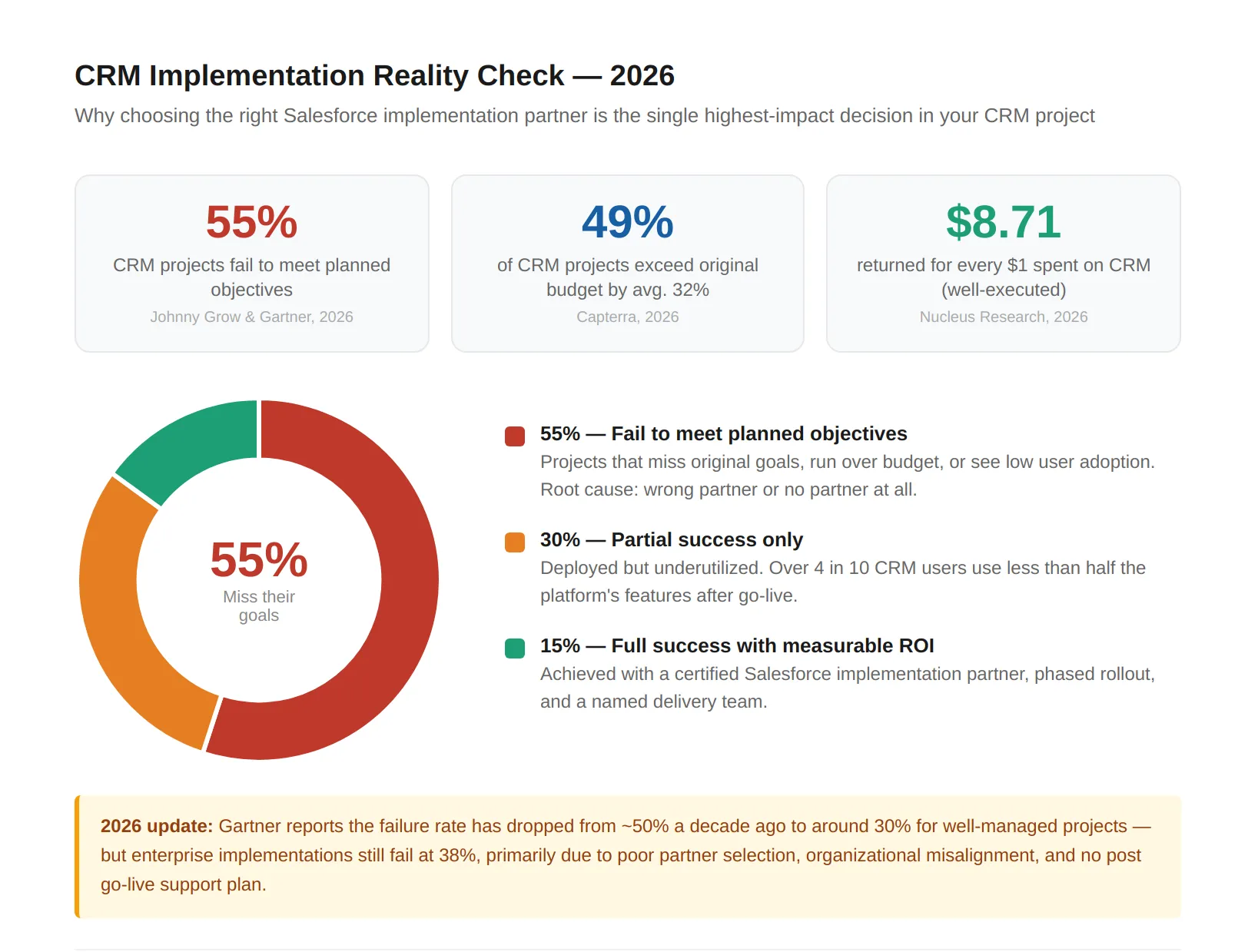
Choosing the wrong Salesforce implementation partner does not just delay your go-live. It costs you budget, team trust, and sometimes the entire project. Research shows that the CRM implementation failure rate is 55%, and the platform is rarely the problem. Poor data migration, inexperienced delivery teams, and a lack of post-go-live support are the real causes. That is why 90% of Salesforce customers rely on a certified consulting partner to implement, customize, and optimize their org correctly from day one.
This 2026 guide gives you a step-by-step framework to evaluate every Salesforce consulting partner on the criteria that determine success: industry experience, team quality, data migration depth, Agentforce and AI readiness, and post-implementation support before you sign a single page.
Before you evaluate a single partner, understand the landscape you are operating in. These are verified stats from official and authoritative sources, not estimates.
Stat | What It Means for You | Source |
Most businesses cannot implement Salesforce successfully without specialist help. | Salesforce Official Blog | |
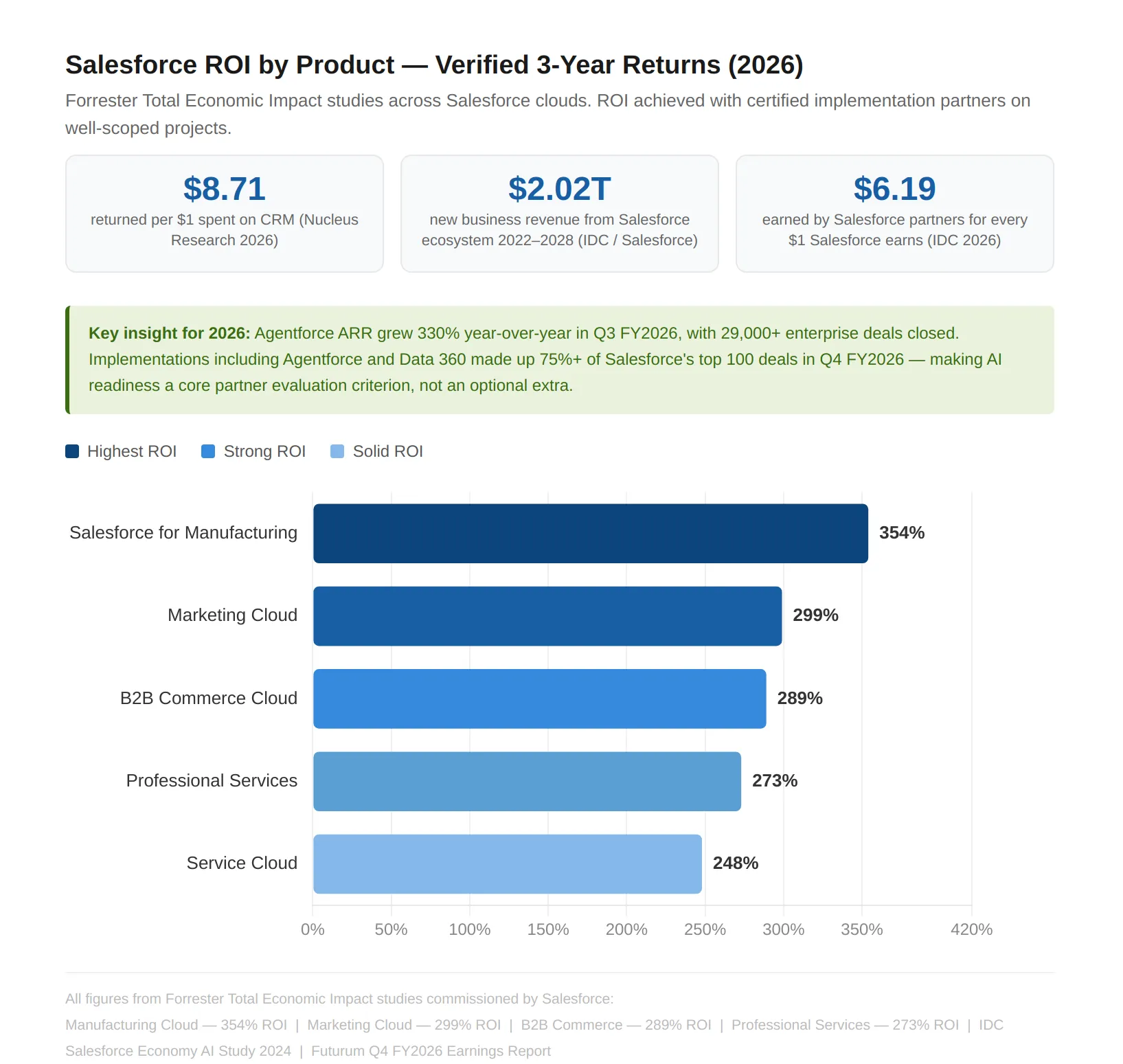
A qualified partner delivers measurable, documented results. | Forrester TEI Study via Salesforce | |
Product-specific ROI depends heavily on implementation quality, not just the platform itself. | Forrester Total Economic Impact Study | |
More partners mean more choice, but also more risk if you do not know what to look for. | Salesforce Official Blog | |
The partner ecosystem is growing fast. Demand for qualified consultants continues to outpace supply. | IDC Study via Salesforce |
Most businesses expect a Salesforce implementation partner to set up the software and hand it back. The reality is significantly broader, and understanding the full scope prevents budget surprises later.
A certified Salesforce consulting partner typically handles all of the following across your project:
Salesforce org configuration: Building your sales pipeline, record types, page layouts, user roles, and permission sets inside your dedicated Salesforce org to match your actual business process.
Data migration: Extracting, cleaning, and importing your existing customer records, contact history, and deal data from a legacy CRM or spreadsheets without breaking relationships between accounts, contacts, and opportunities.
System integrations: Connecting Salesforce to your ERP, finance platform, HR tools, or marketing system using native APIs or middleware tools such as MuleSoft, so data flows in real time across your business.
Salesforce Flow automation: Replacing manual steps in your sales and service workflows using Salesforce's built-in automation tool, reducing errors and saving your team time without writing custom code.
User training and change management: Preparing your team to actually use the platform through role-based training, adoption plans, and structured go-live support.
Post go-live support: Providing ongoing administration, platform updates review, and enhancement hours after launch so your Salesforce org keeps working as your business evolves.
Some partners focus only on the initial build. Others provide managed services that continue long after go-live. Knowing which model you need is the first decision to make before you contact anyone.
Poor data migration, inadequate change management, and inexperienced delivery teams account for more than 75% of Salesforce project failures. None of those are technical problems. All of them are partnership problems.
When businesses choose the wrong partner, outcomes like these follow:
The team stops using the platform within 90 days because workflows do not match how they work.
Duplicate records and broken account-to-contact links appear after migration, and data trust collapses immediately.
Budget disputes begin at the first change request because the Statement of Work was too vague from day one.
A second partner is brought in to fix what the first one built, which doubles the original budget.
The partner decision deserves as much attention as hiring a senior executive. This guide gives you every tool to make it confidently.
Choosing the right Salesforce implementation partner is the single decision that determines whether your project succeeds. Our certified team has navigated complex implementations across healthcare, finance, real estate, and manufacturing. Yours could be next.
Talk to a Salesforce Implementation ExpertThe clearest sign that a business is not ready to evaluate partners is that it cannot clearly answer what success looks like. Walk into every conversation with specific answers to four questions.
What specific problem are you solving? "Our sales team has zero pipeline visibility," or "we are migrating five years of contact history off a legacy CRM," are precise starting points. "We want to improve customer relationships" tends to produce generic proposals that may not match your real needs.
Each Salesforce cloud is a distinct product. Misidentifying it wastes weeks of shortlisting time. Here is a quick reference:
Sales Cloud: It manages your sales pipeline, opportunities, forecasting, and customer relationship data.
Service Cloud: It handles customer support cases, omnichannel routing, and service workflows.
Marketing Cloud: It runs email campaigns, customer journeys, and marketing automation at scale.
Experience Cloud: It builds customer-facing portals, partner portals, and online self-service communities.
Revenue Cloud (CPQ): It manages complex product configuration, pricing rules, and quoting workflows.
A partner who specializes in Sales Cloud may have shallow experience in Service Cloud. Knowing your product upfront removes significant wasted time from the evaluation.
Do you have an internal Salesforce administrator? A Salesforce administrator manages user accounts, permissions, and day-to-day configuration after go-live. If you do not have one, the partner covers more ground during the project, and your post-implementation plan must account for that resource gap from the start.
What is your realistic timeline? A focused Sales Cloud setup for a small team takes four to eight weeks. A multi-cloud implementation with data migration and ERP integrations takes six to twelve months. Any partner quoting six weeks for a complex project has either not understood your requirements or is deliberately underestimating the work.
Salesforce significantly restructured its partner program in early 2026, and understanding the current structure matters because the old tier names: Registered, Silver, Gold, and Platinum, are now retired. If a partner is still presenting themselves as a "Gold" or "Platinum" partner without referencing the new structure, that is a sign they are not current with the ecosystem they claim to know.
What changed and why it matters to you:
Salesforce collapsed its previous four-tier hierarchy into two tiers and simultaneously cut its required certification badges from 170 down to 28. The remaining badges are heavily weighted toward AI, Agentforce deployment, and Data Cloud proficiency. The clear message from Salesforce is that the partner program is now built around AI delivery capability, not traditional CRM configuration and consulting. Understanding where partner selection sits inside the full Salesforce implementation process helps you ask the right questions at the right stage
The current two-tier structure (2026):
Tier | What it signals | Requirements |
|---|---|---|
Select Partner | Base tier. Actively delivering Salesforce solutions. Covers what were previously Registered and Silver partners. | Minimum badge coverage, at least 2 active customer references, passing CSAT threshold |
Summit Partner | Top tier. Covers what were previously Gold and Platinum partners. Now requires demonstrated AI delivery, not just certifications. | Verified Agentforce deployments with outcome data, full AI badge coverage, dedicated Agentforce practice lead on staff |
Where to search: Start on Salesforce AppExchange, the official marketplace where partners publish certifications, case studies, and verified client reviews. Then cross-check independently on G2 and Clutch, where clients post reviews that the partner cannot edit or remove.
This is where many buyers make their biggest mistake. They check certification counts and tier status, then skip the question that matters most: has this firm solved my specific problem in my specific industry before?
Every industry has requirements that a generalist partner will spend weeks learning at your cost:
Financial services: Strict data access controls, audit logging, and compliance reporting structures.
Healthcare: HIPAA-aligned data handling, patient data privacy frameworks, and consent management.
Manufacturing: CPQ (Revenue Cloud) logic tied to production scheduling, product configuration, and pricing rules.
Retail and e-commerce: Complex Commerce Cloud integrations, loyalty workflows, and omnichannel customer data.
Ask for named, specific case studies rather than general sector references. "We implemented Sales Cloud for a logistics company managing 200 field reps across five regions" is meaningful. "We have worked with multiple transport companies" doesn't provide much context.
Ask the partner to walk through a project similar to yours, including what went wrong and what they did about it. A firm that cannot name a specific challenge from a past project either lacks relevant experience or is not being transparent.
Listen for natural use of your industry's terminology. Real sector experience shows up in vocabulary without prompting.
This is the most underused question in every partner evaluation, and the most important one you will ask. Junior consultants frequently replace the senior architect who presents at the sales meeting once the contract is signed. Experienced buyers call this the bait-and-switch, and it is one of the most reliable predictors of implementation failure.
Industry benchmarks show that specialist firms maintaining a senior-architect ratio of 12% or higher on delivery teams consistently produce stronger project outcomes. Large generalist firms often run at 3% to 5% senior architects on live delivery teams. That gap is evident directly in the quality of architectural decisions and the speed at which complex problems are resolved.
Before you sign, ask every one of these questions and request written confirmation in the contract:
Who specifically will be the project lead and lead architect on this engagement?
Can we meet the full delivery team before the contract is signed?
What is the firm's written policy when a key team member needs to leave mid-project?
What percentage of your delivery consultants hold an Application Architect or System Architect certification?
What is the ratio of senior architects to junior consultants on a typical mid-market implementation?
Any partner who uses language like "we will assign our best available resources" without naming individuals is warning you.
These two areas create more post-go-live failures than any other part of an implementation. Most buyers do not probe them deeply enough, and most partners will not volunteer specific answers unless asked directly.
Moving customer records, contact history, deal records, and account relationships from a legacy CRM or spreadsheets into Salesforce is far more complex than exporting a file. Poor migration can lead to duplicate records, broken relationship links, missing deal history, and data your team will not trust from day one.
A reliable partner describes a migration process that covers all of the following:
Data audit: Reviewing the quality, volume, and structure of your source data before any migration work begins.
Field mapping: Documenting exactly how each field in your source system maps to a field in your Salesforce org.
Data cleansing: Identifying and resolving duplicates, missing values, and inconsistent formats before migration runs.
Test migrations: Running the migration in a Salesforce sandbox (a testing copy of your org) and validating results before any data enters your live environment.
Sign-off process: A defined point where your team reviews and approves data accuracy before go-live proceeds.
Any answer that amounts to "we will sort that out during the project" is a serious warning for the highest-risk stage of your implementation.
Salesforce rarely operates alone. Most businesses need it to be connected to an ERP (enterprise resource planning software that manages operations like inventory, accounting, and procurement), HR platforms, finance tools, and marketing systems. An org that does not share data cleanly with your other tools becomes one more silo your team updates separately.
Ask whether the partner has direct hands-on experience connecting Salesforce to the exact platforms you use, such as SAP, NetSuite, Workday, or HubSpot.
Ask which integration tools they use: native Salesforce APIs, MuleSoft (Salesforce's own integration platform), or third-party middleware such as Workato or Boomi, and why they recommend that approach for your situation.
Ask how they handle integration failures, because every integration breaks at some point, and their answer reveals how they manage risk in practice.
This is the evaluation factor that most competitor guides published before 2025 entirely miss. It is now one of the most important criteria for any implementation starting in 2026.
Salesforce has made three significant investments that are reshaping how modern Salesforce orgs are designed:
Agentforce is Salesforce's autonomous AI agent platform. It embeds AI agents directly into CRM workflows to handle tasks such as service case resolution, sales development follow-up, and customer onboarding, without manual intervention by your team.
Data Cloud is Salesforce's unified customer data platform. It pulls real-time data from all your sources into a single customer profile. It is now the foundational layer for AI-powered implementations and is central to how enterprise orgs are being built in 2026.
Einstein powers AI features throughout every Salesforce cloud, including lead scoring, opportunity predictions, case classification, Einstein Bots, and conversational AI via Einstein Copilot.
A partner who has not yet built a live project using Agentforce or Data Cloud is already designing implementations that will need significant rearchitecting within two to three years.
Ask this question in every evaluation call: "Can you describe a recent project where you deployed Agentforce or Data Cloud? What was the specific use case, and what measurable outcome did the client achieve?" Specific, detailed answers indicate genuine experience. Promotional or vague responses do not.
Go-live is not the end of the project. It is closer to the halfway point. And what happens next determines whether your team actually uses the platform or quietly goes back to spreadsheets. That outcome depends entirely on the support model your partner provides, and on how well your organization is prepared for Salesforce user adoption from day one.
A managed services retainer is a fixed monthly fee for an agreed number of administration and enhancement hours. It keeps a qualified consultant available without the cost of hiring a full-time internal Salesforce administrator.
Hypercare is a defined period of intensive, high-availability support, typically 30 to 60 days post go-live, during which the partner monitors the system and responds to issues with guaranteed response times. Ask what those response time commitments are in writing.
The right partner trains your team to manage and grow the platform independently over time. A partner whose model relies on your continued dependency is a long-term budget risk.
Understand exactly what happens when you need help beyond the scope of your retainer. Hidden hourly rates are one of the most common sources of post-go-live budget surprises.
If you observe more than two of the following during your evaluation, remove that partner from your shortlist without exception.
Proposal arrives before thorough discovery: A proposal sent before the partner has asked detailed questions about your data, integrations, and workflows is a pre-built template, not a solution designed for your business.
No specific data migration methodology: Any answer that is not a documented, step-by-step process poses the highest risk in your project.
Unnamed delivery team: "We will assign our best available resources," without naming specific people, carries direct bait-and-switch risk.
Over-reliance on custom Apex code: Apex is Salesforce's server-side programming language for custom logic. Less-experienced partners often write Apex when Salesforce Flow could handle the same requirement at a fraction of the long-term maintenance cost. Ask whether they have a formal policy of using a standard configuration before writing custom code.
Vague scope in the proposal: Broad deliverable descriptions in the Statement of Work create the conditions for every budget dispute and missed expectation that follows. Every deliverable should be named specifically.
Resistance to reference calls: Partners confident in their delivery welcome reference checks without hesitation. Those who delay, limit, or redirect them away from speaking with past clients are telling you something they have not said directly.
No AI or Agentforce readiness: A partner with no hands-on experience in Agentforce, Data Cloud, or Einstein is already behind where the Salesforce platform is heading.
Use this framework to evaluate every partner you speak with on identical criteria. Score each area from 1 to 5, where 5 means specific and verifiable evidence was provided and 1 means the answer was vague or the partner could not provide evidence at all.
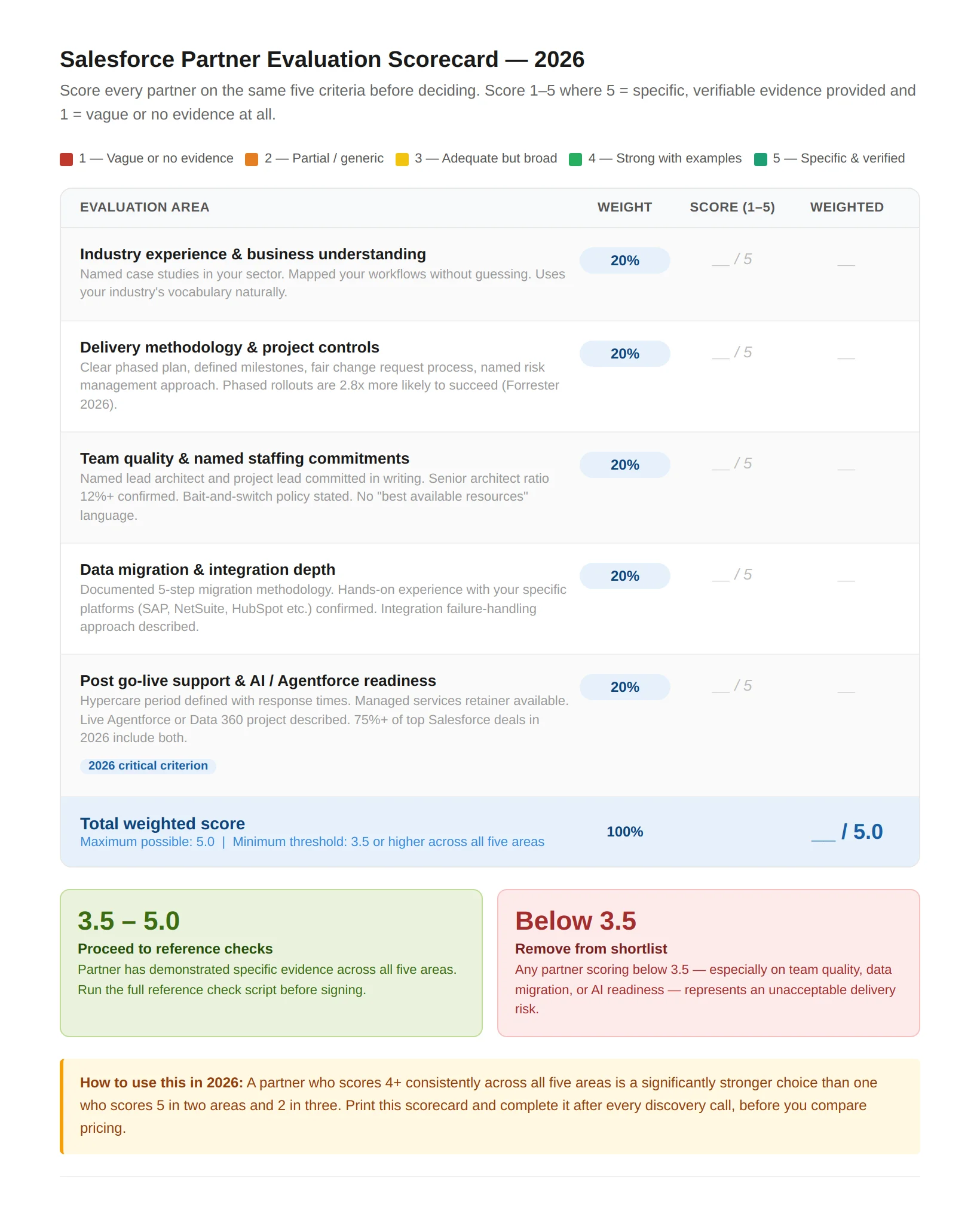
Evaluation Area | Weight | Score (1–5) | Weighted Score |
Industry experience and business understanding | 20% | ||
Delivery methodology and project management controls | 20% | ||
Team quality and named staffing commitments | 20% | ||
Data migration and integration depth | 20% | ||
Post go-live support and AI readiness (Agentforce/Data Cloud) | 20% | ||
TOTAL | 100% |
A Salesforce consulting partner who scores consistently across all five areas is a stronger choice than one who excels in two and falls short in three. Each area represents a documented failure mode in real Salesforce projects.
Run every question from this guide through our team. Ask about our delivery architects by name, our data migration methodology, and our post-go-live support model. We have a specific answer for every point on the scorecard.
Start the ConversationThe Statement of Work defines what the partner delivers, by when, and for how much. A vague SOW is one of the most reliable predictors of a troubled engagement. Before you sign, verify that all of the following are explicitly stated.
A specific list of what is in scope, written in plain business language, not just product names.
A clear written statement of what is explicitly out of scope.
Defined discovery outputs with completion dates, such as agreed workflow documentation and a confirmed data model.
A phased delivery plan with milestones and specific acceptance criteria for each phase.
Named project lead and named lead architect committed for the duration of the engagement.
A written process for replacing key team members if they leave mid-project.
Clear roles and time commitments for both the partner team and your internal team.
Data migration is explicitly listed as in scope, not assumed or implied.
Number of test migration runs included before go-live, with a defined data validation and client sign-off process.
User training sessions are defined by role, where possible, not a single group session.
A defined hypercare period with written response time commitments.
Handover documentation and knowledge transfer are included before the engagement closes.
Salesforce implementation cost varies significantly based on scope, the Salesforce products involved, and the partner type. Use these ranges for budgeting and planning purposes, and always request a line-by-line scope breakdown rather than comparing headline totals across proposals.
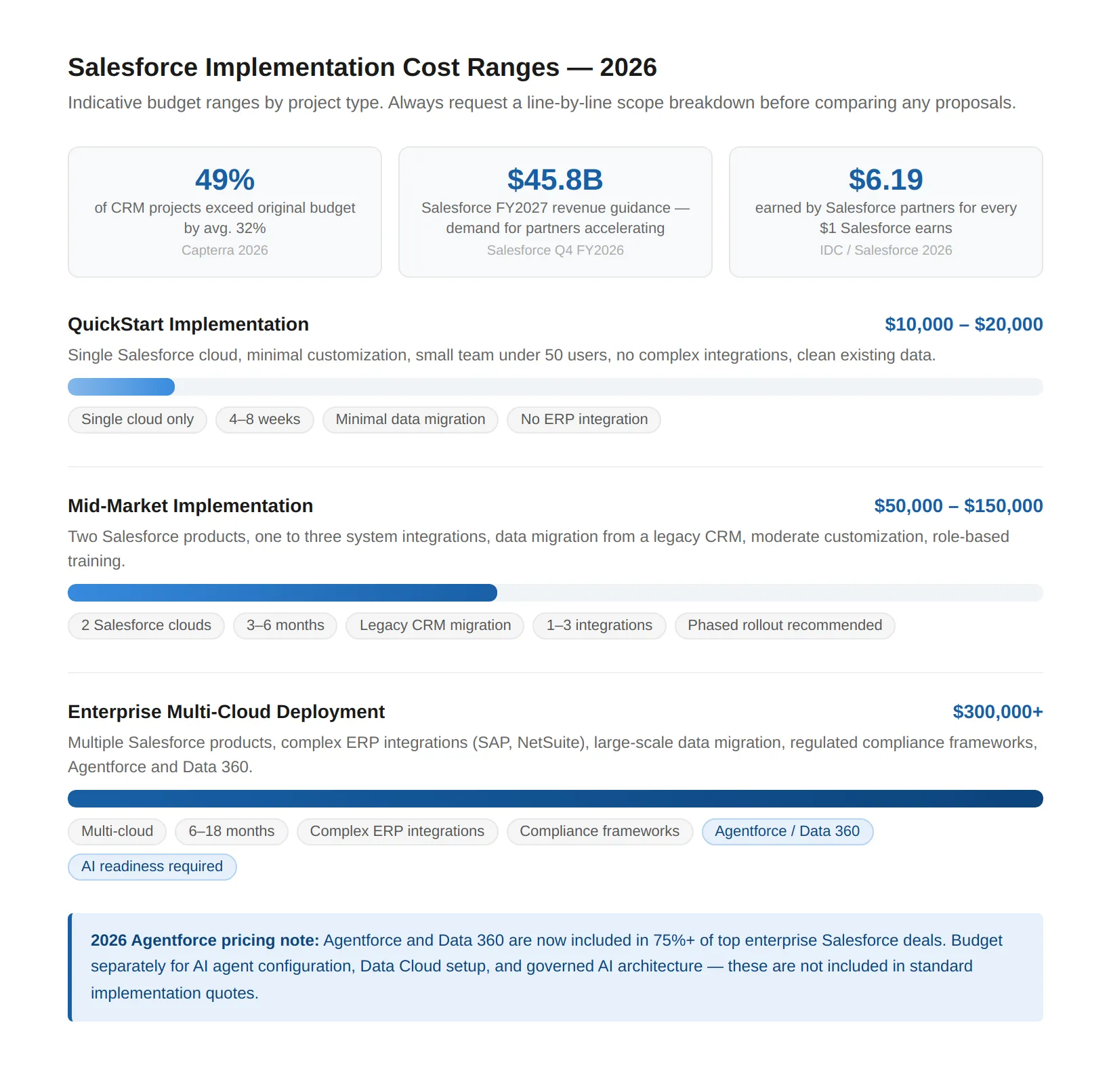
QuickStart implementations: Single cloud, minimal customization, small team, no complex integrations: $10,000 to $20,000.
Mid-market implementations: Two Salesforce products, one to three integrations, data migration from a legacy CRM: $50,000 to $150,000.
Enterprise multi-cloud deployments: Multiple products, complex ERP integrations, large-scale data migration, regulated industry compliance: $300,000 and above.
A lower quote that excludes data migration, user training, and post-launch support will almost always cost more in total than a higher quote that covers everything. Compare scope, not price.
The partner you choose shapes how your sales team works, how your customer data is structured, and whether your team actually uses the platform 90 days after go-live. Use the scorecard in this guide to compare every candidate on identical criteria. Confirm that your contract covers scope, named team members, data migration, and post-go-live support before you sign a single page.
If you want to discuss your specific requirements with a certified Salesforce implementation partner who has delivered projects in your industry, we would welcome that conversation.
You have the criteria. We have the track record. Let's talk about your project, your timeline, and the right way to move forward.
Talk to a Salesforce ConsultantAns: If you have experienced Salesforce administrators and developers internally, straightforward single-cloud setups with clean, well-structured data are manageable without an external partner. For projects involving complex data migration, multiple system integrations, or limited internal Salesforce expertise, a qualified partner significantly reduces the risk of building something that does not scale. A strong partner also brings cross-industry knowledge from dozens of completed projects that your internal team would take years to build.
Ans: Earlier than most businesses think. The right partner helps you make better decisions before your requirements are finalized, including which Salesforce cloud to choose, how to structure your data model, which integrations to prioritize first, and what a realistic go-live plan looks like. Bringing them in after all decisions are already made means paying for expertise while limiting its impact on outcomes.
Ans: It happens when junior consultants replace the senior architect who presents at the sales meeting once you sign. Prevent it by requiring named team members in the proposal, confirming team composition in writing in the contract, and asking for the specific ratio of senior architects to junior consultants on the delivery team before you commit.
Ans: AppExchange is Salesforce's official marketplace where certified partners publish their credentials, case studies, industry experience, and verified client reviews. You can filter by Salesforce cloud, industry, and location. Use it to build your initial shortlist, then verify independently on G2 and Clutch, where clients post reviews that the partner cannot edit. Balance both sources before drawing any conclusions.
Ans: Ask them to describe a specific recent project where they deployed Agentforce or Data Cloud. Ask for the use case, the technical approach they took, and the business outcome the client measured. Genuine experience produces detailed, specific answers that reference real constraints and decisions. Promotional language about "AI-ready capabilities" without a specific example is not evidence of experience.
 Outsource Salesforce Development or Build In-House Which is the Best for Your Business.webp)
Outsourcing Salesforce development vs. building an in-house Salesforce team: 2026 cost insights, salary comparisons, key benefits, challenges, and the best hiring model for your business growth.
We are more than just developers and consultants—we are your partners in navigating the digital landscape. Let us be the engine behind your next big success while you focus on your core vision.
Explore Opportunities!