10 Ways to Build Stronger Customer Relationships and Increase Loyalty
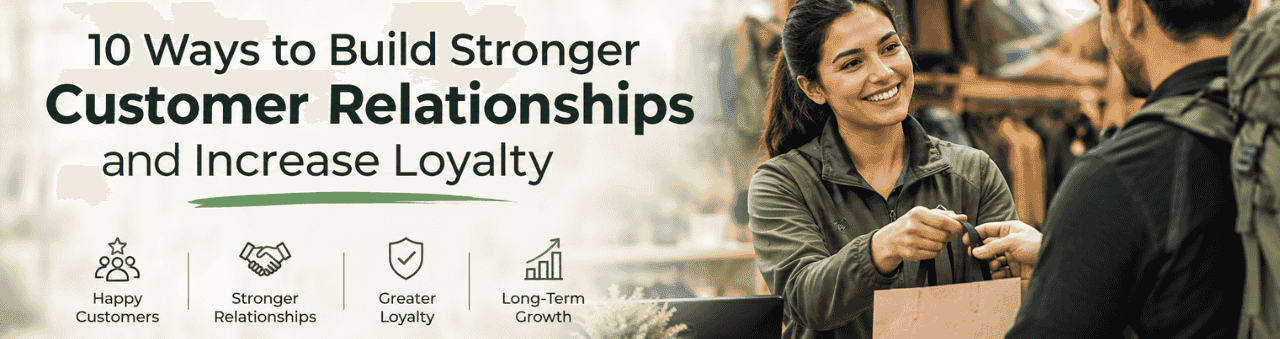
Quick answer: The best ways to build strong customer relations are to listen actively, communicate proactively, personalize every interaction, respond fast, be transparent, exceed expectations, act on feedback, reward loyalty, build a community, and use a CRM to keep every customer touchpoint connected. Businesses that do this consistently keep more customers, earn more referrals, and spend less on acquisition. |
Customer relations are the ongoing interactions, attitudes and experiences that shape how a customer feels about your business before, during and after a purchase. Strong customer relations mean customers feel heard, valued and confident that you will keep your promises.
It covers every touchpoint: your website, sales calls, onboarding, support tickets, billing, emails, social media and even how you handle a complaint. A customer who trusts you does not just buy again. They recommend you, forgive the occasional mistake and give you honest feedback.
People often use the two terms interchangeably, but they are not the same.
Customer Service | Customer Relations | |
|---|---|---|
Focus | Solving specific issues and answering questions | Building long-term trust and loyalty |
Timing | Reactive, when a customer needs help | Proactive, throughout the whole customer lifecycle |
Owned by | Support team | Sales, marketing, support, success and leadership |
Goal | Resolve the request | Retain the customer and grow lifetime value |
Example | Fixing a billing error | Checking in after the fix and offering a better plan |
Good customer service is a vital piece of good customer relations, but relations go further. They shape whether the customer stays at all.
Every business says customers come first. The ones that act on it see clear commercial benefits:
Higher retention and lower churn. Loyal customers keep buying, which makes revenue more predictable.
Lower acquisition costs. Keeping a customer is generally cheaper than winning a new one, and long-standing research from Bain & Company links small retention gains to large profit gains.
More word-of-mouth. Happy customers become brand ambassadors who bring in referrals without ad spend.
Higher customer lifetime value. Trusted customers buy more, try new products and accept upgrades more readily.
Honest feedback. Customers who feel valued tell you what is broken before they leave.
A competitive edge. When products and pricing look alike, the relationship becomes the difference.
Here are ten practical ways to build strong customer relations, with specific actions you can start this week.
Active listening means giving customers your full attention, asking follow-up questions and confirming you understood the problem before offering a solution. It is the base of every other tip on this list.
How to do it:
Let the customer finish before you respond, then repeat their issue back in your own words.
Record pain points, preferences and personal context in your CRM so the next conversation picks up where the last one ended.
Listen beyond calls and emails. Review social comments, survey replies and support transcripts for patterns.
Result: Customers feel understood, and your team spots problems earlier.
Do not wait for a complaint to get in touch. Share updates, delays, new features and useful advice before the customer has to ask.
How to do it:
Send onboarding emails, renewal reminders and service updates on a predictable schedule.
Reach customers on their preferred channel, whether that is email, chat, WhatsApp, phone or social.
Tell customers early when something goes wrong. Bad news delivered late damages trust far more than bad news delivered early.
Result: Fewer surprises, fewer escalations and a stronger sense that you are reliable.
Customers do not want to feel like ticket numbers. Using their name, purchase history, past conversations and stated preferences shows you pay attention.
How to do it:
Segment customers by behavior, industry, plan or lifecycle stage and tailor messages to each group.
Recommend products or content based on what they actually bought or searched for.
Mention relevant history in support chats so customers never have to repeat themselves.
Marketing automation platforms can help you scale this. See how Salesforce Marketing Cloud handles journeys, personalization and AI for a practical example.
Result: Higher engagement, higher conversion and a stronger emotional connection.
Speed signals respect. A quick, correct answer often matters more to a customer than a perfect answer that arrives days later.
How to do it:
Set response-time targets for each channel and track them.
Give frontline staff the training and authority to solve problems without passing them up the chain.
Build a searchable knowledge base so agents and customers can find answers quickly.
Use automation and case routing to send each query to the right person immediately.
Result: Lower frustration, better first-contact resolution and fewer repeat tickets.
Trust is the currency of customer relationships, and honesty is how you earn it. Be clear about pricing, timelines, limitations and policies.
How to do it:
Never overpromise to close a sale. Promise what you can deliver and deliver it.
Own mistakes quickly, explain what happened and say how you will fix it.
Publish clear pricing, terms and service-level commitments.
Result: Customers believe what you tell them, which shortens sales cycles and softens the impact of occasional errors.
Meeting expectations keeps customers. Exceeding them makes customers talk about you. Small, thoughtful gestures often outperform expensive ones.
How to do it:
Send a helpful resource or a quick tip you know will matter to a specific customer.
Follow up after a project goes live to check that everything works as intended.
Fix a small issue before the customer notices it.
Send a handwritten or personal thank-you after a milestone.
Result: Memorable experiences that drive referrals and reviews.
Feedback shows customers you value their opinion. Acting on it, and telling them you did, shows you mean it.
How to do it:
Use short surveys (CSAT, NPS, CES) at key moments such as after onboarding, support resolution or renewal.
Offer easy ways to share feedback: in-app prompts, review links, feedback forms or a quick call.
Tell customers what changed because of their input. A simple “you asked, we built it” message goes a long way.
Follow up personally with unhappy customers.
Result: Better products, higher trust and early warning of churn risk.
Long-term customers should feel noticed. Recognition costs little and has an outsized effect on retention.
How to do it:
Create loyalty or referral programs with rewards customers actually want.
Offer early access to new features, exclusive discounts or priority support for long-standing customers.
Celebrate anniversaries and milestones with a personal note.
Say thank you, often and specifically.
Result: Stronger loyalty, more repeat purchases and more referrals.
A community turns customers into participants. When customers connect with each other as well as with your brand, they are far less likely to leave.
How to do it:
Launch a user group, forum, private social group or customer advisory board.
Host webinars, workshops and live Q&As where customers share what is working for them.
Spotlight customer stories, reviews and case studies.
Let customers help each other, and let your team join the conversation.
Result: Peer support, more brand advocates and a steady stream of product ideas.
All nine tips above get harder as your customer base grows. Spreadsheets, shared inboxes and disconnected tools lead to forgotten follow-ups and customers repeating themselves. A CRM solves this by giving sales, marketing and support one shared view of every customer.
How to do it:
Centralize contact details, purchase history, support cases and conversations in one platform.
Automate reminders, follow-ups and renewal alerts so nothing slips.
Use dashboards and AI insights to spot at-risk customers and upsell opportunities.
Connect your CRM to email, chat and Microsoft 365 so your team works in the tools they already use.
For a deeper look at what a CRM can do, read Cynoteck's guide to the biggest benefits of CRM.
Result: Consistent experiences across every channel and team.
Use this checklist as a quick audit of your current approach.
Do we record customer preferences and history where every team can see them?
Do we contact customers before they have to contact us?
Do we know our average first-response and resolution times?
Can any frontline employee resolve a common issue without escalation?
Do we ask for feedback at least at onboarding, after support and at renewal?
Do we tell customers what we changed based on their feedback?
Do our best customers receive recognition or rewards?
Do we give customers a place to connect with each other?
Can we spot at-risk customers before they cancel?
If you answered “no” to more than three, start with the matching tip above.
Microsoft Dynamics 365 brings CRM and business applications together in one connected platform, so every team works from the same customer information. That matters because strong customer relations depend on context: who the customer is, what they bought, what they asked last week and what they are likely to need next.
Here is how Dynamics 365 supports the practices described above.
A 360-degree customer view. Sales, marketing and service teams see the same history, so customers do not repeat themselves.
Smarter customer service. Case management, SLA tracking, knowledge articles and intelligent routing help agents respond faster and resolve more issues first time.
AI-powered insight. Copilot and predictive scoring help teams prioritize the right accounts and surface churn risk. Learn more in Cynoteck's overview of Dynamics 365 Sales AI features.
Personalization at scale. Segmentation and automated journeys let you send the right message at the right moment.
Pipeline and relationship visibility. Managers see where deals and accounts stand, and which relationships need attention. Explore Dynamics 365 Sales benefits, capabilities and features.
Seamless Microsoft integration. It connects with Outlook, Teams and the wider Microsoft ecosystem. See the benefits of upgrading to Dynamics 365.
A tool alone does not build relationships, though. The platform has to fit your sales process, service workflows and data. Poor setup leads to low user adoption and unused features.
Cynoteck is a Microsoft Solutions Partner with certified Dynamics 365 consultants and developers. The team helps businesses plan, implement, customize, integrate and support Dynamics 365 across Sales, Customer Service, Marketing, Field Service, Business Central and Project Operations, so your CRM supports the customer relationships you want to build.
What you get with our Dynamics 365 consulting services:
Discovery and CRM strategy aligned to your customer journey
Implementation, configuration and custom development
Data migration and integration with your existing systems
User training and adoption support
Ongoing support, optimization and upgrades
Cynoteck works with clients across 15+ countries and maintains a client retention rate above 90 percent, which comes from the same principles in this article: clear communication, consistent delivery and long-term partnership.
Still choosing a partner? Compare the top Dynamics 365 consulting companies in India or the top Dynamics 365 consultants in the USA.
Ready to turn customer data into stronger relationships? Talk to a Dynamics 365 consultant at Cynoteck.
You cannot improve what you do not measure. Track these metrics every month or quarter:
Metric | What It Tells You |
|---|---|
Customer retention rate | The share of customers who stay over a given period |
Churn rate | The share of customers who leave |
Net Promoter Score (NPS) | How likely customers are to recommend you |
Customer Satisfaction (CSAT) | Satisfaction after a specific interaction |
Customer Effort Score (CES) | How easy it was to get help or complete a task |
Customer Lifetime Value (CLV) | Total revenue expected from a customer over time |
First response and resolution time | How quickly your team responds and solves problems |
Repeat purchase and referral rate | How often customers return and bring others |
Compare results by segment, product and account owner. Patterns show you where relationships are strong and where they are slipping.
Only contacting customers to sell. Mix in helpful, non-promotional communication.
Treating all customers the same. Segment and personalize.
Collecting feedback and doing nothing. Always close the loop.
Making customers repeat themselves. Keep a shared record of every interaction.
Over-automating. Automation should free your team to be more human, not replace the human touch.
Ignoring existing customers after the sale. Retention starts at onboarding.
Overpromising. Short-term wins cost long-term trust.
First 30 days: Audit your current touchpoints, review feedback and complaints, and pick your top three tips from this list.
Days 31 to 60: Centralize customer data in a CRM, set response-time targets and launch one feedback survey.
Days 61 to 90: Introduce a loyalty or recognition program, start a customer community, and review your retention, CSAT and NPS results.
The most effective ways are active listening, proactive communication, personalization, fast issue resolution, honesty, going beyond expectations, collecting and acting on feedback, rewarding loyalty, building a community and using a CRM to keep customer information connected.
Start with trust. Understand what your customers need, communicate openly, deliver on your promises and follow up after every key interaction. Then make it repeatable with shared customer data, clear service standards and regular feedback.
Use the customer’s name, respond quickly, say thank you, admit mistakes honestly, check in after a purchase and ask for feedback. Small, consistent actions build more trust than occasional big gestures.
Customer service solves specific problems when customers ask for help. Customer relations is the broader, long-term effort to build trust and loyalty across every interaction. Service is one part of relations.
Strong customer relations improve retention, reduce churn, raise lifetime value, generate referrals and lower acquisition costs. They also give you honest feedback that helps you improve.
Track retention rate, churn rate, NPS, CSAT, CES, customer lifetime value, response and resolution times, and repeat purchase or referral rates.
A CRM stores every interaction in one place, automates follow-ups, supports personalization and highlights at-risk customers. This lets every team deliver consistent, informed experiences. Dynamics 365 adds AI-driven insights and integrates with Microsoft 365.
There is no fixed timeline. Trust builds through repeated positive interactions, so many businesses see better feedback and retention within a few months of consistent effort, while deeper loyalty grows over years.
Building strong customer relationships is not about one big campaign. It is about doing the basics well, every time: listen, communicate, personalize, respond quickly, be honest, delight, learn from feedback, reward loyalty, build community and use the right technology to tie it together.
If you want your CRM to support those habits, a Dynamics 365 setup built around your customer journey is a strong place to start. Explore Cynoteck's Dynamics 365 consulting services to see how we can help.
The most effective ways are active listening, proactive communication, personalization, fast issue resolution, honesty, going beyond expectations, collecting and acting on feedback, rewarding loyalty, building a community and using a CRM to keep customer information connected.
Start with trust. Understand what your customers need, communicate openly, deliver on your promises and follow up after every key interaction. Then make it repeatable with shared customer data, clear service standards and regular feedback.
Use the customer’s name, respond quickly, say thank you, admit mistakes honestly, check in after a purchase and ask for feedback. Small, consistent actions build more trust than occasional big gestures.
Customer service solves specific problems when customers ask for help. Customer relations is the broader, long-term effort to build trust and loyalty across every interaction. Service is one part of relations.
Strong customer relations improve retention, reduce churn, raise lifetime value, generate referrals and lower acquisition costs. They also give you honest feedback that helps you improve.
Track retention rate, churn rate, NPS, CSAT, CES, customer lifetime value, response and resolution times, and repeat purchase or referral rates.
A CRM stores every interaction in one place, automates follow-ups, supports personalization and highlights at-risk customers. This lets every team deliver consistent, informed experiences. Dynamics 365 adds AI-driven insights and integrates with Microsoft 365.
There is no fixed timeline. Trust builds through repeated positive interactions, so many businesses see better feedback and retention within a few months of consistent effort, while deeper loyalty grows over years.

The best ways to build strong customer relations are to listen actively, communicate proactively, personalize every interaction, respond fast, be transparent, exceed expectations, act on feedback, reward loyalty, build a community, and use a CRM to keep every customer touchpoint connected. Businesses that do this consistently keep more customers, earn more referrals, and spend less on acquisition.

Discover the top 10 benefits of custom CRM software development for modern businesses. Learn how tailored CRM solutions improve efficiency, enhance customer relationships, and drive business growth.
We are more than just developers and consultants—we are your partners in navigating the digital landscape. Let us be the engine behind your next big success while you focus on your core vision.
Explore Opportunities! Dynamics 365 Sales Pricing, Features & Alternatives.webp)
.png)
 Microsoft Dynamics 365 Sales Professional vs Enterprise.webp)