How Much Does Salesforce Customization Cost in 2026?
Summary: This guide breaks down real Salesforce customization pricing by project size, explains what drives costs up or down, and shows you how to avoid paying for development you do not need. |
Most businesses asking this question have already been told they need Apex development. Some of them do. Many of them do not, and they are about to pay several times more than necessary for a system their own admin cannot maintain afterward. This guide gives you real numbers, not vague ranges. By the end, you will know what small, mid-size, and large customization projects cost, as well as which factors most affect the price.
Quick Answer: A small Salesforce customization, covering custom objects, fields, and basic Flow automation, typically costs between $3,000 and $8,000. A mid-size project involving Apex development and Lightning Web Components ranges from $8,000 to $25,000. A larger project with multi-system integration and Agentforce agent configuration usually starts above $25,000. Your final number depends on scope, not just project type.
Salesforce customization pricing is not random. It comes down to how much custom code is required and how many systems need to talk to each other. Here is what moves the number:
Amount of custom code needed: Apex development and Lightning Web Components cost more than declarative Flow work because they need a certified developer, not just an admin.
Number of integrations: Connecting Salesforce to one system is straightforward. Connecting it to your ERP, billing platform, and support desk at once multiplies both the cost and the testing required.
Data complexity: Migrating or restructuring years of messy data costs more than building clean structures from scratch.
Compliance requirements: Healthcare and financial services projects need extra security work, such as field-level encryption and audit logging, which adds time and cost.
Existing org condition: Customizing a clean, well-documented org costs less than fixing one built with no version history or unclear logic.
Note: Two businesses asking for "a custom quoting tool" can receive very different quotes, because one needs three fields and the other needs a multi-source pricing engine with real-time tax calculations. |
Compare your customization needs with real project examples and receive practical guidance before committing to development.
Get a Cost AssessmentSalesforce breaks down into three clear tiers once you know what you're building. Each one covers a different mix of work, from a simple automation tweak to a full multi-system build. Find the tier that matches your requirement below to see the real price and timeline.
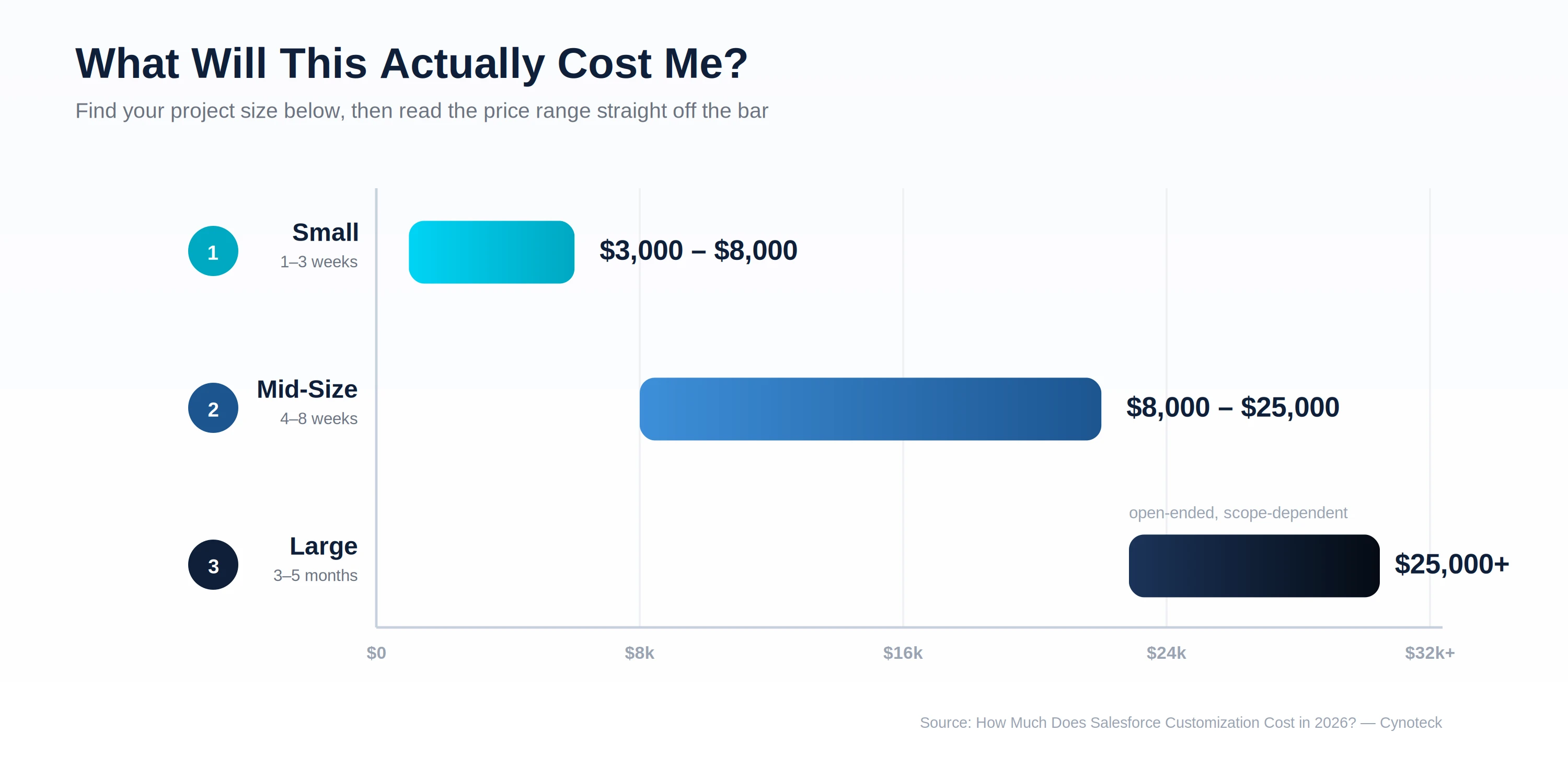
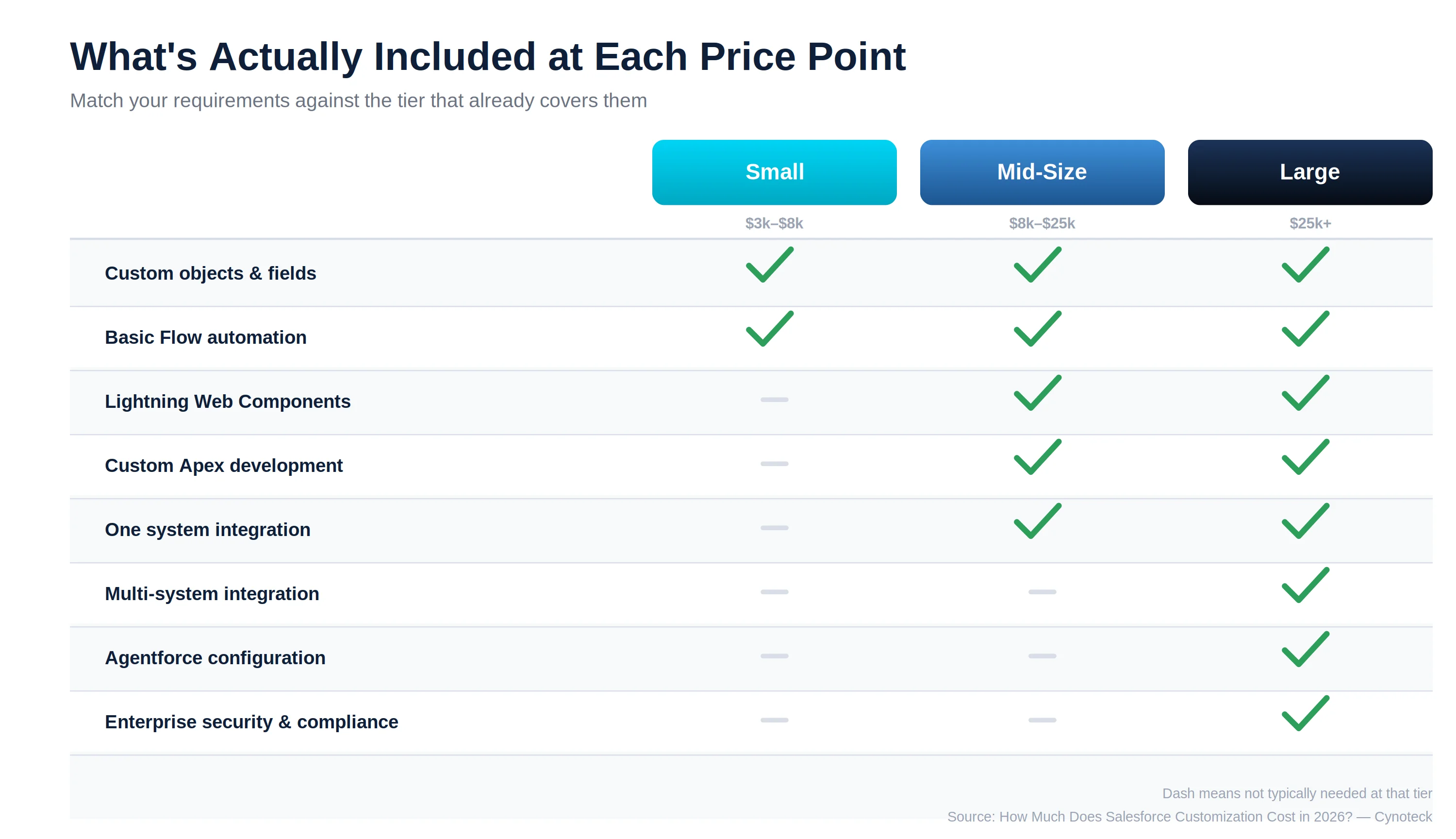
Small Salesforce customization work typically costs $3,000 to $8,000 and takes one to three weeks. This usually covers:
Custom objects and fields for a specific business need
Page layout and record type adjustments
Basic Flow automation, such as automated follow-up emails or record assignment rules
Validation rules and simple reporting setup
Pro Tip: If your requirement fits this list, ask whether it can be solved through configuration instead of customization. Many small projects do not need a developer at all, which saves the entire cost.
Mid-size projects run $8,000 to $25,000 and take four to eight weeks. This tier usually includes:
Custom Apex development for logic Flow cannot handle, such as multi-object calculations
Lightning Web Components for a purpose-built interface, like a quoting tool or support dashboard
A single third-party integration, such as connecting Salesforce to a billing platform
Full testing and documentation for the custom code delivered
This is the most common tier for growing businesses that have outgrown configuration but do not need a full platform overhaul. Most mid-size Salesforce projects fall here because they solve a genuine gap without requiring an enterprise-level rebuild.
Larger projects start above $25,000 and can run three to five months, depending on scope. This tier typically involves:
Multi-system integration across an ERP, support desk, and Salesforce, using middleware such as MuleSoft or Dell Boomi
Agentforce agent configuration for AI-handled sales or service tasks
Significant data architecture changes across multiple objects and business units
Enterprise-level security and compliance work, such as Salesforce Shield encryption
Note: Projects at this scale should always start with a discovery phase and a written requirements document before any development pricing is finalized. Without this step, scope creep is almost guaranteed. |
Beyond the build itself, a few costs catch businesses off guard:
Ongoing maintenance: Custom code needs upkeep across Salesforce's three annual releases. Budget for this separately from the initial build.
Sandbox environments: Complex projects need Developer Pro, Partial Copy, or Full Copy sandboxes for proper testing, which some quotes leave out.
Legacy cleanup: If you are customizing an org another vendor built, expect extra hours for a health check before new work begins.
User training: Larger interface changes, like new Lightning Web Components, need training time that is easy to underestimate.
Discover the most cost-effective solution by validating whether configuration, Flow, or custom development best fits your requirements.
Discuss Your RequirementsThe single biggest cost saver is checking whether Flow, Salesforce's no-code automation tool, can solve the problem before agreeing to any Apex development. This is why a proper discovery call matters more than a fast quote. A partner who pushes straight to custom code without asking about your existing setup is a warning sign, not a good sign.
For this reason, request a fixed-fee quote only after a 30-minute discovery conversation, not before. This is the point where scope, and therefore cost, becomes clear.
Vague pricing is how businesses end up paying for Apex development they never needed. Cynoteck's estimates come from 500+ delivered Salesforce customization projects, not a generic price list. That is why our quotes tend to hold up once the real work starts.
Every engagement starts with a 30-minute discovery call, followed by a fixed-fee quote, not an hourly rate that grows as the project goes on. This is also why we check Flow before Apex on every request. It is the single biggest lever for keeping your number where we said it would be. Clients notice the difference, which shows up in our 90% retention rate and our 95% on-time deployment record.
Fixed-fee quotes after discovery, so there are no hidden line items added later
500+ delivered projects, meaning estimates are grounded in real project data
Flow is checked before Apex, which keeps both build and maintenance costs down
95% on-time deployment rate, so the timeline in your quote holds up in practice
Salesforce customization cost comes down to scope, not guesswork. Once you know whether your need is small, mid-sized, or large, you can budget with confidence rather than relying on a vague estimate. If you want an exact number for your specific situation, a free discovery call will give you a fixed quote before you commit to anything.
Get more details on our Salesforce customization services; please refer to our service page.
If part of your scope includes AI automation, our guide on what Agentforce actually costs to configure is worth reading next. For the bigger picture on what customization involves, see our Complete Guide to Salesforce Customization.
Speak with certified Salesforce consultants and get transparent pricing based on your business goals, scope, and technical requirements.
Book Your Free ConsultationAns: Small projects, such as custom objects, fields, and basic automation, typically cost $3,000 to $8,000 and take one to three weeks to complete. Many of these requirements can also be addressed through configuration alone, at even lower cost.
Ans: Cost depends on the amount of custom code required, the number of integrations, and the condition of your existing org. Two similar-sounding requests can involve very different amounts of actual development work.
Ans: Yes. Flow is a no-code tool your own admin can maintain, so it avoids developer costs entirely. Apex is only needed when a requirement is too complex for Flow to handle.
Ans: It can, particularly if the existing setup has no documentation or was built inconsistently. A short health check before pricing helps avoid surprise costs later.
Ans: A fixed-fee quote, given after a discovery call, protects you from scope creep and gives you a clear number to plan around. Hourly pricing works better only for ongoing, open-ended support work.
 Outsource Salesforce Development or Build In-House Which is the Best for Your Business.webp)
Outsourcing Salesforce development vs. building an in-house Salesforce team: 2026 cost insights, salary comparisons, key benefits, challenges, and the best hiring model for your business growth.
We are more than just developers and consultants—we are your partners in navigating the digital landscape. Let us be the engine behind your next big success while you focus on your core vision.
Explore Opportunities!