Salesforce Consulting vs Salesforce Implementation: What's the Difference?

Summary: This guide breaks down the real difference between Salesforce consulting and Salesforce implementation, where the two overlap, and how to tell which one your business needs right now. |
A manufacturing company signs a contract for "Salesforce consulting," expecting a live, working CRM at the end of it. Three months later, they have a roadmap document and a phased plan, but no system their sales team can log into.
Nobody did anything wrong. The business just bought the wrong service for what it actually needed.
This mix-up happens more than most people expect. Salesforce consulting and Salesforce implementation sound like they mean the same thing, but they solve different problems at different points in a project. This article breaks down what each service covers, how they connect, and which one your business needs right now.
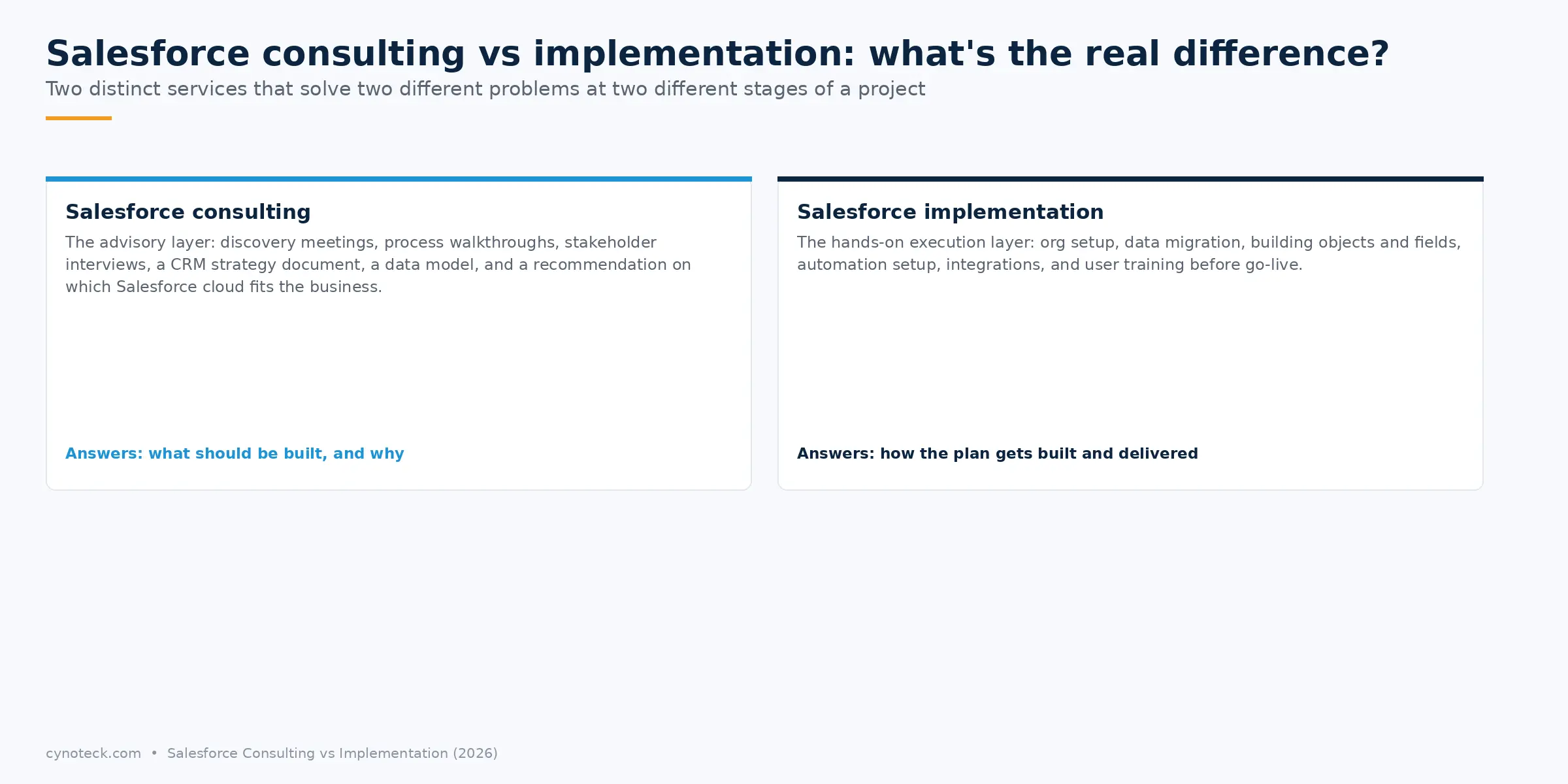
Salesforce consulting is the advisory work that happens before, during, and after a build. A consultant looks at how your business operates today, where the friction sits, and how Salesforce can be shaped around those real workflows rather than a generic template. That means discovery meetings, process walkthroughs, and stakeholder interviews before recommending a single feature.
The output is often a CRM strategy document, a data model, a roadmap, or a recommendation on which Salesforce Cloud fits the business.
A healthcare provider managing patient relationships needs a different setup than a manufacturing company running a multi-stage sales cycle. A consultant's job is figuring out which direction makes sense before any configuration begins.
Consulting also extends past the initial build. A consultant can run a Salesforce org health check on a system that's grown messy, recommend automation using Flow (Salesforce's tool for building automated business processes), or advise on license optimization when a business is paying for seats it doesn't use.
Note: Consulting is the thinking and planning layer of a Salesforce project. It answers what should be built and why, not necessarily who builds it. |
Also, Read: What Is Salesforce Consulting?
Salesforce implementation is the hands-on execution work where a decision on paper becomes a live, working system. An implementation engagement typically covers:
Org setup: Configuring a company's Salesforce environment from scratch, or restructuring an existing one.
Data migration: Moving records out of a legacy CRM or spreadsheets.
Building objects and fields: The records and data structures Salesforce runs on.
Automation setup: Configuring workflows to eliminate manual work.
Integration: Connecting Salesforce to other business systems through APIs.
Training: Getting users ready before go-live.
A logistics company migrating off an outdated CRM needs someone who can map legacy fields to a new Salesforce object structure and clean up duplicate records before the migration runs.
They also need to plan a cutover date that doesn't collide with peak shipping season. That's implementation work. It answers how the plan gets built, tested, and delivered.
Also, Read: Salesforce Consulting Process: Step-by-Step Guide
Compare Salesforce consulting and Salesforce implementation to choose the right service, reduce project risks, and build a CRM that supports your business goals.
Talk to Our CRM ExpertThink of one as the architect and the other as the construction crew. A Salesforce CRM consultant designs the blueprint. An implementation team builds the structure and hands over the keys.
Factor | Salesforce Consulting | Salesforce Implementation |
Main question answered | What should we build, and why? | How do we build it and get it live? |
Typical deliverables | CRM strategy, roadmap, process maps, cloud recommendation | Configured org, migrated data, trained users, live system |
Timing in a project | Usually first, can continue after go-live | After strategy is set, with a defined start and end |
Focus | Business alignment and long-term direction | Technical build, data accuracy, go-live readiness |
Success measure | A clear, workable plan the business can act on | A working, tested system users can log into on day one |
This isn't a hierarchy where one service matters more than the other. A brilliant strategy that never gets built delivers nothing. A fast technical build with no strategy behind it often produces a system that works but doesn't fit how the business operates.
In practice, the line blurs more than the table above suggests, since most experienced partners run both as connected phases of one engagement.
A typical project moves through discovery and requirements gathering, which is consulting work, straight into solution design and configuration, which shifts into implementation. The same team often stays involved through both stages, because decisions made during consulting directly shape how implementation gets built.
A consultant who recommends Service Cloud for a retail business needs to stay close to the implementation team, so the case management setup reflects the workflow they mapped out earlier.
Note: This is why many businesses find it easier to work with a single partner offering both services, instead of hiring a strategy firm for the plan and a separate development shop to execute it. Handoffs between separate vendors are where requirements get lost, and timelines slip. |
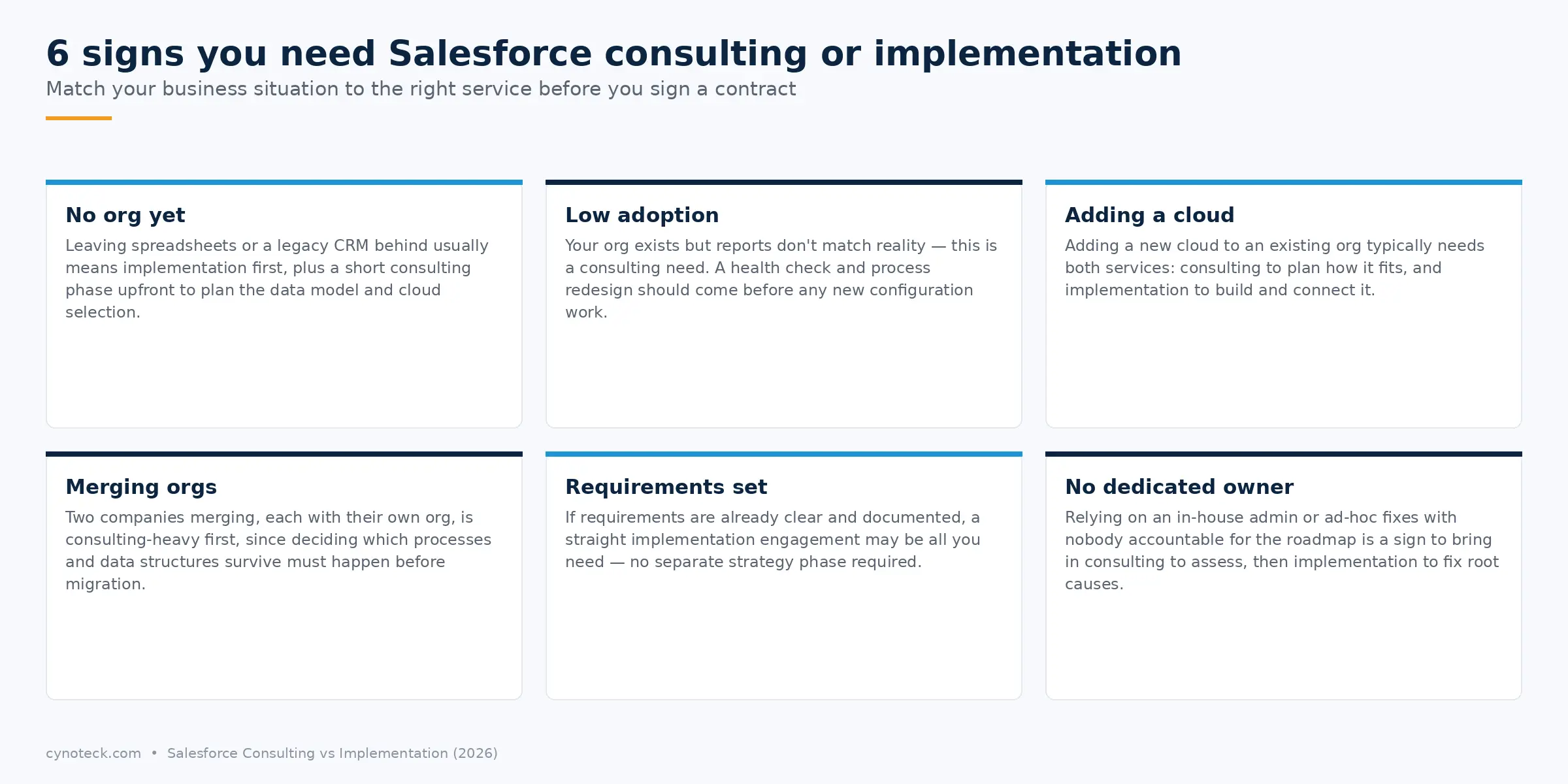
Most businesses fall into one of five common situations. Matching yours to the right service saves time and budget.
No Salesforce org yet, or moving off spreadsheets: You likely need implementation first, though a short consulting phase upfront to plan the data model and cloud selection prevents a rebuild later.
You have Salesforce, but adoption is low, and reports don't match reality: This is usually a consulting need. A health check and process redesign should come before new configuration work.
Adding a new cloud to an existing org: This typically needs both consulting to plan how it fits and implementation to build and connect it.
Two companies merging, each with their own org: This is consulting-heavy first, since deciding which processes and data structures survive has to happen before any technical migration.
You know exactly what needs to be built: If requirements are already clear and documented, a straight implementation engagement may be all you need.
Pro Tip: If you're not sure which category fits, a short discovery call is usually enough to tell. A partner who only sells implementation will often skip straight to a build quote. A partner who understands both will ask about your current processes first.
Also, Read: Types of Salesforce Consulting Services Explained
Not every project begins with implementation. Let experts evaluate your current Salesforce environment and recommend the right path for lasting business success.
Book a Free ConsultationWhat Each Engagement Actually Looks Like
Here’s how the two play out for a financial services firm using Salesforce Financial Services Cloud, an edition built around compliance tracking and advisor workflows.
A consulting engagement for this firm might start with interviews across the advisory team, a review of how household relationships and compliance documentation currently get tracked, and a recommendation on which features to prioritize next. The deliverable is a roadmap and a data model, not a live system.
An implementation engagement builds on that roadmap. The team configures the org, builds custom objects for tracking household relationships, and migrates client records from the legacy system.
They also set up validation rules to ensure compliance data accuracy and to train advisors before go-live. By the end, advisors are logging into a working system rather than reading a strategy document.
A manufacturing company connecting Salesforce to an ERP system shows the same pattern. Consulting maps out which data needs to sync, how often, and what happens when a sync fails.
Implementation builds the actual API connection, tests it against real order data, and monitors it once live. Neither phase replaces the other.
Three patterns show up repeatedly when businesses misjudge which service they need for their business.
Hiring implementation without strategy first: This often produces a technically sound system that doesn't match how the business sells or serves customers, since nobody mapped the real workflow before building started. The fix usually means paying for a second round of customization later.
Paying for consulting with no path to execution: A business ends up with a thick strategy document and then struggles to find a team that can build it. Strategy without a clear path to implementation tends to sit on a shelf.
Assuming an in-house admin can cover both roles: An admin is often strong at day-to-day changes and routine configuration. A full implementation or a strategic redesign usually calls for broader experience across data migration, integration, and solution architecture. This isn't a reflection on the admin's skill, just a different scope of work.
Also, Read: Common Salesforce Consulting Challenges
Most established partners run consulting and implementation as one continuous service, since the reasoning behind a decision needs to carry directly into the build.
When the same team designs and builds the solution, nothing gets lost in translation between a strategy document and a working system.
A partner offering both also tends to stay involved after go-live. Optimization, ongoing support, and future cloud additions all benefit from a team that already understands your data model, rather than starting from scratch with a new vendor each time.
That continuity is often the biggest practical advantage of choosing a single partner over stitching together separate consulting and implementation vendors.
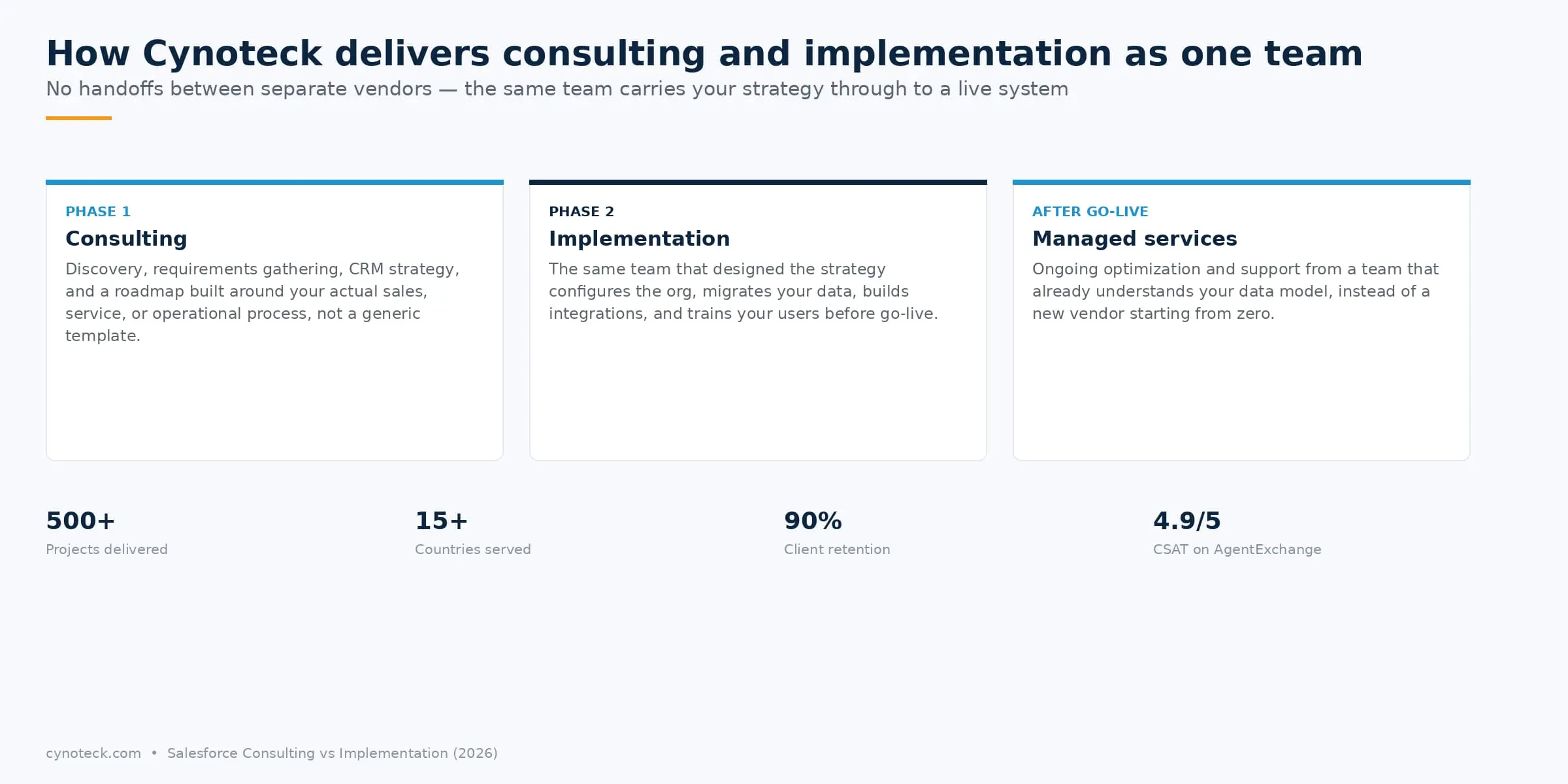
Cynoteck runs consulting and implementation as a single connected service, not two separate contracts, so the thinking behind your strategy is built in.
Cynoteck is a certified Salesforce Select Partner with 500+ projects delivered across 15+ countries, a 90% client retention rate, and a 95% on-time deployment rate. That same team carries a 4.9 out of 5 CSAT score on AgentExchange, verified through independently audited client reviews.
Here's how that plays out on a real project:
Consulting phase: Discovery, requirements gathering, CRM strategy, and a roadmap built around your actual sales, service, or operational process, not a generic template.
Implementation phase: The same team that designed the strategy configures the org, migrates your data, builds integrations, and trains your users before go-live.
After go-live: Ongoing optimization and managed services from a team that already understands your data model, instead of a new vendor starting from zero.
Explore Cynoteck's Salesforce Consulting Services or Salesforce Implementation Services to see how strategy and execution work together under one roof.
Work with one trusted Salesforce partner for consulting, implementation, optimization, and ongoing support without losing momentum between planning and execution.
Start Your Salesforce ProjectThe Salesforce consulting vs implementation question usually resolves itself once you know which of the five situations above actually describes you. An architect without a construction crew has a plan nobody builds. A construction crew without an architect builds something nobody asked for.
Cynoteck runs both under one roof, so you're not stitching together two vendors to get one working system. Tell us where your project actually stands- strategy, build, or both- and we'll tell you honestly what it needs next.
Ans: Implementation can be one deliverable within a broader consulting engagement, but the two are distinct services. Consulting covers strategy and planning, while implementation covers the technical build and go-live.
Ans: In most cases, yes. Even a short consulting phase to confirm requirements and data structure before configuration begins helps avoid a rebuild later. Businesses with already-documented requirements sometimes move straight to implementation.
Ans: Yes, and this is the more common approach. A single partner running both phases keeps the rationale for strategic decisions intact throughout the technical build, reducing the risk of the finished system drifting from the original plan.
Ans: Costs vary widely based on scope. A short consulting engagement, such as a health check or roadmap, typically costs less than a full implementation, which involves configuration, data migration, integration, and training across a defined timeline.
Ans: Most businesses move into an optimization or managed services phase that blends elements of both consulting and implementation, including ongoing configuration changes, user feedback review, and periodic health checks as the org evolves.
Ans: An in-house admin usually covers routine, day-to-day changes well. Full implementations, major redesigns, and strategic consulting typically call for broader experience across solution architecture, data migration, and integration that most admin roles don't include.
 Outsource Salesforce Development or Build In-House Which is the Best for Your Business.webp)
Outsourcing Salesforce development vs. building an in-house Salesforce team: 2026 cost insights, salary comparisons, key benefits, challenges, and the best hiring model for your business growth.
We are more than just developers and consultants—we are your partners in navigating the digital landscape. Let us be the engine behind your next big success while you focus on your core vision.
Explore Opportunities!