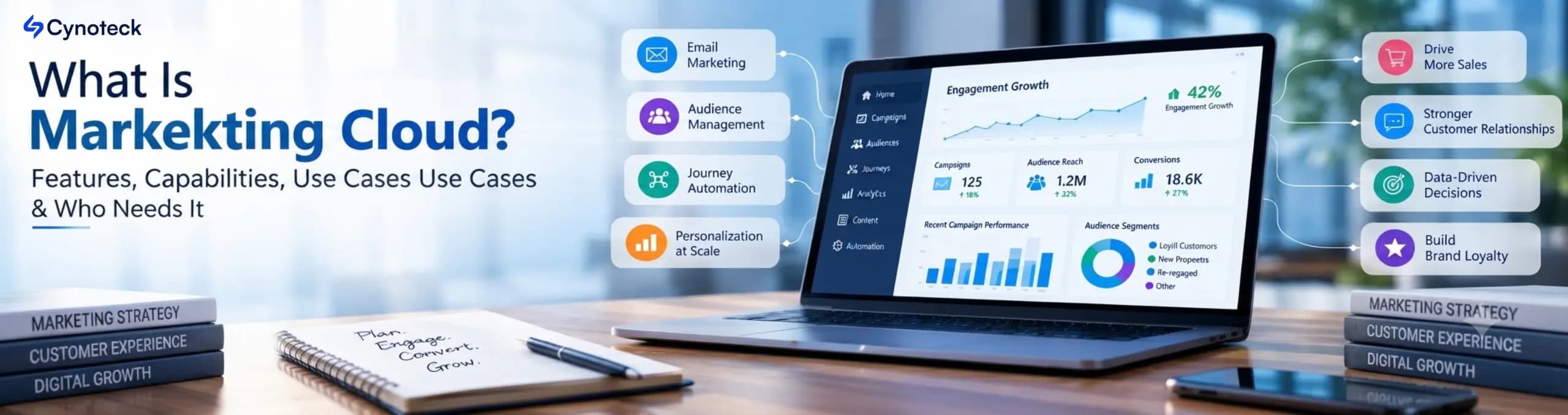
What Is Salesforce Marketing Cloud? Features, Capabilities, Use Cases & Who Needs It
Key Takeaways:
|
Salesforce Marketing Cloud plans, personalizes, and measures marketing campaigns. It covers email, SMS, mobile, and web, all from one platform. It's also built on Salesforce Data Cloud. So, it connects marketing activity to the same customer records your sales and service teams already use.
Because of that link, it fits mid-market and enterprise teams best. Specifically, teams run multi-channel campaigns with data too messy for a single email tool to handle.
This guide breaks down what it is, what it isn't, and whether your team needs it.
Salesforce Marketing Cloud is the umbrella name for Salesforce's marketing product line. Marketing Cloud Engagement is the core platform inside it. Specifically, it covers email, SMS, mobile messaging, and cross-channel journeys.
The product traces back to 2013, since that's when Salesforce acquired a company called ExactTarget. Even now, "Marketing Cloud" mostly still means this Engagement product. That's true even though Salesforce has added newer tools on top of it since.
In practice, Marketing Cloud gives a team one place to work. Build a campaign, pick who gets it, and decide when. Then personalize it, send it, and measure what happened next. That beats stitching separate email, SMS, and reporting tools together by hand.
No, it isn't. Sales Cloud and Service Cloud are Salesforce's CRM products. Specifically, they run the sales pipeline and handle support cases. Marketing Cloud, on the other hand, is a marketing execution layer.
It can run fine on its own contact data alone. However, its real value grows once you connect it to Salesforce CRM data or Data Cloud. Once connected, campaigns can react to real account and deal activity. Not just email opens and clicks.
Salesforce groups its products under something it calls Customer 360. Specifically, Sales Cloud runs the pipeline, Service Cloud runs support, and Marketing Cloud runs outbound and inbound marketing.
Data Cloud sits underneath all three, and it unifies customer records. So, a Marketing Cloud journey can trigger off a deal changing stage in Sales Cloud. Likewise, a Service Cloud case can pull in recent campaign activity.
Note: That shared-record benefit matters a lot for some businesses. For others, it barely matters at all. Weigh it honestly before you assume you need the full setup. |
At a high level, Marketing Cloud plans, sends, and measures campaigns across channels. One platform handles all of it. Specifically, here's how each common task maps to the part of Marketing Cloud that handles it.
Marketing Activity | How Marketing Cloud Handles It |
Email marketing | Email Studio: design, segment, automate, and send campaigns |
SMS & push messaging | Mobile Studio: two-way SMS, MMS, and app push notifications |
Multi-step customer journeys | Journey Builder: trigger-based, cross-channel orchestration |
Content creation & reuse | Content Builder: shared templates and blocks across channels |
Marketing automation | Automation Studio: scheduled and event-based automation |
Personalized recommendations | Salesforce Personalization: real-time web and product picks |
Campaign performance measurement | Built-in reporting, connected to Data Cloud |
Together, this table covers most of what people mean by Marketing Cloud features in day-to-day use.
Marketing Cloud used to be organized around named "studios" and "builders," though Salesforce has renamed and merged a few over time. Still, the basic idea holds. Separate tools handle separate channels, and Journey Builder ties them together.
Product / Component | What It Does |
Marketing Cloud Engagement | The core cross-channel product: email, SMS, mobile, journeys. This is what most people mean by "Marketing Cloud" |
Marketing Cloud Next (Growth / Advanced) | The newer generation, built natively on the Salesforce Platform, with Flow-based orchestration and native AI agent tools |
Email Studio | Email design, segmentation, and sending |
Journey Builder | Visual, trigger-based journeys across channels |
Mobile Studio | SMS, MMS, and push messaging |
Content Builder | A shared content library for reusable assets |
Automation Studio | Scheduled and event-driven automation |
Salesforce Personalization | A standalone tool for real-time personalization |
Marketing Cloud Account Engagement (Pardot) | A separate B2B lead-nurturing product, often paired with Marketing Cloud |
Data Cloud | Unifies marketing, sales, and service data into one record |
Two older products were phased out. That's worth knowing if you run into an outdated comparison somewhere. First, Social Studio retired in November 2024. Then, Marketing Cloud Advertising, once called Advertising Studio, stopped renewing subscriptions in August 2026. Salesforce now points customers toward Data Cloud Ad Audiences instead.
Marketing Cloud's core strengths break into three areas.
Email, SMS, push, and in-app messages all run through Journey Builder. So, a customer's next message depends on what they did, or didn't do, last time. Not a fixed schedule.
Content and offers adapt to each person, based on real behavior. Also, Agentforce Campaign Creation adds natural-language, AI-assisted tools too. That means less manual setup for every single variant.
Once connected to Data Cloud, Marketing Cloud can segment off real, unified customer data. Not just marketing history alone. As a result, reporting ties engagement back to pipeline and revenue, not just opens and clicks.
Business Type / Size | Fit Signal |
Mid-market and enterprise B2C brands | Running email/SMS across large, changing segments |
Retail & eCommerce | Needs personalized product picks and abandoned-cart journeys |
Financial services, healthcare & regulated industries | Needs compliant, auditable communication with consent management |
Organizations already on Sales Cloud or Service Cloud | Wants marketing and CRM data in one record |
Franchise or multi-brand organizations | Needs shared content and journeys across units |
Marketing spans three or more channels, like email, SMS, web, and mobile, that don't share data yet.
Campaigns need to react to real CRM or purchase activity. Not just email opens.
Also, multiple teams need shared control over content and data.
On top of that, consent and compliance rules make a lightweight tool genuinely risky.
Marketing runs through one channel, usually email, with a small, stable list.
Also, there's no dedicated marketing operations or Salesforce admin person to run it.
Budget and timeline can't stretch to cover licensing plus implementation.
Pro Tip: That last point is the one teams skip most often. Marketing Cloud rewards a team that can run it well, but it punishes a team that can't.
Marketing and sales data live in separate systems. So, a Data Cloud connection unifies the record both teams work from.
Campaigns are manual and don't scale. Instead, Automation Studio and Journey Builder cut out the repetitive steps.
Messaging isn't personalized past a first name. Personalization and AI-assisted content adapt to real behavior instead.
There's no single view of what's working. Instead, built-in reporting connects engagement back to pipeline and revenue.
No. Sales Cloud runs the pipeline. Think opportunities, quotes, forecasting. Marketing Cloud runs the campaigns that feed that pipeline in the first place.
No. Service Cloud handles support and case resolution after the sale. Marketing Cloud's two-way messaging can hand a conversation over once it needs a real person.
No, though the two are closely related. Account Engagement is built for B2B lead scoring, tied to Sales Cloud deals. Marketing Cloud Engagement is broader and more B2C-focused, built for cross-channel campaigns. Many B2B teams end up running both together.
There's no single answer here. It depends on how many channels you run today. It also depends on how messy your customer data already is, and whether you have the team to run something this capable.
If the fit signals above sound familiar, the next step is simple. Look into what it costs to license and set up, plus what a consulting partner's help looks like.
Buying licenses before you define a data strategy. This usually means Email Studio or Journey Builder gets set up around messy, incomplete segments.
Treating Marketing Cloud like a bigger email tool. Skip Journey Builder and Data Cloud, and you're paying enterprise prices for basic results.
Skipping the Sales Cloud or Service Cloud connection. Marketing then runs on stale or duplicate contact data. That defeats much of the point.
Underestimating the change-management work. Running Marketing Cloud well takes marketing operations capacity. Most small teams don't have that on day one.
Salesforce Marketing Cloud is a cross-channel marketing platform, not a CRM. Its biggest advantage shows up once it connects to the same customer data your sales and service teams already use.
It's built for teams managing real complexity across channels and segments. Still, not every marketing team needs that much depth. Still, for the teams that do, few platforms match it, and few match its range of Marketing Cloud use cases across industries.
Not sure if Marketing Cloud is the right fit for your team? The clearest way to find out is to walk through your channels, your data, and your actual goals with a team that works in Salesforce Marketing Cloud every day, before you commit to a license.
A: No. Salesforce CRM means Sales Cloud and Service Cloud, which run the pipeline and support cases. Marketing Cloud is a separate product for running campaigns, though teams often connect the two through Data Cloud.
A: Marketing Cloud Engagement is the broader, cross-channel platform: email, SMS, mobile, journeys, mostly B2C. Account Engagement, formerly Pardot, is built for B2B lead scoring tied to Sales Cloud deals. Many B2B companies use both.
A: Yes. Marketing Cloud runs fine on its own contact data, and it doesn't need Sales Cloud or Service Cloud. Still, campaigns get more powerful once they can react to real CRM activity, not just marketing engagement alone.
A: No, though it's built for real complexity. Marketing Cloud Next's Growth edition targets mid-market teams. The Advanced edition and Engagement's higher tiers serve bigger, more complex organizations. It's usually overkill for one channel and a small list.
A: Social Studio retired in November 2024. It's gone from Marketing Cloud now, and Salesforce hasn't offered a direct replacement. Instead, social strategy usually runs through separate social tools, paired with Data Cloud for unifying that data.
A: Agentforce Campaign Creation uses natural-language prompts to help build and tune campaigns. Meanwhile, Einstein-powered features support segmentation, send-time optimization, and personalization, all based on real behavior.
 Outsource Salesforce Development or Build In-House Which is the Best for Your Business.webp)
Outsourcing Salesforce development vs. building an in-house Salesforce team: 2026 cost insights, salary comparisons, key benefits, challenges, and the best hiring model for your business growth.
We are more than just developers and consultants—we are your partners in navigating the digital landscape. Let us be the engine behind your next big success while you focus on your core vision.
Explore Opportunities!