What is the Cost of AI in Retail and E-Commerce? What to Budget in 2026
TL;DR
The cost of AI in retail and e-commerce starts with a small monthly fee for a ready-made tool. A custom build runs about $3,000 to $60,000 or more. Three things set the price: how many systems the AI uses, how clean your data is, and how much it does on its own.
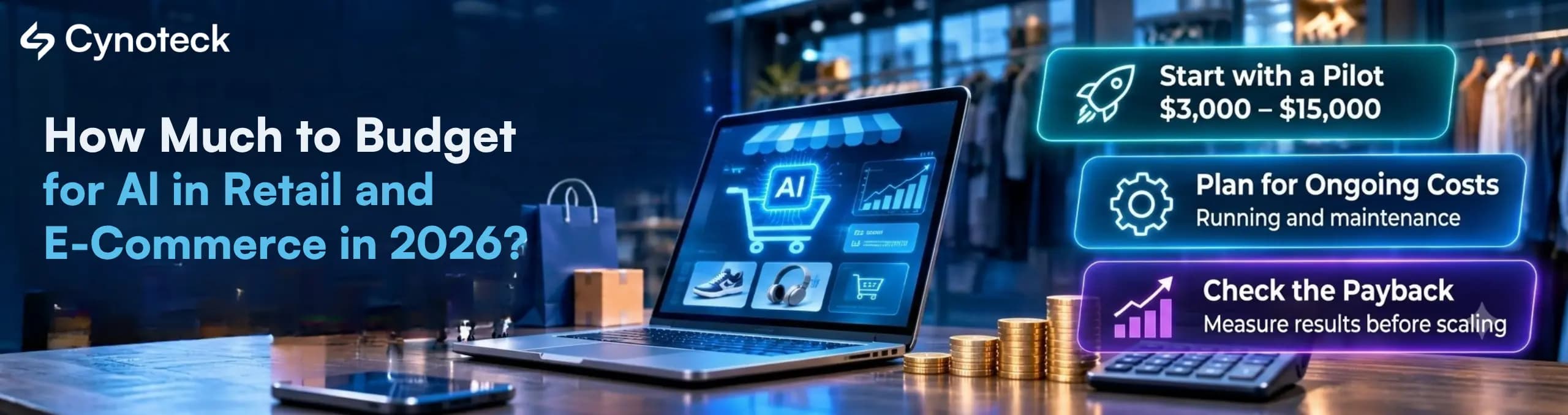
- Start with a small pilot: A focused first project can cost between $3,000 and $15,000.
- Plan for ongoing costs: Include running and maintenance expenses, not just the initial development cost.
- Check the payback: Measure the results before expanding AI across more business operations.
You have heard that AI can save businesses time and money. However, when you go to find out the cost of AI in retail and e-commerce, you get a different answer every time. This is very frustrating for businesses when they have a budget to protect.
The cost of AI in retail and e-commerce depends on various key factors. You can review these factors before proceeding with an AI project. This guide explains what affects the cost and provides practical examples to help you estimate your AI project budget.
What Is the Cost of AI in Retail and E-Commerce?
The cost of AI in retail and e-commerce ranges from a small monthly fee for a ready-made solution to $60,000 or more for custom AI solutions. A small AI project typically costs from $3,000 to $15,000 and takes 3 to 4 weeks. Overall, you can proceed with four ways to use AI in your business. The final cost depends on whether you use an existing tool, customize a solution, or develop from scratch.
Level | What you get | Rough cost | Time to finish |
Ready-made tool | A chat box or product-recommendation plugin | A monthly fee set by the vendor | Days |
Small pilot | One use case, one data source, your real data | $3,000 to $15,000 | 3 to 4 weeks |
Full build | Works with your store, CRM, or ERP | $12,000 to $26,000 | 6 to 12 weeks |
Large build | Many systems, strict security, complex steps | $26,000 to $60,000 or more | 12 to 24 weeks |
Table 1. Rough planning ranges, not quotes. They match our enterprise AI chatbot cost guide and our generative AI project timeline. They assume an experienced offshore team.
Moreover, the cost of AI in retail and e-commerce can be higher if your AI project needs a lot of work or new store equipment. AI project budgets are also rising. In NVIDIA’s January 2026 survey, 90% of retail and consumer packaged goods (CPG) organizations expected to increase their AI spending in 2026
Which AI Use Cases Cost the Most?
Fraud detection and store cameras are AI use cases in retail and e-commerce that cost the most, as they require special data, equipment, and security measures. Whereas content creation is usually less expensive. In short, three things can increase AI costs: more system connections, poor data quality, and more automated workflows.
Use case | Cost level | Why |
Product content | Low to medium | Cleaning product data |
Product recommendations | Medium | Data from many channels |
Support chatbot | Medium | Links to order and help-desk systems |
Medium to high | Sales history and stock data | |
Dynamic pricing | Medium to high | Competitor prices and approval rules |
Returns | Medium | Return reasons and order links |
Fraud detection | High | Past fraud data and security |
Store cameras | High | Cameras, devices, and privacy work |
Table 2. Relative cost levels, not prices.
What Does AI Cost After Launch?
After launch, AI still has running costs, such as usage fees, regular checks, hosting, and updates. A support chatbot that handles 10,000 chats per month may cost around $140 a month in AI usage fees. Here is how we get this AI cost after launch.
AI models use tokens to read and write small pieces of text. In addition, AI providers charge based on the number of tokens used, usually per million tokens.
Let's break down the example:
Each chat uses around 4,000 input tokens and 600 output tokens.
For 10,000 chats, that adds up to 40 million input tokens and 6 million output tokens.
Anthropic's published Sonnet 5.5 rates are $2 per million input tokens and $10 per million output tokens.
Input cost: 40 million × $2 = $80
Output cost: 6 million × $10 = $60
Total monthly usage cost: $140
Go deeper: Output tokens cost five times more than input tokens at these rates. Moreover, Anthropic offers 50% off on batch processing for tasks that you need quick action on. Our Sonnet versus Opus comparison shows how model choice changes cost.
Always remember, usage cost is only part of the total cost of AI. The linking systems, cleaning data, and testing can cost much more. To get more details on these expenses, you can go through the table below.
Step | How we get it | Result |
Chats the AI answers | 25% of 10,000 | 2,500 a month |
Staff time saved | 2,500 × 6 minutes | 250 hours |
Value of that time | 250 hours × $30 | $7,500 a month |
Running cost (our guess) | AI fees, hosting, checks | $1,000 a month |
Left over each month | $7,500 − $1,000 | $6,500 |
Months to repay $15,000 | $15,000 ÷ $6,500 | About 2.3 |
Table 3. A careful example. The Bureau of Labor Statistics says customer service reps earn a median of $20.59 an hour. We use $30 to include benefits and overhead.
You have to be careful when estimating how quickly AI will pay for itself. Saving time doesn’t always mean saving money; to save money, you have to reduce working hours or assign staff to other tasks. Therefore, monitor the results at least for 90 days before calculating your actual savings.
Go deeper: Payback = build cost ÷ (monthly value − running cost). For a fuller view, compare 12 months of savings with build plus running costs.
What Hidden Costs Should You Plan For?
Apart from the AI usage fees, you also need to budget for data cleanup, system connections, security checks, staff training, and regular updates. These may cost more than AI usage fees. For example, connecting each new system needs more time to build and test. Moreover, security checks can delay the project by several weeks.
How Can You Lower the Cost?
You can reduce the overall cost of AI in retail and e-commerce by starting with one use case, instead of automating everything at once. Go with a ready-made solution if it meets your requirements and goals, clean your data before starting, and expand your project step-by-step.
Read our AI readiness checklist when preparing your AI investment budget. It will also help you manage the risk of failure. In 2024, Gartner expected at least 30% of generative AI projects to stop after the trial stage by the end of 2025.
What Should You Ask a Vendor Before You Sign?
Start by asking five questions before choosing a vendor for your AI project. This will help you understand what you are paying for, avoid unexpected costs, and compare different vendors. These five questions cover scope, ownership, running costs, success, and an exit plan.
What's included? Ask for a list of work with detailed pricing.
Who owns the code and data? Make sure that your contract clearly states that.
What are the running costs? Ask for a monthly estimate, such as usage, hosting, and maintenance fees.
How will we measure success? Agree on one number, such as the customer query resolution rate.
What if it doesn't work? Ask about a trial period and how you can end the agreement if needed.
For more guidance, read our checklist on how to choose an AI development company
Frequently Asked Questions
How much does AI cost for a small online store?
Most small stores start with ready-made tools that charge a monthly fee, so check each vendor's pricing page first. Custom work, which starts around $3,000 for a pilot, makes sense if a tool can't do the job.
What is the cheapest first AI project?
Product content and support chat are usually the cheapest first projects because they need fewer system links. See all eight ideas in our guide to eight AI use cases in retail and e-commerce.
How long does it take for AI to pay for itself?
It depends on your volume and staff costs. In our careful example, a $15,000 build pays back in about 2.3 months. Track real results for 90 days before you grow.
Explore comprehensive blogs, best practices, and insights from our technology experts.

 What Al Services Does a Business Actually Need in 2026.webp)

10 Proven Benefits of Custom CRM Software for Modern Businesses (2026)
Discover the top 10 benefits of custom CRM software development for modern businesses. Learn how tailored CRM solutions improve efficiency, enhance customer relationships, and drive business growth.
 How Much Does It Cost to Build an Enterprise AI Chatbot in 2026.webp)
How Much Does It Cost to Build an Enterprise AI Chatbot in 2026?
Integrations, HIPAA and state privacy rules, and conversation complexity drive what US companies pay for enterprise AI chatbots. Includes budget ranges, an offshore partner checklist, and a payback calculation using BLS wage data.

A Quick Intro to Artificial Intelligence (AI) & Its Components
What is Artificial Intelligence? Artificial intelligence (AI) is intelligence demonstrated by machines, which makes it possible for machines to learn from experience, adjust to new inputs and perform human-like tasks.
Turning expertise into action for your business.
We are more than just developers and consultants—we are your partners in navigating the digital landscape. Let us be the engine behind your next big success while you focus on your core vision.
Explore Opportunities!