How to Choose the Right AI Development Company: A 15-Point Buyer's Checklist
Knowing how to choose an AI development company comes down to proof, not promises. Look for live AI systems, clear answers on data and security, a named team, and support after launch. Score each AI vendor on 15 checks, then compare the totals side by side.
Many AI projects stall for reasons that have little to do with the model. In many cases, the AI vendor skipped the data work, hid the running costs, or disappeared after launch. A short checklist can catch these problems early.
This guide shows how to choose an AI development company with 15 checks you can run before you sign. Each check in this checklist has a question to ask and a clear sign of a strong answer. If you're still deciding what to build, start with our guide to the AI services a business needs.
Choose the AI development company that can show live AI systems, answer hard questions in writing, and name the people who will build your project. In fact, polished demos and big logos matter much less than those three things.
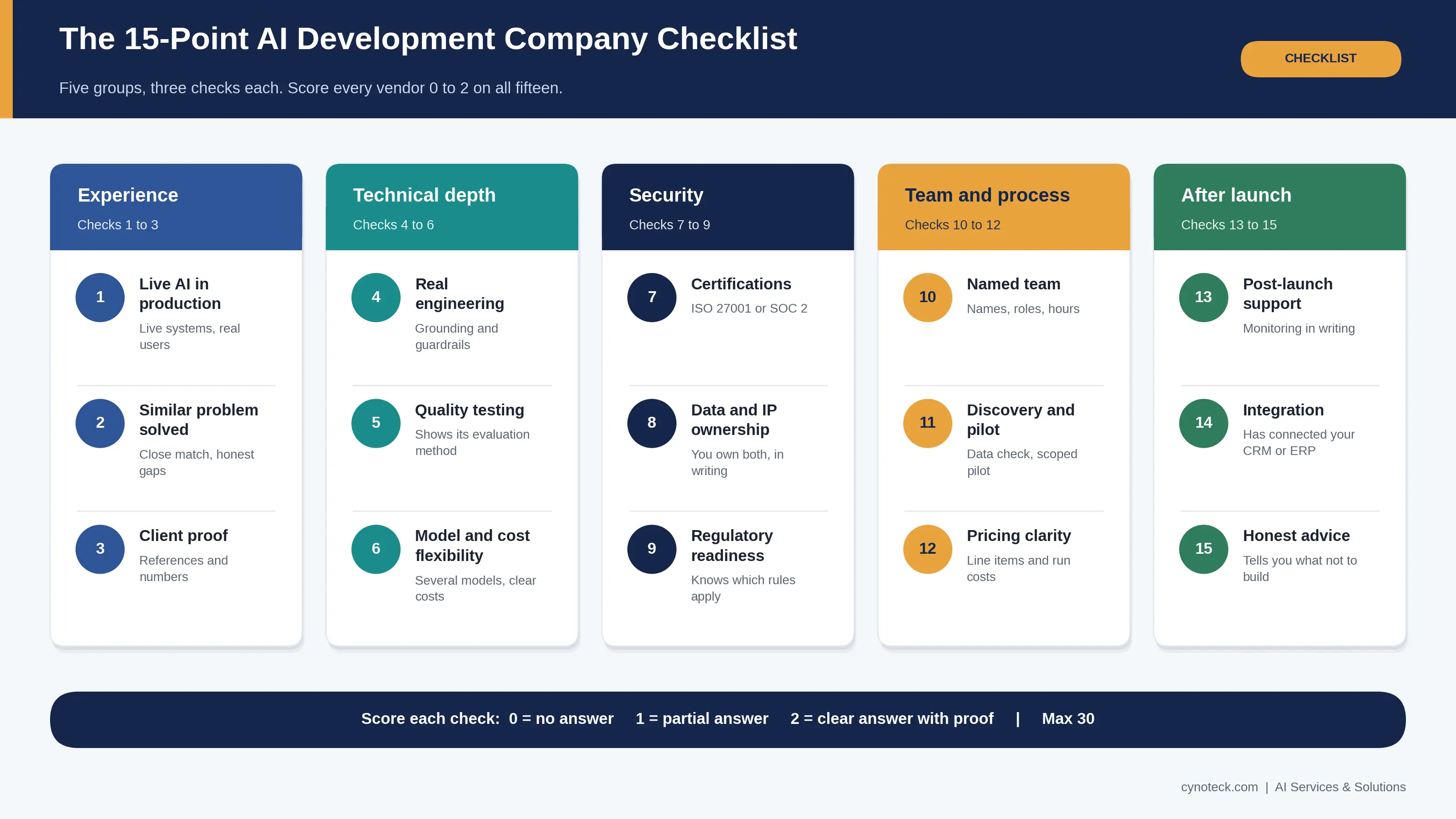
The questions to ask below fall into five groups: experience, technical depth, security, team and process, and life after launch. Score each check from 0 to 2. Then add up the totals for each AI vendor. We explain the scoring near the end.
Some buyers need AI development services for one use case. Others need a long-term team. Either way, define the problem first. An AI development partner can't prove fit if you can't say what should change. Check your data readiness too. If you haven't done either yet, run through our AI readiness checklist before you start calling vendors.
A good AI development company proves its experience with live systems, similar problems, and real client results. Three checks cover this.
First, ask how many AI systems the company runs in production right now. A demo shows that a model can work once. A system in production, though, shows it works every day, for real users, at a sensible cost. So ask to see one running, and ask what it does. A strong AI vendor names live systems and real users. A weak one, by contrast, shows slides and prototypes.
Ask: "Which AI systems are live today, and could I speak with someone who uses one?"
Next, look for a project close to your use case and your industry. A team that has built a document-review tool for a regulated sector already knows the compliance traps. A team that hasn't, though, will learn them on your budget. Ask which parts of your problem the vendor has solved before, and which parts are new. Honest AI development companies, in fact, answer both sides.
Ask: "Which parts of our problem have you solved before, and which parts are new to you?"
Yes, and you should insist on it. Ask for client references and case studies with numbers. A good case study names the problem, the timeline, and the measured result. Case studies without numbers are marketing, not proof. Also ask each reference what went wrong, not just what went well.
For example, our case study on a Salesforce AI support agent reports a six-week launch and an 80% drop in calls reaching human agents. Another covers a generative AI document review tool, with 96% accuracy in the first month. Cynoteck is an AI development company that has delivered 500+ projects overall, across 15+ countries. Those two come from our AI work. Still, ask every AI vendor, including us, for AI-specific results.
Ask: "Can I speak with a client whose project looks like ours?"
Check technical depth by asking how the team builds, tests, and prices AI, not just which tools it uses. Three checks cover this.
Look for retrieval, guardrails, and production monitoring, not just a call to a model's API. A thin wrapper breaks the first time your data gets messy. Ask how the system grounds its answers in your data, for example with retrieval-augmented generation (RAG). Then ask how a person steps in when the AI is unsure. A real team answers with specifics. A thin one, instead, answers with buzzwords.
Ask: "How does the system ground its answers in our data, and when does a person step in?"
In fact, a serious team measures quality before launch and after it. So, ask to see the evaluation method from a past project. It should cover wrong answers, made-up facts (hallucinations), and attempts to trick the system (prompt injection). Strong evaluation also catches problems before your customers do. If the AI development company can't explain how it measures quality, it is guessing.
Ask: "Can you show me the evaluation results from your last project?"
Good vendors choose models for your problem, not for their own partnerships, and they help you avoid vendor lock-in. First, ask whether they have used more than one model provider, and how easily you could switch. Also ask about running costs, such as model usage and hosting. Those costs continue long after launch, so ask early. An AI vendor that hides them will surprise you later.
Ask: "If we wanted to switch models in a year, what would that cost us, and how do you prevent lock-in?"
Go beyond the demo. Ask about production systems, evaluation methods, model choices, and the costs that continue after launch.
Book a Free ConsultationCheck certifications, data ownership, and regulatory readiness. Three checks cover this, and you should get every answer in writing.
Ask which certifications the AI development company holds, what they cover, and when the last audit happened. ISO 27001 covers information security. SOC 2, meanwhile, reports on security controls. ISO/IEC 42001 is the newer standard for managing AI systems. No single badge guarantees safe AI, so ask about scope too. Cynoteck holds ISO 27001 security compliance and ISO 9001 quality management.
Ask: "Can you share your ISO 27001 certificate, plus the scope and date of your latest audit?"
First, data ownership should be clear. You should own your data and the custom code built for you. Next, ask directly whether your data could ever train models for other clients. Ask what happens to your data and models if the contract ends, so you avoid lock-in. Then put data ownership and every other answer in the contract, not in a sales call.
Ask: "Will you ever train a model for another client on our data?"
A good vendor can explain which rules apply to your use case. The EU AI Act is the main one for anyone serving EU customers. Under the Digital Omnibus on AI, which took effect in July 2026, rules for high-risk systems in areas such as employment, education, and critical infrastructure now apply from 2 December 2027. Transparency rules, such as telling users they are talking to an AI, already apply. The European Commission's AI Act page tracks the dates.
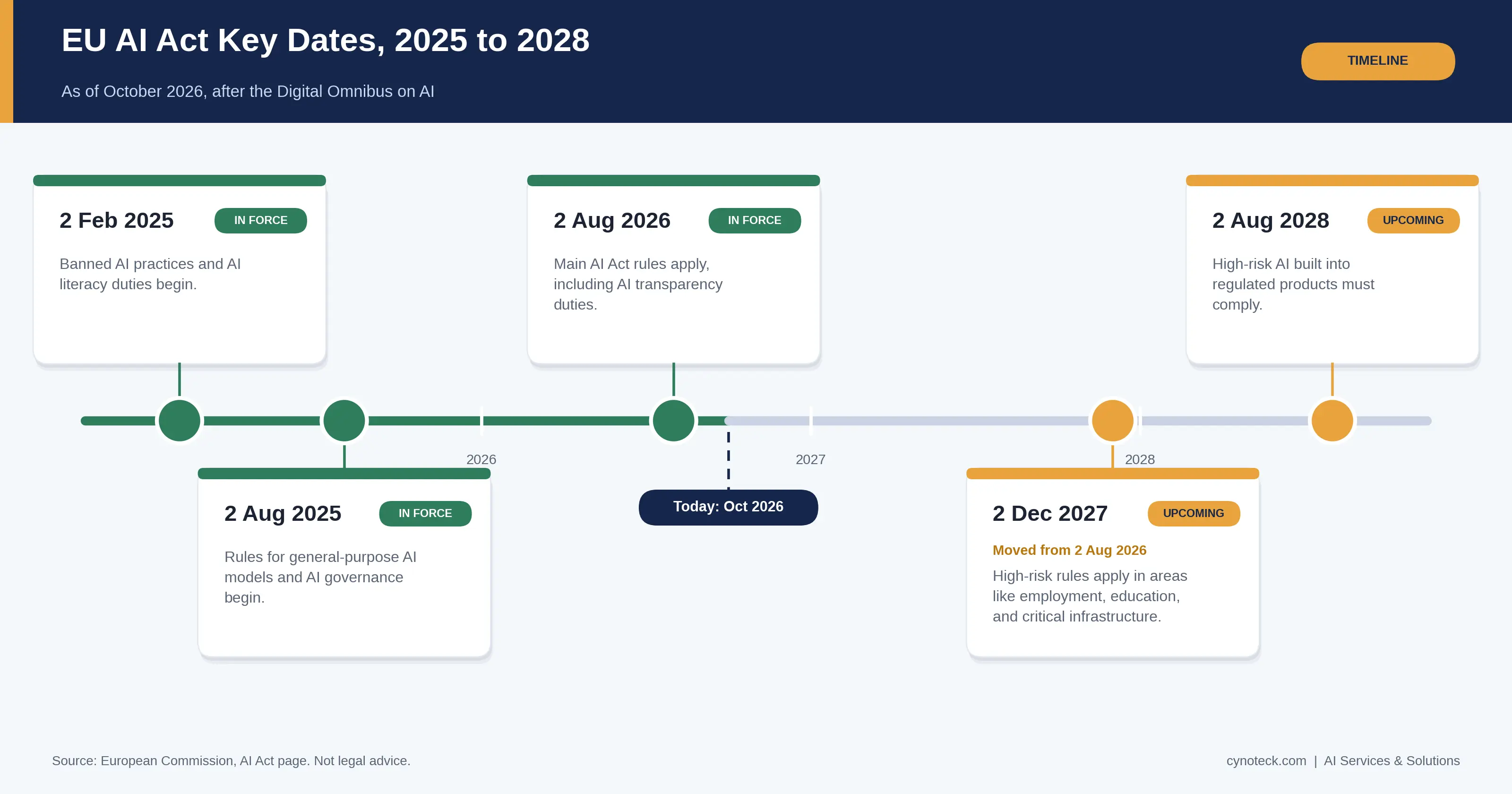
So ask whether your system could count as high-risk under the EU AI Act, and what paperwork you would need. Also ask about GDPR and any rules in your own industry. Finally, check the details with your legal team.
Ask: "Which of our use cases might count as high-risk, and what would we need to document?"
Judge the people who will build your AI project and the process they follow. Three checks cover this: the team, the start of the project, and the price.
First, ask for the names, roles, and time commitments of the people on your project. That matters because the team in the sales call is often not the team that builds. Also ask about turnover, because mid-project changes can stall an AI build. If the AI vendor won't name the team, treat that as a warning.
Ask: "Who exactly will work on this, and for how many hours a week?"
Strong AI development companies start with discovery and data readiness checks. Good data readiness work saves weeks of rework later. Then they run a small pilot, sometimes called a proof of concept, with clear success criteria. Ask what happens if discovery shows your data isn't ready. A good answer is "we fix that first, or we tell you to wait." A bad answer, by contrast, is "we'll start building anyway." Also ask for the path from pilot to production, step by step.
Ask: "What would you check in our data before you write any code?"
Ask the AI development company for a line-item estimate that covers the build, hosting, model usage, support, and rework. AI has ongoing costs that normal software doesn't, such as per-use model fees. Then compare what each proposal includes, not just the total. For a deeper look at what drives the price, read our guide on whether AI development is expensive.
Ask: "What will this cost to run each month after launch?"
Get a clear view of build, hosting, model usage, support, and ongoing costs before choosing an AI development partner.
Get Your AI Project EstimateCheck what happens after launch, because AI systems need ongoing care and strong post-launch support. Three checks cover this.
AI systems drift as data and user behavior change. Ask who monitors quality, how often, and what triggers a retrain. Get post-launch support terms in writing, including response times. Launch isn't the finish line. It's the start of the part that decides whether the AI project pays off.
Ask: "Who watches quality after launch, and what triggers a retrain?"
In short, your AI needs to work inside your CRM, ERP, and daily tools, not beside them. Ask which systems the vendor has connected before, and how. Partner status can help when you pick an AI development partner. Cynoteck is a Salesforce Select Partner and a Microsoft Solutions Partner for Data & AI, so our AI development services cover Salesforce and Azure environments. If Salesforce is your platform, see how Agentforce compares with custom AI agents.
Ask: "Which systems like ours have you connected, and how long did it take?"
The best AI development companies sometimes say no. A simple rules-based workflow can beat a machine learning model on an easy problem. An AI vendor that agrees with every idea is selling, not advising. So the answer to this question shows how honest the AI vendor will be when it matters.
Ask: "What would you advise us not to build?"
Run the evaluation in four steps: shortlist, written answers, proof, and a pilot. Each step removes weaker vendors before you spend real money.
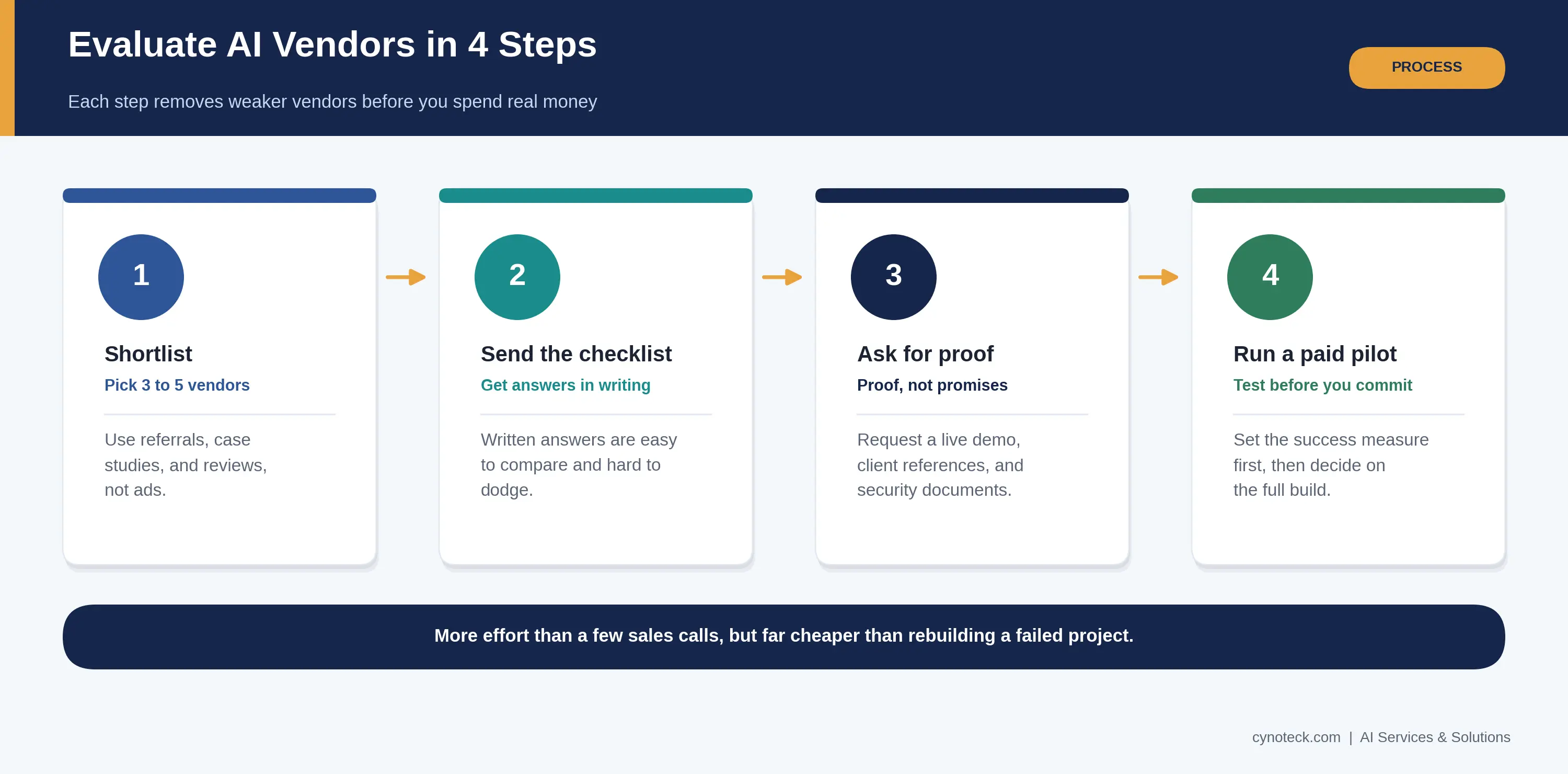
Shortlist three to five AI development companies: Use referrals, case studies, and reviews, not ads.
Send the 15-point checklist as a written questionnaire: Written answers are easy to compare and hard to dodge.
Ask for proof: Request a live system demo, client references, and the security documents.
Start with a paid pilot or proof of concept: Set the success measure first, then decide on the full build.
This takes more effort than a few sales calls. Still, it costs far less than rebuilding a failed project.
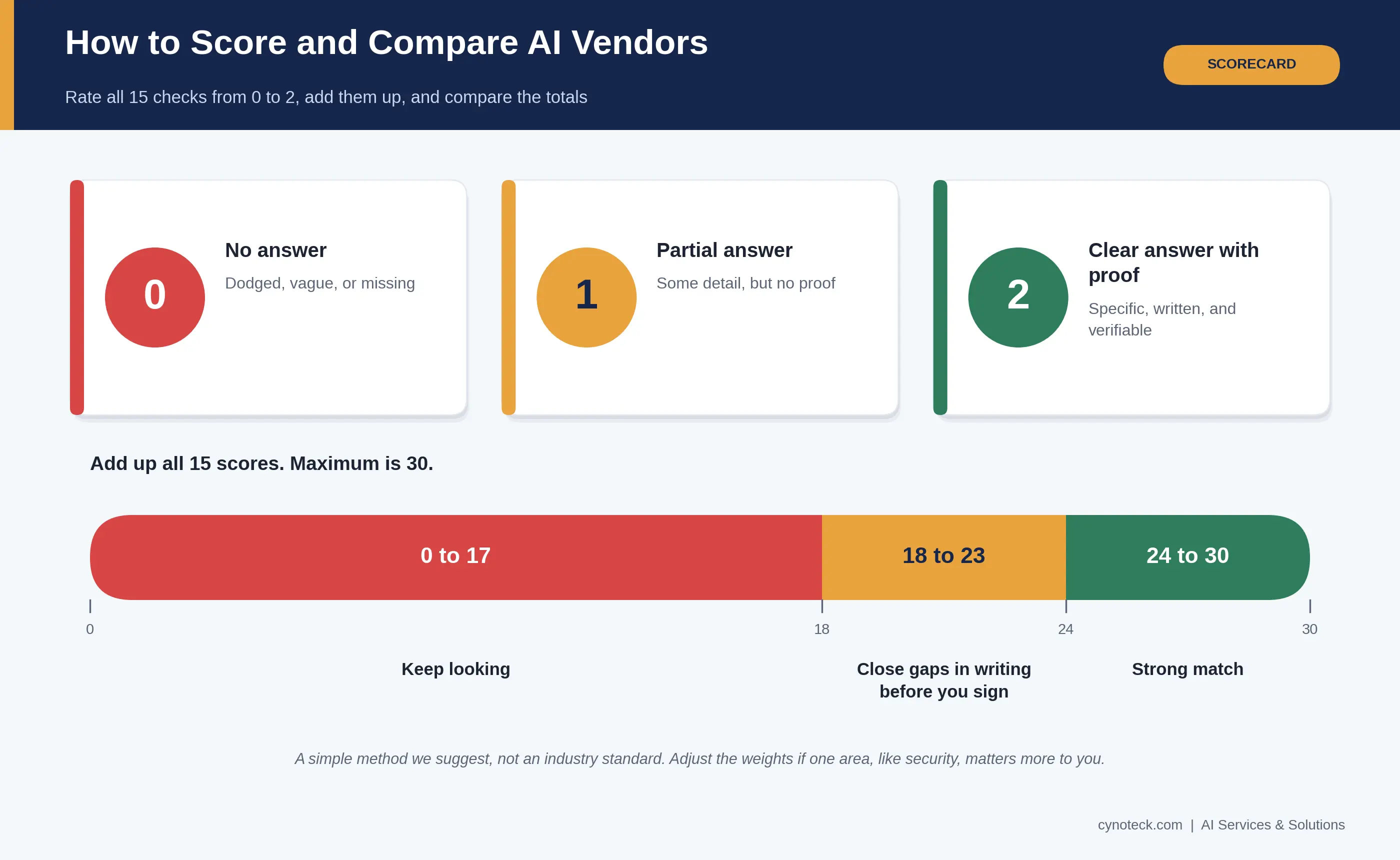
Score each AI vendor from 0 to 2 on all 15 checks, then compare the totals. Give 0 for no answer, 1 for a partial answer, and 2 for a clear answer with proof.
Add up the points. A total of 24 to 30 is a strong match. A score of 18 to 23 means you should close the gaps in writing before you sign. Below 18, keep looking. Use the same questions to ask every vendor, so the scores compare fairly. This is a simple method we suggest, not an industry standard. Change the weights if one area, such as security, matters more to you.
# | Check | A score of 2 looks like |
|---|---|---|
1 | Live AI in production | Names live systems with real users |
2 | Similar problem solved | Close match, plus honest gaps |
3 | Client proof | Reference call and a case study with numbers |
4 | Real engineering | Explains grounding, guardrails, monitoring |
5 | Quality testing | Shows an evaluation method from a past project |
6 | Model and cost flexibility | Works with several models, shares running costs |
7 | Certifications | Current ISO 27001 or SOC 2, with scope shared |
8 | Data ownership and IP | You own both, stated in the contract |
9 | Regulatory readiness | Explains which rules apply to you |
10 | Named team | Gives names, roles, and time commitments |
11 | Discovery and pilot | Checks data first, then runs a scoped pilot |
12 | Pricing clarity | Gives line items, including running costs |
13 | Post-launch support | Puts monitoring and response times in writing |
14 | Integration | Has connected your CRM or ERP before |
15 | Honest advice | Tells you what not to build |
Stop if an AI development company promises accuracy before seeing your data, shows only demos, hides its team, or stays vague about data use. Any one of these is enough reason to walk away.
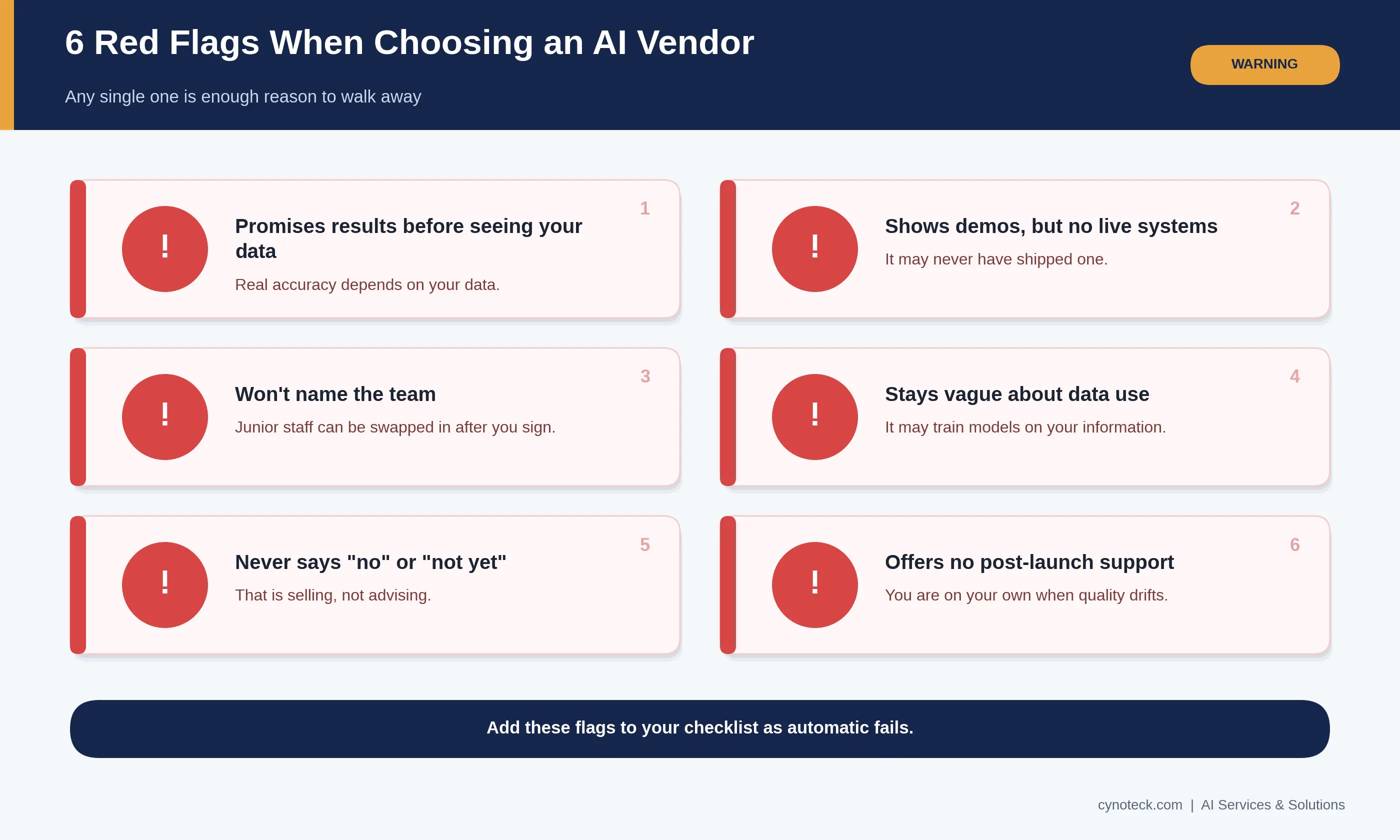
An AI vendor that promises results before it sees your data is guessing. Real accuracy depends on your data.
An AI development company that shows demos but no live systems may never have shipped one.
An AI vendor that won't name the team can swap in junior staff after you sign.
A vendor that stays vague about data use may train models on your information.
An AI vendor that never says "no" or "not yet" is selling, not advising.
A vendor with no post-launch support leaves you alone when quality drifts.
Add these flags to your checklist as automatic fails.
Test your shortlist with written answers, client proof, security evidence, and a focused pilot before committing to the full build.
Schedule Your Free ConsultationYou now know how to choose an AI development company. The next step is to run the 15-point checklist on a real shortlist. If Cynoteck is on yours, we'll answer every check in writing.
To request Cynoteck's Vendor Info Pack, contact our AI development services team. We'll send our certifications, partner status, and project track record. You can also see how we approach generative AI and agentic AI projects.
Three to five is a practical range. Fewer gives you little to compare. More slows the process without improving the decision.
Many buyers need two to four weeks to run this checklist. That covers the shortlist, calls, reference checks, and written answers to the 15 checks.
It depends on your problem. A specialist suits a narrow use case, such as document AI. A full-service company suits projects that also need integration, data work, and support. Either way, ask any AI development partner on your shortlist for proof of concept for your exact use case.
Many teams fix the price of discovery and a pilot. Then they move to milestones or time and materials for the build. AI work has more unknowns than standard software, so a rigid fixed price can create friction on an AI project.
Ask for the statement of work, a data processing agreement, a data ownership and IP clause, security documents, and support terms. Have your legal team review them.
You need a clear problem and a way to measure success, not a full strategy. A good vendor helps refine the rest during discovery. If you can't yet name the problem, start with an AI readiness check.
Ask for proof of live AI systems, get data and IP terms in writing, meet the real team, and score every AI vendor on the same 15 checks. You don't need to judge the code. You need to judge the evidence.
Start with three: which AI systems are live today, who will build ours, and who owns the data. Then use the 15 checks above for follow-ups.
What is Artificial Intelligence? Artificial intelligence (AI) is intelligence demonstrated by machines, which makes it possible for machines to learn from experience, adjust to new inputs and perform human-like tasks.
We are more than just developers and consultants—we are your partners in navigating the digital landscape. Let us be the engine behind your next big success while you focus on your core vision.
Explore Opportunities!
 What Al Services Does a Business Actually Need in 2026.webp)