What Are the Benefits of Agentic Commerce for Businesses and Customers?
TL;DR
The benefits of agentic commerce fall into two main groups: customers can save time and shop within their budget. At the same time, businesses can reduce manual work and improve sales and customer service. Beyond that, results depend on accurate product data, secure payments, and customer trust.
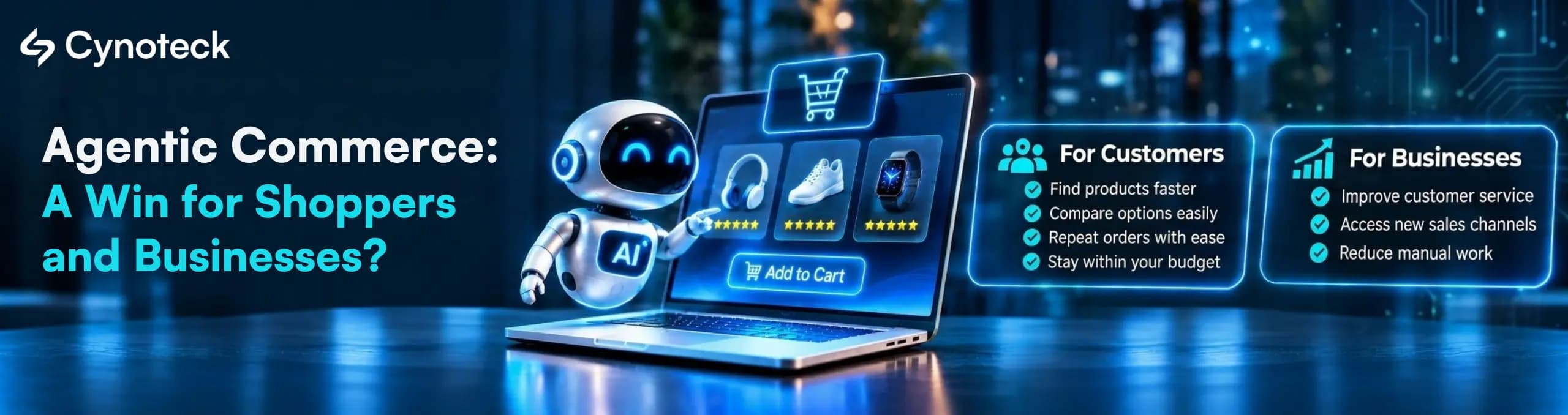
- For customers: It helps customers discover products faster, compare options more easily, and place repeat orders more simply. Moreover, AI agents help customers stay within their budget.
- For businesses: Businesses can improve customer service, access new sales channels, and reduce manual work across shopping and order management.
- The limit: Customer trust is still a challenge for businesses. According to the Boston Consulting Group (BCG), only 4% of customers would let an AI agent make purchases without their approval. However, businesses should start with customer-approved purchases and gradually increase automation as trust grows.
Remember the last time you bought something online. You might have opened a few tabs, compared prices, read reviews, and checked delivery dates before confirming the purchase. This process works, but it takes a lot of time. However, agentic commerce hands this manual work to an AI agent. AI agent will search, compare, and complete the purchase with your permission. That’s why many businesses search for the benefits of agentic commerce.
For customers, AI agents help save time and manual effort. Moreover, it opens new ways for businesses to be found and to sell. This guide describes the benefits of agentic commerce for both businesses and customers, and what still needs work.
What Is Agentic Commerce and How Does It Work?
Agentic commerce empowers AI agents to search, compare features and pricing, and complete the purchase order based on your permission. McKinsey also describes AI agents handling parts of shopping, from finding a product to completing the purchase.
Agentic Commerce works in four steps:
Step 1: Set the goal: what you want and how much you want to spend.
Step 2: Then, the agent searches for the product, checks prices and reviews, and ensures availability across stores.
Step 3: You approve the product, or the agent decides within your rules.
Step 4: Finally, the agent completes the purchase using an approved payment method based on your permissions.
Let us understand it using an example:
You ask an AI agent to find running shoes under $250. It checks stores and reviews, filters out products that exceed your budget or aren't available in your size, and suggests relevant options. You can select the product yourself or let the agent purchase it within your approved limits.
Want to explore Agentic Commerce from the basics? Read our Guide “What is Agentic Commerce”
What Are the Key Benefits of Agentic Commerce for Customers?
The key benefits of agentic commerce for customers are faster and easier shopping. Moreover, customers spend less time searching, get product suggestions that match their needs, and can control their overall budget.
McKinsey’s June 2026 survey found that, across 11 markets, 81% of AI users said AI helps them narrow down their choices, and 79% said it saves them a lot of time. These facts apply to the customers who already use AI. This shows how AI is changing the way customers shop.
1. Faster product discovery and shopping
Using agentic commerce, you can avoid visiting several websites. Instead, you can ask an AI agent to identify products that match your requirements. Then, it searches across stores, checks available options, and gives a shorter list after completing the research.
According to an NRF and IBM study, 41% of 18,000 customers said they use AI assistants to research products.
2. Personalized product recommendations
AI agents can use personalized product details, such as preferred size, budget, favorite brands, and past order details, to suggest relevant products. This gives customers more options that fit their needs, instead of random products. You can also choose what information the AI agent remembers and uses.
3. Easier product comparison and better decisions
If customers manually compare products across different stores, it can take too much time. However, an AI agent can collect all information in one place, including pricing, features, customer reviews, delivery times, and return policies, to speed up product comparison and improve decisions.
The NRF and IBM study also found that 33% of customers use AI to find product reviews. However, an AI agent helps you compare options, but you still make the final call.
4. Convenient and faster checkout
Once you approve the purchase permission, an AI agent can complete the purchase using an authorized payment method and within the limits you set. To keep this safe, payment providers use special tokens, allowing the AI agent to pay without seeing your real card details. This can help reduce the number of steps customers need to complete when placing an order.
5. Better budget control and deal discovery
You can set the spending limit and ask an AI agent to find the best available price. It also compares offers across stores and helps you identify discounts. According to the NRF and IBM study, 31% of customers already use AI to hunt for deals. Moreover, agents can track prices and identify future price drops.
6. More convenient repeat purchases
An AI agent can help you reorder everyday products, such as coffee, pet food, and other household supplies, based on your instructions. In fact, McKinsey found that customers who use AI most often complete purchases with AI in apparel and grocery. This also suggests that customers are beginning to use AI for both planned and everyday purchases.
A note for the US: McKinsey found that 48% of US customers had used AI for shopping, compared with 53% across all surveyed markets. Among US AI users, purchases with AI increased from 10% to 17% in one year. Moreover, 74% of customers trust AI chat and search tools. |
Planning to introduce AI into your business? Use our AI readiness checklist to identify data gaps and understand what you need in place before you begin.
How Does Agentic Commerce Benefit Businesses?
Agentic commerce helps businesses improve customer experience, increase sales opportunities, reduce repetitive tasks, and reach customers through new channels. However, these benefits completely depend on accurate product information, reliable systems, and customer trust.
According to BCG’s 2026 survey, 68% of retailers expect agentic commerce to significantly impact their business within 2 years. Here are the seven common ways agentic commerce can benefit businesses:
1. Better customer experience and satisfaction
Customers want quick answers and product recommendations that match their needs. AI agents help businesses answer product questions, suggest suitable items, describe delivery options, and guide customers through the product purchasing process. Moreover, customers find what they need without searching through multiple pages or waiting for support.
2. More chances to convert shoppers
AI agents allow customers to complete a purchase, from product discovery to checkout, in an easier way. Moreover, AI agents help customers find relevant products and reduce the effort of comparing options. Therefore, agentic commerce gives businesses more opportunities to convert customers.
BCG reports that Nordstrom’s own agent drove higher conversion rates in early tests, although the company noted that the results may reflect selection bias. Deloitte has also identified early signals of lower conversion and smaller baskets in agent-driven channels. So, businesses should test agent-led shopping on a small scale before investing heavily, as the results are not consistent across businesses.
3. Faster sales and customer support
Agentic commerce also helps businesses speed up sales and customer support. It answers common product-related questions, order status inquiries, account questions, and shipping questions at any time. For example, in one Cynoteck project, a Salesforce Agentforce agent automated routine order, account, and shipping queries for a water treatment company in Austin, Texas. The agent went live in six weeks.
4. Less manual work through automation
Retailers spend too much time on repetitive tasks, such as checking stock, searching product details, processing orders, and managing repeat purchases. However, AI agents can automate these tasks and handle them without any hassle, allowing customers to focus on customer issues and decisions that need human involvement. According to Deloitte’s research, 58% of global retailers expect AI agents to take over most customer conversations within five years.
5. Better customer insights and decisions
Customer conversations with an AI agent can reveal many things, such as what customers want, which features matter to them, and their budget. However, businesses can use these insights to improve product selection, pricing, and stock plans. These same signals can also support AI demand forecasting. Therefore, businesses must handle customer information carefully.
6. New ways for products to be found
Agentic commerce also benefits businesses by unlocking new ways for products to reach customers. It helps customers find products directly through an AI assistant, even without visiting any website. BCG also explains that retailers can now complete a sale even when shoppers never visit their websites.
Therefore, accurate product information, such as product title, description, prices, stock levels, and delivery details, is a must for this. However, this channel is still developing. BCG found that agent referrals accounted for less than 1% of website visits at leading European retailers in late 2025.
7. More efficient B2B purchasing and procurement
Agentic commerce isn't limited to individual customers; businesses can also use it to streamline purchasing and supplier management. For example, an AI agent can compare suppliers, check product availability and pricing, and prepare purchase orders for approval.
As a result, employees can review larger purchases before confirming them. This reduces your team's time spent on routine supplier checks and ordering tasks while keeping important spending decisions under human control.
How Is Agentic Commerce Changing Different Industries?
Many businesses think agentic commerce is limited to online stores. However, it can also help businesses in retail, grocery, finance, travel, manufacturing, and healthcare. By implementing agentic commerce, businesses can serve customers faster and more easily through product discovery, option comparison, and purchase completion.
Each industry also has different requirements for an AI agent solution. For example, a grocery store may need AI agents to manage repeat orders, while a manufacturing business may need them to compare suppliers. Moreover, industries such as healthcare and financial services require high-level privacy controls and approval processes. Here are the common use cases across six industries:
Industry | Potential use | What to check first |
Retail and e-commerce | Finding products, recommendations, and buying | Accurate product data and stock |
Grocery | Shopping lists, repeat orders, and delivery times | Substitutions and delivery slots |
Travel and hospitality | Comparing flights, hotels, and bookings | Live prices and cancellation rules |
Financial services | Guided product choice and eligible service purchases | Customer consent and regulation |
Manufacturing | Comparing suppliers and helping with procurement | Supplier approval steps |
Healthcare | Finding eligible medical supplies and equipment | Eligibility rules and patient privacy |
According to McKinsey, in the US, grocery and beauty, which have low online presence or shopping today, are adopting AI quickly. Healthcare and financial services have strict privacy and eligibility rules, so they need extra care. Start with the industry you sell in, and review the last column with your team. If you sell online, our guide to AI in retail and e-commerce shows where AI can help businesses in retail.
Also, read: The cost of AI in retail and e-commerce guide to understand the investment involved in adopting AI agents.
What Role Does AI Play in Delivering These Benefits?
Behind agentic commerce, AI helps users discover products, compare features, and complete shopping tasks. Moreover, various technologies work together to make this process possible; here are six important ones:
AI agents: They handle multi-step tasks, such as searching for products, comparing options, and placing orders within set limits.
Machine Learning: It helps AI understand past shopping patterns and improve product recommendations.
Natural Language Processing: NLP empowers AI agents to understand everyday requests, such as finding shoes under $250.
APIs: They help connect AI agents to online stores, product catalogs, stock levels, and order management systems.
Payment Connections: They handle payments, allowing agents to complete transactions through approved, secure payment methods.
Customer Data and CRM Systems: Data from customer and CRM systems give AI agents access to relevant customer preferences. Depending on permissions, they can also access purchase history and previous interactions.
Well, AI agents handle shopping tasks, while APIs, payment systems, and customer data help them work with existing business systems. If businesses need help, they can connect with us; we offer AI development services and connect them to CRM and commerce systems through Salesforce integration services.
If you are new to AI agents, you can start with our “What agentic AI is” detailed guide.
Is Agentic Commerce Worth Adopting for Businesses?
Yes, most businesses should prepare now to adopt agentic commerce, even if they adopt it gradually. Customers can save time, compare products more easily, and simplify repeat orders. Moreover, businesses can reach customers through new channels, improve support, and reduce repetitive work.
The benefits depend on four important factors: accurate product data, secure payments, systems integration, and customer trust. Businesses do not need to automate everything at once. Instead, they should start with a small pilot, test customer response, and expand when results support further investment.
If you are looking to build an AI agent, explore our agentic AI development services or visit our Salesforce consulting services page.
Frequently Asked Questions
What are the main benefits of agentic commerce?
For customers, agentic commerce can save time by automating product discovery and making it easier to compare options. Moreover, businesses can reach customers through new channels, deliver faster service, and reduce manual work, depending on accurate data, reliable payment systems, and customer trust.
How does agentic commerce improve customer experience?
Agentic commerce removes repeated steps. Moreover, customers only need to describe what they need, and the agent searches, compares products, and shortlists recommendations. Beyond that, customers can also control purchases and set spending limits.
Can agentic commerce increase online sales?
It can, but higher online sales are not guaranteed. However, fewer steps and better product recommendations can encourage customers to complete the purchase. Nordstrom also reported higher conversions in early tests, and Deloitte’s early signals show lower conversion in some agent-led shopping channels. So, always test agentic commerce with at least one product category before expanding.
Is agentic commerce better than traditional e-commerce?
Agentic commerce doesn’t replace traditional e-commerce; instead, it adds a new way to shop. Customers can still browse websites, visit physical stores, and make purchases themselves. The NRF and IBM study also found that 72% of customers said they still shop in physical stores. Moreover, most businesses will need to support both shopping methods for better outcomes.
How do AI agents make purchases?
Customers give AI agents a shopping goal and set limits, such as price and preferred brand. The agent searches for products, compares options, and starts checkout. Secure payment tokens allow it to complete transactions without exposing the customer's actual card details. Customers can also approve larger purchases.
What are the risks of agentic commerce?
Risks include privacy issues, fraud, incorrect product details, and unintended purchases. Clear permissions, accurate data, secure payments, and human approval for larger orders help reduce these risks.
Explore comprehensive blogs, best practices, and insights from our technology experts.

 What Al Services Does a Business Actually Need in 2026.webp)

10 Proven Benefits of Custom CRM Software for Modern Businesses (2026)
Discover the top 10 benefits of custom CRM software development for modern businesses. Learn how tailored CRM solutions improve efficiency, enhance customer relationships, and drive business growth.
 How Much Does It Cost to Build an Enterprise AI Chatbot in 2026.webp)
How Much Does It Cost to Build an Enterprise AI Chatbot in 2026?
Integrations, HIPAA and state privacy rules, and conversation complexity drive what US companies pay for enterprise AI chatbots. Includes budget ranges, an offshore partner checklist, and a payback calculation using BLS wage data.

A Quick Intro to Artificial Intelligence (AI) & Its Components
What is Artificial Intelligence? Artificial intelligence (AI) is intelligence demonstrated by machines, which makes it possible for machines to learn from experience, adjust to new inputs and perform human-like tasks.
Turning expertise into action for your business.
We are more than just developers and consultants—we are your partners in navigating the digital landscape. Let us be the engine behind your next big success while you focus on your core vision.
Explore Opportunities!