What Is Generative AI? A Complete Guide for 2026
Summary: Generative AI is a type of artificial intelligence that creates new content, such as text, images, audio, or code, instead of only analyzing data. This guide explains what it is, how it works, where businesses are using it today, and where it still falls short. |
Generative AI has moved from a niche research topic to a tool most companies now use in at least one part of their business. This guide explains what generative AI is, how it differs from the AI you have used for years, and what it can realistically do for your team. According to McKinsey's Global Survey on AI, the share of organizations using generative AI regularly in at least one business function roughly doubled between 2023 and 2025, rising from about a third of companies to roughly two-thirds.
Generative AI is artificial intelligence that creates original content in response to a prompt or instruction. Instead of only recognizing patterns and predicting an outcome, it uses those patterns to generate something new: a paragraph, an image, a piece of code, or a video.
Give a generative AI tool an instruction like "write a follow-up email to a customer who has not paid an invoice," and it drafts the full email in seconds. Ask it to design a logo, summarize a contract, or turn rough notes into a proposal, and it can do that too.
Well-known generative AI tools include:
ChatGPT (OpenAI): A text-based assistant used for writing, research, and answering questions.
Gemini (Google): A conversational AI tool built into Google's search and workplace products.
Claude (Anthropic): A text-based assistant known for longer, more detailed responses.
Midjourney and DALL-E: Image generators that turn a written description into original artwork.
GitHub Copilot: A coding assistant that writes and suggests code inside a developer's editor.
Each of these tools runs on a foundation model, a large AI system trained on vast amounts of text, images, or other data. That training is what enables the model to produce fluent, relevant output on almost any topic.
Whether you're looking to streamline operations, enhance customer experiences, or build AI-powered applications, Cynoteck helps you identify the right use cases and implement solutions that deliver measurable value.
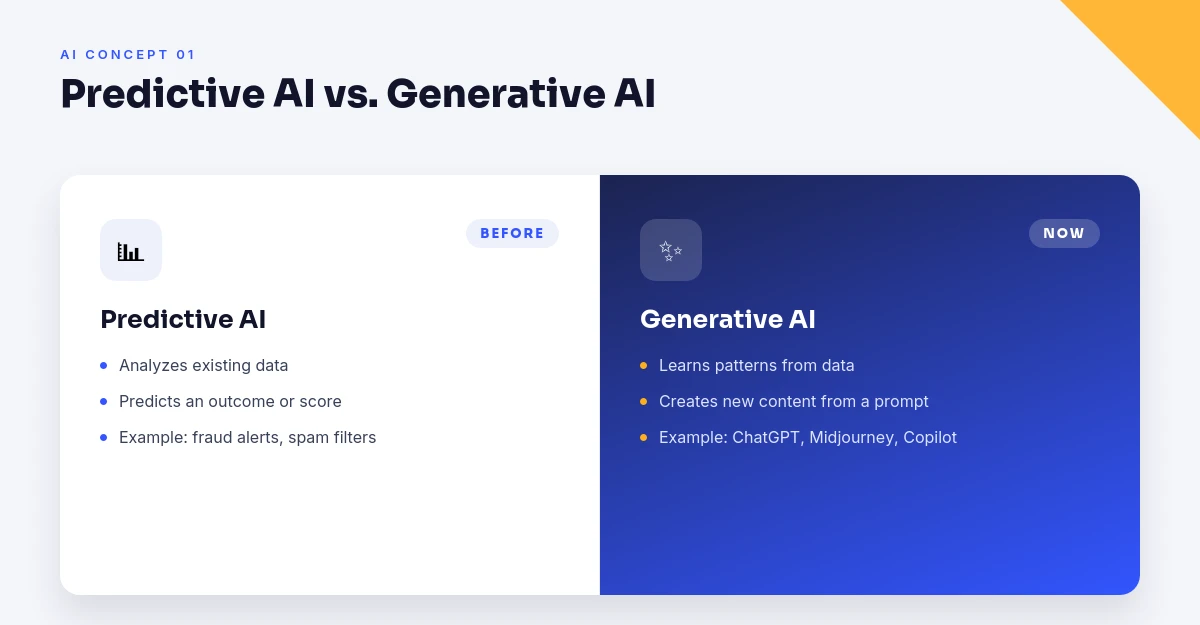
Get a Free AI Tool RecommendationMost of the AI you used before generative AI became mainstream is predictive AI, also called traditional AI. This is the kind of AI that recommends a show on a streaming service, flags a suspicious credit card charge, or filters spam out of an inbox. It studies existing data to predict an outcome or to sort information into a category.
Generative AI goes a step further. Instead of predicting an outcome, it creates new content that did not exist before.
Predictive AI | Generative AI | |
What it does | Analyzes data and predicts an outcome | Creates new content from a prompt |
Example task | "Is this customer likely to cancel?" | "Write a retention email for this customer" |
Typical output | A score, a label, or a recommendation | Text, images, audio, video, or code |
Where you have seen it | Spam filters, fraud alerts, streaming recommendations | ChatGPT, Gemini, Midjourney, GitHub Copilot |
Note: Many businesses already run both types of AI side by side. Predictive AI can flag which customers are at risk of leaving, and generative AI can draft the retention email that follows. |
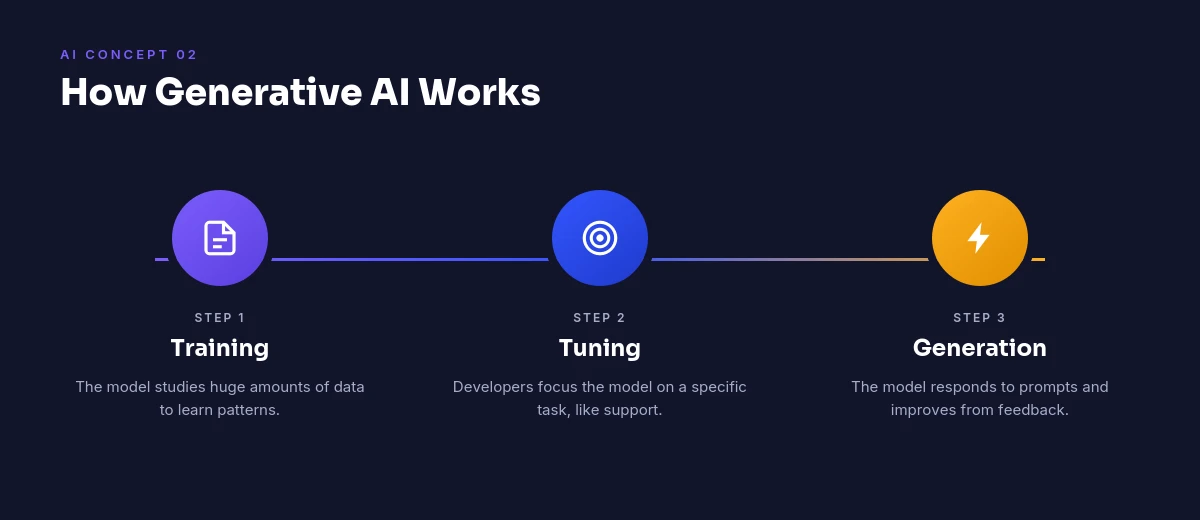
Generative AI relies on deep learning, a type of machine learning loosely modeled on how the human brain processes information. The process happens in three stages:
Training: Developers feed a deep learning model enormous amounts of text, images, or other data, often pulled from the internet or licensed sources. The model studies this data and learns the patterns and structure within it, which is how it picks up grammar, facts, and coding syntax without being taught a single explicit rule.
Tuning: A freshly trained model is a generalist. It knows a little about almost everything but is not yet strong at any one task, so developers tune it for a specific purpose, such as customer support, by feeding it examples of the exact questions and answers it will need to handle.
Generation: Once deployed, the model generates output in response to prompts, and developers continue to monitor and adjust it based on real-world performance and user feedback. This is why tools like ChatGPT keep improving after their initial release.
The engine behind most of today's leading generative AI tools is called a transformer, a model architecture introduced by Google researchers in 2017. Transformers are especially good at tracking context across long pieces of text, which is why modern AI chatbots hold a coherent conversation instead of responding to each sentence in isolation.
Generative AI is not limited to chatbots. Depending on the tool, it can produce text such as emails, blog posts, product descriptions, reports, and summaries, along with images and video, including original artwork, product mockups, marketing visuals, and short clips built entirely from a written description.
It also handles content types that go beyond writing and visuals:
Audio and music: Realistic voiceovers, podcast narration, and original background tracks.
Code: Working snippets, bug fixes, and full functions, based on a plain-language description of what the code should do.
Structured data: Synthetic data sets used to train other AI models or test software without exposing real customer information.
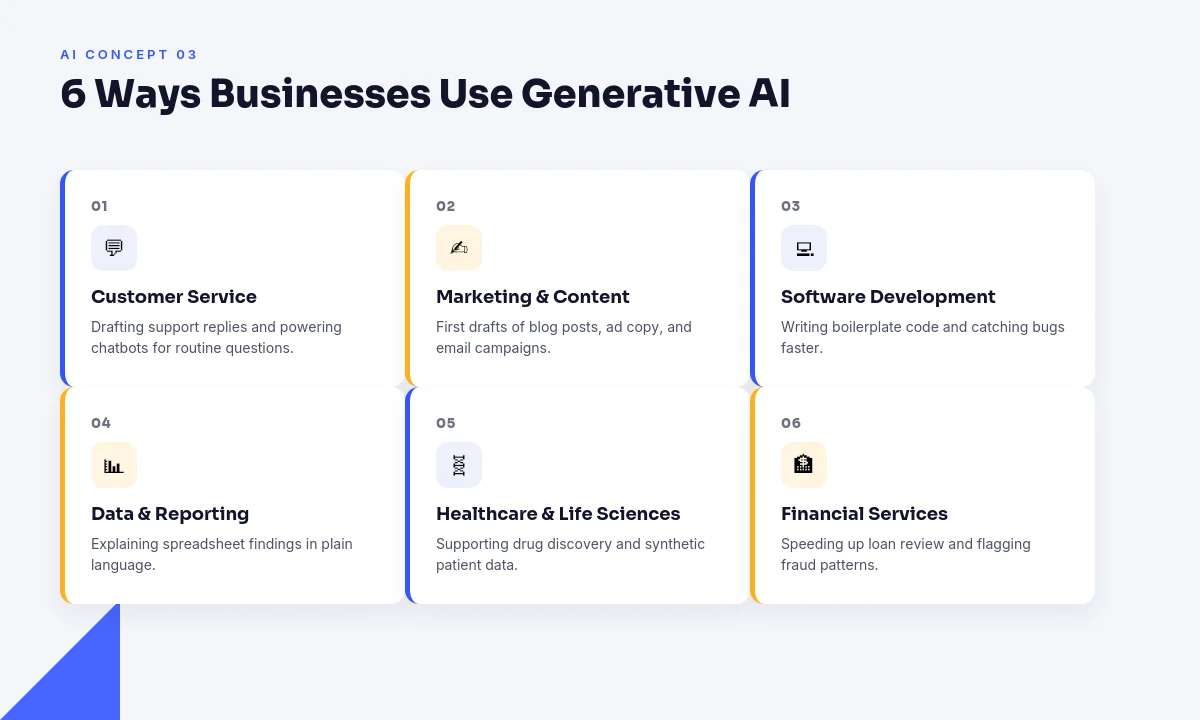
Generative AI adoption has moved past early testing and into daily use across most industries. Gartner has projected that more than 80 percent of enterprises will have used a generative AI application or API by 2026. Here is where that adoption is showing up.
Customer service: Companies use generative AI to draft support responses, power chatbots for routine questions, and summarize long customer interactions for human agents. This frees support staff to focus on issues that genuinely need a person.
Marketing and content: Marketing teams use generative AI to draft blog posts, social captions, ad copy, and email campaigns. It handles the first draft quickly, though most teams still have a human edit for tone and accuracy before anything goes live.
Software development: Developers use AI coding assistants like GitHub Copilot to write boilerplate code, catch bugs, and speed up updates to older software systems.
Data analysis and reporting: Instead of hiring a dedicated analyst for every question, teams can ask a generative AI tool to read a spreadsheet and explain the findings in plain language, such as which product line underperformed last quarter.
Healthcare and life sciences: Researchers use generative AI to help design new molecules for drug discovery and to generate synthetic patient data for training other medical AI systems without exposing real patient records.
Financial services: Banks and lenders use generative AI to draft personalized financial guidance, speed up loan document review, and detect unusual patterns that may indicate fraud.
Example: A regional bank used a generative AI tool to draft first-pass summaries of loan applications for underwriters. The tool did not approve or deny anything. It simply gave underwriters a head start, significantly reducing review time for routine applications.
Note: Adoption alone does not guarantee results. Google Cloud's 2025 ROI of AI study found that 74 percent of executives report achieving a return on their generative AI investment within the first year. Still, that return shows up fastest when a tool is applied to a clearly defined task rather than rolled out everywhere at once. |
From AI consulting and custom AI application development to enterprise integrations and workflow automation, Cynoteck helps businesses move from experimentation to real-world results.
Schedule a Free ConsultationAny honest guide to generative AI has to cover its limitations, since this is usually the first concern a skeptical business leader raises.
Hallucinations: Generative AI can produce information that sounds confident but is factually wrong. A widely reported case, Mata v. Avianca, involved a lawyer who used a generative AI tool for legal research and submitted a filing containing fabricated court cases.
Inconsistent answers: Because generative AI models work probabilistically, the same question can produce a slightly different answer each time. That inconsistency can be a problem in situations like customer support, where a predictable answer matters.
Bias: A generative AI model can absorb and repeat biases present in its training data. Developers reduce this through careful data selection and ongoing evaluation, but no model is completely free of it.
Data privacy and security: Feeding sensitive company or customer information into a public AI tool can create real privacy exposure. Businesses handling confidential data should understand exactly how a given AI vendor stores and uses the information they submit.
Cost and complexity at scale: Running generative AI for a single task is often cheap or free. Building and maintaining a custom, fine-tuned model for a large organization requires significant technical investment.
Pro Tip: Treat generative AI output the way you would treat a draft from a new employee. It is a strong starting point, not a finished, verified answer. Review anything involving numbers, legal language, or compliance before it goes out. |
Not every business needs a major AI initiative, and not every task benefits from one. Generative AI tends to deliver the most value when a task meets a few honest criteria.
The task is repetitive and time-consuming, such as drafting similar emails or reports every day.
The output does not need to be perfect on the first try because a human reviews it before it goes out.
There is a clear way to measure success, so you can tell whether the tool is genuinely saving time once it is in use.
The task involves language, images, or code, rather than pure numerical calculation, which is still better handled by traditional software.
If a task checks most of these boxes, it is a strong candidate. If it involves high-stakes decisions, sensitive data, or a need for guaranteed accuracy, treat generative AI as an assistant that supports a human decision-maker rather than a replacement for one.
The businesses seeing real results from generative AI rarely start with a company-wide rollout. They start small and expand once a task proves its value.
Step 1: Pick one repetitive task that already eats up time, such as customer email replies, first-draft marketing copy, or internal reporting.
Step 2: Test a free or low-cost generative AI tool on that single task for a few weeks, with a human reviewing every output.
Step 3: Measure the result. Track the time saved and the quality of the output before deciding whether to continue.
Step 4: Move on to the next task only once the first one is genuinely saving time, instead of trying to overhaul everything at once.
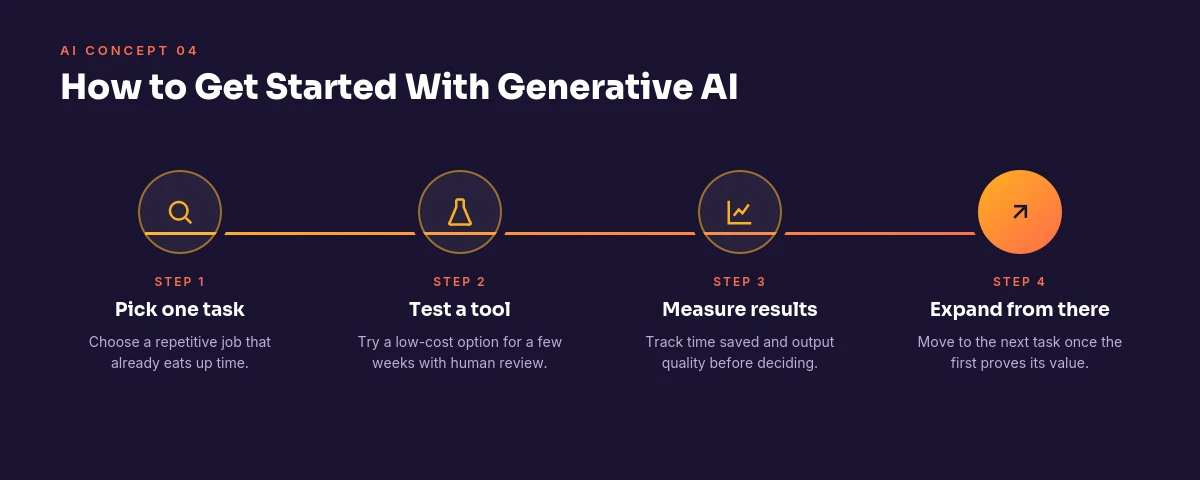
Note: This slow, task-by-task approach is why some companies get real value from generative AI while others, who applied it everywhere at once without a clear plan, end up disappointed with the results.
The next stage of this technology is already taking shape and is generally called agentic AI. Instead of only drafting content for a person to review and send, an AI agent can take the next step on its own, such as checking inventory levels, following up with a vendor, or updating a record, stepping back only when a decision genuinely requires human judgment.
Understanding generative AI well today makes that next shift far less intimidating when it reaches your business.
At Cynoteck, we help businesses plan, develop, and deploy secure Generative AI solutions tailored to their workflows, industry requirements, and long-term growth objectives.
Connect with Our AI ExpertsGenerative AI is not a replacement for human judgment. It is a genuinely useful tool that creates content rather than only analyzing it, and it has already moved from an experimental novelty to daily use at most companies. The businesses getting real value from it are the ones that picked one clear, repetitive problem, tested a tool on it honestly, and expanded from there once it proved itself.
Ans: Generative AI is a type of artificial intelligence that creates new content, such as text, images, audio, or code, rather than merely analyzing existing data. Give it an instruction, and it produces an original response based on patterns it learned during training.
Ans: AI is the broad field of building machines capable of performing tasks that typically require human intelligence. Generative AI is a specific subset of AI focused on creating new content rather than only classifying or predicting outcomes from existing data.
Ans: ChatGPT for writing and answering questions, Midjourney and DALL-E for image generation, GitHub Copilot for writing code, and AI voice tools for generating narration are all widely used examples of generative AI in use today.
Ans: Not always. Generative AI can produce confident-sounding answers that are factually incorrect, a problem known as hallucination. Important output, especially anything involving facts, numbers, or legal or medical information, should be reviewed by a human before use.
Ans: Not necessarily. Many generative AI tools offer free or low-cost plans that are enough for testing on a single business task. Costs rise significantly only when a company builds and maintains a custom, fine-tuned model at scale.
Ans: Start with one repetitive, time-consuming task, such as email drafting, first-draft content, or basic reporting. Test a low-cost tool on that task for a few weeks with human review, then expand to additional tasks once it proves its value.

What is Artificial Intelligence? Artificial intelligence (AI) is intelligence demonstrated by machines, which makes it possible for machines to learn from experience, adjust to new inputs and perform human-like tasks.
We are more than just developers and consultants—we are your partners in navigating the digital landscape. Let us be the engine behind your next big success while you focus on your core vision.
Explore Opportunities!
 What Al Services Does a Business Actually Need in 2026.webp)