Why Your Restaurant Must Have a Mobile App in 2026
In 2026, a mobile app is not just an option for restaurants. It is a necessity. This guide explores why a restaurant mobile app is critical for your success, from boosting customer loyalty to modernizing your marketing efforts.
Smartphones have changed how customers interact with restaurants. Since the early 2010s, mobile apps have steadily gained traction, and by 2026, they are expected to be a core part of the dining experience. The reason is simple because mobile app development in restaurant industry offer convenience and speed. With just a few taps, customers can browse menus, place orders, and make reservations.
The COVID-19 pandemic also played a major role in accelerating this shift. In addition, restaurants adopted digital solutions to serve customers while following social distancing guidelines. That shift has never reversed. Today, customers expect to order and pay on their phones with a few taps, and restaurants without a mobile app risk falling behind.
The growing preference for contactless transactions has also accelerated this trend. Mobile apps give customers a secure and efficient way to interact with restaurants, and this is only going to increase in the years ahead.
Not every restaurant needs an app the day it opens its doors. A single-location cafe six months into business and a five-location chain doing 200 online orders a day are asking the same question, but they are not in the same place to answer it. The real question is not "should restaurants have apps," it is "is my restaurant at the point where one actually pays off?" Here is how to tell, and what to do with the answer.
An app pays for itself fastest when a restaurant already has some demand it is not fully capturing. Think of it less as a new feature and more as a way to keep revenue that is currently leaking out to phone calls, third-party apps, or forgotten follow-ups. These are the restaurant profiles where that gap tends to be largest:
Restaurants with repeat customers: If the same faces keep coming back, an app turns that loyalty into a direct channel you control, rather than relying on them remembering your phone number or your name in a delivery app search.
Restaurants offering delivery or takeaway: Every delivery or pickup order is a chance to skip a phone call and skip a third-party commission. A restaurant doing even 30 delivery orders a week at a 20 percent average commission is handing over real money every single week.
Multi-location restaurant chains: One app across every location gives customers a single, consistent way to order and gives you a single dataset instead of five disconnected ones across five different systems.
Restaurants receiving frequent online orders: If online orders already show up daily through a website, social media, or a delivery app, that demand is proof the channel works. An app just makes it yours, not a platform's.
Restaurants spending heavily on third-party delivery platforms: If commission fees already appear as a line item on your monthly statement, an app is one of the few practical ways to bring that number down, order by order.
Need alone does not always mean now is the right moment. Timing depends on whether the pressure is already visible in your day-to-day operations, not just in theory. These are the moments that usually push an app from "someday" to "this quarter":
Growing customer base: More customers means more phone calls, more mistakes, and more staff time spent taking orders instead of preparing them. Past a certain volume, a host or server answering the phone mid-shift is not a minor inconvenience; it is a bottleneck.
Increasing online orders: Once online orders become a habit for your customers rather than the exception, the volume alone justifies the investment, since you are no longer testing a channel; you are scaling one that already works.
Rising third-party commission costs: If your commission bill keeps climbing every quarter as delivery volume grows, that trend line is telling you the cost of not owning your own channel is compounding, not staying flat.
Need to improve customer retention: An app gives you a direct line to customers, through notifications and loyalty rewards, that a phone number alone cannot offer. You can remind a customer about their favorite order; a phone number sitting in a drawer cannot.
Planning to scale the business: Adding locations or franchising is much easier to support with one ordering system already in place and proven, rather than building it from scratch under pressure once location two is open.
An app is not automatically the right next step for every restaurant, and building one too early can mean paying for infrastructure your current order volume cannot yet justify. It is worth waiting, at least for now, if any of these describe where you are:
Newly opened restaurants with very few customers: Without enough order volume yet, the app has little real usage data to learn from and a small audience to serve, which means the investment sits mostly idle in its first months.
Businesses still validating their concept: If the menu, pricing, or concept itself is still changing week to week, it makes sense to get that right first. An app built around a menu that is about to change is money spent twice.
Restaurants that rarely receive online orders: If nearly all orders happen in person today, an app solves a problem you do not currently have, and that budget is likely better spent elsewhere for now.
Limited budget where a website is currently sufficient: A simple website or ordering page can cover the basics, taking orders and payments, until the volume actually justifies a dedicated app with its own ongoing cost.
Answer these five questions honestly with a plain yes or no, not what you hope will be true in six months.
Do you receive repeat customers regularly?
Do you offer delivery or takeaway?
Are you paying high commissions to food delivery platforms?
Do you want to build direct relationships with customers?
Are you planning to expand your restaurant business?
Two or more yes answers is a reasonably strong signal that a mobile app would earn back its cost within a reasonable window, and it is worth getting a real quote before deciding either way. One "yes" answer usually means it is worth revisiting this checklist in three to six months rather than acting today. Zero or one "yes" answer means a website and a solid phone ordering process are likely still doing the job just fine, and that the budget is better spent on the menu, the space, or the staff for now.
A restaurant mobile app offers key benefits for owners and customers, including improved customer satisfaction and greater data visibility. Here are some of the most important benefits of having a dedicated mobile app for your restaurant:
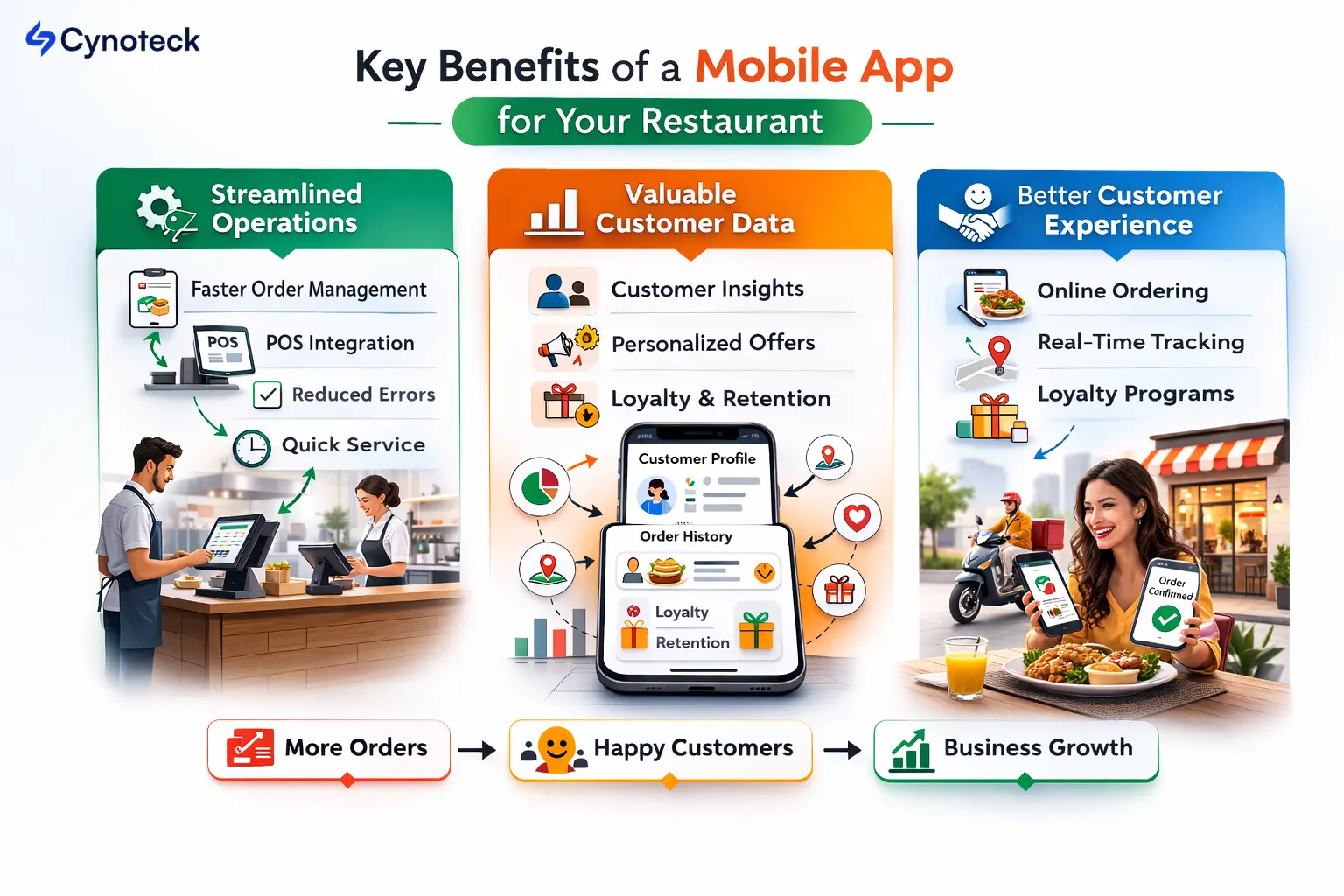
Streamlined Operations: A mobile app can integrate directly with your existing POS system, simplifying order management and reducing errors. This frees up your staff to focus on customer service rather than manual order handling.
Valuable Customer Data: Apps allow you to collect and analyze customer behavior and preferences. This data helps you run more targeted and personalized marketing campaigns.
Better Customer Experience: Features like online ordering, real-time tracking, and loyalty programs make it easier for customers to engage with your restaurant and keep coming back.
Every restaurant is different. Let us show you how a custom mobile app can work specifically for your business, your customers, and your goals.
Talk to Our TeamMany restaurant owners wonder whether they really need their own app when platforms like DoorDash and Uber Eats already exist. It is a fair question, and the answer comes down to one thing: how much of your revenue you want to keep.
Third-party delivery platforms charge restaurants a commission on every single order placed through their platform. These commissions typically range from 15 to 30 percent per order. On a $50 order, that means $7.50 to $15 goes straight to the platform before you account for food costs, staff, and overheads. For high-volume restaurants, this adds up to tens of thousands of dollars every year.
Here is how the two compare side by side:
Factors | Third-Party Apps (DoorDash / Uber Eats) | Your Own Restaurant App |
|---|---|---|
Commission per order | 15% – 30% | Zero |
Customer data ownership | The platform owns it | You own it |
Brand control | Limited | Full control |
Loyalty programs | Not available | Fully customisable |
Marketing reach | Dependent on their algorithm | Direct push notifications |
Long-term cost | Grows with every order | Fixed development cost |
Beyond the commission cost, there is another issue that most restaurant owners do not think about until it is too late. When a customer orders through a third-party platform, that platform owns the customer data, not your restaurant. You cannot follow up with them, send personalized offers, or invite them back without going through the platform again and paying for the privilege.
Your own branded app changes this completely. You keep the full order value, you own your customer relationships, and you build loyalty on your own terms.
That said, the two approaches need not be mutually exclusive. Many successful restaurants use third-party platforms to attract new customers and then use their own app to retain them, keeping the high-margin repeat orders in-house where they belong.
A restaurant mobile app can transform the dining experience in ways that traditional methods simply cannot match. Let us look at how:
Online Ordering: Customers can browse your menu, customize their orders, and pay directly from their smartphones. This saves time and reduces errors that often happen with phone orders.
Real-Time Order Tracking: Customers want to know exactly when their food will be ready, whether they are dining in, picking up, or waiting for delivery. Real-time tracking builds trust and improves overall satisfaction.
Loyalty Programs: Customers can earn points, receive special offers, and redeem rewards all within the app. This encourages repeat visits and strengthens the relationship between your customers and your restaurant.
Many restaurants still rely on phone calls and in-person orders. While these methods work, they come with clear limitations. The table below highlights the key differences between restaurant mobile apps and traditional ordering methods:
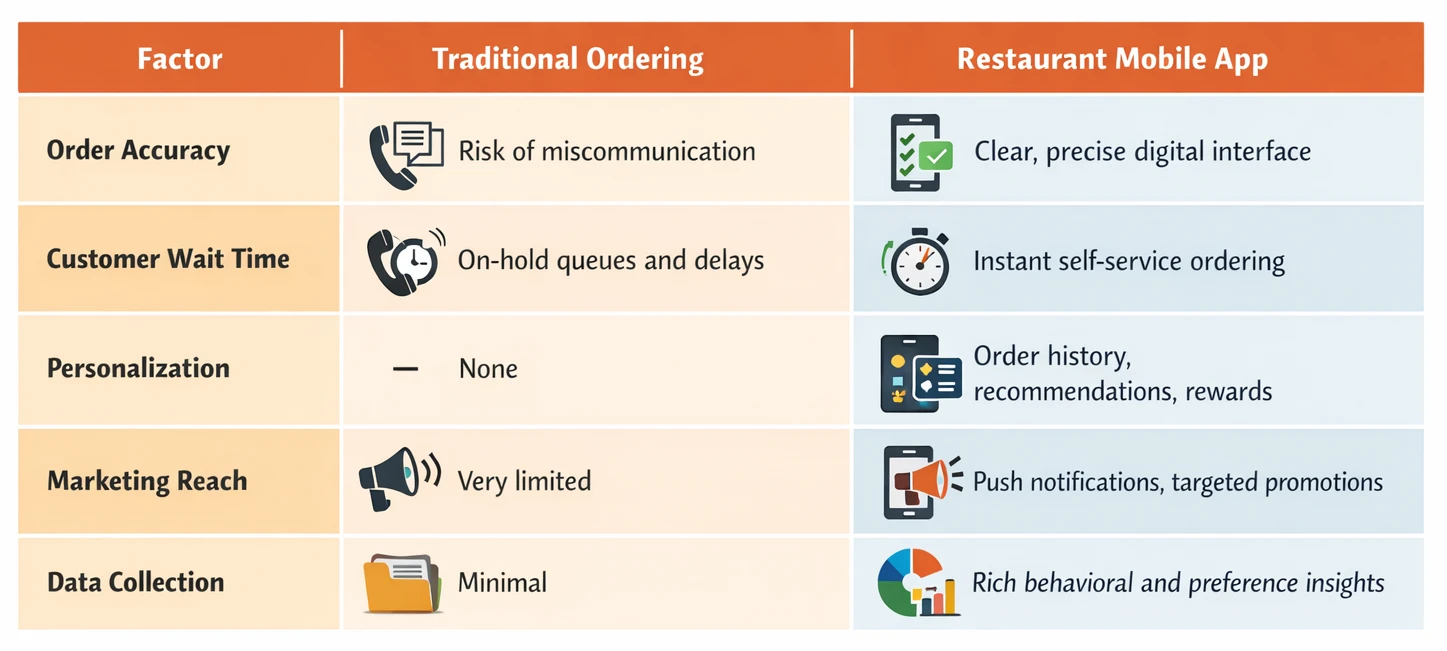
Factor | Traditional Ordering | Restaurant Mobile App |
Order Accuracy | Risk of miscommunication | Clear, precise digital interface |
Customer Wait Time | On-hold queues and delays | Instant self-service ordering |
Personalization | None | Order history, recommendations, rewards |
Marketing Reach | Very limited | Push notifications, targeted promotions |
Data Collection | Minimal | Rich behavioral and preference insights |
Restaurant mobile apps eliminate the frustration of waiting on hold or repeating orders. Moreover, customers place orders quickly and accurately, which makes the experience smoother for everyone, both customers and restaurant staff.
Stop losing orders to long wait times and missed calls. A smarter, faster solution built around your restaurant is just one conversation away.
Get a Free ConsultationTo get the most out of your restaurant mobile app, get the right features in place from the start. Here are the must-have features for a restaurant app in 2026:
User-Friendly Interface: The app should be easy to navigate, with clear menus and simple controls so that customers can order without confusion.
Online Ordering and Payment: Customers should be able to browse, customize, and pay all within the app.
Loyalty Programs and Rewards: Allow customers to earn points and redeem rewards to encourage repeat business.
Real-Time Order Tracking: Keep customers informed at every stage of their order.
Push Notifications: Share promotions, new menu items, and events directly with your customers.
Personalized Recommendations: Use past order history to suggest relevant items to each customer.
POS System Integration: Sync orders directly with your back-of-house systems for smooth operations.
Customer loyalty is one of the most important factors for long-term restaurant success. A well-built restaurant loyalty app can help you build and maintain that loyalty in several ways.
Loyalty Programs: Allowing customers to earn points on every purchase and redeem them for rewards gives them a clear reason to return. It also gives your restaurant a competitive edge over others that do not offer such programs.
Personalization: A mobile app can track customer preferences and order history. This allows you to offer recommendations and promotions that feel relevant and personal. As a result, customers who feel understood are far more likely to return.
Direct Communication: Push notifications let you reach customers with updates on promotions, new menu items, and upcoming events. Staying in front of your customers regularly helps build a lasting connection with your brand.
A restaurant mobile app is one of the most direct marketing tools available to restaurant owners today. Here is how it helps:
Push Notifications: These alerts instantly inform customers about special offers, new dishes, and events. Unlike email or social media, push notifications land directly on the customer's screen, making them hard to miss.
Targeted Campaigns: By analyzing customer data collected through the app, you can create promotions tailored to specific customer groups. A targeted approach also leads to better engagement and higher conversion rates compared to broad, generic campaigns.
Several well-known restaurant brands have demonstrated just how powerful a mobile app can be. Here are a few examples of restaurant brands that have transformed how they work with mobile apps.
Starbucks has one of the most widely used restaurant apps in the world. The app offers seamless ordering and payment, a highly effective loyalty program, and personalized offers for each customer. Real-time order updates and store locators make it a practical tool that customers use daily. Their mobile app now accounts for over 31% of total U.S. orders, making it one of the highest-performing direct revenue channels in the food and beverage industry.
Domino's Pizza has seen significant growth driven by its mobile app. Customers can customize orders, track deliveries in real time, and even place orders via voice commands. A strong loyalty program rewards every purchase with points redeemable for free pizzas, keeping customers engaged and coming back. Digital channels, led primarily by their mobile app, now contribute to more than 75% of Domino's total sales globally.
Chipotle allows customers to order their favorite meals, customize every detail, and save previous orders for quick reordering. The rewards program, combined with real-time pickup updates, delivers a fast, reliable experience that customers appreciate. Chipotle's digital sales reached approximately $3.8 billion in 2024, with their mobile app playing a central role in driving that growth and reducing dependence on third-party delivery platforms.
If you are ready to build a app for your restaurant, here is a step-by-step overview of the mobile app development process. So, go through each step and understand them carefully.
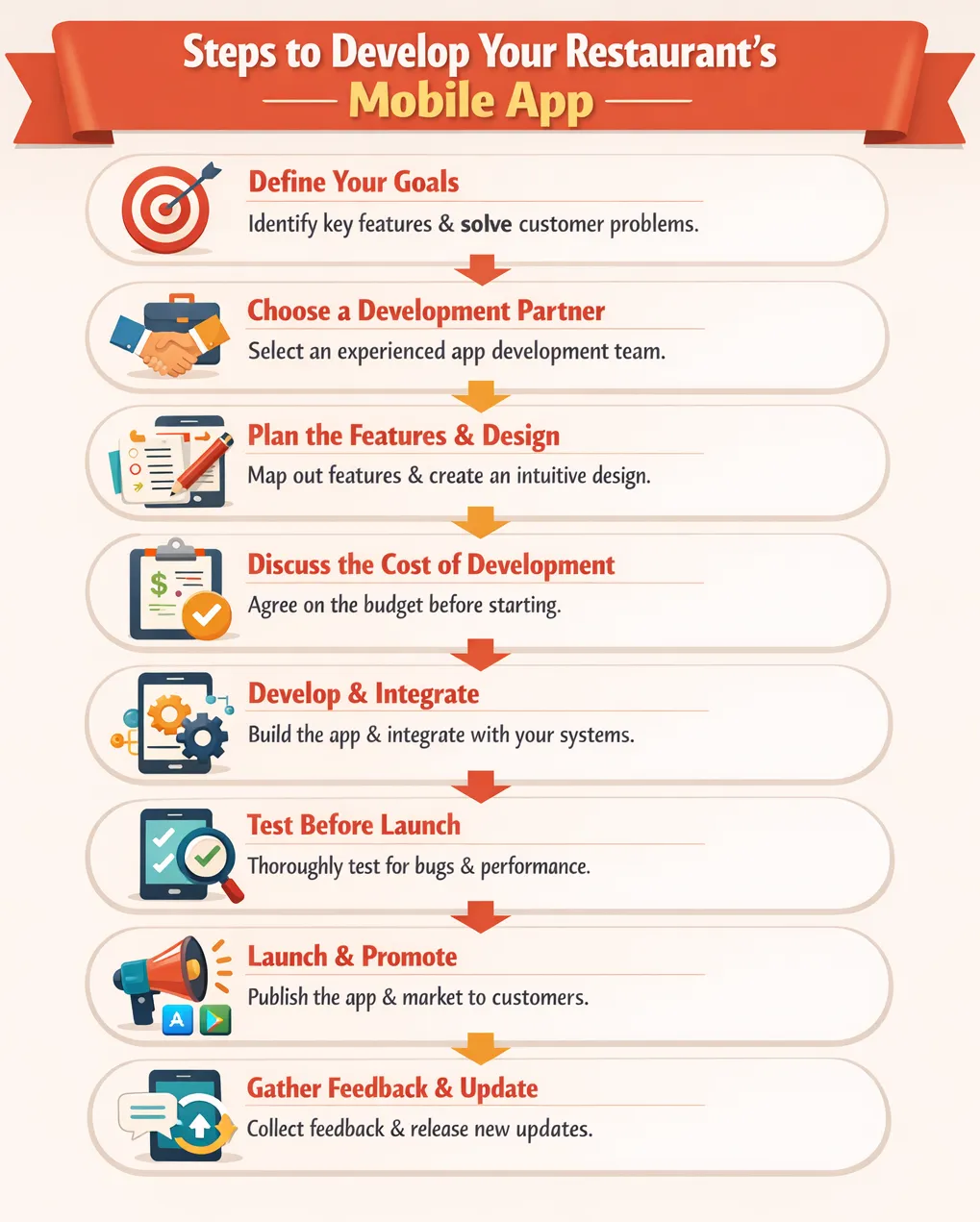
Define Your Goals: Identify what features matter most to your customers and what problems the app needs to solve. This gives your development team a clear direction from the start.
Choose a Development Partner: Look for a team with proven experience in restaurant mobile app development. Check their portfolio, discuss your budget and timeline, and confirm what post-launch support they offer.
Plan the Features and Design: Work with your development team to map out all features and create a user-friendly design that is both intuitive and visually appealing.
Discuss the Cost of Development: Before any work begins, have an open conversation with your app partner about the cost of app development. Understanding the budget upfront helps you avoid surprises later and plan your investment confidently.
Develop and Integrate: The development team will build the app's features and integrate it with your POS, payment systems, and any other platforms your restaurant uses.
Test Before Launch: Thorough testing ensures the app is bug-free and performs well across devices and operating systems.
Launch and Promote: Publish your restaurant app on App Store and Google Play Store, and actively promote it to your existing and potential customers through your marketing channels.
Gather Feedback and Update: After launch, collect user feedback regularly and release updates to improve performance and add new features over time.
From defining your goals to the final launch, our experienced team handles every step. Start your restaurant mobile app journey with us today and build it right.
Start Your Project NowThis is one of the most common questions restaurant owners ask before starting, and one of the most important to answer clearly. In 2026, building a restaurant mobile app typically costs between $15,000 and $150,000 or more. The range is wide because the cost depends heavily on what you want the app to do, which platforms you build for, and the development team you work with.
Here is a simple breakdown to help you plan:
App Type | What Is Included | Estimated Cost |
|---|---|---|
Basic App | Menu display, online ordering, and payment | $15,000 – $30,000 |
Standard App | Loyalty program, order tracking, push notifications | $30,000 – $75,000 |
Advanced App | AI recommendations, multi-location support, full admin dashboard | $75,000 – $150,000+ |
Building a restaurant mobile app is not a one-size-fits-all investment. The final cost depends on a combination of decisions you make before development even begins — from the features you want to the team you choose to build it. Understanding these factors early helps you plan a realistic budget and avoid unexpected costs along the way. Here are the key things that will shape your total spend:
Features and integrations: Every feature you add, whether it is a payment gateway, GPS tracking, or push notifications, increases development time and cost. Plan your must-have features carefully before starting.
Platform choice: Building separate native apps for iOS and Android costs more. A cross-platform framework like Flutter or React Native builds both simultaneously at a lower overall cost.
Developer location: Teams in North America and Australia charge higher hourly rates. Teams in Eastern Europe or South Asia offer the same quality at a more affordable price point.
Ongoing maintenance: After launch, budget 10 to 20 percent of your initial development cost each year for hosting, updates, and improvements.
Building a restaurant mobile app does not have to stretch your budget. Here are five practical ways to keep costs under control:
Start with core features only: Avoid building everything at once. Launch with online ordering, payment, and basic loyalty rewards. Add advanced features later based on real customer feedback.
Choose cross-platform development: One codebase for both iOS and Android reduces development time and cost by 30 to 40 percent without compromising on quality.
Work with an experienced partner: A team that has built restaurant apps before moves faster, makes fewer mistakes, and reduces the risk of costly rework after launch.
Organize your data before you start: If you are migrating an existing menu or customer list, clean and structure that data beforehand to avoid delays and extra charges during development.
Discuss the full budget upfront: Before signing anything, clarify the total cost, including design, development, testing, and post-launch support. No surprises mean better planning.
Please Note: These figures are approximate and intended as a general guide only. The actual cost of your restaurant mobile app will depend on several factors, including features, integrations, platform choice, and your chosen development partner.
The restaurant mobile app space is evolving quickly, especially in 2026. Here are the key trends to watch in 2026 and beyond:
AI features in mobile apps is making restaurant apps smarter. From analyzing customer data to delivering highly personalized recommendations, AI-powered features are becoming a standard expectation. AI chatbots can also handle customer queries and assist with orders directly within the app.
AR allows customers to visualize dishes before ordering. This interactive feature is becoming more accessible and can significantly enhance the customer decision-making experience.
Some restaurants are beginning to explore VR for virtual tours or behind-the-scenes kitchen previews. While still emerging, this trend could become a strong differentiator for forward-thinking restaurant brands.
Consumers increasingly prefer businesses that reflect their values. Moreover, restaurant apps that highlight sustainable sourcing, reduce food waste, or support community initiatives can attract environmentally conscious customers and strengthen brand reputation.
Staying ahead of these trends and continuously improving your app will ensure it remains a valuable tool for your restaurant and a preferred experience for your customers.
A restaurant mobile app is no longer a nice-to-have feature; it is a core part of how modern restaurants operate and grow. From streamlining orders and collecting customer data to running targeted promotions and building loyalty, the benefits are clear and measurable. Restaurants that invest in a well-built mobile app today will be far better positioned to meet customer expectations and outperform competitors in 2026 and beyond.
If you are looking to build a mobile app for your restaurant, Cynoteck can help you design and develop a solution tailored to your specific business needs. Get in touch with our app development team and build a mobile app your customers will actually use every week.
Cynoteck builds restaurant mobile apps that deliver real, measurable results. Let's sit down, discuss your idea, and create something your customers will love using every day.
Contact Us TodayA: Yes. A website is important, but a mobile app gives your customers a faster, more personal experience. It also lets you send direct notifications, run loyalty programs, and collect data that a website alone cannot offer.
A: The mobile app development cost depends on the features you need, the platform you choose, and the development team you work with. Starting with a clear list of must-have features helps you stay within budget without compromising on quality.
A: For most restaurants, yes. Third-party delivery platforms charge commissions of 15 to 30 percent on every order. Over time, these fees add up to a significant portion of your revenue. Your own app eliminates per-order commissions, gives you full ownership of your customer data, and lets you build a loyalty program that brings customers back to you directly.
A: Absolutely. A mobile app is not just for big chains. Small and mid-sized restaurants benefit greatly from online ordering, reduced phone calls, and direct customer communication, all of which save time and increase revenue.
A: This is a very common concern. The key is how you promote it at launch. Offering a first-order discount, loyalty points at sign-up, or an exclusive app-only deal gives customers a clear, immediate reason to download. A simple table card or receipt mention can drive a surprising number of early downloads.
A: A basic app with core features can take anywhere from a few weeks to a couple of months. A more complex app with custom features, POS integration, and loyalty systems may take longer depending on the scope.
A: The must-have features are online ordering, secure in-app payment, real-time order tracking, a loyalty and rewards program, and push notifications. Worth considering as you grow are AI-powered menu recommendations, table reservation tools, and full integration with your existing POS system.
A: Yes, and many restaurants do exactly this. Third-party platforms are useful for reaching new customers who have not yet heard of your restaurant. Your own app is where you retain those customers and serve repeat orders at full margin. Using both together is a smart strategy as long as your own app is where your loyal customers order from.
A: Yes, when built properly. A reliable development team will build your app with secure payment gateways, built-in data encryption, and privacy compliance from the start.
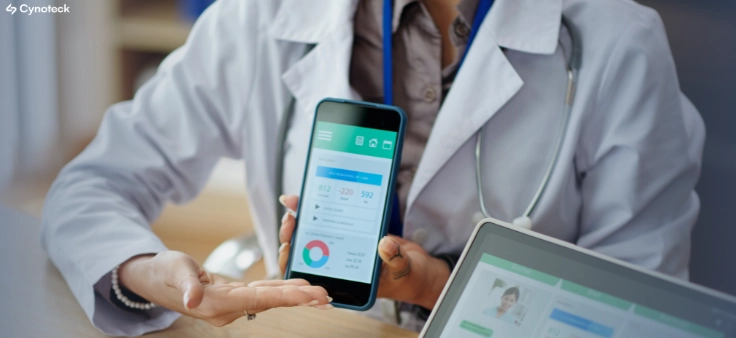
Mobile healthcare apps improve patient care by enabling remote monitoring, timely reminders, secure data access, better communication, and cost-efficient healthcare services through mHealth technology.
B2B apps help businesses streamline operations, enable on-the-go access to data, improve client engagement, support omnichannel sales, and drive scalable revenue by simplifying complex business workflows.
We are more than just developers and consultants—we are your partners in navigating the digital landscape. Let us be the engine behind your next big success while you focus on your core vision.
Explore Opportunities!