Mobile App Development Cost in 2026: A Complete Pricing Guide for Businesses
Mobile app development cost in 2026 ranges from $15,000 for a simple MVP to $300,000+ for complex enterprise apps. Most business apps fall between $25,000 and $85,000. Beyond development, businesses must budget for maintenance (15–25% annually), cloud hosting, QA testing, and post-launch fixes, which typically add 30–50% on top of the original build cost. |
Most businesses searching for a mobile app quote get a range so wide it becomes useless. One agency says $30,000. Another says $300,000. Both can be right. The honest answer for mobile app development cost depends on what you are building, who builds it, and what you are not accounting for in your budget.
This guide gives you specific numbers, explains what drives them up or down, and shows you the mistakes that quietly double budgets mid-project. By the end, you will understand where costs come from, identify hidden expenses before they surprise you, learn specific steps to avoid unexpected costs, ensure strong ROI, and choose a trustworthy development partner.
Mobile app development cost is the total investment a business makes to design, build, test, and launch a mobile application. It covers everything from the first discovery session through to app store submission, and does not end at launch.
A common mistake is budgeting only for the development quote. The real total cost includes QA testing, cloud infrastructure, app store fees, legal compliance, and at least the first year of maintenance.
Basic app (1 platform, simple features): $15,000 – $35,000
Mid-level business app (multi-feature, both platforms): $25,000 – $85,000
Complex or enterprise app: $85,000 – $300,000+
Monthly running cost after launch: $300 – $5,000+
Annual maintenance budget: 15–20% of original development cost
This guide explains exactly what drives these numbers — and how to plan your budget before you start.
Industry data compiled from over 5,000 app development projects puts the average cost of custom mobile app development at $171,450 in 2025–2026, though most small-to-mid business applications fall between $50,000 and $120,000, depending on features and platform
App Type | Cost Range (USD) | Timeline | Best For |
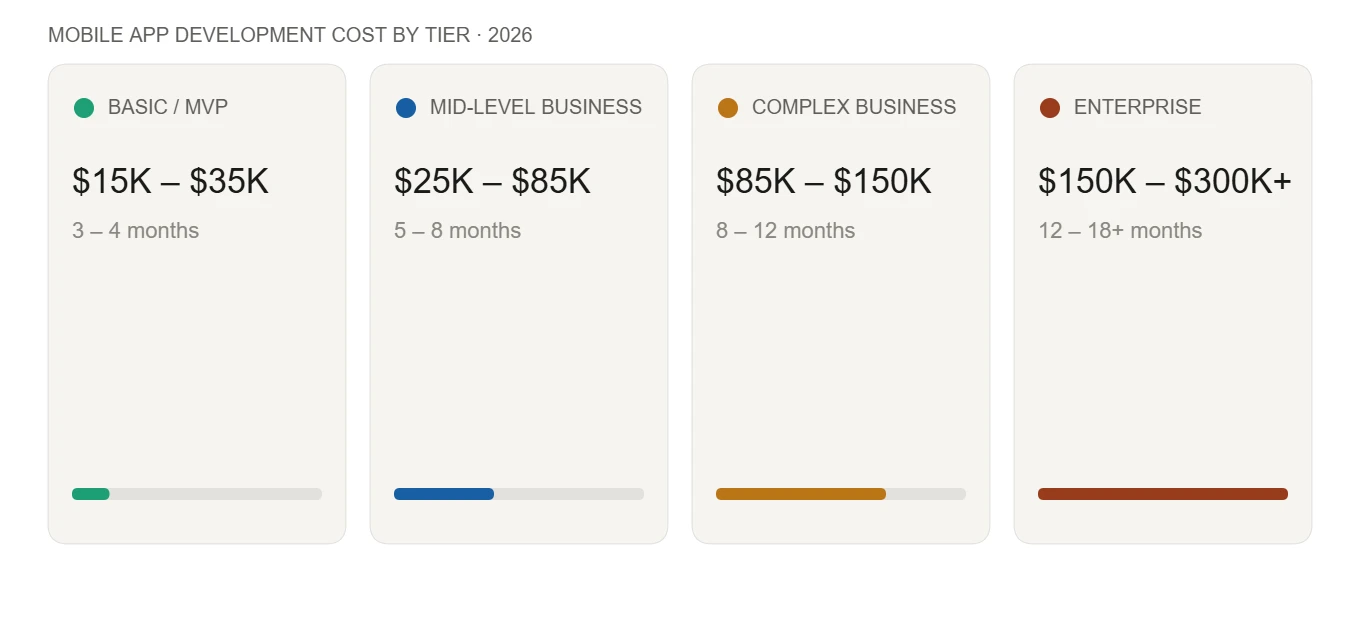
Basic / MVP app | $15,000 – $35,000 | 3–4 months | Validating an idea on one platform |
Mid-level business app | $25,000 – $85,000 | 5–8 months | Multi-feature apps on both platforms |
Complex business app | $85,000 – $150,000 | 8–12 months | CRM integrations, real-time data, and AI features |
Enterprise app | $150,000 – $300,000+ | 12–18+ months | Large user base, compliance, scalability |
Monthly running cost | $300 – $5,000+/mo | Ongoing | Hosting, maintenance, third-party services |
Annual maintenance | 15–20% of the build cost | Ongoing | OS updates, bug fixes, feature improvements |
Send us your feature list, even a rough one. We will come back with a realistic cost range, a suggested platform approach, and a timeline for mobile app development.
Get Free EstimateMobile app development costs reflect the scope and complexity of what you're building. Understanding which tier matches your needs prevents budget surprises and sets realistic expectations with stakeholders and development teams.
Basic applications solve single-purpose problems with straightforward functionality that doesn't require complex logic or backend systems. These apps include essential features such as user login, basic content display, simple forms, and basic data storage. Mobile app development timelines typically range from 3-4 months for a single platform, as the scope is focused and the requirements are clear.
You’re validating an idea
You need core features only
No complex backend integrations
Single platform launch (Android or iOS)
Login & user profiles
Basic data storage
Simple dashboard
Static content or forms
These are basic productivity and content-focused applications in which the primary value lies in presenting information clearly. These apps work well for startups validating market fit or established businesses solving specific problems for niche audiences.
While basic in scope, these apps still require professional design, smoke testing, and publishing to app stores for credibility.
Mid-level apps meet most business needs by combining multiple integrated features that work together. These include:
User authentication systems,
Payment transaction processing,
Push notifications to keep users engaged,
Analytics to track usage patterns,
API integrations (CRM, ERP) with external services,
Professional design that reflects the brand identity.
Cross-platform launch
Developing this type of app typically takes 5-8 months because features must integrate seamlessly and handle moderate user volumes.
Most successful business apps fall into this category because they balance feature richness with development efficiency. They're sophisticated enough to solve real business problems, yet straightforward enough to launch without excessive complexity or cost. Examples include:
Dealer & Distributor Management App
Multi-Location Service Booking App
Sales Team Tracking & Reporting App
Inventory & Order Management App
Customer Loyalty & Rewards App
Vendor or Partner Portal App
Subscription-Based Service App
Note that Uber, Instagram, and Airbnb were not built for $150,000. Platforms like these represent $500,000-$1,000,000+ in builds after reaching scale. If an agency quotes you $50,000 for an Uber-like platform, that is a red flag, not a bargain.
Enterprise apps demand specialized expertise because they integrate with existing business systems, comply with industry regulations, and support mission-critical operations whose failures directly impact revenue. Examples include sophisticated SaaS platforms serving thousands of customers, real-time collaboration tools for distributed teams, or customer platforms handling millions of daily transactions.
These ranges represent development alone. Infrastructure, testing, security, maintenance, and marketing can easily double your total investment. Understanding this upfront prevents budget surprises during project execution.
Mobile app development costs depend on numerous factors that interact to create your final budget. Understanding these factors individually and how they combine helps you make strategic decisions about your app's scope, approach, and investment level. Most importantly, understanding these factors enables you to identify where costs can be optimized without sacrificing business value.
Every app project involves trade-offs between scope, timeline, budget, and quality. You can have any three of these at the expense of the fourth: a fast, high-quality, feature-rich app costs significantly more; a quick, inexpensive app lacks quality or features; a high-quality app with all features takes longer and costs more. The art of app development is making intelligent choices about which trade-offs align with your business priorities.
Simple apps with basic features and straightforward interactions require 300 to 500 hours of development. Medium-complexity apps with multiple integrated features require 500 to 2,500 hours to develop. Highly complex apps with sophisticated architectures typically require 2,500 to 5,000 hours or more to develop.
The difference between these tiers is not just more features — it is a fundamentally different engineering approach. Complex apps need professional-grade architecture built to handle millions of users, advanced database optimization, caching mechanisms, load balancing, and redundancy systems that keep the service running even when individual components fail. Understanding your complexity level early prevents budget surprises later.
Every feature adds cost, and integration complexity multiplies expenses fast. Core features like user authentication cost $5,000 to $15,000. Payment processing integrations run $8,000 to $25,000. Advanced features like real-time collaboration and AI recommendations cost $15,000 to $50,000 or more.
Each third-party integration also requires error handling, testing, and ongoing maintenance as external services update. For a detailed app development cost breakdown by feature, see our comprehensive guide on mobile app development costs by features, complexity, and app type.
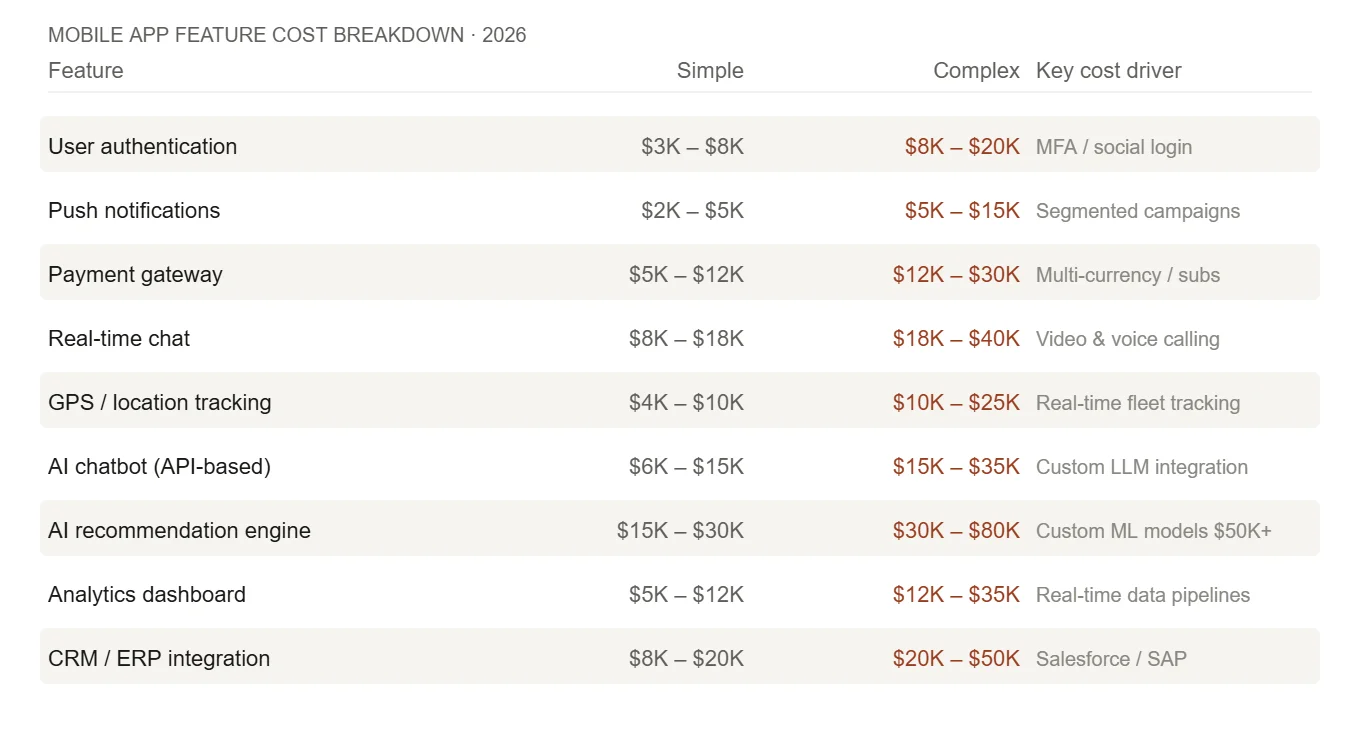
Feature / Module | Simple | Complex | Notes |
User Authentication (login/signup) | $3,000–$8,000 | $8,000–$20,000 | Social login and MFA add cost |
Push Notifications | $2,000–$5,000 | $5,000–$15,000 | Segmented campaigns cost more |
Payment Gateway Integration | $5,000–$12,000 | $12,000–$30,000 | Multi-currency subscriptions are higher |
Real-time Chat / Messaging | $8,000–$18,000 | $18,000–$40,000 | Video/audio adds significantly |
GPS / Location Tracking | $4,000–$10,000 | $10,000–$25,000 | Real-time fleet tracking higher |
AI Recommendation Engine | $15,000–$30,000 | $30,000–$80,000 | Custom ML models start at $50K+ |
AI Chatbot (API-based) | $6,000–$15,000 | $15,000–$35,000 | Custom LLM integration costs more |
Analytics Dashboard | $5,000–$12,000 | $12,000–$35,000 | Real-time data pipelines cost more |
CRM / ERP Integration | $8,000–$20,000 | $20,000–$50,000 | Salesforce/SAP integration is complex |
Your platform choice directly impacts your budget — and the consequences play out for years. Building for a single platform costs less but limits market reach. Building separate native apps for both iOS and Android essentially doubles your development cost.
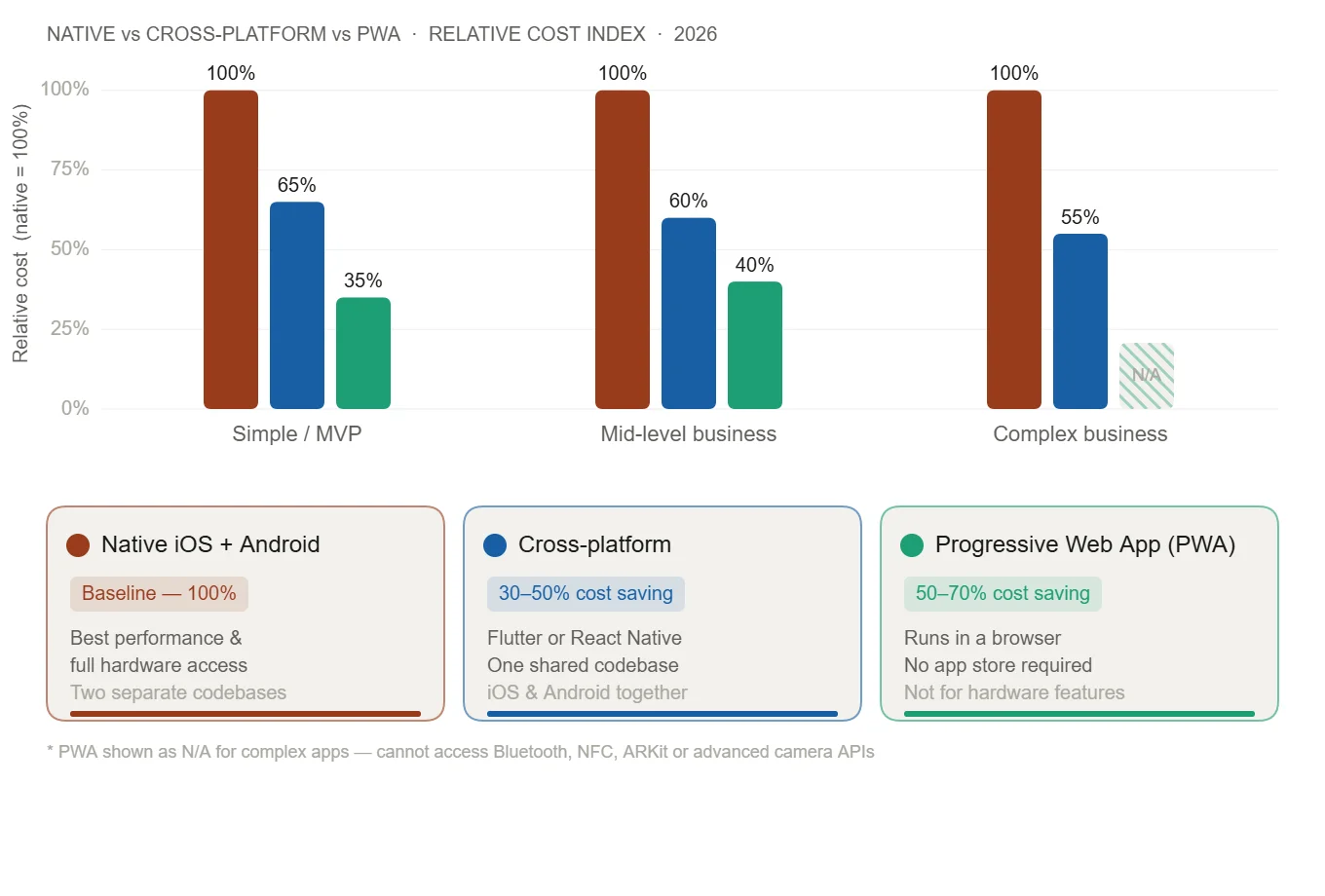
Cross-platform development using React Native or Flutter reduces costs by 30 to 50 percent compared to building two separate native apps. This allows you to reach both iOS and Android audiences at the same time — at a significantly lower total investment. For most businesses in 2026, this is the smarter starting point.
To understand the strategic and financial implications of different platform approaches, review our detailed analysis of iOS vs. Android vs. cross-platform development costs. That guide compares the total cost of ownership, including long-term maintenance, across different platform strategies.
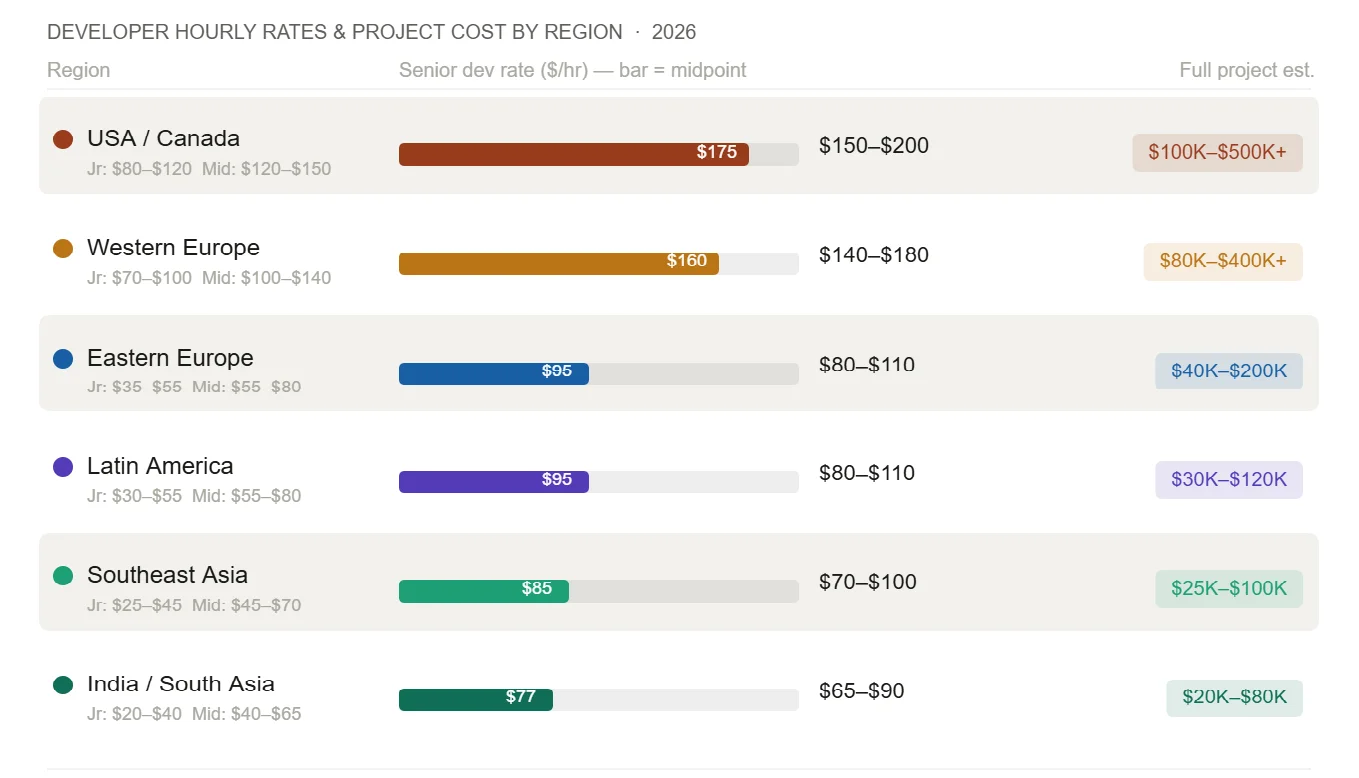
Where your development team is based is one of the biggest factors in your final cost. Here is a clear comparison of typical hourly rates and project cost ranges by region.
Region | Junior Dev ($/hr) | Mid-Level Dev ($/hr) | Senior Dev ($/hr) | Full Project Est. |
USA / Canada | $80–$120 | $120–$150 | $150–$200+ | $100K–$500K+ |
Western Europe | $70–$100 | $100–$140 | $140–$180 | $80K–$400K+ |
Eastern Europe | $35–$55 | $55–$80 | $80–$110 | $40K–$200K |
India / South Asia | $20–$40 | $40–$65 | $65–$90 | $20K–$80K |
Southeast Asia | $25–$45 | $45–$70 | $70–$100 | $25K–$100K |
Latin America | $30–$55 | $55–$80 | $80–$110 | $30K–$120K |
Offshore development can reduce your total project cost by 40 to 70% compared to US-based teams. Quality depends on the company’s process and communication systems, not location alone. A well-managed offshore team with daily updates and clear documentation routinely outperforms a disorganized local team.
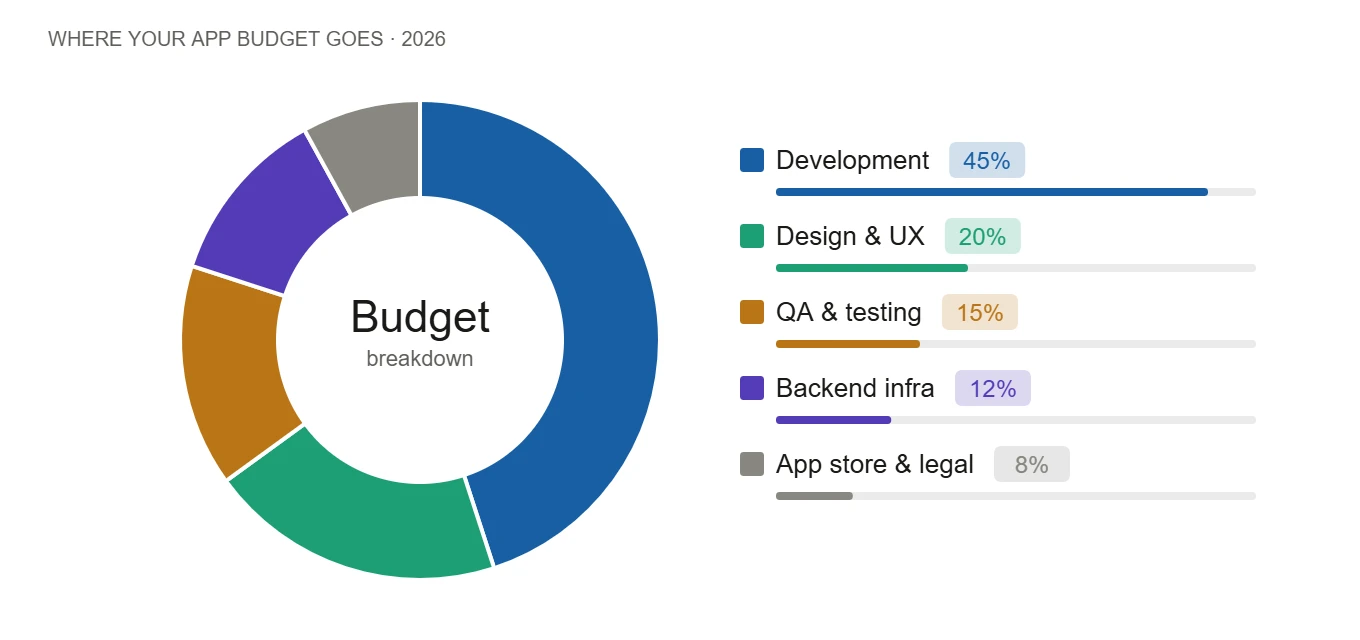
Design investment directly determines whether users keep your app or delete it. Basic design using templates costs $5,000 to $15,000. Professional custom design runs $15,000 to $50,000. Premium design with sophisticated interactions costs $50,000 to $150,000 or more — but delivers a measurable competitive advantage through a superior user experience.
The return on this investment is real. Apps with excellent design achieve 30 percent higher conversion rates and significantly better retention. Thoughtful interfaces reduce friction and guide users toward the value your app delivers — making design one of the highest-ROI decisions in any app project.
Your app's backend — the invisible systems that process data and run business logic — determines whether your app can scale reliably. Simple backend infrastructure costs $5,000 to $20,000. Moderate infrastructure supporting thousands of concurrent users costs $20,000 to $60,000. Advanced infrastructure supporting millions of users costs $60,000 to $150,000 or more.
Technology stack selection also affects long-term maintenance costs. Different programming languages and frameworks have different learning curves, developer availability, and performance profiles. Choosing the right stack from the start prevents expensive rewrites down the road as your user base grows.
AI is no longer a premium add-on in 2026 — it is increasingly a baseline expectation in competitive apps. Understanding what AI features cost actually helps you plan realistically.
Adding a basic AI recommendation engine costs $15,000 to $40,000. A conversational AI chatbot built on a third-party API, such as OpenAI, costs $8,000 to $20,000 to integrate. Custom machine learning models trained on your own data start at $50,000 and scale significantly depending on data volume and complexity.
The good news is that most businesses do not need custom AI. Using existing AI APIs — for recommendations, search, or customer support — delivers strong results at a fraction of the cost of building from scratch. For most apps, an AI budget of $10,000 to $30,000 is enough to add genuinely useful intelligent features without overcomplicating the build. This is also one of the fastest-growing cost categories in 2026, so planning for it early puts you ahead of most competitors who treat it as an afterthought.
If your app collects personal data, processes payments, or serves users in regulated industries, compliance is a separate budget category that many businesses discover too late.
Compliance Standard | Who Needs It | Added Cost Estimate |
|---|---|---|
GDPR (European users) | Any app with EU users | $5,000 – $20,000 |
HIPAA (US healthcare data) | Healthcare, telemedicine apps | $15,000 – $40,000 |
PCI-DSS (payment processing) | Any app processing card payments | $8,000 – $25,000 |
COPPA (children's data, US) | Apps used by under-13s | $5,000 – $15,000 |
SOC 2 (enterprise SaaS) | B2B SaaS apps with enterprise clients | $20,000 – $60,000 |
Building compliance from day one costs far less than retrofitting it after a security audit flags violations. Adding GDPR-ready data handling to a finished app typically costs two to three times more than building it from the start.
How AI Development Tools Are Reducing App Costs in 2026AI-assisted development tools — including GitHub Copilot, Cursor, and Claude — have materially changed development economics. Similar-scope projects that required $75,000–$150,000 and 6–9 months in 2021–2023 now deliver at $35,000–$70,000 in 4–6 months. The time savings come from AI-accelerated debugging, boilerplate generation, and automated QA path simulation. However, this cost reduction is partially offset by the rising expectation to include AI features natively in apps — pushing overall project budgets back up. For Cynoteck clients, our AI-augmented development workflow delivers faster results without sacrificing quality. |
You have now seen the six factors that drive your app cost. If you have a feature list in mind, our team can map it to a specific cost range in one call.
Schedule Strategy Call TodayPlatform selection deserves special attention because it represents one of your first major strategic decisions with lasting financial implications.
Native apps deliver the best performance and deepest device integration because they're optimized specifically for each platform. iOS apps use Swift, Android apps use Kotlin. Building for both platforms costs substantially more because you're maintaining two separate codebases with different frameworks, testing on different device types, and managing separate app store releases.
Cross-platform frameworks like React Native (40% market share) and Flutter (30% market share) let you write code once and deploy to iOS and Android simultaneously. This reduces development time by 30-50% compared to native apps. Performance trade-offs exist—cross-platform apps are typically 5-15% slower than native—but this difference is imperceptible for most business applications.
For detailed analysis comparing platforms, including lifecycle costs and when each approach makes financial sense, see our comprehensive breakdown on iOS vs Android vs cross-platform development costs and ROI.
Quick Fact: Cross-platform development using React Native or Flutter reduces costs by 30-50% compared to building separate native apps. React Native's official benchmarks show performance differences of 5-15% compared to native applications for most business use cases.
A Progressive Web App (PWA) is a website built using modern browser technology to behave like a native app. Users can install it from their browser to their home screen, receive push notifications, and use it offline without going through the App Store or Google Play.
PWAs are gaining ground in 2026 for businesses that need an app-like experience without the overhead of App Store approval cycles or the need for two separate native codebases.
PWA Complexity | Cost Range | Timeline |
|---|---|---|
Simple PWA (offline access, basic UI) | $8,000 – $15,000 | 4–8 weeks |
Medium PWA (custom features, integrations) | $15,000 – $40,000 | 2–4 months |
Complex PWA (enterprise features, real-time data) | $40,000 – $100,000+ | 4–8 months |
Your users are spread across iOS and Android, and you cannot afford two native builds
You need a faster launch and a lower initial investment
Your app is content-focused rather than hardware-dependent
You want to avoid the App Store review delay (which can take 1 to 3 weeks)
Your app needs access to Bluetooth, NFC, advanced camera processing, or ARKit
You need to be featured in the App Store for discoverability
Your users expect native performance in graphics-heavy features
You do not need a developer to get a ballpark estimate. Use this simple framework before your first agency call.
Write down the 5 to 10 features your app absolutely must have at launch. Nothing else. Remove anything that is nice-to-have. Every feature you add increases cost non-linearly — an app with 20 features costs 3 to 5 times more than an app with 10 features, not twice as much.
Single platform (iOS or Android) = lowest cost. Cross-platform using Flutter or React Native = 30 to 50% less than two separate native apps. Two separate native apps = highest cost, highest performance.
Use this as a rough guide:
Basic app with 5–8 core features: 300–600 hours
Mid-level app with 10–15 features: 800–2,000 hours
Complex app with 15+ features and integrations: 2,000–5,000 hours
Multiply estimated hours by your development team’s rate. Use the regional rate table above for reference.
Quick formula: Development Cost = Total Hours × Hourly Rate
Example: 1,000 hours × $50/hour = $50,000 development cost
Add 30 to 40% on top of your development estimate to cover QA testing, infrastructure setup, app store fees, and the first three months of post-launch maintenance. Most teams that skip this step run out of budget before the app is stable.
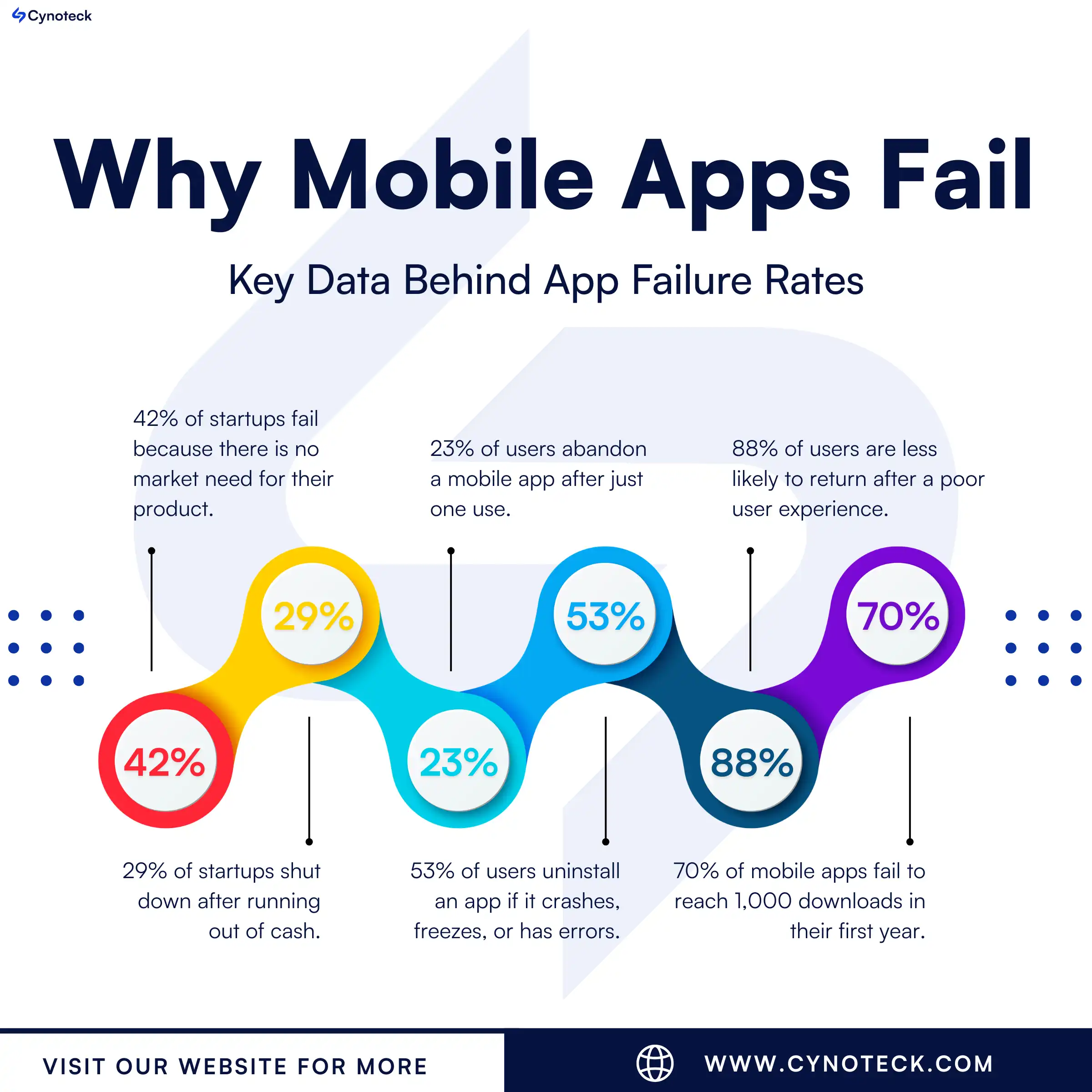
These are the mistakes that most commonly turn a $60,000 project into a $150,000 one.
Most successful apps launch on one platform, validate the idea, and expand later. Building for both immediately doubles early-stage risk and cost.
Every feature you add increases cost non-linearly. An app with 20 features costs 3 to 5 times more than one with 10. Define your must-haves ruthlessly.
QA testing, app store fees, infrastructure, and first-year maintenance typically add 30 to 40% on top of the development quote. Budget for all of it upfront.
A $40,000 app that fails or requires a complete rebuild costs far more than a $100,000 app built the first time correctly.
A 2 to 4 week paid discovery phase costs $5,000 to $15,000, but prevents the most common and expensive cause of budget overrun: unclear requirements discovered mid-build.
In 2026, users expect smart features as standard. Search, personalized recommendations, and automated support are no longer premium additions. Most businesses do not need custom-built AI. Integrating an existing API such as OpenAI or Google Gemini costs $6,000 to $20,000 and delivers features users now expect by default. The mistake is either skipping AI entirely and launching an app that feels dated, or planning to "add it later" to an architecture that was not designed for it.
The first 12 months after launch typically cost 25 to 35% of the original development cost, not the standard 15 to 20%, because real user data drives faster iteration than testing alone can anticipate.
These strategies are used by the most cost-effective app projects. None of them requires sacrificing the quality of the final product.
Start with a single platform: Launch on iOS or Android first. Add the second platform once you have validated the concept with real users.
Build an MVP, not a complete app: Launch with 5 to 8 core features. Gather user feedback. Then invest in the next set of features based on what users actually want.
Choose cross-platform development with Flutter or React Native to reduce development costs by 30 to 50% compared to two separate native apps for most business use cases.
Use existing APIs instead of building from scratch: Payment gateways, authentication, maps, push notifications, and AI features are all available as proven third-party services at a fraction of the cost of a custom build.
Do a paid discovery phase first: Two to four weeks of planning costs $5,000 to $15,000 but reduces mid-project scope changes, which are the most common cause of budget overrun.
Separate your must-haves from your nice-to-haves: Every feature in the backlog that does not make it into v1 is money saved for features users actually request after launch.
Consider an offshore or hybrid team: India and Eastern Europe offer experienced, professional development at 40 to 70% lower cost than US-based teams. Quality depends on the company’s processes, not its location.
Reuse design systems and component libraries: Building a minimal design system in the first two weeks saves 15 to 20% of total front-end development hours over the project lifecycle.
Many costs surprise teams that budget only for development work. Understanding these expenses prevents financial problems during and after project execution. These "mobile app development hidden costs" aren't hidden because developers want to surprise you—they're hidden because they're not part of development work itself, they're legitimate business expenses that every successful app must address.
Testing runs continuously throughout development, not just at the end. Quality assurance includes functional testing, validating that features work correctly across all user scenarios; performance testing, ensuring apps respond quickly under load with high user volumes; security testing, protecting user data from unauthorized access; compatibility testing, ensuring reliability across the hundreds of different devices your users employ, and user acceptance testing with actual users validating that what you built solves their problems. These testing activities cost $15,000-$50,000, depending on app complexity, and prevent far more costly post-launch issues caused by unhappy users leaving negative reviews.
Your app's backend requires reliable hosting infrastructure that scales with your user growth and handles unexpected traffic spikes. Small apps with fewer than 10,000 users cost $200- $500 per month for managed services such as Firebase or Heroku that automatically scale. Medium apps serving 10,000-100,000 users cost $500-$2,000 per month and require more sophisticated infrastructure. Large apps serving 100,000+ users cost $2,000–$10,000+ per month due to redundancy and disaster-recovery requirements. These costs scale non-linearly as user bases grow because infrastructure must handle not only average traffic but also peak traffic, with redundancy to account for system failures.
Your app doesn't stop needing work after launch. Maintenance includes bug fixes and issue resolution for reported problems; operating system and device compatibility updates as Apple and Google release new versions, and manufacturers introduce new devices; performance optimization as user bases grow and usage patterns become clear; and feature improvements based on user feedback. Plan for $15,000-$50,000 in year-one post-launch maintenance for most apps because you're addressing realities that testing couldn't completely anticipate.
Apple charges $99 annually to list apps on the App Store. Google Play charges $25 one-time. Beyond store fees, ensuring apps comply with regulations such as GDPR, CCPA, HIPAA (for healthcare), and PCI DSS (for payments) incurs high costs. Security implementation, penetration testing, and vulnerability assessment cost $10,000- $50,000, depending on application sensitivity and compliance requirements.
For a complete breakdown of these often-overlooked expenses and their impact on the total cost of ownership, review our comprehensive guide on the hidden costs of mobile app development most businesses miss. That resource details the cost of each category so that you can budget accurately for the true investment required.
Building the app is step one. Getting users to download it is a separate investment. A realistic launch budget for a new app typically includes Google Universal App Campaigns (UAC), Meta ads, and App Store search ads. Even a modest $3,000 to $5,000 launch campaign helps validate whether the market responds before you commit to a larger spend. Apps that launch with no acquisition budget often stall at zero organic downloads for weeks. Budget for at least one paid acquisition test before launch.
$2,000 to $5,000 upfront + ongoing monthly management. This covers keyword research, title and description copy, screenshot design, and preview video production. ASO is the difference between an app that users find and one they never discover. It belongs in your launch budget, not as an afterthought.
Most development quotes leave out QA, infrastructure, compliance, and year-one maintenance. Ask us for a total cost of ownership estimate, not just a development quote. That is the number that actually matters for your budget planning.
Get a Total Cost BreakdownDevelopment costs get most of the attention, but the ongoing costs of running an app are often what catch business owners off guard. Once your app is live, you have recurring monthly costs that continue for as long as the app runs.
Cost Category | Small App (< 10K users) | Mid App (10K–100K users) | Large App (100K+ users) |
Cloud hosting (AWS/GCP/Azure) | $70–$300 | $500–$2,000 | $2,000–$10,000+ |
Third-party services (push, analytics) | $100–$400 | $300–$1,200 | $1,000–$5,000+ |
App maintenance (pro-rated monthly) | $500–$1,200 | $1,200–$3,500 | $3,000–$10,000+ |
Support and monitoring tools | $50–$200 | $200–$800 | $500–$3,000 |
Estimated total monthly cost | $720–$2,100 | $2,200–$7,500 | $6,500–$28,000+ |
Cloud hosting is usage-based on platforms like AWS, Google Cloud, and Microsoft Azure. As your user base grows, your data storage, bandwidth, and compute costs grow with it. A spike in users does not just increase your hosting bill — it increases monitoring complexity, support volume, and the frequency of needed bug fixes.
Third-party service costs scale similarly. Push notification services, analytics platforms, payment gateways, and customer support tools are often priced based on active users or message volume. What costs $100/month at launch can cost $2,000/month once you reach scale.
Security and compliance are ongoing, not one-time. In 2026, GDPR, CCPA, and new AI-specific data regulations require regular security audits ($1,000–$10,000 annually) and periodic penetration testing. Regulated industries like healthcare and fintech face higher compliance maintenance costs.
The industry standard for app maintenance is 15–20% of the original development cost per year. Here is what that looks like at different investment levels:
Original Development Cost | Annual Maintenance Budget | Monthly Equivalent |
$30,000 | $4,500–$6,000/year | $375–$500/month |
$60,000 | $9,000–$12,000/year | $750–$1,000/month |
$100,000 | $15,000–$20,000/year | $1,250–$1,667/month |
$200,000 | $30,000–$40,000/year | $2,500–$3,333/month |
Important Note on Year-One Maintenance:The first year after launch typically costs 25–35% of development — not the standard 15–20% — because real user data drives more rapid bug fixes and feature adjustments than testing could anticipate. Budget conservatively for year one. |
Understanding costs is meaningless without a framework for making decisions aligned with your business priorities. Different businesses should make different choices based on their unique situations, risk tolerances, and growth objectives. This decision framework helps you determine the appropriate investment level for your specific circumstances.
If you're a startup testing product-market fit with uncertain demand, invest in a basic MVP with only essential features. You need to answer the question: "Do real users want this?" rather than building a perfect product. Launch quickly, gather user feedback, and iterate based on reality rather than assumptions. At this investment level, platform selection matters less than speed to market. Cross-platform development often makes sense because it allows you to reach both iOS and Android audiences without doubling development costs. Design can be as basic as long as it's professional enough not to damage credibility.
If you're an established business adding digital presence to your operations, invest more in quality and features that integrate with existing business systems. You have existing customers and brand credibility to protect, so app quality is critical to customer satisfaction. Your app likely requires integration with existing systems (CRM, payment systems, and inventory systems), which increases complexity. Design matters because your app represents your brand. A mid-range investment in this tier enables you to launch a professional app that extends your brand to mobile while generating measurable business value.
If you're building a consumer app in a crowded category, invest heavily in design, user experience, and marketing, as these factors determine whether users choose your app over competitors. A beautiful, thoughtfully designed app competing in a crowded market outperforms a functionally correct but generic app despite higher development costs. Your infrastructure must handle scale from day one if you plan to grow aggressively. Your marketing budget might equal or exceed development costs. This investment tier makes sense only if you have differentiation—unique features, target audience insights, or execution excellence that justifies entering crowded markets.
If you're building enterprise apps serving internal operations or mission-critical business functions, invest heavily in security, testing, compliance, and infrastructure. Downtime costs money directly. Bugs damage operations. These apps justify enterprise-grade development practices, rigorous quality assurance, and professional project management. Consider native development, prioritizing performance and reliability over time-to-market. Maintenance budgets should be substantial because these apps require continuous optimization and updates.
If you are building an app for small businesses that connects to wearable devices — employee safety monitoring, retail service management, or health tracking for teams — budget $40,000–$100,000 in 2026. The core mobile app sits in the standard mid-range cost, but supporting wearable hardware (Apple Watch, Garmin, Fitbit) adds 15–25% to both development and ongoing maintenance. For small businesses, a wearable MVP that supports one device type (typically Apple Watch) is the most cost-effective entry point.
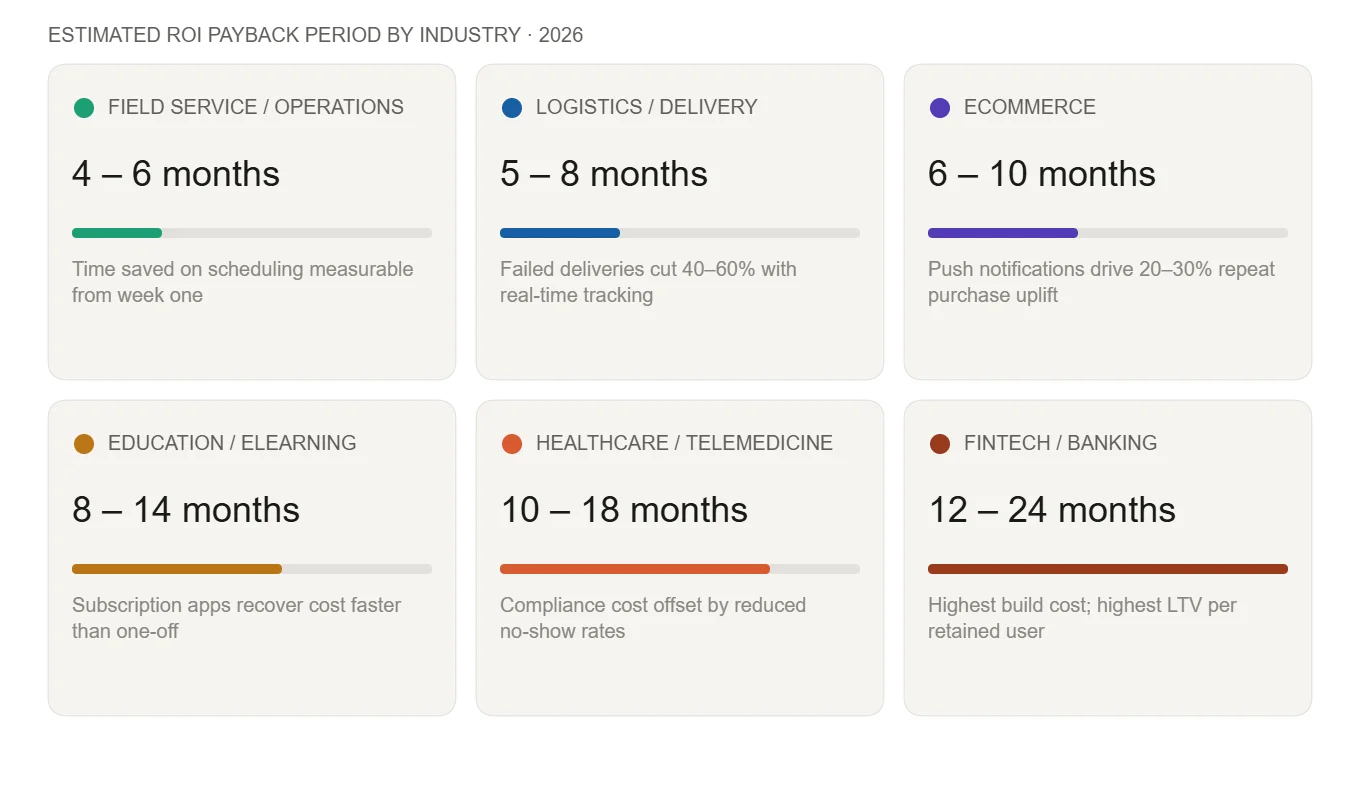
App development costs aren't just expenses—they're investments with measurable business returns that extend far beyond direct revenue. Understanding how to calculate ROI helps you justify investment to stakeholders and make decisions about appropriate investment levels for your specific business situation.
Calculate expected revenue or cost savings from your app over 3-5 years, subtract development and operating costs, and compare to your investment. Most apps don't achieve positive financial ROI in year one, making this a multi-year calculation. A $100,000 app investment might generate $50,000 in year one, $150,000 in year two, and $250,000 in year three, resulting in cumulative positive ROI in year two and substantial returns by year three.
Strategic benefits often exceed financial returns. Customer lock-in through mobile apps creates switching costs, making customers less likely to switch to competitors. Competitive advantage through mobile presence directly impacts market share—competitors without apps lose customers to apps offering superior convenience. Brand presence on users' home screens creates daily brand impressions that traditional marketing never achieves. User data collected by apps (with permission) provides valuable insights informing product development and business strategy.
For many successful businesses, strategic ROI is more important than financial ROI. The app becomes a business asset that defends market position and enables innovation rather than necessarily generating direct profits.
Understanding costs for familiar apps helps calibrate expectations and enables honest conversations with mobile app development teams about your requirements.
Functionality includes user authentication, text and media messaging, voice and video calls, end-to-end encryption, and reliable message delivery. Development requires sophisticated backend infrastructure, security expertise, and real-time communication systems.
Requirements include product catalogs with search and filtering, a shopping cart and checkout, multiple payment gateways, order management, inventory tracking, and customer reviews. E-commerce requires payment compliance, security certifications, and infrastructure handling thousands of simultaneous transactions.
Features include user profiles and goal setting, workout logging with GPS tracking, wearable device integration, social challenges, analytics, and progress reports. Fitness apps require integration with multiple wearable platforms and compliance with health data security regulations.
Functionality includes team management, project creation and collaboration, real-time updates, file sharing, advanced reporting, API for integrations, and enterprise security. SaaS platforms require sophisticated backend, real-time infrastructure, and enterprise-grade security.
A basic dApp connecting a mobile app to a blockchain smart contract on an established network (Ethereum, Solana, Polygon) starts at $80,000–$150,000. A full dApp with custom tokenomics, NFT marketplace functionality, wallet integration, and governance features ranges from $200,000 to $450,000+. dApp costs are high because of smart contract auditing requirements (a mandatory security step before any blockchain launch), the specialized expertise required, and the need for gas fee optimization, particularly important for apps where users pay transaction fees.
A facilities management company with 15 field technicians builds a $60,000 scheduling and reporting app.
Before the app: technicians spend 1.5 hours per day on phone calls, manual logging, and paper forms.
After the app: that time drops to 20 minutes. Time saved per technician per day: 70 minutes.
At 15 technicians working 250 days per year at a loaded cost of $45 per hour, total annual saving = $196,875.
The app pays for itself in under 4 months.
This is why field service, logistics, and operations apps consistently show the fastest ROI of any app category. The efficiency gain is measurable from week one.
Tell us your industry, your current manual process costs, and your target user volume. We will show you a realistic ROI projection alongside your build estimate, so you can take a budget case to your leadership team, not just a quote.
Build Your ROI CaseYour Situation | Recommended Budget | Strategic Priority |
Testing a new app idea | $25,000–$50,000 | Speed to market. Cross-platform MVP. Validate before investing more. |
Established business going digital | $50,000–$150,000 | Quality and integration with existing systems. Brand representation matters. |
Consumer app in a competitive market | $100,000–$300,000+ | Design excellence and marketing. Budget as much for user acquisition as development. |
Enterprise or internal operations | $200,000–$500,000+ | Security, compliance, reliability. Native development. Significant maintenance budget. |
Not all apps are created equal. The industry your app serves determines many of the most expensive factors: regulatory compliance, security architecture, integration complexity, and data handling requirements. Two apps with identical features can have very different costs if one serves healthcare and the other serves retail.
Here is a practical guide to what different industries typically spend on mobile app development in 2026.
Real estate apps range from simple property search tools to full-featured marketplace platforms. The cost depends primarily on whether you need live MLS/property database integration and AI-powered features such as automated valuations.
Real Estate App Type | Estimated Cost | Timeline |
Basic property listing (search, filter, contact) | $40,000–$65,000 | 3–5 months |
Mid-level platform (map view, lead management) | $65,000–$130,000 | 5–8 months |
Full marketplace (MLS, AI valuation, payments) | $150,000–$400,000+ | 8–14 months |
Core cost drivers: Map and geolocation integration ($8,000–$15,000), MLS/property API connection ($10,000–$30,000), mortgage calculator and comparison tools ($5,000–$12,000), agent portal and CRM integration ($15,000–$35,000).
E-commerce app development costs depend on the size of your product catalog, the variety of payment methods, and whether you need features like AR product previews or AI-powered recommendations.
E-Commerce App Type | Estimated Cost | Timeline |
Basic retail catalog app | $30,000–$60,000 | 3–5 months |
Mid-market e-commerce platform | $60,000–$150,000 | 5–9 months |
Enterprise retail platform (AR, AI, multi-vendor) | $150,000–$350,000+ | 8–14 months |
Core Cost Drivers: Inventory sync with ERP systems (SAP, Oracle, NetSuite) and GDPR-compliant data handling for EU customers are the most common cost additions beyond the standard feature set.
Fintech apps carry the highest compliance burden of any category. Security architecture, regulatory compliance (PCI-DSS, KYC/AML), and real-time transaction processing all add meaningful cost on top of standard development.
Fintech App Type | Estimated Cost |
Personal finance/budgeting app | $50,000–$100,000 |
Digital banking (basic, standard security) | $80,000–$150,000 |
Investment or trading platform | $120,000–$300,000 |
Full neobank or lending platform | $200,000–$500,000+ |
Core Cost Drivers: PCI-DSS compliance for card processing, KYC (Know Your Customer) identity verification workflows, and AML (Anti-Money Laundering) transaction monitoring are non-negotiable in this category. These add $20,000 to $60,000 to a standard development budget.
Healthcare apps have strict compliance requirements in the US. Any app that handles protected health information (PHI) must comply with HIPAA, adding meaningful cost to the baseline development work.
Healthcare App Type | Estimated Cost |
Wellness/fitness (no PHI, no HIPAA) | $40,000–$80,000 |
Telehealth/patient portal (HIPAA required) | $100,000–$250,000 |
EHR-integrated clinical platform | $200,000–$400,000+ |
Core Cost Drivers: HIPAA compliance, EHR integration, and HL7 FHIR standards for health data exchange are the three largest cost drivers. Budget an additional $15,000 to $40,000 specifically for these requirements.
On-demand apps (delivery, ride-hailing, booking services) and marketplace platforms require sophisticated multi-sided infrastructure: separate user and provider experiences, real-time tracking, two-sided payment flows, and rating systems.
On-Demand / Marketplace Type | Estimated Cost |
Simple booking or scheduling app | $40,000–$80,000 |
Food delivery or service marketplace | $80,000–$180,000 |
Full Uber/Airbnb-style platform | $200,000–$500,000+ |
IoT apps that communicate with physical devices — smart home systems, industrial sensors, connected health wearables, or logistics-tracking hardware add a device-integration layer on top of standard mobile development.
IoT app development typically costs $80,000–$250,000 for the software layer alone (the mobile application that communicates with and controls devices). Hardware costs are additional and separate. For small-business wearable apps — such as employee tracking or health-monitoring tools — budget $40,000–$100,000, depending on the number of device types supported.
Not Sure What Your App Will Cost? Get a Real EstimateInstead of working with generic ranges, many businesses find it faster to share their requirements with a mobile app development team and get a real, itemized estimate. At Cynoteck, we have delivered 500+ mobile applications across healthcare, fintech, retail, and enterprise software. Our team reviews your specific requirements and provides a clear cost breakdown — feature by feature, platform by platform — so you can plan with confidence before any code is written. • Free initial estimate based on your actual requirements • Itemized breakdown by design, frontend, backend, QA, and project management • 16+ years of mobile app development experience across 40+ countries • Transparent process: you own all code and IP from day one |
Our team will review your requirements, identify your complexity tier, flag any hidden cost risks, and come back with an itemized estimate you can take straight into a budget conversation. Most clients hear back within 24 hours.
Start Your Journey NowUnderstanding costs empowers you to make strategic decisions about your app investment. You know what basic, mid-level, and enterprise apps cost. You understand the major cost factors. You've learned cost-saving strategies. The next step is to determine exactly what your app requires and obtain accurate estimates.
At Cynoteck, we help businesses navigate mobile app development from concept to scale. We've guided startups from zero to profitable apps and enterprises through digital transformation. Whether you need cost estimation, architectural guidance, or hands-on development, we bring proven expertise across healthcare, fintech, e-commerce, SaaS, and consumer applications.
Schedule a free strategy call with our team!
We'll discuss your vision, assess feasibility, and provide a preliminary cost estimate, just honest guidance about your app's potential and investment requirements.
[Schedule Your Free Strategy Call]
A: Mobile app development cost in 2026 ranges from $15,000 for a basic single-platform MVP to $300,000+ for enterprise-grade applications. Most business apps — those with user accounts, payment processing, push notifications, and API integrations — fall between $50,000 and $120,000. The single biggest driver of cost is app complexity, which determines the number of development hours required. A simple app requires 300–500 hours; a complex platform needs 2,500–5,000+ hours. Beyond development, budget 15–20% of your initial cost annually for maintenance, plus $500–$5,000 per month for hosting and infrastructure. For most mid-market businesses in 2026, a realistic all-in first-year budget is $80,000–$180,000.
A: Six core factors determine mobile app development cost: app complexity (the number of features and their technical depth), platform choice (iOS-only, Android-only, or both), design quality (template vs. custom UX), backend infrastructure requirements, third-party integrations (payment gateways, CRM, AI APIs), and developer location (US developers charge $100–$200/hour versus $20–$65/hour in India). Among these, complexity is the dominant cost driver — the difference between a 500-hour project and a 5,000-hour project often comes down to real-time data processing, AI features, and multi-user role management. Planning these factors early prevents budget overruns during development.
A: Mobile app development in India typically costs $20,000–$80,000 for projects that would run $100,000–$300,000+ with a US-based team. Indian mobile developers charge $20–$65 per hour, depending on seniority and agency tier. A basic MVP built in India runs $20,000–$35,000; a mid-complexity business app with payment integration and multiple user roles costs $40,000–$80,000. The cost advantage is substantial — approximately 60–75% less than comparable North American development. Quality varies widely, so due diligence on reviews, portfolios, and reference calls is essential before committing. Timezone overlap and communication cadence are as important as hourly rate when selecting an Indian development partner.
A: Building an app with features comparable to Uber costs $200,000–$500,000+ in 2026. Uber's core functionality — real-time GPS tracking, dynamic pricing algorithms, driver/rider matching, in-app payments, and multi-role dashboards — requires sophisticated backend engineering and extensive QA. An Instagram-like social platform with media upload, feeds, direct messaging, and content moderation costs $150,000–$350,000. These figures represent v1 products, not full-scale versions. For most businesses, starting with a focused MVP at $40,000–$80,000 and iterating based on user data delivers better ROI.
A: App maintenance costs 15–25% of the original development investment annually. For a $60,000 app, expect $9,000–$15,000 per year in maintenance — covering updates, bug fixes, security patches, and improvements. In the first year, this may rise to 25–35% due to real user feedback. Monthly hosting adds $300–$5,000+, depending on usage. For high-traffic apps, costs can exceed $10,000 per month. Maintenance is an ongoing requirement, not a one-time cost.
A: Both React Native and Flutter reduce mobile app development cost by 30–50% compared to native development, since one codebase supports both iOS and Android. Flutter offers faster UI development, while React Native has a larger ecosystem. Cost differences between them are minimal. The better choice depends on your team’s expertise and long-term needs. For most business apps, both provide strong cost savings without performance trade-offs.
A: Development time directly impacts cost because most projects are billed based on hours. A basic app takes 3–4 months, a mid-level app takes 5–8 months, and an enterprise app takes 8–16 months or more. At a monthly cost of $15,000–$30,000, a 6-month project can cost $90,000–$180,000. Adding features during development increases both time and cost. Defining a clear MVP scope helps control the budget and timeline.
A: The most common hidden costs include QA and testing (15–25% of development cost), app store fees ($99/year for Apple, $25 one-time for Google), third-party services (analytics, APIs, payment tools), marketing (often 50–100% of development cost), and compliance costs ($10,000–$50,000 for regulated industries). These factors can double the total first-year investment if not planned in advance.
A: Cross-platform development using React Native or Flutter is more cost-effective for most businesses. It reduces development costs by 30–50% and supports both platforms at once. Performance differences are minimal for standard business apps. Native development is only needed for advanced features like AR, VR, or high-performance gaming. For most use cases, cross-platform is the better financial choice.
A: Choose a development partner based on experience, verified client reviews, clear project scoping, post-launch support, and communication quality. Review case studies similar to your project. Avoid providers who give quick estimates without detailed analysis. Focus on long-term value instead of the lowest cost. A good partner helps you control budget, timeline, and quality over the full lifecycle of your app.
A: A native app is built specifically for one operating system using that platform's official programming language. iOS native apps use Swift; Android native apps use Kotlin. A cross-platform app uses one shared codebase, typically built with Flutter or React Native, that runs on both iOS and Android. Native apps offer the best performance and access to hardware. Cross-platform apps cost 30 to 50 percent less to build and maintain, but cannot access every hardware feature. For most business apps in 2026, cross-platform is the practical and financially sound choice.
A: Adding AI to an existing app that was not designed for it typically costs more than including it in the original build. A basic AI chatbot using an existing API can be added for $6,000 to $20,000. Personalized recommendation features cost $15,000 to $40,000. Custom machine learning models trained on your own data start at $50,000. The cost increases further if your existing data architecture needs to be restructured to support AI features.
A: MVP stands for Minimum Viable Product. It is a working version of your app that includes only the core features needed to solve the central problem for your first users. Building an MVP first costs $15,000 to $35,000 and gives you real user data before you commit to a full build. Most successful apps start as MVPs. The features users request after launch are almost always different from the features assumed during planning. An MVP reduces the risk of building the wrong product at full cost.
Mobile App Development Cost Breakdown by App Type, Features, and Complexity (2026)
iOS vs Android vs Cross-Platform App Development Costs in 2026: What Businesses Should Choose
Hidden Costs of Mobile App Development Most Businesses Miss (2026 Guide)
How to Hire the Right Mobile App Development Company: A Buyer's Checklist
Note: The development cost is an estimated industry range based on common project scenarios. The actual cost of mobile app development can vary depending on features, integrations, complexity, security requirements, and project scope. For an accurate estimate, a detailed discussion with the development team is recommended.

Mobile healthcare apps improve patient care by enabling remote monitoring, timely reminders, secure data access, better communication, and cost-efficient healthcare services through mHealth technology.
B2B apps help businesses streamline operations, enable on-the-go access to data, improve client engagement, support omnichannel sales, and drive scalable revenue by simplifying complex business workflows.

Learn the complete mobile app development process in 2026 — from idea to launch. Covers all 10 steps, timelines, costs, native vs cross-platform, and how to choose the right development partner.
We are more than just developers and consultants—we are your partners in navigating the digital landscape. Let us be the engine behind your next big success while you focus on your core vision.
Explore Opportunities!
 Mobile App Development Cost Breakdown by App Type, Features, and Complexity (2026).png)