The Role of AI and Advanced Technologies in Mobile App Development
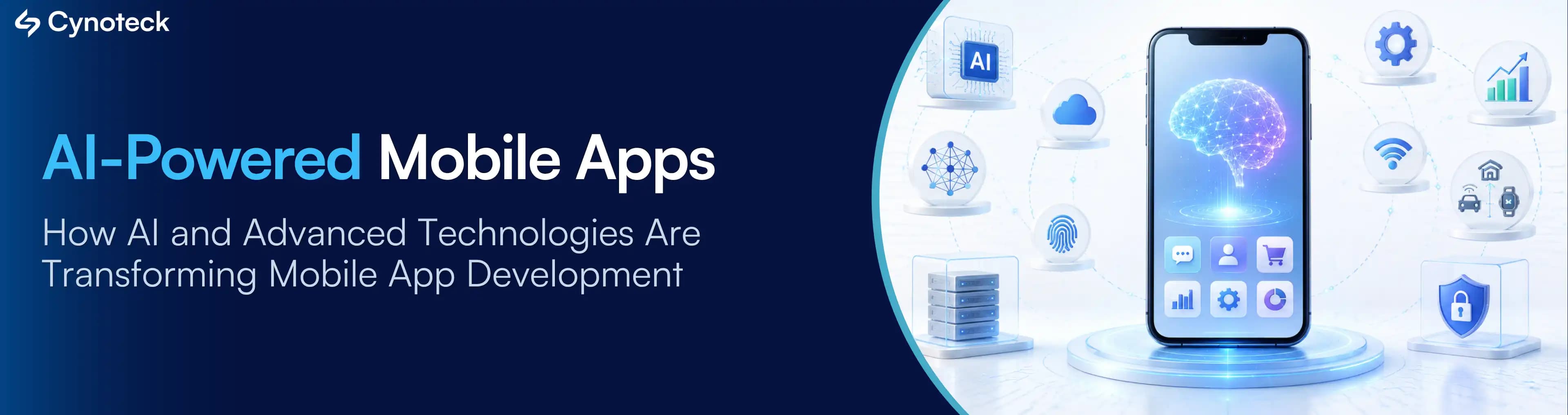
In 2026, AI and advanced technologies are becoming an important part of modern mobile app development. They are changing both how mobile apps are developed and what mobile apps can do.
Developers are using these technologies to build apps faster, automate tasks, understand users better, and deliver more personalized experiences. But adding AI to an app is not always necessary. The question is when AI and advanced technologies add value and when you actually need them.
Below, we explain how AI and advanced technologies are used in mobile app development, what they can do, their benefits and costs, what businesses should consider before adopting them, and how they can shape the next generation of mobile apps.
AI and advanced technologies are changing mobile app development in two main ways.
First, they help developers build apps faster and better. Development teams can use AI to assist with tasks such as planning, writing code, testing, finding bugs, and improving app performance.
Second, these technologies make the app itself smarter. They help apps understand user behavior, make predictions, recognize images and voice, automate tasks, personalize experiences, and provide better recommendations.
In simple terms, AI and advanced technologies help developers build apps faster and launch them sooner.
For businesses and users, these apps provide more personalized, intelligent, and convenient experiences that better match individual needs.
AI and advanced technologies can be used at different stages of mobile app development. Some help the development team build the app, while others improve the app's design, security, performance, and user experience.
Before development starts, tools such as ChatGPT, Claude, AI research Agent, Perplexity and Gemini help product teams turn an app idea into clearer requirements. They help you to do deep research to identify user needs, organize features, create user flows, and prepare initial product documentation. This gives developers and business owners a clearer direction before development begins.
AI-powered UI/UX technologies such as Generative UI, AI Design Agents, Text-to-UI, Design-to-Code, and AI Prototyping help design teams move from ideas to interactive experiences faster. Designers can generate layouts, create design variations, build prototypes, work with design systems, and speed up development with AI-assisted workflows.
AI is also improving usability testing, personalization, accessibility, and motion design. This helps teams test and improve digital experiences earlier, while designers remain in control of the final design.
Advanced coding technologies such as AI Coding Agents, Agentic Development, AI Code Generation, Repository-aware AI, and Design-to-Code are helping developers build and maintain applications more efficiently.
Tools such as Cursor, Claude Code, OpenAI Codex, GitHub Copilot, Windsurf, Cline, and Devin generate and modify code, understand existing codebases, identify errors, write tests, review code, and handle development tasks across multiple files.
Mobile apps cloud platforms now offer much more than basic servers and storage for modern mobile apps. Technologies such as serverless computing, managed databases, containers, APIs, cloud storage, authentication, and cloud AI services help teams build and manage mobile app backends with less infrastructure work. Platforms such as AWS, Microsoft Azure, and Google Cloud provide these services for different mobile app needs.
APIs allow different software systems to communicate with each other. Technologies such as API-first architecture, GraphQL, gRPC, event-driven architecture, webhooks, microservices, API gateways, service mesh, real-time APIs, and serverless APIs help developers build flexible mobile app backends. iPaaS platforms also simplify connections between multiple business systems, while AI agent integration, tool calling, and MCP (Model Context Protocol) help AI systems interact with apps, APIs, and external services.
These technologies help connect services such as payment gateways, CRMs, ERPs, maps, AI services, databases, and other business systems while supporting data exchange and complex workflows.
Machine learning (ML) helps mobile app software learn from data, identify patterns, and make predictions or decisions based on that data.
In mobile apps, ML is used for personalized recommendations, fraud detection, demand prediction, customer behavior analysis, predictive maintenance, image recognition, and voice recognition.
Generative AI and Large Language Models (LLMs) help mobile apps create and understand content such as text, images, summaries, recommendations, and natural-language responses. They are used for AI chatbots, virtual assistants, personalized experiences, content generation, translation, and smart search. Popular platforms are OpenAI, Google Gemini, Anthropic Claude, and Meta Llama.
Natural Language Processing (NLP) helps mobile apps understand and process human language for features such as voice commands, chatbots, text translation, sentiment analysis, smart search, and text suggestions.
Platforms and tools commonly used to add NLP capabilities to mobile apps include Google Cloud Natural Language API, Azure AI Language, and Amazon Comprehend.
Speech and voice AI allows apps to understand spoken language and respond to voice-based commands. Technologies such as speech-to-text, text-to-speech, and voice recognition are commonly used for this purpose.
They support voice search, voice commands, transcription, accessibility features, and AI voice assistants.
Build voice-enabled app experiences that make it easier for users to search, interact, and complete tasks.
Talk to Our ExpertsComputer Vision enables mobile app software to understand information from images and video. Mobile apps use it for document scanning, OCR, object recognition, visual search, product identification, identity verification, and image-based inspections.
Advanced technologies like LangChain, LangGraph, OpenAI Agents SDK, and Amazon Bedrock Agents help developers build AI-powered workflows and agents behind mobile apps. They connect AI models with tools, APIs, databases, business data, and other services so an AI agent can understand a task, make decisions, use different tools, and complete multi-step actions. These are not mobile app development frameworks, but they help add intelligent workflows and agent-based features to mobile apps.
Augmented Reality (AR) lets mobile apps add digital objects and information using the phone’s camera. It is used for virtual try-ons, placing furniture in a room, product previews, navigation, training, and interactive experiences.
Internet of Things (IoT) allows a mobile app to connect with physical devices and sensors, receive data from them, and send commands back to them. The app acts as the interface where users can view device information, monitor activity, and control connected devices.
For example, a smart home app can show temperature data from sensors and allow users to control lights, while a healthcare app can receive data from connected medical devices.
Edge Computing processes data closer to where it is being used instead of sending all the data to a cloud server. This helps mobile apps reduce delays, improve response time, and handle data faster. It is useful for real-time AI features, AR applications, IoT apps, video processing, and apps that need to work with limited internet connectivity.
Biometric technology helps mobile apps verify a user’s identity using unique features such as fingerprints, face recognition, iris scans, and voice recognition. It is mainly used for secure login, passwordless access, payment authorization, banking apps, and protecting sensitive data. This gives users a faster and more secure way to access mobile apps and their important features.
Advanced Predictive Analytics helps mobile apps understand how users interact with the app and how the app is performing. It helps teams track user behavior, popular features, drop-off points, conversions, user retention, and app performance. This data helps businesses improve the app, provide better user experiences, and make better product decisions.
Advanced and Automated Mobile App Testing uses technologies such as AI-powered test generation, AI test automation, visual testing, self-healing test automation, automated regression testing, cross-device testing, and AI-powered bug detection. Tools such as Appium, BrowserStack, Sauce Labs, LambdaTest, Maestro, and Kobiton help developers automate tests, check different devices and screen sizes, find bugs, and identify UI and performance issues.
These technologies reduce repetitive testing work for developers and help find problems earlier. They also improve app quality, stability, performance, and user experience, while helping teams release apps faster and with fewer issues.
Advanced Security and Fraud Detection technologies helps mobile apps identify suspicious activity and protect user accounts and transactions. It checks things such as unusual transactions, login activity, account behavior, and payment patterns to detect possible fraud and security risks. Platforms such as AWS Fraud Detector, Stripe Radar, Sift, Feedzai, and DataVisor provide fraud detection and security solutions for mobile apps. These technologies are widely used in banking, FinTech, payments, e-commerce, and insurance apps to protect users, reduce fraud, and improve app security.
CI/CD and DevOps Automation helps mobile app teams automate the process of building, testing, and releasing app updates. Tools such as GitHub Actions, GitLab CI/CD, Bitrise, Codemagic, Jenkins, and Fastlane help developers run tests, create app builds, check code, and prepare releases automatically. This reduces manual work, helps find issues earlier, and makes mobile app updates faster and more reliable.
AI and advanced technologies improve mobile apps at different levels, from development and testing to user experience, security, and business decisions. The main benefits include:
AI-assisted planning, design, coding, testing, and DevOps automation reduce repetitive work and help teams build apps faster, from the initial idea to the final app.
AI helps apps provide personalized content, recommendations, voice interactions, smart search, and easier navigation based on user needs and behavior.
Machine learning, analytics, recommendation engines, and AI models help businesses understand users and provide experiences based on their preferences and past interactions.
Generative AI, NLP, computer vision, AI agents, and voice AI help mobile apps understand text, voice, images, and user requests, making apps more useful and interactive.
Cloud computing, edge computing, on-device AI, and modern backend technologies help apps process data faster, reduce delays, and support advanced features.
Biometrics, security technologies, and fraud detection help protect user accounts, payments, and sensitive information by improving authentication and detecting suspicious activity.
Automated testing and AI-based testing help teams test apps across different devices, find bugs earlier, and reduce issues before the app reaches users.
Modern APIs, microservices, API gateways, event-driven architecture, and integration platforms help mobile apps connect with CRMs, ERPs, payment systems, AI services, databases, and other business platforms.
Advanced analytics helps businesses understand user behavior, feature usage, conversions, retention, and app performance, giving product teams useful information to improve the app.
Cloud services, microservices, serverless technologies, and modern integration methods help apps handle more users, data, features, and connected services as the business grows.
AI and advanced technologies help businesses add features such as AI assistants, personalized recommendations, virtual try-ons, connected-device experiences, predictive services, and automated workflows, creating new ways to serve customers and generate value.
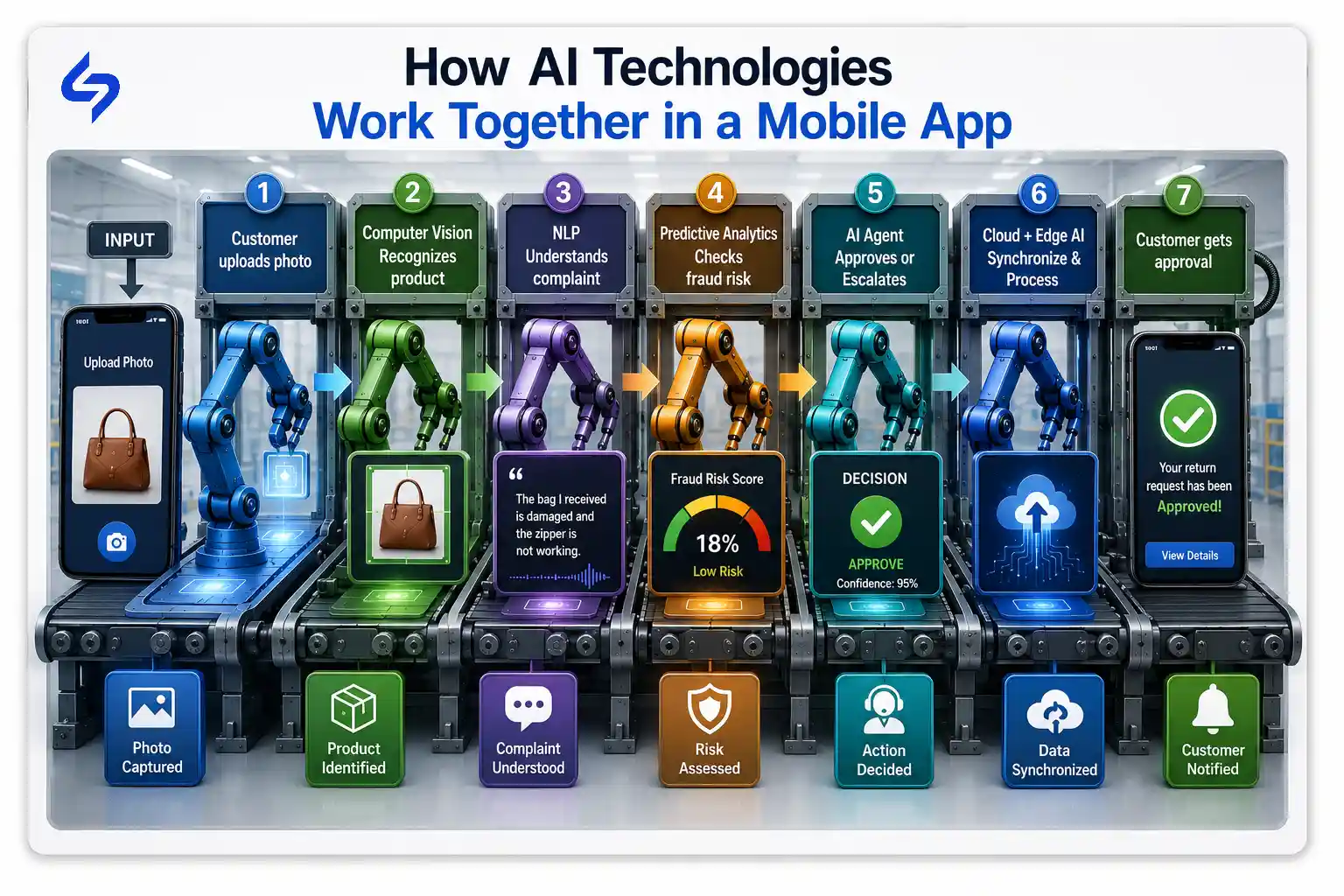
AI and advanced technologies work together to build mobile apps that are smarter, faster, more secure, and more efficient. Each technology supports a different part of the app, and when they are planned and used together, they improve the overall development process, app performance, user experience, and business value.
This combined approach helps development teams build more capable apps with easier development, testing, integration, and future improvements, while helping businesses improve customer engagement, increase conversions, reduce operational costs, and create more opportunities to generate revenue.
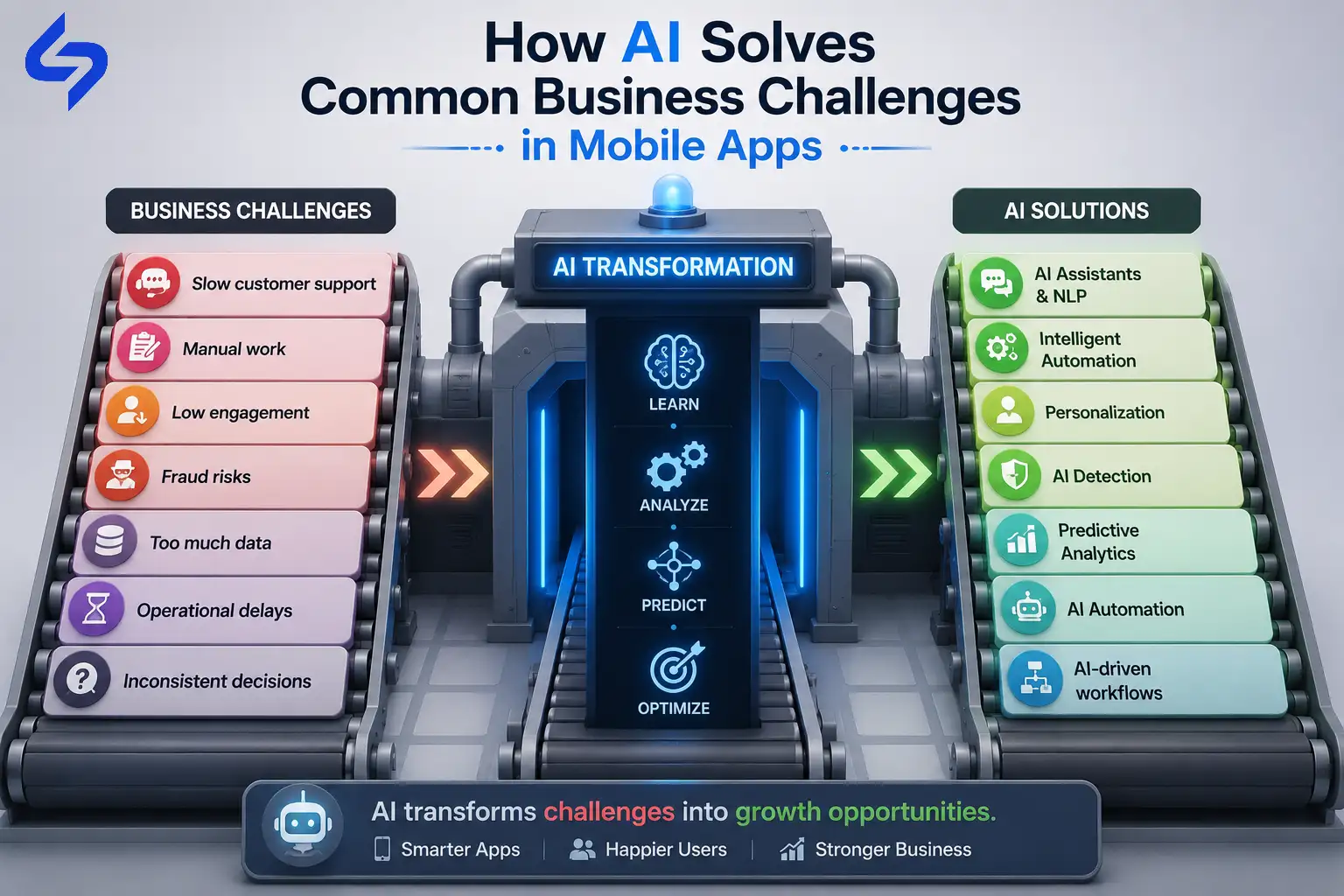
Businesses and mobile app development teams face challenges in development, customer support, app management, user engagement, and scaling. AI and advanced technologies help solve these challenges while reducing manual work and improving app quality.
AI tools, automation, and AI Agents help developers handle repetitive coding, testing, documentation, and routine tasks. Businesses can also automate common workflows inside the app.
AI coding tools, automated testing, and CI/CD help teams build, test, and release apps faster, helping businesses launch new features sooner.
AI Assistants, chatbots, NLP, and smart search help apps handle common questions and routine requests, reducing support work.
Personalization, recommendation engines, and analytics help apps provide more relevant content, products, and features based on user behavior.
APIs, microservices, cloud services, and integration technologies help connect apps with CRMs, ERPs, payment systems, databases, and other platforms.
Automated testing, AI-powered testing, and performance monitoring help teams find issues earlier and maintain app quality across devices and updates.
Cloud Computing, Edge Computing, microservices, and modern backend technologies help apps handle more users, data, and features as the business grows.
Advanced Analytics and Machine Learning help businesses understand user behavior, feature usage, and customer needs, supporting better product decisions.
AI and advanced technologies are helping different industries make their mobile apps smarter, faster, more useful, and more personalized. Each industry uses these technologies based on its users, business needs, and the type of services industry provides.
Healthcare apps use AI and advanced technologies for diagnosis support, patient management, remote monitoring, appointment support, and personalized health services. These technologies help doctors and patients access and manage information more easily.
Banking and FinTech apps use advanced technologies for fraud detection, secure payments, personalized services, risk analysis, and faster customer support. They also help protect user accounts and financial transactions.
E-commerce apps use product recommendations, personalized shopping, AR try-ons, smart search, and AI assistants to make online shopping easier. These features help users find relevant products and make better purchase decisions.
Travel and hospitality apps use AI assistants, smart recommendations, navigation, trip planning, and personalized offers. These features help users plan trips, find suitable services, and manage their travel more easily.
Education apps use AI tutors, personalized learning, voice features, smart search, and automated learning support. These technologies help students get learning content based on their needs and learning progress.
Media and entertainment apps use content recommendations, Generative AI, smart search, voice features, and personalized experiences. It helps users to find relevant movies, shows, music, and other content more easily.
Logistics and transportation apps use real-time tracking, route optimization, location services, and predictive analytics so that their app can track vehicles, manage deliveries, and improve routes.
Real estate apps use AI and AR to make property search more interactive. Users can take virtual property tours, visualize spaces using AR, get personalized property recommendations, and interact with AI assistants while searching for properties.
The right technologies help businesses improve their services, solve user problems, and create better digital experiences. With the right approach, you can use these technologies to build apps that better meet your users’ needs and support your business goals.
We help businesses choose the right technologies and build mobile apps that match their industry needs and support business growth.
Discuss Your App RequirementsAI and advanced technologies add strong capabilities to a mobile app, but they need the right planning from the beginning. Businesses and development teams should understand the cost, technology, data, security, performance, and long-term maintenance before development starts.
Businesses should first define what problem the app needs to solve and where AI or advanced technology adds real value. AI may be useful for recommendations, AI assistants, predictions, or natural language features, while technologies such as cloud computing, AR, biometrics, and advanced APIs may be better suited for other requirements. Businesses should also plan mobile app development costs, technology costs, expected ROI, data requirements, privacy, security, and future scalability before selecting the technology.
It is also important to check the dependency on third-party AI platforms, cloud services, APIs, and other technology providers. Choosing reliable platforms and keeping alternatives in mind helps businesses manage future pricing, service changes, and technology updates.
Development teams need to plan how AI and advanced technologies will fit into the mobile app, backend, database, APIs, and overall architecture. The right approach depends on the feature. They also need to consider performance, security, testing, integration, and maintenance.
AI features need proper testing for different user inputs, while technologies such as APIs, cloud services, biometrics, and CI/CD need to work correctly across supported devices and environments. The architecture should also make it easier to update AI models, APIs, SDKs, and other technologies later.
Both businesses and developers should focus on creating a useful, secure, reliable, and easy-to-use app. AI and advanced technologies should improve the user experience instead of simply adding more features. User data should be handled carefully, important app functions should have proper checks, and the app should continue to perform well as users and data grow.
Planning for future updates, new technologies, changing user needs, and continuous improvement also helps keep the app useful over the long term. The goal is to use AI and advanced technologies where they provide real value while keeping the app practical, secure, scalable, and easy to maintain.
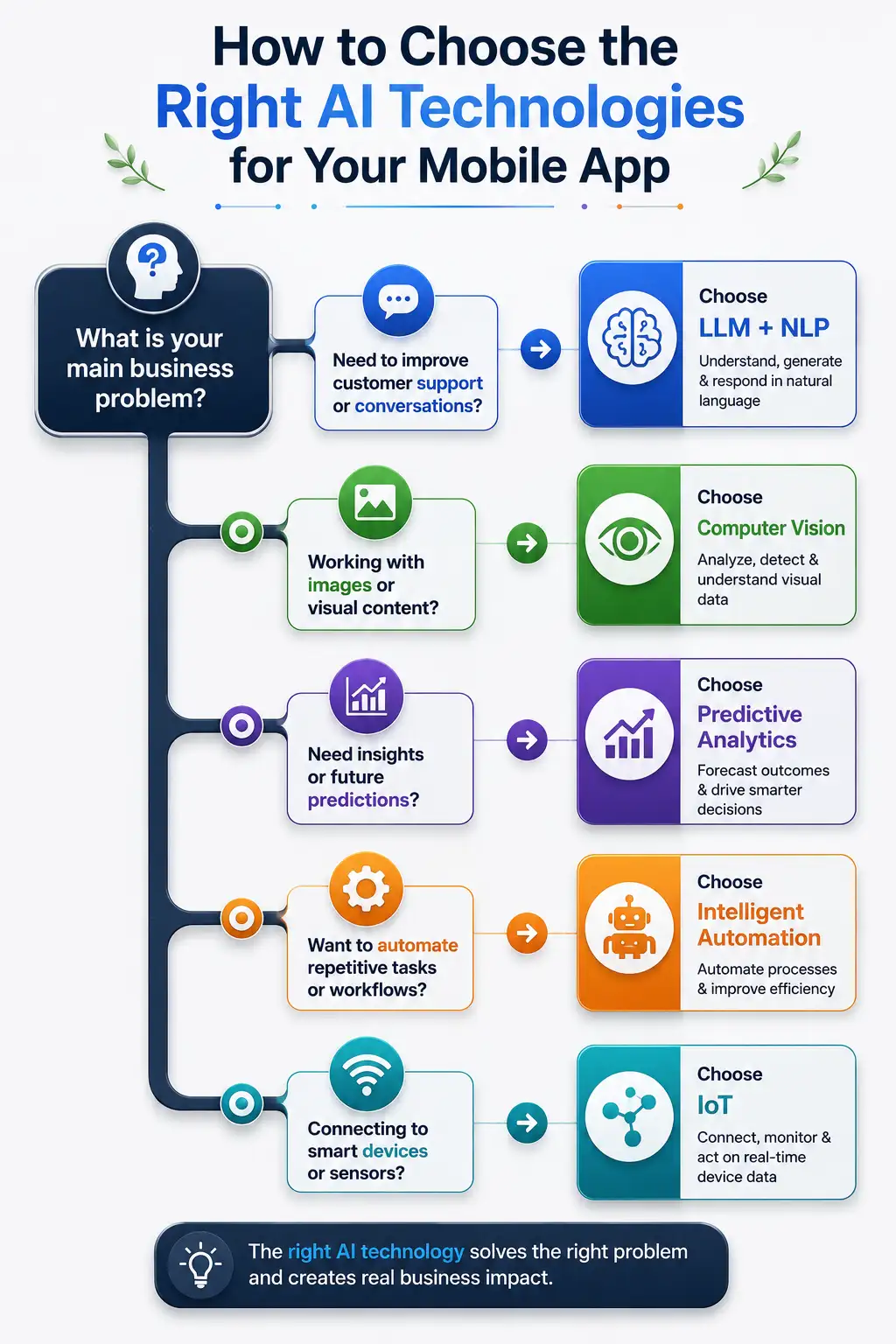
Choosing the right AI and advanced technologies starts with understanding the app idea, business goals, user needs, and required features. The client shares these requirements with the mobile app development team, and the developers then decide which technologies will actually help build the app better and faster.
First, clearly define what the app needs to do, who will use it, what problem it will solve, and which features are required. The development team uses this information to understand the project properly before choosing any technology.
Based on the requirements, developers decide where AI and advanced technologies should be used. The goal is to use the right technology where it provides value.
Plan how to use the selected technologies at the right stage and for the right purpose. For example, AI tools help with planning, UI/UX design, coding, and testing, while Cloud Computing, APIs, Edge Computing, Biometrics, and CI/CD support the app’s architecture, integration, security, performance, and deployment.
The selected technologies should help the team build the app faster without affecting performance, security, or quality. Developers also consider infrastructure costs, API usage, device performance, maintenance, and the number of users the app may need to support.
After development, the team tests the app across different devices, features, and real user scenarios. Testing helps find bugs, performance issues, security problems, and other areas that need improvement before the app reaches users.
The app should be built in a way that makes it easier to add new features, AI models, APIs, and advanced technologies later. This helps the app grow with changing user needs and business requirements.
Mobile app development is moving towards apps that are smarter, more personalized, faster, and more automated. AI and advanced technologies will help developers build apps that understand users better, perform more tasks automatically, and work across different devices and services.
AI Agents will help mobile apps handle multi-step tasks, customer support, bookings, recommendations, and other workflows with less user effort.
On-Device AI and Edge Computing will become more common for features that need faster responses, better privacy, and less dependence on the cloud.
With Multimodal AI, mobile apps will work with text, voice, images, video, and other inputs together, creating more natural ways for users to interact with apps.
Generative UI and AI Design technologies will help create interfaces that adjust based on user needs, behavior, and context instead of showing the same experience to every user.
AI Coding Agents, automated testing, AI-powered debugging, and DevOps automation will help development teams write, test, fix, and release apps with less manual work.
Mobile apps will increasingly connect with IoT devices, wearables, smart devices, business systems, and cloud services, creating more connected digital experiences.
Overall, the future of mobile app development is moving towards smarter apps, simpler user experiences, faster development, and more automated workflows. Businesses that choose the right technologies based on their actual needs will be better prepared for this change.
The main takeaway is that businesses do not need to use every new technology. They need to understand their app requirements, user needs, business goals, and then choose the technologies that actually fit their project. Developers also need to use these technologies at the right stages to build the app faster, maintain quality, control costs, and prepare it for future growth.
Whether you're building a new app or modernizing an existing one, our experts can help you choose and implement the right technologies for long-term success.
Start Your Mobile App ProjectDevelopers use AI Coding Agents, AI Code Generation, Repository-aware AI, Natural Language Programming, and AI Debugging to write, understand, improve, and fix code. Popular tools include Cursor, Claude Code, OpenAI Codex, GitHub Copilot, Windsurf, Cline, and Devin.
Developers use AI Test Generation, AI-powered Testing, Visual Testing, Self-Healing Test Automation, Automated Regression Testing, and Cross-Device Testing. Tools such as Appium, BrowserStack, Sauce Labs, LambdaTest, Maestro, and Kobiton help automate testing and find issues across different devices and environments.
Mobile apps mainly use Machine Learning, Recommendation Engines, Advanced Analytics, and user behavior data to provide personalized recommendations. These technologies help apps understand user interests and show relevant products, content, services, or features.
Technologies such as Cloud Computing, Cloud Databases, Edge Computing, Data Analytics, APIs, and modern backend architectures help manage mobile app data. The right choice depends on the app's data volume, performance needs, security requirements, and expected number of users.
Natural Language Processing (NLP) helps mobile apps understand and process human language. It is used for voice commands, chatbots, text translation, sentiment analysis, smart search, and text suggestions. Platforms such as Google Cloud Natural Language, Azure Language, and Amazon Comprehend provide NLP capabilities.
They can help an e-commerce app provide personalized product recommendations, smart search, AI assistants, fraud detection, AR product previews, personalized shopping experiences, and better customer support. These features can help users find products faster, improve engagement, increase conversions, and create more sales opportunities.
Healthcare apps use these technologies for patient support, remote monitoring, personalized health experiences, medical image analysis, appointment support, voice features, and data analytics. The exact technology depends on the healthcare use case, data requirements, privacy needs, and regulatory requirements.
They can provide real value when used for the right requirements. AI tutors, personalized learning, recommendation systems, voice features, smart search, analytics, and automated workflows can improve the learning experience and reduce manual work. However, adding technologies without a clear purpose can increase development and maintenance costs, so the technology should be selected based on your platform's actual needs.
No-code and low-code platforms such as FlutterFlow, Bubble, Adalo, Glide, and Microsoft Power Apps help build applications with less manual coding. AI-powered development tools are also making it easier to generate UI, code, and app components from natural-language instructions. For complex, highly customized, or high-scale apps, professional development is still usually required.
Start with your app requirements, user needs, business goals, and required features. Then the development team should identify where a technology provides real value. For example, one app may need AI personalization, while another may benefit more from cloud computing, AR, advanced analytics, or automated testing. The goal is to choose the right technology for the problem, not to use every new technology available.
Yes. AI tools can reduce repetitive work in planning, UI/UX design, coding, debugging, documentation, and testing. Advanced technologies such as CI/CD, automated testing, cloud services, and modern development architectures also help teams build, test, and release apps more efficiently.
No. AI tools support developers by handling repetitive tasks, generating code, finding issues, and helping with development work. Developers still need to handle architecture, technical decisions, security, code quality, integrations, testing, and final implementation. AI works best as a development assistant rather than a complete replacement for the development team.
Yes, when they solve real customer or business problems. Personalization, recommendation engines, AI assistants, smart search, better analytics, automation, and improved user experiences can help increase engagement, conversions, retention, and customer value. The actual revenue impact depends on the app, business model, users, and how well the technology is implemented.

Mobile healthcare apps improve patient care by enabling remote monitoring, timely reminders, secure data access, better communication, and cost-efficient healthcare services through mHealth technology.

B2B apps help businesses streamline operations, enable on-the-go access to data, improve client engagement, support omnichannel sales, and drive scalable revenue by simplifying complex business workflows.
We are more than just developers and consultants—we are your partners in navigating the digital landscape. Let us be the engine behind your next big success while you focus on your core vision.
Explore Opportunities!