Top 10 Programming Languages for Mobile App Development in 2026
Mobile apps have become a core part of how businesses connect with customers, streamline operations, and generate revenue. However, before development even begins, one decision shapes almost everything that follows: which programming language your app is built on.
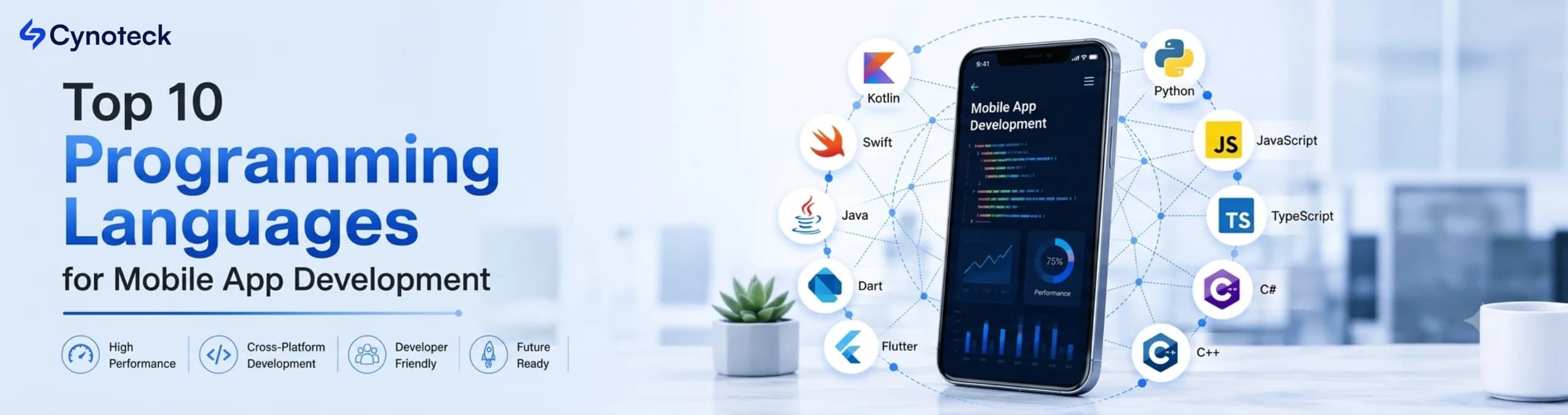
This guide compares the 10 best programming languages for mobile app development in 2026, including Kotlin, Swift, Dart, JavaScript, and more. You will learn the strengths and limitations of each language, how to match a language to your business goals, and what it means for your development cost and timeline.
The programming language you choose affects much more than coding. It shapes your app's performance, development speed, user experience, scalability, and long-term maintenance cost.
In simple terms, the language is the foundation your entire app sits on. Get it right, and your team ships faster and spends less fixing avoidable problems later. Get it wrong, and small feature requests turn into expensive rework.
Performance: Some languages compile closer to the hardware, which means smoother animations and faster load times.
Development speed: Cross-platform languages typically get you to launch faster than building two separate native apps.
User experience: Native languages give deeper access to platform-specific features that shape how polished an app feels.
Scalability: The right language makes it easier to add features and users without a rebuild.
Maintenance costs: Some languages need a larger, harder-to-find developer pool, which raises long-term support costs.
Note: The programming language you choose influences much more than coding. It affects development cost, app performance, ongoing maintenance, and how well your app scales as your business grows. |
Native languages are built specifically for a platform and deliver the best performance, while cross-platform languages share a single codebase across iOS and Android to save time and costs.
This distinction is the first decision to make, before you even start comparing individual languages.
Native languages are built specifically for either Android or iOS. This means they get full access to platform-specific features and typically deliver the best possible performance. Our guide to native mobile app development, its pros, cons, and alternatives covers this in more depth if you are still weighing native against other approaches.
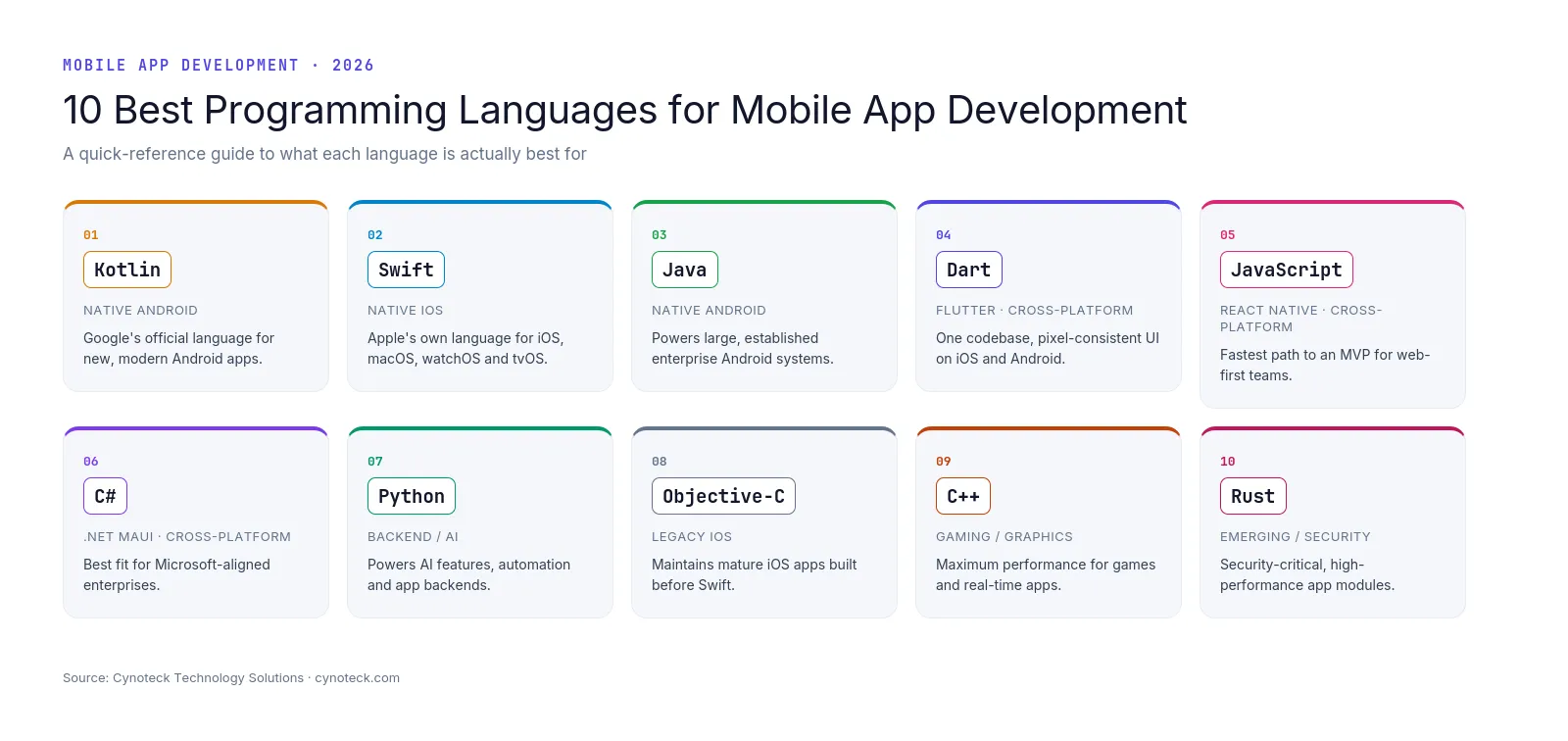
Kotlin: Google's official language for Android.
Java: The original Android language, still active in many enterprise systems.
Swift: Apple's official language for iOS.
Objective-C: The older iOS language, still used to maintain legacy apps.
Cross-platform languages let mobile app developers write one codebase that runs on both iOS and Android. As a result, businesses get faster development and lower upfront costs.
Dart: Powers Flutter, Google's cross-platform framework.
JavaScript: Powers React Native, one of the most widely adopted cross-platform frameworks.
C#: Powers Xamarin and .NET MAUI for Microsoft-aligned businesses.
If speed to market matters more than deep native features, hybrid app development is a third path worth comparing, since it wraps a web-based app inside a native shell for the fastest possible launch.
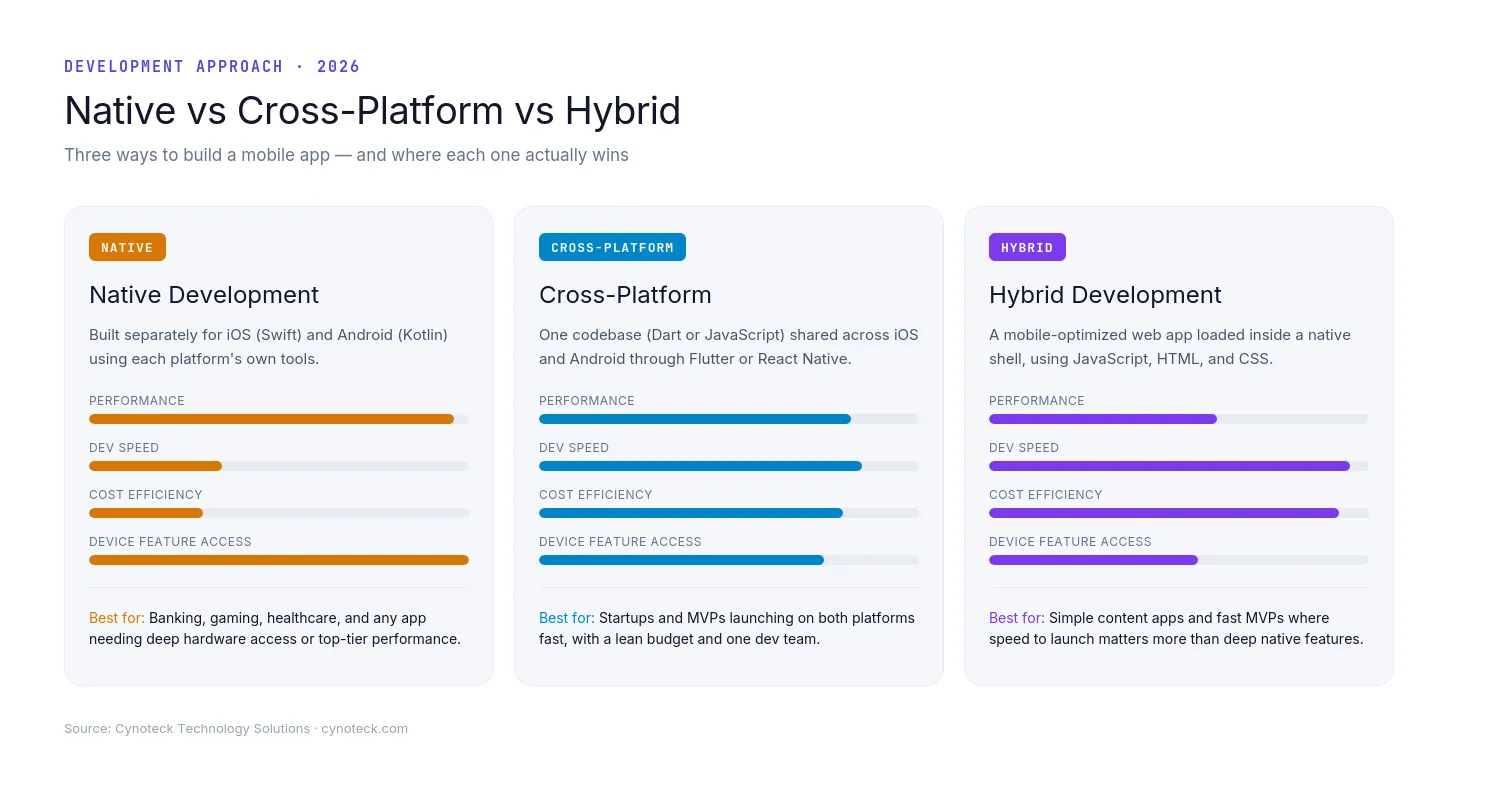
Pro Tip: If your business is unsure whether to go native, cross-platform, or Android-only, our detailed breakdown of iOS vs Android vs cross-platform development costs compares the total cost of ownership across all three approaches. |
Choosing between native and cross-platform development affects cost, performance, and scalability. Get expert guidance before investing in the wrong technology stack.
Discuss Your App IdeaPicking from the list of mobile app development programming languages below is easier once you see them side by side. Each one solves a different problem, whether that is native performance, cross-platform speed, or backend intelligence, so the sections ahead walk through what each language does best, where it falls short, and which real businesses already trust it.
Kotlin is Google's officially recommended language for Android development, designed to fix common pain points found in Java.
Key features: Null safety, concise syntax, full interoperability with Java.
Advantages: Fewer crashes, less boilerplate code, strong tooling in Android Studio.
Limitations: Smaller talent pool than Java, though it is growing quickly.
Best for: New Android app development projects and modernizing existing Android codebases.
Popular apps using Kotlin: Google Pay, Pinterest, and Trello all rely on Kotlin for their Android builds.
Why businesses choose Kotlin: It reduces bugs and development time on Android, which lowers both build and maintenance costs over the life of the app. |
Swift is Apple's modern language for building iOS, macOS, watchOS, and tvOS apps, created to replace the older Objective-C.
Key features: Type safety, memory safety, fast compilation to native code.
Advantages: Clean syntax, excellent performance, immediate access to new iOS features.
Limitations: Only works within the Apple ecosystem.
Best for: Businesses building an iOS app development project that is iOS-first or Apple-exclusive.
Popular apps using Swift: LinkedIn, Airbnb, and Lyft all use Swift for their iOS apps.
Why businesses choose Swift: It delivers the smoothest, most polished experience for Apple users, which matters for premium or design-led products. |
Java laid the foundation for Android and still powers a large share of enterprise mobile systems today.
Key features: Mature ecosystem, "write once, run anywhere" portability, strong backend versatility.
Advantages: Decades of documentation, a large hiring pool, proven stability at scale.
Limitations: More boilerplate code than Kotlin, and considered legacy for brand-new projects.
Best for: Maintaining or extending large existing enterprise Android systems.
Popular apps using Java: Large parts of the Android operating system itself, along with many enterprise banking and logistics apps, are still built on Java.
Why businesses choose Java: Existing systems already run on it, and rewriting a stable enterprise app is rarely worth the cost. |
This is one of the fastest-growing entries on this list, and it deserves more attention than most competitor guides give it.
Dart is Google's client-optimized language, used with the Flutter app development framework to build apps that run natively on both iOS and Android from one codebase.
Why Flutter has become popular: Its custom rendering engine draws every pixel itself, so the app looks identical on both platforms, and hot reload lets developers see changes instantly.
Benefits: Single codebase, near-native performance, consistent design across devices.
Drawbacks: Larger app file sizes and a smaller pool of experienced Dart developers compared with JavaScript.
Best use cases: Startups launching an MVP on both platforms at once, and businesses that want pixel-perfect design consistency.
Why businesses choose Dart: It cuts development costs by up to 35% compared with building two separate native apps, while still delivering a near-native feel. |
JavaScript, used through the React Native framework, lets teams that already build web apps reuse that skill set for mobile development.
Why it remains popular: It has the largest developer talent pool of any language on this list, plus a massive library of ready-made components.
Benefits: Faster hiring, shared code with existing React web apps, large third-party ecosystem.
Limitations: Performance can lag native for very complex, animation-heavy apps, and some features still need custom native modules.
Best projects: Social apps, marketplaces, and MVPs where speed to market and hiring flexibility matter most.
Businesses evaluating this option can see how our React Native app development team approaches this stack for real projects.
Why businesses choose JavaScript: React Native's component architecture typically reduces development time by around 40% compared with building two native apps. |
C# is Microsoft's object-oriented language, used with Xamarin and now .NET MAUI to build cross-platform apps that fit naturally into a Microsoft-based technology stack.
Best for Microsoft ecosystems: Businesses already running Azure, .NET, or SQL Server benefit from smoother integration.
Xamarin and .NET MAUI: Both let developers target iOS, Android, and Windows from a single C# codebase.
Business use cases: Enterprise apps that need tight integration with existing Microsoft infrastructure.
Why businesses choose C#: It reduces the integration work needed to connect a mobile app to systems the business already depends on. |
Python rarely builds the visible screens of a mobile app, but it plays a major role in the backend, automation, and AI features behind one.
When it makes sense: AI-powered recommendation engines, chatbots, and data-heavy backend logic.
Limitations for mobile apps: Frameworks like Kivy and BeeWare see limited production use, so Python is not a true native mobile language.
AI and backend advantages: Its libraries for machine learning and data processing are among the strongest in any language.
Why businesses choose Python: It pairs well with any frontend language when the app's core value depends on AI or heavy data processing. |
Objective-C was the primary iOS language before Swift, and it still runs inside a meaningful number of mature enterprise apps.
Legacy iOS applications: Many older, complex iOS codebases were never fully migrated to Swift.
When businesses still use it: Maintaining a stable, long-running iOS app without the cost of a full rewrite.
Why businesses choose Objective-C: It keeps a proven, revenue-generating app stable rather than risking a costly migration. |
C++ gives developers direct control over memory and hardware, which makes it the language of choice for the most performance-demanding mobile apps.
High-performance applications: Real-time processing, AR/VR, and compute-heavy tools.
Gaming and graphics: Most high-end mobile game engines rely on C++ under the hood.
Why businesses choose C++: When raw speed defines whether the app succeeds, such as in gaming, no other language on this list matches its performance. |

Rust is the newest entry on this list, and it is gaining traction fast for mobile modules that need both security and speed.
Emerging mobile development language: Increasingly used for performance-critical modules inside larger apps, rather than entire apps.
Security and performance benefits: Rust's design prevents entire categories of memory-related bugs that are common in C++.
Future potential: As mobile apps handle more sensitive data, Rust's safety guarantees make it a language worth watching closely.
Why businesses choose Rust: It offers C++-level performance with far fewer security risks, which matters for fintech and healthcare apps handling sensitive data. |
Language | Platform | Learning Curve | Performance | Best For |
Kotlin | Android | Medium | Excellent | Native Android apps |
Swift | iOS | Medium | Excellent | Native iOS apps |
Java | Android | Medium | Good | Enterprise apps |
Dart | Cross-platform | Easy | Excellent | Flutter apps |
JavaScript | Cross-platform | Easy | Good | React Native apps |
C# | Cross-platform | Medium | Good | Enterprise solutions |
Python | Cross-platform (backend) | Easy | Moderate | AI-powered apps |
Objective-C | iOS | Hard | Good | Legacy apps |
C++ | Multiple | Hard | Excellent | Gaming apps |
Rust | Multiple | Hard | Excellent | Secure, high-performance apps |
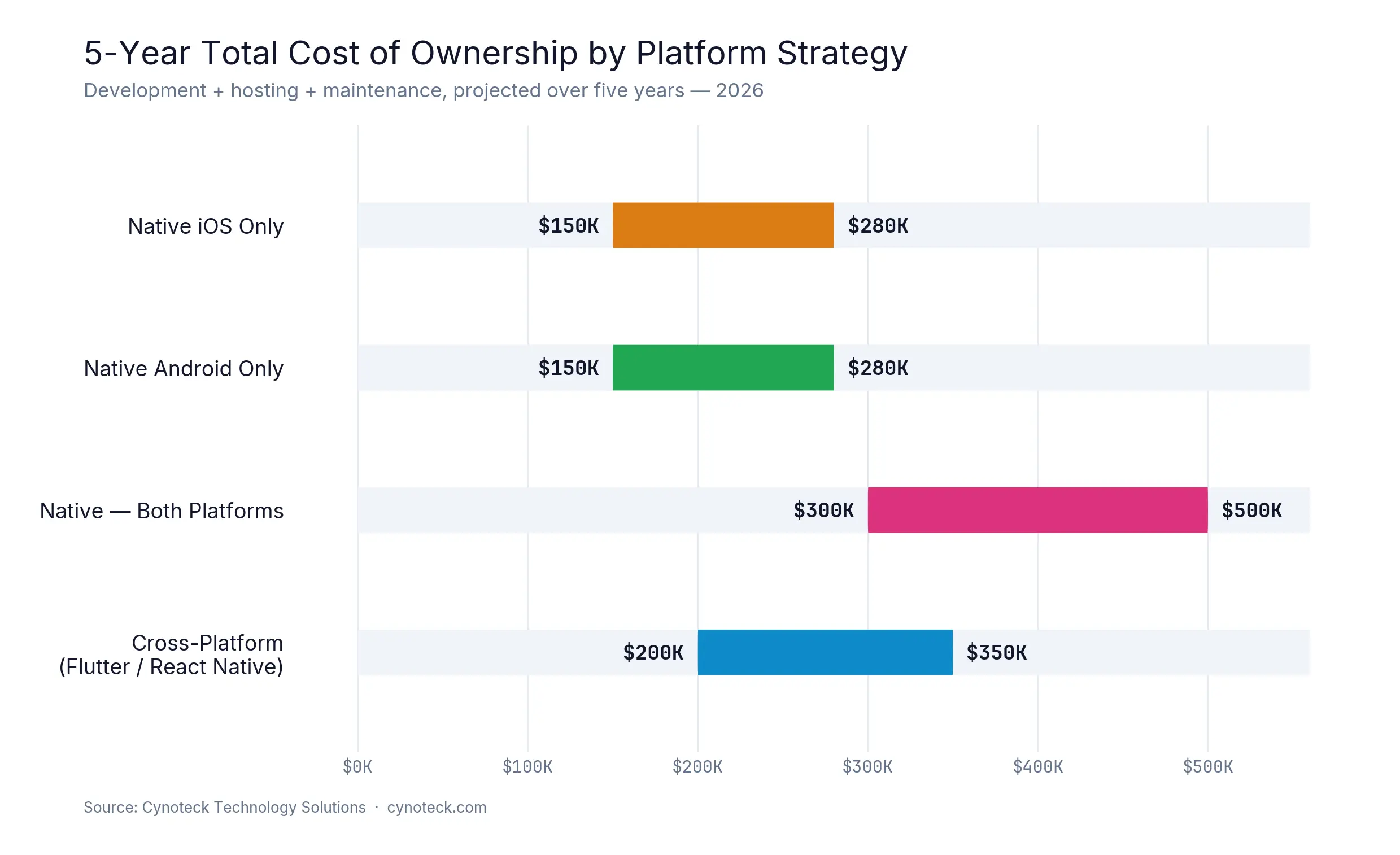
Choose your language by working through your platform, budget, timeline, performance needs, scalability plans, team skills, and long-term maintenance cost, in that order.
Consider your target platform: If your audience is almost entirely on one platform, native development often makes the most sense.
Define your budget: Cross-platform languages generally cost less upfront because a single team builds a single codebase.
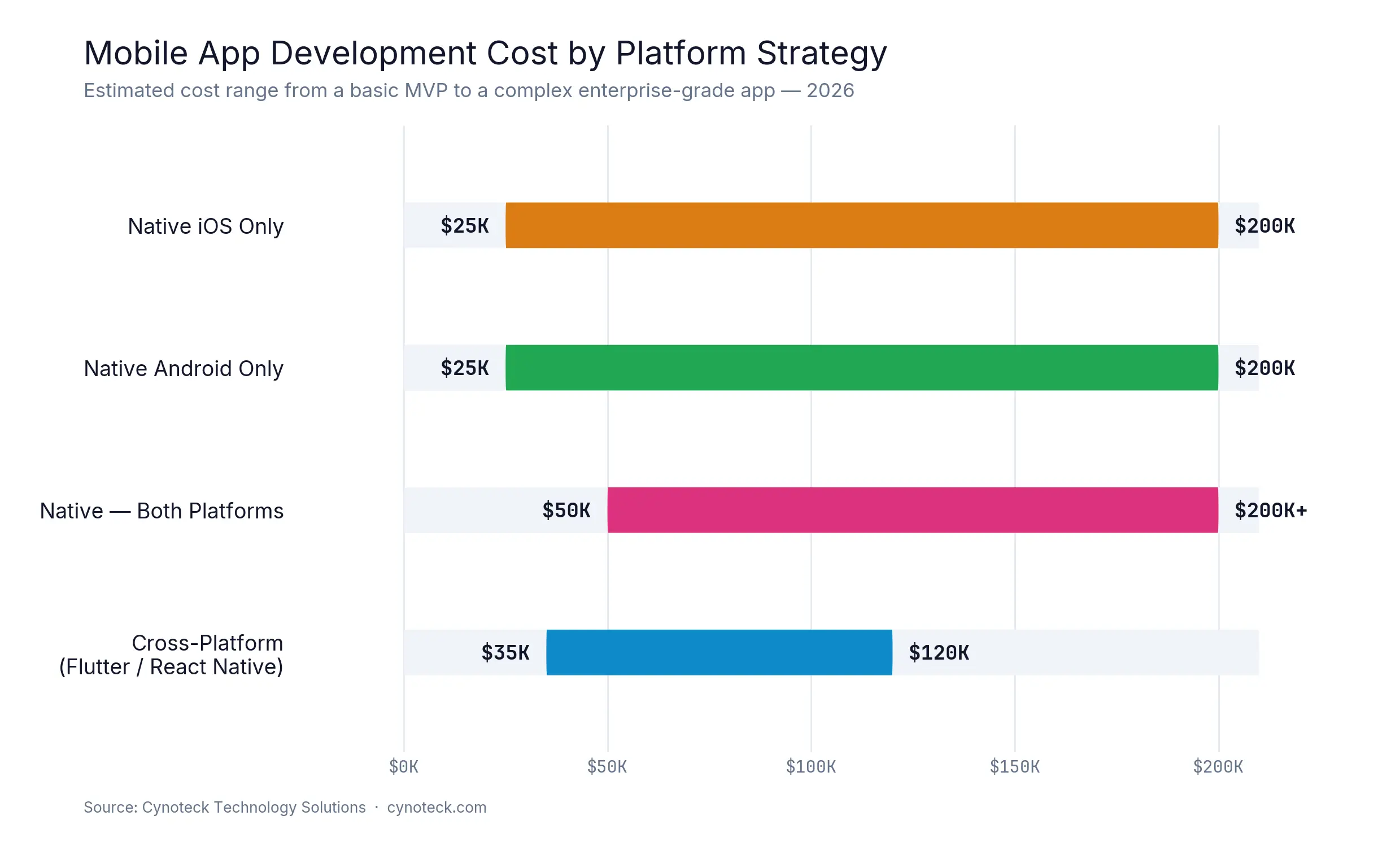
Evaluate your development timeline: Cross-platform tools like Flutter and React Native typically launch faster than building two native apps.
Assess performance requirements: Apps with heavy graphics or real-time processing benefit from native languages such as C++ or C.
Think about future scalability: A shared codebase is usually easier to maintain as your user base grows.
Consider your team's expertise: A team fluent in JavaScript will move faster in React Native than in an unfamiliar language.
Evaluate maintenance costs: Some languages need a larger, more specialized developer pool to support long-term.
Note: There is no single best language for every project. The right choice is the one that matches your platform, budget, and team, not the one that ranks first on a list. |
Match your business goals, budget, timeline, and app requirements to the right mobile app development language with expert recommendations.
Get a Free Consultation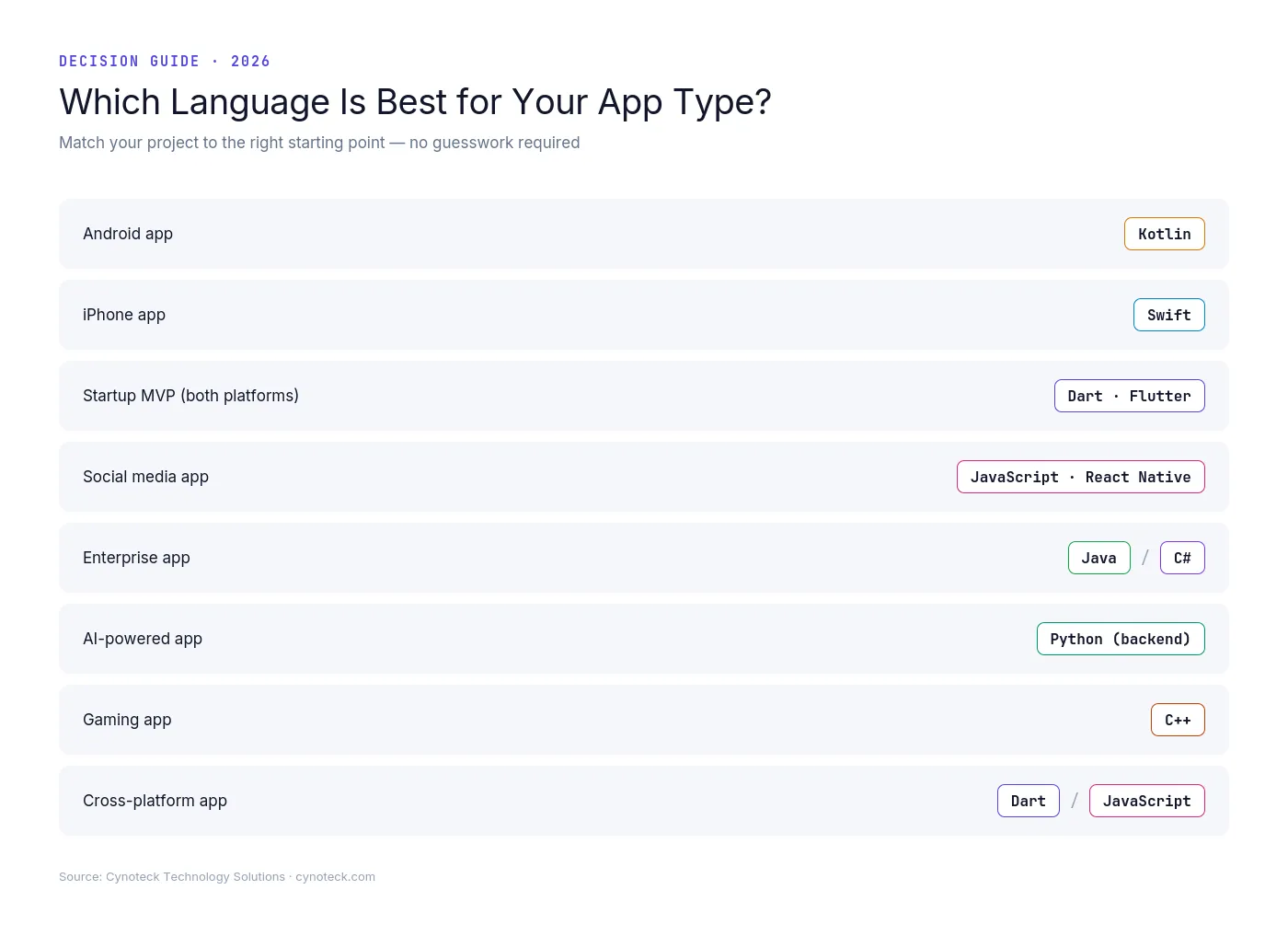
App Type | Recommended Language |
Android app | Kotlin |
iPhone app | Swift |
Startup MVP | Dart |
Social media app | JavaScript |
Enterprise app | Java or C# |
AI-powered app | Python (backend) |
Gaming app | C++ |
Cross-platform app | Dart or JavaScript |
Seeing how real, widely used apps apply these languages makes the decision easier to picture.
Instagram: Uses a Python-based backend paired with native iOS and Android frontends.
Uber: Relies primarily on native Swift and Java, with select features built in React Native.
WhatsApp: Built on native iOS and Android frontends connected to a highly scalable backend.
Spotify: Combines native development with Python for backend data and recommendation systems.
Airbnb: Uses native Swift and Kotlin for its core apps after moving away from an earlier React Native approach.
Google Pay: Built natively using Kotlin on Android and Swift on iOS.
Note: Even large companies often mix languages rather than picking just one. Your app does not need to fit into a single category either. |
AI-integrated apps: More apps are building recommendation engines and smart features directly into their core experience, increasing demand for Python-based backends. Our breakdown of what AI actually changes for Android development looks at this shift in practical terms.
Cross-platform development growth: Flutter and React Native together already power a large share of new apps, and that share continues to grow.
Flutter adoption: Dart's use is expanding beyond startups into enterprise-grade apps as the framework matures.
.NET MAUI expansion: Microsoft-aligned businesses are increasingly standardizing on .NET MAUI for cross-platform builds.
Rust's growing popularity: Security-conscious industries such as fintech and healthcare are increasingly adopting Rust for sensitive, performance-critical modules.
Low-code and no-code influence: These tools are speeding up simple app builds, though they still rely on the same underlying languages for anything custom.
Choosing based on popularity alone: A trending language is not automatically the right fit for your specific app.
Ignoring long-term maintenance: The cheapest language to build with is not always the cheapest to maintain.
Focusing only on initial costs: A lower upfront quote can hide higher costs down the road if the language cannot scale with your app.
Not considering scalability: Some languages handle rapid growth in users or features better than others.
Overlooking developer availability: A powerful but niche language can leave you stuck if your original developer moves on.
An experienced mobile app development partner, like Cynoteck Technology Solutions, helps you choose the right technology stack and carries that decision through to design, testing, security, and long-term scalability.
Choosing a language is only the first step. This is why most businesses work with a development partner rather than making the call alone:
Technology selection: An experienced team maps your business goals to the right combination of language and framework.
Architecture planning: The right technical foundation prevents expensive rework as your app grows.
UI/UX design: Design decisions need to work within the strengths of whichever language you choose.
Testing: Every language has its own testing tools and common failure points to check for.
Security: Handling sensitive user data safely depends partly on the language and partly on its implementation.
Scalability: A development partner plans for your app's growth from day one, not just its launch.
This is also why many businesses compare building a fully custom mobile app against ready-made solutions before committing to a language or a platform strategy. Whichever direction fits your business, the goal is the same: map the technology to your goals before writing a single line of code, not after.
From technology selection to development and launch, our mobile app development experts help you build scalable, high-performance applications faster.
Schedule a Free ConsultationThere is no single best programming language for every mobile app. The right choice depends on your target platform, budget, performance needs, and future growth plans. Kotlin and Swift remain the leaders for native development, while Dart and JavaScript dominate cross-platform builds, and Python, C++, and Rust each serve more specific technical needs. Instead of chasing whichever language is trending, choose the one that offers long-term value for your specific business.
If you want help matching the right technology stack to your app idea, book a free consultation with our mobile app development team, and we will walk through the right language and platform strategy together.
Ans: There is no single best language for every project. Kotlin is the top choice for native Android apps; Swift is the top choice for native iOS apps; and Dart or JavaScript is the best pick when you need a single app for both platforms.
Ans: For new projects, yes. Kotlin requires less code, reduces common crashes through null safety, and is Google's officially recommended language. Java still matters for maintaining large, established Android systems.
Ans: Swift is mainly used for iOS, but it also builds apps for macOS, watchOS, and tvOS. It does not run natively on Android.
Ans: Flutter uses Dart, a language created by Google specifically for working with Flutter's rendering engine and supporting fast, cross-platform app development.
Ans: Yes, particularly through the React Native framework. It gives businesses access to the largest developer talent pool of any language on this list and enables reuse of web development skills.
Ans: Dart (with Flutter) and JavaScript (with React Native) are the two leading cross-platform options. Dart tends to edge ahead on UI consistency, while JavaScript offers the larger hiring pool.
Ans: Python is rarely used to build the visible part of a mobile app, but it is an excellent choice for the backend, AI features, and data processing that support it.
Ans: JavaScript and Dart are generally considered the easiest starting points, thanks to straightforward syntax and strong beginner documentation.
Ans: Kotlin, Swift, Dart, and JavaScript currently see the strongest demand, driven by native Android and iOS development and the continued growth of Flutter and React Native.
Ans: Expect continued growth in cross-platform adoption through Flutter and React Native, more AI-driven features built on Python backends, and rising interest in Rust for security-sensitive, high-performance modules.

Mobile healthcare apps improve patient care by enabling remote monitoring, timely reminders, secure data access, better communication, and cost-efficient healthcare services through mHealth technology.
B2B apps help businesses streamline operations, enable on-the-go access to data, improve client engagement, support omnichannel sales, and drive scalable revenue by simplifying complex business workflows.
We are more than just developers and consultants—we are your partners in navigating the digital landscape. Let us be the engine behind your next big success while you focus on your core vision.
Explore Opportunities!