Custom Mobile App Development vs Ready-Made Solutions: Which One Is Right for Your Business in 2026?
Summary: Not sure whether to build a custom mobile app or go with a ready-made solution? It's a decision many businesses face as they grow. The right choice can improve efficiency, reduce long-term costs, and support future expansion, while the wrong one can create unnecessary limitations and expensive changes later. This guide compares both approaches, highlights common mistakes, explains the real costs, and helps you decide which option best fits your business in 2026. |
Every business reaches a point where existing software no longer fits the way it operates. What worked well in the beginning may start creating limitations as your team grows, customer expectations change, and new business processes emerge. At that stage, many business owners ask the same question:
Should we continue using a ready-made solution, or is it time to invest in a custom mobile app development services that are built around your business goals?
The answer isn't just about development cost or launch time. It affects how easily your business can scale, integrate with other systems, protect its data, and adapt to future requirements.
In this guide, we'll compare both approaches across the factors that matter most, including cost, scalability, security, integrations, long-term value, and common mistakes, helping you choose the option that best fits your business.
Get expert guidance on the right approach for your business, budget, and growth plans.
Get Expert GuidanceCustom mobile app development is the process of designing and building a mobile application specifically for your business. Instead of adapting your operations to fit existing software, the app is designed around your workflows, users, and business goals.
Although every project is different, custom mobile app development generally follows these stages:
The project begins by understanding your business requirements, defining project goals, identifying user needs, and planning the overall solution. This stage helps establish a clear roadmap before development begins.
Designers create wireframes, prototypes, and user interfaces that focus on delivering an intuitive and engaging user experience. Refining the design early helps reduce development changes later.
Developers build the frontend and backend of the application while integrating the required business systems and features. Depending on the project, technologies such as Flutter or React Native development may be used.
Before launch, the app is tested for functionality, performance, security, usability, and compatibility across supported devices and operating systems.
Once testing is complete, the app is published and continuously updated based on user feedback, new business requirements, and platform updates.
Custom mobile apps are widely used in industries such as healthcare, banking, manufacturing, logistics, retail, and enterprise software, where businesses require greater flexibility, specialized workflows, and long-term scalability.
Custom mobile apps can be built in different ways depending on your business needs, target platforms, budget, and required features. The three common technology approaches to build custom mobile apps:
A mobile app that is built specifically for a particular mobile platform (either android or iOS) is called a Native Mobile App. Examples: Google Maps, Spotify, WhatsApp.
A mobile app that is built using a single codebase and works on multiple mobile platforms, such as Android and iOS, is called a Cross-Platform Mobile App. Examples: Instagram, Uber, Airbnb.
A mobile app that is built using web-based technologies and made to work like a mobile app on different platforms is called a Hybrid Mobile App. Examples: Gmail, Microsoft Teams, Instagram.
Designed around your business processes instead of forcing your team to adapt.
Greater control over data, security, and compliance.
Easier to build scalable mobile applications as users, features, and business requirements grow.
Supports unique features that differentiate your business.
Integrates seamlessly with existing business systems.
Provides long-term flexibility without depending on a vendor's product roadmap.
Higher upfront investment than ready-made solutions.
Longer development timeline before launch.
Requires an experienced development partner.
Ongoing maintenance and updates remain the business's responsibility.
Success depends on clear planning and well-defined project requirements.
When your operations, customer expectations, or growth plans go beyond the capabilities of ready-made platforms, custom development becomes a strategic investment rather than an additional expense.
Key signs indicate that you need a custom mobile app:
Your business follows unique workflows that standard software cannot support efficiently.
You handle sensitive business/customer data and need greater control over how it is stored, secured, and managed.
Your mobile app needs to integrate with specialized business systems such as ERP, CRM, legacy software, or industry-specific platforms.
You expect significant business growth, including more users, new features, additional products, or expansion into new markets.
Your team spends too much time working around the limitations of ready-made software instead of focusing on productive work.
You operate in a regulated industry where security, compliance, or data governance requirements exceed what generic platforms can provide.
You plan to introduce AI-powered mobile apps with intelligent recommendations, predictive analytics, automation, or personalized experiences.
Your mobile app is becoming a core part of your business strategy, whether it's a customer-facing platform, partner portal, marketplace, or SaaS product.
Ready-made mobile apps are pre-built applications that are already developed with common features and can be used by businesses. Businesses usually customize basic settings, branding, or features based on their needs and start using the app.
These solutions help businesses get started quickly, but customization and flexibility are generally limited to the options supported by the platform provider.
Software that is already built and hosted online, so you can use it directly through the internet without developing the software yourself.
Examples: Salesforce, Microsoft 365, Google Workspace, HubSpot, Shopify, QuickBooks, Slack.
A ready-made app that a company can take, add its own name, logo, and branding, and offer it to its customers as its own app.
Examples: Pre-built apps - BuildFire, GoodBarber, AppInstitute, Shoutem.
Ready-made app designs and features that let you create an app without writing code. You mainly select, arrange, and customize the available options.
Examples: Bubble, Glide, Adalo, Thunkable.
Software whose source code is available for others to use and modify. Businesses can take the existing solution and customize it according to their needs.
Examples: Mattermost, Nextcloud, Element, Moodle.
Faster implementation with minimal development effort.
Lower upfront investment through subscription-based pricing.
Vendor manages hosting, updates, and infrastructure.
Built-in integrations with many commonly used business applications.
Proven platforms supported by established user communities.
Limited flexibility for unique business requirements.
Businesses often need to adapt their workflows to the software.
Long-term subscription costs can increase as the business grows.
Integrating specialized internal systems may require additional development.
Data ownership and customization options are controlled by the platform provider.
Limited ability to create a unique customer experience compared to custom mobile apps.
Both approaches have their strengths. Understanding how they differ is the first step toward choosing the solution that best supports your business goals.
Choose ready-made solutions if your business requirements are well supported by an existing platform, a ready-made solution can help you launch faster, reduce upfront costs, and simplify ongoing maintenance.
A ready-made solution is often the right choice when:
You need to launch quickly.
Your business processes are standard.
Your team is small.
You're validating a new business idea or MVP.
Your budget is limited.
The software supports a common business function.
You prefer the vendor to manage updates, maintenance, security, and infrastructure.
Factor | Custom Mobile App | Ready-Made Solution |
Upfront Cost | High ($25K – $400K+) | Low ($0 – $500/month) |
Time to Launch | 3 – 12 months | Days to weeks |
Flexibility | Fully tailored | Limited to vendor features |
Scalability | Built for your growth | Vendor-controlled tiers |
Integrations | Custom-built | Standard connectors only |
Data Ownership | Full ownership | Vendor-controlled |
Security Control | Full control | Shared responsibility model |
Long-Term TCO | Lower at scale | Higher over time |
Competitive Edge | High | Low — same tools as competitors |
The tables below compare the estimated costs of both options over three and five years, making it easier to see how expenses change as your business grows.
Business Size | Ready-Made 3-Year Cost | Custom App 3-Year Cost |
Small (1–10 users) | $5,000 – $20,000 | $30,000 – $80,000 |
SMB (10–50 users) | $25,000 – $80,000 | $60,000 – $150,000 |
Mid-Market (50–200) | $80,000 – $250,000 | $100,000 – $300,000 |
Enterprise (200+) | $300,000 – $800,000+ | $200,000 – $600,000 |
Business Size | Ready-Made 5-Year Cost | Custom App 5-Year Cost | What Changes at Year 5 |
|---|---|---|---|
Small (1–10 users) | $10,000 – $35,000 | $40,000 – $95,000 | Ready-made still wins, but the gap narrows as team size creeps up. |
SMB (10–50 users) | $45,000 – $140,000 | $75,000 – $175,000 | The two options are now roughly comparable. |
Mid-Market (50–200) | $150,000 – $420,000 | $130,000 – $360,000 | Custom is now cheaper on average. |
Enterprise (200+) | $550,000 – $1,400,000+ | $260,000 – $750,000 | Custom is significantly cheaper, and the gap keeps widening every year after. |
For many businesses, a ready-made solution remains the more affordable option in the early stages. However, as the number of users, integrations, and required features increases, subscription fees and additional platform costs continue to grow.
On the other hand a custom mobile app follows a different cost pattern. Most of the investment happens during development. After launch, the primary expenses are maintenance, updates, and infrastructure, which generally increase at a slower pace than recurring subscription-based pricing.
The total cost of mobile app goes beyond development or subscription fees. Businesses should also consider factors such as manual work, inefficient workflows, integration limitations, duplicate data entry, and productivity losses caused by software that doesn't fully support their operations. While these costs are often difficult to measure, they can have a significant impact over time.
Get a clear estimate of your total cost, including development, maintenance, and ongoing expenses.
Request a Free Cost EstimateScalability isn't just about handling more users. As your business grows, your app also needs to support new features, larger amounts of data, additional integrations, and changing business processes. The difference is how easily each approach can adapt to that growth.
A custom mobile app is designed around your business rather than a fixed product template. As your requirements evolve, you can introduce new features, integrate additional systems, support higher user volumes, or expand into new markets without waiting for a vendor to release an update.
The architecture can also be planned for future growth from the beginning, making it easier to handle increasing traffic, larger datasets, and new business opportunities as your organization scales.
Ready-made platforms works well for many businesses in the early stages. However, if you need functionality the platform doesn't offer, deeper integrations with your existing systems, or support for unique business processes, you're limited by the vendor's product roadmap. Your business can only grow as far as the platform allows.
Following established mobile app security standards helps businesses protect sensitive data while meeting compliance requirements. Customer information, business records, payment details, and operational data are valuable assets that need to be protected. Beyond security, businesses should also understand who controls their data, how it is stored, and how much flexibility they have as their requirements change over time.
Most ready-made platforms include built-in security features and follow established security practices, making them a reliable choice for many businesses. The vendor is responsible for maintaining the infrastructure, applying security updates, and protecting the platform.
However, businesses typically have limited control over where data is stored, how long it is retained, or how security policies are implemented. Data management, integrations, and compliance options are usually limited to what the platform supports.
With a custom mobile app, your business has greater control over both security and data ownership. You can choose where your data is stored, implement security measures that align with your compliance requirements, and define how different users access sensitive information.
A custom solution also makes it easier to integrate with existing business systems while maintaining consistent security policies across your technology ecosystem. Although this approach requires ongoing maintenance and security management, it provides the flexibility to adapt as your business and regulatory requirements evolve.
Businesses increasingly rely on enterprise custom crm mobile apps to connect CRM, ERP, payment gateways, and other business systems. These platforms often needs to exchange data with platforms such as CRM, ERP, payment gateways, inventory management systems, accounting software, marketing tools, and customer support platforms. The easier these integrated systems work together, the more efficient your business becomes.
Most ready-made platforms support integrations with popular business applications through built-in connectors or third-party integration tools. For many businesses, this is enough to connect commonly used services without additional development.
Challenges arise when you need to integrate with a custom-built system, industry-specific software, or unique internal workflows. In these situations, businesses may need middleware, additional API development, or manual workarounds if the required integration isn't supported.
A custom mobile app is designed around your existing technology ecosystem. Instead of relying only on predefined integrations, it can connect directly with the systems your business already uses, whether they are commercial platforms or internally developed applications.
This flexibility makes it easier to automate workflows, synchronize data in real time, and ensure information flows consistently across different business systems without unnecessary manual effort.
Different industries have different operational requirements, compliance standards, and customer expectations. Understanding how mobile apps are used across different industries can help you make a more informed decision when choosing between a ready-made solution and a custom app.
Healthcare organizations handle sensitive patient data, comply with HIPAA regulations, and often need to integrate telehealth platforms, EHR systems, and other clinical software. These requirements make custom software the preferred choice for most clinical and patient-facing applications.
Ready-made platforms work well for businesses with standard online selling requirements. Retailers looking to offer personalized shopping experiences, loyalty programs, advanced inventory management, or unique customer journeys often choose custom mobile apps to support those capabilities in mobile app.
Financial applications require strong security, regulatory compliance, and reliable transaction processing. When businesses need specialized financial workflows or customer experiences, custom mobile app development often provides greater flexibility than ready-made solutions.
Businesses that rely on real-time tracking, route optimization, offline access, or coordination between office staff and field teams often benefit from custom mobile apps designed around their operational workflows.
If your mobile app is the product you plan to offer customers, a custom solution is typically the preferred approach. It allows you to build unique features, maintain full control over the product, and continuously evolve it based on customer feedback.
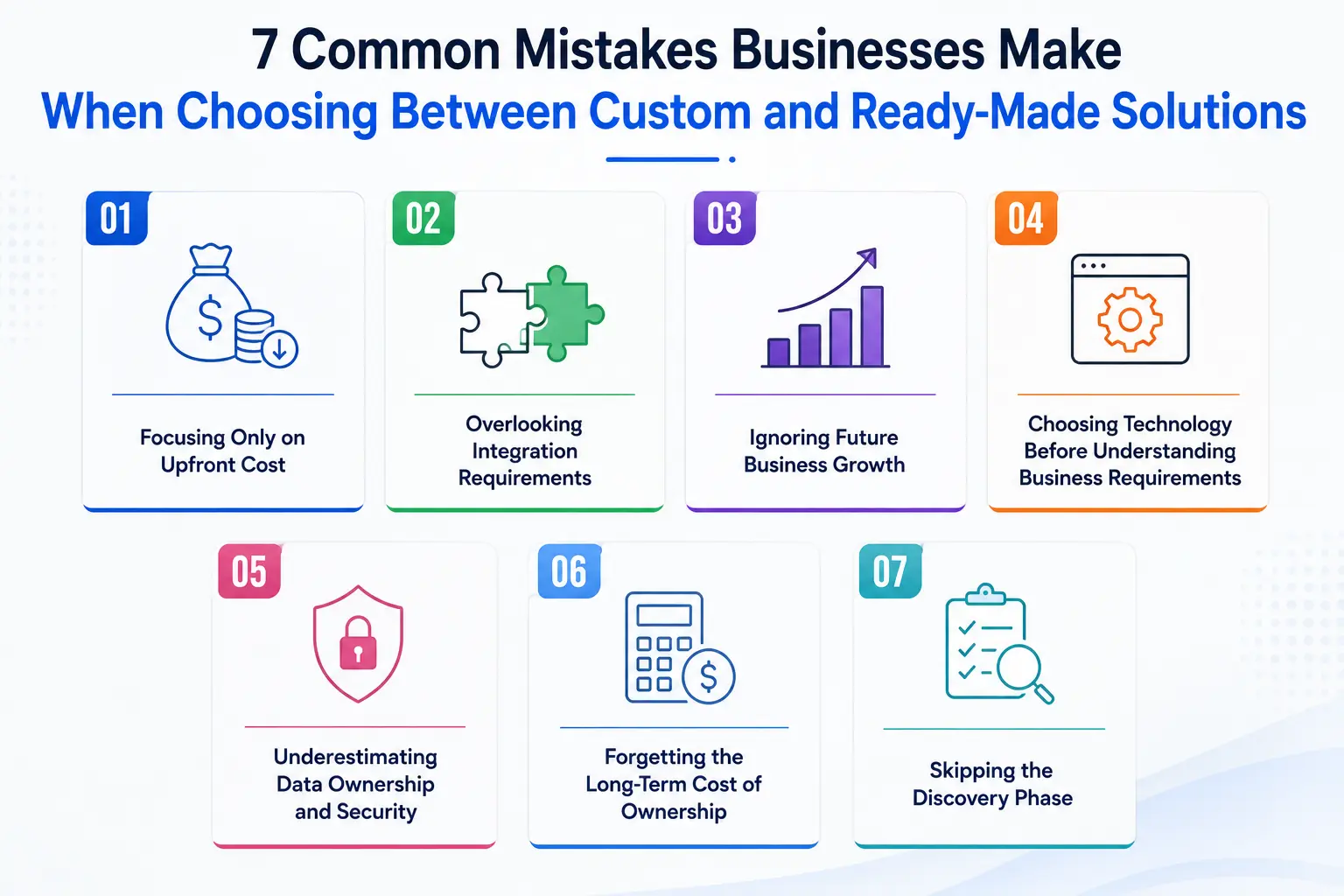
Choosing the wrong approach doesn't usually happen because of the technology itself. It happens when businesses make decisions without fully considering their long-term requirements. The following mistakes are among the most common and can often be avoided with proper planning.
A ready-made solution may seem less expensive initially, while a custom app requires a larger upfront investment. However, comparing only the initial cost ignores future subscription fees, additional users, integrations, and ongoing operational expenses.
Many businesses discover too late that their chosen solution doesn't connect easily with the systems they already use. Evaluating integration requirements early helps prevent costly workarounds later.
The solution that meets today's requirements may not support tomorrow's users, features, or expansion plans. Choosing technology without considering future growth often leads to expensive migrations.
Selecting a platform or development approach before clearly defining business goals and user needs increases the risk of unnecessary features, project delays, and costly changes.
Businesses handling sensitive customer or operational data should understand who controls that information, where it is stored, and whether the chosen solution supports future compliance requirements.
Subscription fees, premium features, integrations, maintenance, and operational inefficiencies all contribute to the overall cost of a solution. Looking beyond the initial price provides a more accurate comparison.
Whether you're choosing a ready-made platform or planning a custom mobile app, taking time to evaluate business processes, user expectations, and technical requirements helps reduce project risks and supports better long-term decisions.
Note: The right technology decision isn't about choosing the newest platform or the lowest price. It's about selecting a solution that aligns with your business goals today while continuing to support your growth in the years ahead. |
Does this functionality give your business a competitive advantage?
Will your business requirements change as you grow?
Do you need greater control over your data and security?
Does a ready-made solution meet most of your requirements?
Which option makes more sense over the long term?
We’ll look at your business needs, budget, and goals and help you choose the approach that makes the most sense.
Talk to an ExpertBy now, you probably have a clearer idea of which direction fits your business. The earlier you choose the right approach, the easier it becomes to avoid costly migrations, disconnected systems, and software that slows your business down as it grows.
Don't feel pressured to build custom software simply because it's more flexible. If a ready-made solution supports your business go for it.
A: No, If your business has standard workflows and an existing solution meets your needs, a ready-made platform is often the most practical choice. Custom mobile app development becomes more valuable when your business requires unique workflows, specialized integrations, greater control over data, or long-term scalability.
A: Custom app development ranges from $25,000 for a simple MVP to $400,000+ for a complex enterprise platform. Ready-made solutions typically range from $0 to $500/month at the entry level, scaling significantly with user growth and feature additions. At enterprise scale, the 3-year TCO of ready-made solutions often exceeds the cost of a well-built custom app.
A: Development timelines vary depending on the app's complexity, required features, integrations, and testing requirements.
App Complexity | Typical Timeline |
Simple MVP | 2–4 months |
Mid-Complexity with Integrations | 4–7 months |
Complex Enterprise Platform | 7–12+ months |
A: Yes. Many businesses begin with a ready-made solution to validate their idea or support early operations. As their requirements become more complex, they transition to a custom mobile app that offers greater flexibility, scalability, and control.
A: A ready-made solution is designed to serve many businesses with similar needs, while a custom mobile app is built specifically around your business processes and objectives. The right choice depends on how closely standard software matches your requirements.
A: Both. The main difference is control. Ready-made platforms follow the vendor's security model, while custom mobile apps allow businesses to define their own security policies, data storage approach, and compliance strategy.
A: The hybrid approach combines ready-made software with custom mobile app development. Businesses use ready-made solutions for standard operations while developing custom applications for workflows that require greater flexibility, unique functionality, or a competitive advantage.
Start with your business goals, workflows, growth plans, integration requirements, and long-term technology strategy. If your current software supports your needs without creating limitations, a ready-made solution may be sufficient. If it restricts your operations or future growth, custom mobile app development is often the better long-term investment.
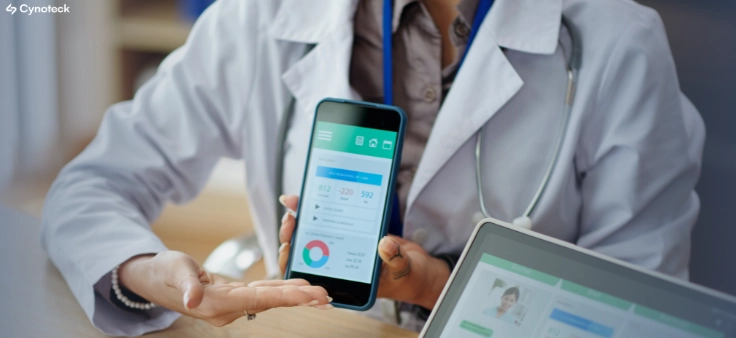
Mobile healthcare apps improve patient care by enabling remote monitoring, timely reminders, secure data access, better communication, and cost-efficient healthcare services through mHealth technology.
B2B apps help businesses streamline operations, enable on-the-go access to data, improve client engagement, support omnichannel sales, and drive scalable revenue by simplifying complex business workflows.
We are more than just developers and consultants—we are your partners in navigating the digital landscape. Let us be the engine behind your next big success while you focus on your core vision.
Explore Opportunities!