iOS vs Android vs Cross-Platform App Development Costs in 2026: What Businesses Should Choose
Choosing between iOS, Android, and cross-platform development represents one of your first strategic decisions with lasting financial implications. Each approach has distinct cost structures, performance characteristics, and long-term maintenance expenses that vary dramatically. Choosing the wrong approach can waste significant budget, while choosing the right one can accelerate your timeline and reduce overall expenses by 30-50%, depending on your specific requirements.
Key Insight: According to 2025 platform market analysis, choosing the right platform strategy can reduce your total development cost by 30-50% compared to the wrong approach. iOS dominates premium markets with 61% US market share, while Android leads globally at 71.68%. Understanding these dynamics upfront prevents costly missteps and ensures your investment aligns with your target audience.
This guide compares the total cost of ownership across all three approaches so you understand not only initial development costs but also ongoing infrastructure, maintenance, and support expenses. Understanding these trade-offs enables intelligent conversations with development teams about which approach aligns with your business priorities, user demographics, and budget constraints.
Platform choice affects your budget for years. Compare costs, market reach, and ROI of each approach to decide wisely.
Book a Free ConsultationiOS mobile app development targets Apple's ecosystem using Swift, the modern programming language optimized specifically for Apple devices. iOS apps must comply with Apple's strict guidelines and undergo review before being listed on the App Store. This controlled ecosystem ensures high-quality user experiences but also creates development overhead not present on less-regulated platforms.
Basic iOS App: $25,000-$50,000
Mid-Level iOS App: $50,000-$100,000
Complex iOS App: $100,000-$200,000+
Basic iOS App: $25,000-$50,000 A basic iOS app with core features, simple design, and fundamental functionality takes 3-4 months for an experienced iOS developer. You're developing specifically for iPhones and iPads with various screen sizes, creating an app store-optimized presence, and testing across multiple iOS versions.
Mid-Level iOS App: $50,000-$100,000 Mid-level apps with multiple integrated features, professional design, third-party integrations, and the ability to handle thousands of users take 5-8 months. Development complexity increases significantly when features must work together seamlessly and scale to handle traffic from your growing user base.
Complex iOS App: $100,000-$200,000+ Complex apps with sophisticated features, AI capabilities, real-time data processing, and infrastructure for millions of users require 8-16 months. These apps demand deep iOS expertise and experience with performance optimization, advanced frameworks, and enterprise-grade security patterns.
Apple's ecosystem delivers superior user experience consistency because all iPhones run current or near-current iOS versions. This means you don't support 5+ year-old devices, unlike Android developers. iPhones have similar hardware specifications, simplifying testing and optimization. iOS users have higher purchasing power and spend more money on apps, making iOS the preferred platform for monetization-focused apps. The App Store review process, while initially frustrating, helps ensure quality standards and prevents malware and poorly designed apps.
Apple Developer Program costs $99 annually to publish apps. App Store fees take 15-30% commission on app sales and in-app purchases, higher than Android's rates. Testing across multiple iPhone models and iOS versions increases QA costs. Performance optimization for memory-constrained devices requires specialized expertise.
Android app development targets Google's open-source platform and uses Kotlin, a modern language replacing Java. The Android ecosystem includes thousands of device models from dozens of manufacturers with varying screen sizes, hardware capabilities, and OS versions.
Basic Android App: $25,000-$50,000
Mid-Level Android App: $50,000-$100,000
Complex Android App: $100,000-$200,000+
Basic Android App: $25,000-$50,000 A basic Android app with core features takes 3-4 months for an experienced Android developer. You develop for the diverse Android ecosystem with varying device capabilities, screen sizes from small phones to large tablets, and multiple active Android versions.
Mid-Level Android App: $50,000-$100,000 Mid-level apps with integrated features and multiple third-party services take 5-8 months. The broader device and OS version diversity means more testing scenarios and optimization work than iOS development, given iOS's more controlled ecosystem.
Complex Android App: $100,000-$200,000+ Complex Android apps require 8-16 months because you must handle the full spectrum of device fragmentation. What works on high-end devices might fail on budget devices. Performance optimization across the spectrum of hardware becomes specialized, expertise-intensive work.
Android serves a larger global market share, particularly strong in emerging markets. Android's open nature supports more customization options, appealing to technical users. Google Play Store has a faster, less stringent review process than Apple, allowing updates to be made more quickly. The Android ecosystem supports diverse device manufacturers appealing to different user segments and price points. Device fragmentation, while complex, means your app reaches users on everything from budget phones to flagship devices.
Publishing app on Google Play Store required developer account that costs $25 one-time (far cheaper than Apple). Testing infrastructure for device fragmentation costs more than iOS because you must test across 1000+ device types. Supporting multiple Android versions simultaneously creates ongoing compatibility work. Performance optimization for low-end devices with limited memory and processing power requires specialized expertise.
Cross-platform frameworks let you write code once and deploy to iOS and Android simultaneously. This approach eliminates duplicate development work, reducing the timeline by 30-50% compared to building separate native apps.
React Native uses JavaScript, the world's most popular programming language. The large community makes it easier and more affordable to find experienced React Native developers than with specialized frameworks. Development speed is high because JavaScript knowledge transfers from web development. Most business applications show negligible performance differences compared to native apps.
React Native Costs: $40,000-$120,000 for basic to mid-level apps (30-50% cheaper than native apps)
React Native Advantages:
Largest developer community,
Fastest development speed,
Ability to hire experienced web developers who learn React Native quickly,
Good performance for most business applications,
And an extensive third-party library ecosystem.
React Native Disadvantages:
Slight performance overhead (5-10% slower than native),
Some device features require native code,
The user interface might feel slightly different from native apps,
And framework updates sometimes require significant refactoring.
In flutter app development, developers use Dart (client-optimized language) and delivers superior UI performance and smoothness compared to React Native. Animations and complex user interfaces perform nearly identically to native apps. Framework is opinionated about design patterns, creating consistency across Flutter apps. Developer experience is excellent with fast development cycles and comprehensive documentation.
Flutter Costs: $35,000-$110,000 for basic to mid-level apps (similar to React Native)
Flutter Advantages:
Superior performance for graphics-heavy applications,
Beautiful animations and interactions, excellent developer experience,
Strong framework opinions reducing design decisions,
Rapidly growing community, and job market.
Flutter Disadvantages:
Smaller community than React Native (fewer third-party libraries),
Fewer available developers increase hiring difficulty and costs,
Newer framework with less production history than React Native,
Less suitable for apps requiring unique native features.
Revenue Reality: According to 2025 app spending data, iOS users spend an average of $12.77 per app compared to $6.19 for Android users—more than double the spending per user. This means iOS generates 65% of global app revenue despite serving only 28% of global smartphone users, making it the platform of choice for revenue-focused apps.
Initial development represents only part of your app investment. Ongoing costs for infrastructure, maintenance, and support extend for years after launch.
Native iOS Only: $25,000-$50,000 (development) + $300-$800 (hosting) + $500-$3,000 (maintenance) = $26,000-$54,000.
Native Android Only: $25,000-$50,000 (development) + $300-$800 (hosting) + $500-$3,000 (maintenance) = $26,000-$54,000.
Native Both Platforms: $50,000-$100,000 (development) + $500-$1,500 (hosting) + $1,000-$5,000 (maintenance) = $52,000-$107,000.
Cross-Platform (React Native/Flutter): $40,000-$110,000 (development) + $300-$1,000 (hosting) + $1,000-$4,000 (maintenance) = $41,000-$115,000.
Native iOS Only: $150,000-$280,000 (includes development, hosting for 5 years, maintenance for 5 years).
Native Android Only: $150,000-$280,000.
Native Both Platforms: $300,000-$500,000 (developing and maintaining two separate codebases).
Cross-Platform: $200,000-$350,000 (single codebase, slightly higher ongoing maintenance).
Cross-platform approaches achieve lower 5-year costs despite similar initial development because you maintain one codebase rather than two. Building native for both platforms creates a long-term cost burden from maintaining separate teams and codebases.
Stop debating iOS vs Android. Our experts analyze your target market and business goals to recommend the right platform strategy.
Get Expert Recommendation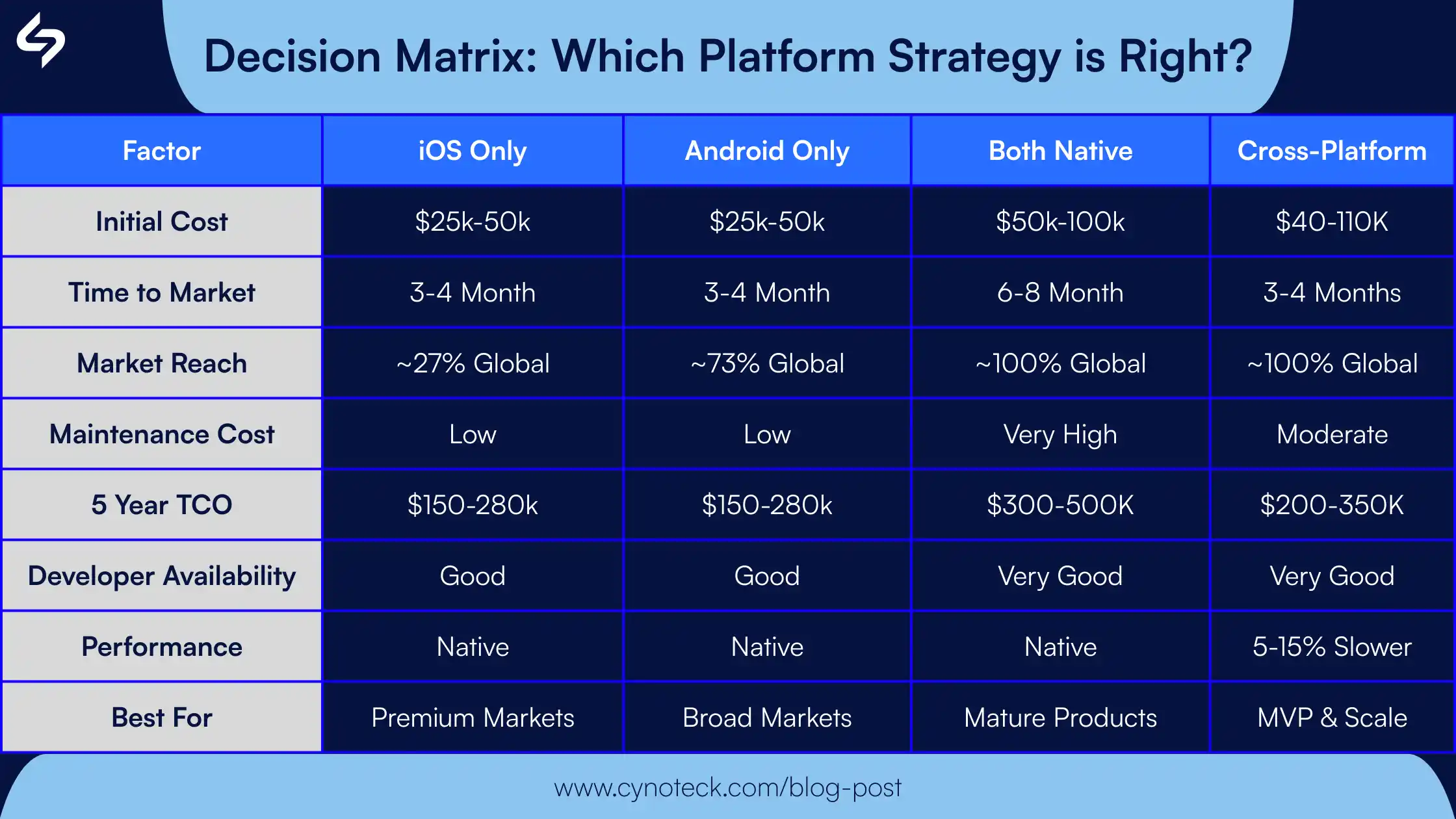
Choose iOS only if:
Targeting premium users in developed markets
Users willing to pay for apps and in-app purchases
Audience demographics skew toward Apple users
Choose Android only if:
Targeting broad international markets with a large user base
Focusing on emerging economies where Android dominates
Specifically building for Android users due to higher device adoption and market share
Choose native for both platforms only if:
You have the budget to support separate iOS and Android development teams
Long-term plans to maintain two separate codebases for both platforms
Need maximum performance and platform-specific features on iOS and Android
Choose cross-platform if:
Reach both iOS and Android users with a limited development budget
Launch faster with a shorter time to market
Build an MVP to validate product–market fit before investing in full native development
Platform strategy affects ongoing maintenance burden for years after launch.
Apple releases major iOS versions annually with sometimes-breaking API changes. Your app must update within 6-12 months to maintain App Store presence. Testing on new iOS versions costs $5,000-$15,000 per release. New iPhone models are released annually, requiring screen size optimization. These ongoing maintenance expenses average $10,000-$20,000 annually for typical iOS apps.
Android fragmentation creates perpetual testing and optimization work. Supporting older Android versions while optimizing for newer versions costs $8,000- $18,000 annually. Thousands of device models create potential compatibility issues that require investigation. Device manufacturers add custom features, creating additional testing scenarios. These ongoing expenses average $12,000- $22,000 annually due to the complexity of fragmentation.
Cross-platform framework updates sometimes require significant code changes. Framework updates may introduce breaking changes that require refactoring. Updates to React Native or Flutter happen frequently, requiring monitoring and planning. Maintenance for cross-platform apps averages $10,000-$20,000 annually, typically lower than maintaining separate native codebases because you fix issues once rather than twice.
iOS Only Makes Sense If: You're targeting wealthy demographics in developed markets. Your primary users have iPhones. You want premium positioning. You have a budget for iOS-specific optimization and are willing to forego the Android market entirely.
Android Only Makes Sense If: You're targeting broad global audiences, including emerging markets. Your primary users have Android devices. You want to maximize market reach. You're targeting technical audiences who prefer Android.
Native for Both Makes Sense If: You have a substantial budget for two separate teams. You're building high-performance apps requiring maximum device integration. Your app is strategically critical enough to justify 2x development and maintenance costs. You need independent iOS and Android strategies.
Cross-Platform Makes Sense If: You have a limited budget and want the fastest time to market. You're building an MVP to test product-market fit. You need to reach both iOS and Android users simultaneously with one team. You prioritize development speed over absolute performance optimization.
For comprehensive app development cost information beyond platform selection, review our complete business pricing guide and detailed analysis of features and complexity factors affecting your platform costs.
Make your platform decision with confidence. We'll guide you through development, launch, and long-term support.
Talk to Our App Development ExpertsA: For most business applications, no. Cross-platform apps are 5-15% slower, but the difference is imperceptible for productivity, e-commerce, and business apps. Gaming and graphics-heavy apps should consider native. Performance-sensitive apps can still use a cross-platform approach for the MVP, then move to native after validating the market.
A: Yes, many companies do this successfully. You can build an MVP in React Native, then rewrite performance-critical sections in native Swift/Kotlin after understanding your users and business priorities. This reduces initial risk while preserving the option to optimize later if needed.
A: React Native has the largest developer pool because JavaScript developers can transition easily. Android and iOS have strong availability but require platform-specific expertise and command higher rates. Cross-platform helps because you can hire web developers who learn frameworks quickly, rather than requiring specialized mobile expertise.
A: Apple's App Store review takes 1-3 days on average. Google Play reviews much faster (sometimes within hours) or might require no review. This matters if you need to release updates frequently. Apple's stricter review prevents malware but slows deployment cycles.
Note: The development cost is an estimated industry range based on common project scenarios. The actual cost of mobile app development can vary depending on features, integrations, complexity, security requirements, and project scope. For an accurate estimate, a detailed discussion with the development team is recommended.

Mobile healthcare apps improve patient care by enabling remote monitoring, timely reminders, secure data access, better communication, and cost-efficient healthcare services through mHealth technology.
B2B apps help businesses streamline operations, enable on-the-go access to data, improve client engagement, support omnichannel sales, and drive scalable revenue by simplifying complex business workflows.
We are more than just developers and consultants—we are your partners in navigating the digital landscape. Let us be the engine behind your next big success while you focus on your core vision.
Explore Opportunities!