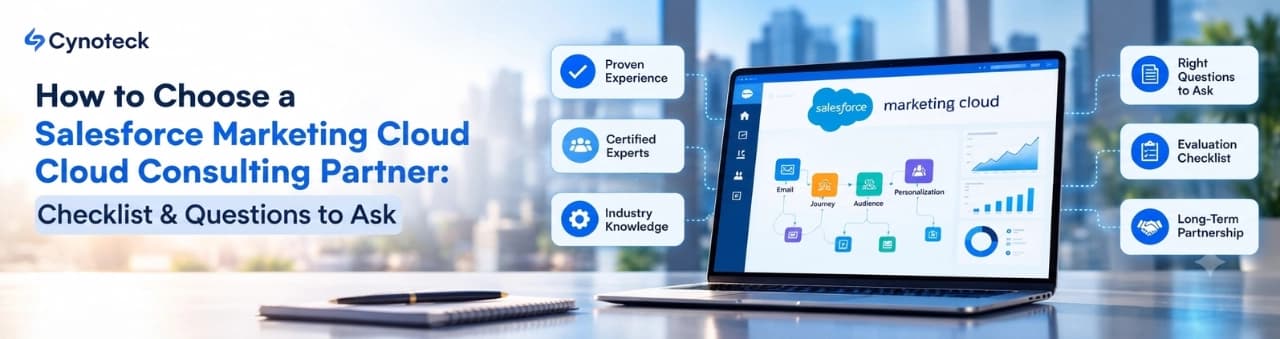
How to Choose a Salesforce Marketing Cloud Consulting Partner: Checklist & Questions to Ask
Choosing the right Salesforce Marketing Cloud consulting partner shapes your entire implementation. In fact, most businesses don't do this alone. 91% of Salesforce customers use partner experts or apps, not the platform by itself. The right partner brings certified expertise, real Marketing Cloud project history, and a clear process. The wrong one brings vague scope and expensive rework later.
It's not a small-level hire at all. The right Salesforce Marketing Cloud consulting partner keeps your data clean, your journeys focused, and your deliverability strong. The wrong one leaves you rebuilding work within the year.
This guide covers what to look for, the exact questions to ask, the red flags to watch for, and what a partner costs in 2026.
A Salesforce Marketing Cloud consulting partner plans, builds, and configures the platform around your business. Otherwise, you're left figuring it out alone. Their work covers data architecture, Business Units, and journeys, plus everything in between.
Most partners offer a mix of services. Some focus purely on implementation, the initial build. Others offer ongoing managed services instead, real support after launch. Still, many offer both, plus training for your internal team.
This differs a lot from hiring a generalist Salesforce partner. Marketing Cloud runs on its own data model, its own automation tools, and its own deliverability rules. So, a partner strong in Sales Cloud or Service Cloud doesn't automatically know Marketing Cloud well. In fact, that mismatch is one of the most common hiring mistakes businesses make.
The right partner determines whether your implementation works or quietly underperforms for years. Marketing Cloud is powerful. Still, it's only powerful when it's built around your real data and real use cases.
Consider the scale here. Over 14,000 verified companies now run Salesforce Marketing Cloud worldwide, based on Landbase's 2026 technology tracking data. Most of them didn't build their implementation alone. And 91% of all Salesforce customers use partner apps or experts, according to AppFrontier's research, not the platform in isolation.
So, the partner question isn't really "should we hire one?" Most businesses already do. Instead, the real question is which one. That choice compounds over time too. A strong partner sets up data architecture that scales for years. A weak one, though, leaves you patching the same problems every single quarter.
Look for four things above everything else. Real Marketing Cloud project history matters most. So do current certifications, industry experience, and a transparent process. Generic Salesforce experience alone just isn't enough.
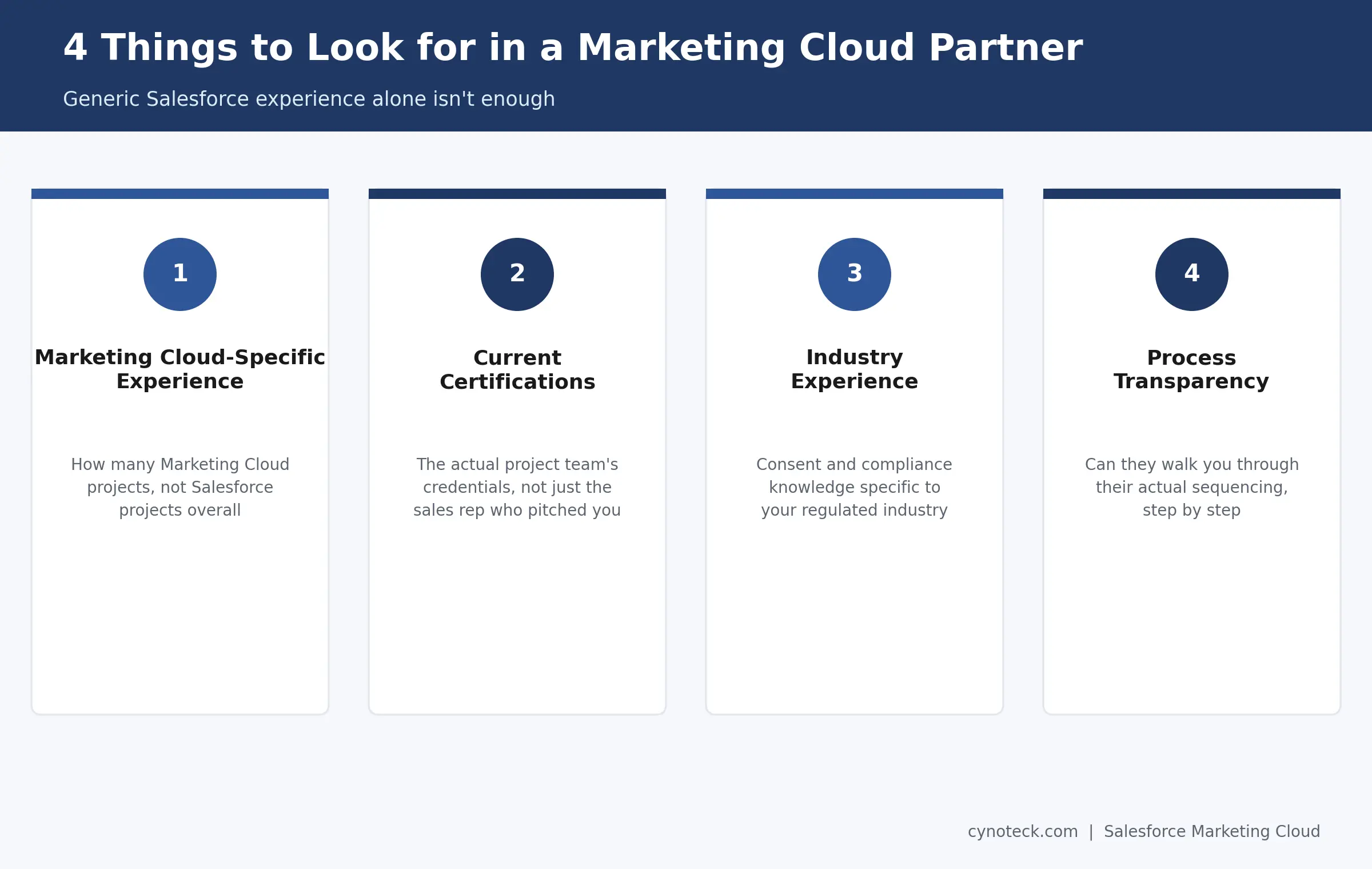
Marketing Cloud-specific experience matters most. Ask directly how many Marketing Cloud projects they've delivered. Not Salesforce projects overall, but specifically Marketing Cloud ones. A partner with twenty Sales Cloud rollouts and two Marketing Cloud builds isn't a Marketing Cloud specialist yet.
Current certifications matter too, since Marketing Cloud certifications change as the platform does. So, always confirm the actual people on your project hold current credentials. Not just the sales rep who pitched you.
Industry experience counts as well. A partner who's built journeys for a regulated industry, like healthcare or financial services, understands consent and compliance in a way a generalist won't. If your industry has specific rules, ask directly about that experience.
Process transparency rounds this out. A strong partner can walk you through their actual process, step by step. If they can't explain how they sequence data architecture, Business Units, and journeys, that's genuinely worth noting.
Choose a partner with real Marketing Cloud projects, current certifications, industry experience, and a process you can clearly evaluate.
Book a Free ConsultationAsk questions in five categories: experience, process, team, cost, and support. Here's specifically what to ask in each one.
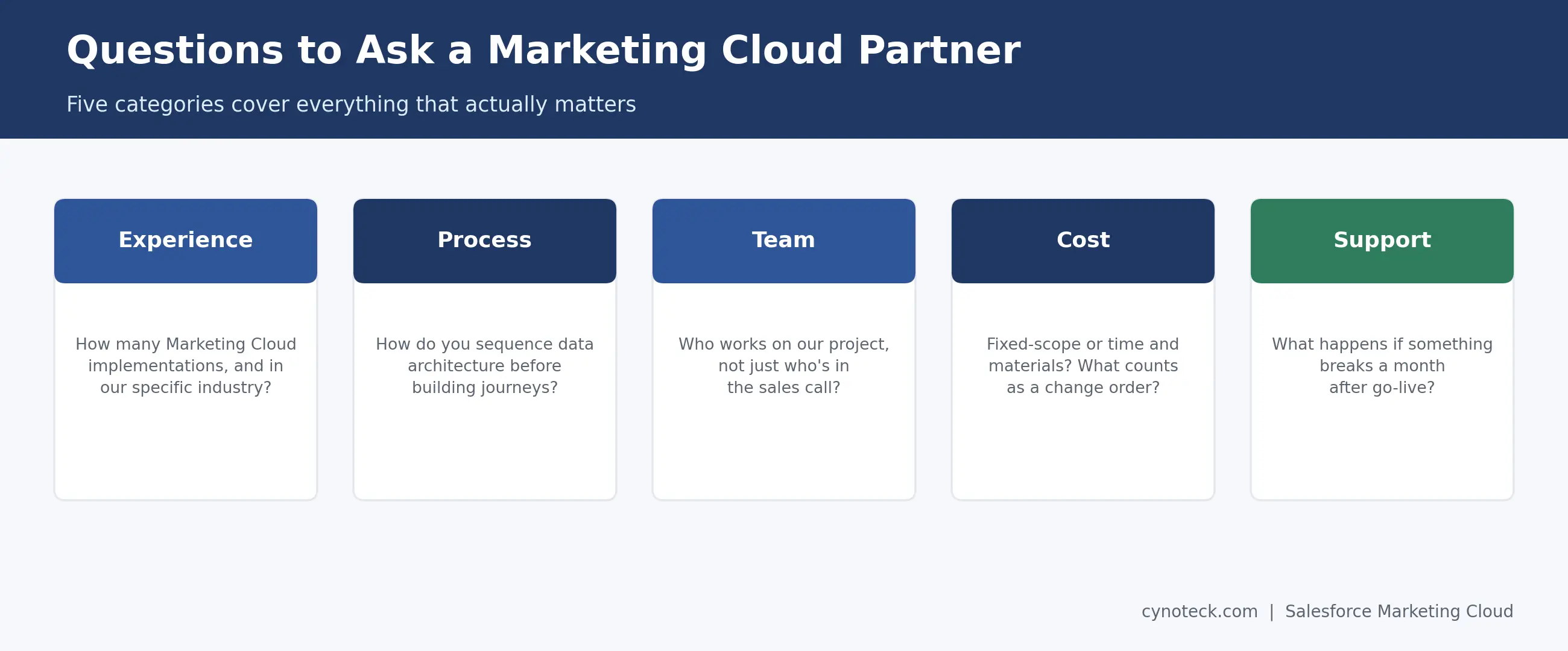
How many Salesforce Marketing Cloud implementations has your team completed?
Can you share two or three references from projects similar to ours?
What's your experience in our specific industry?
Walk us through how you sequence a typical implementation.
How do you handle data architecture before building journeys?
What does your QA and testing process cover?
Who specifically will work on our project? Not just who's in the sales call.
What Marketing Cloud certifications does that team currently hold?
Will the same team stay on through go-live, or does it change?
Is this a fixed-scope engagement or time and materials?
What's included in the quoted price, and what counts as a change order?
What ongoing support costs should we expect after launch?
What happens if something breaks a month after go-live?
Do you offer managed services, or just implementation?
How do you document the build for our internal team afterward?
Three signals matter most here: vague scope, generic industry claims, and no real Marketing Cloud references. Any single one is worth pausing over.
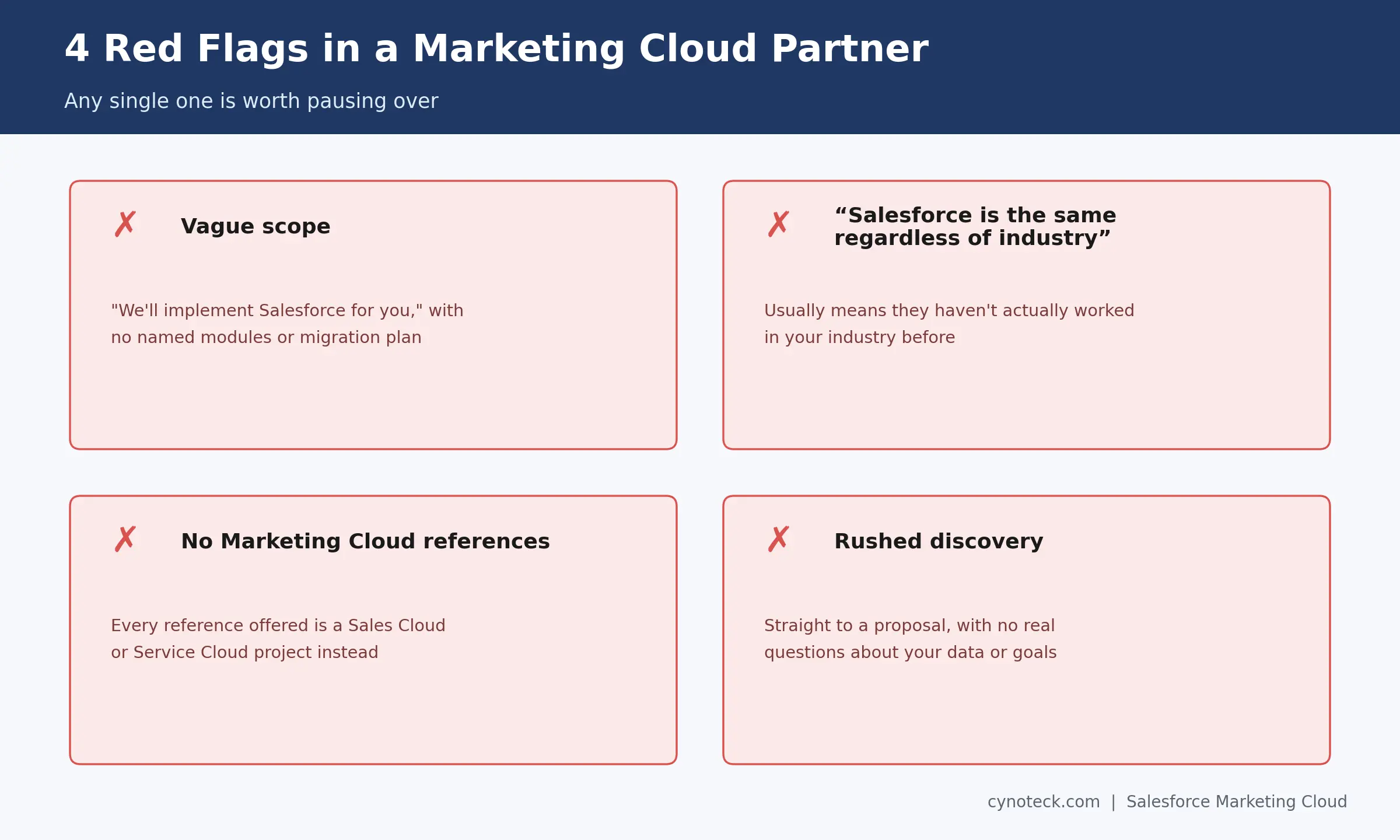
Vague scope: If a partner says "we'll implement Salesforce for you," without naming specific modules, journeys, or a data migration plan, that's a real warning sign. Scope should be specific from the first proposal, not after you've signed.
"Salesforce is the same regardless of industry": This claim usually means the partner hasn't worked in your industry before. Consent rules, compliance needs, and typical use cases differ by sector. So, a real specialist already knows that.
No Marketing Cloud references is another sign: If every reference they offer is a Sales Cloud or Service Cloud project, that fact alone tells you something. So, ask directly for Marketing Cloud clients. Be cautious if they can't produce any.
Rushed discovery is the last one: A partner who skips straight to a proposal is building blind. That's true whenever they skip asking about your data, your team, or your actual goals. Discovery should feel like a real conversation instead, not a formality before the pitch.
Salesforce Marketing Cloud consultants typically charge $100 to $350 or more per hour. The exact rate depends on experience, location, and project complexity. That's separate, too, from Salesforce's own platform licensing.
A few things move that number. Senior architects and specialists sit at the higher end. Offshore or hybrid teams often come in lower instead, though not always with the same depth. Fixed-scope projects bundle these hours into one quote too, which can make budgeting easier. Still, it's worth understanding the rate underneath it.
Cost alone shouldn't decide your choice, though. A cheaper partner who misses the data architecture step usually costs more in the end. So, you end up paying twice to fix the same problem.
Tier matters, but less than most businesses assume. Salesforce currently recognizes two main partner tiers: Select and Summit. Still, a higher tier signals scale, not automatically a better fit for your specific project.
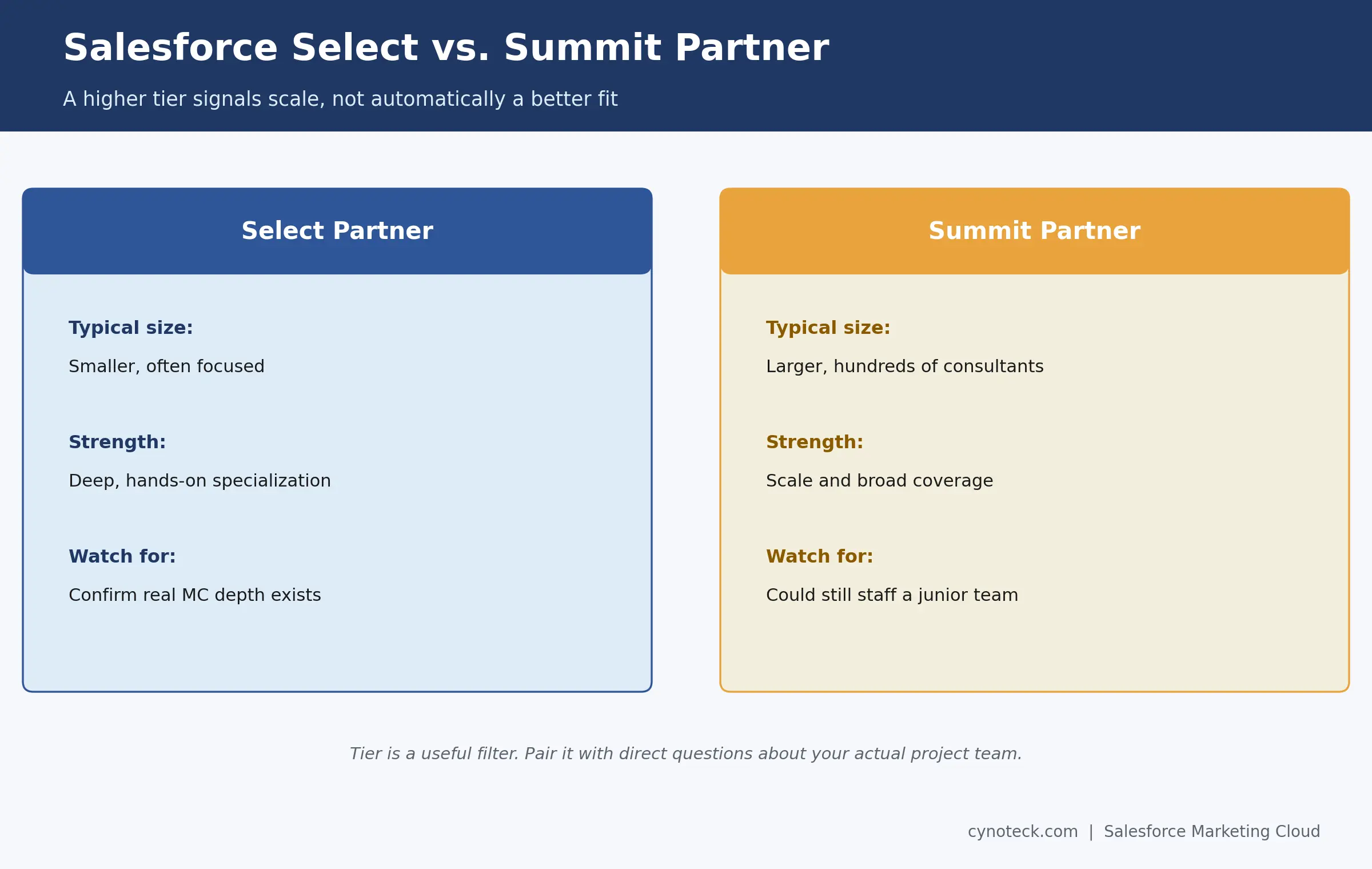
Even a Summit Partner with hundreds of consultants can still staff your project with a junior team. Meanwhile, a smaller Select Partner focused on Marketing Cloud might bring deeper, hands-on expertise to your exact use case. So, tier works as a useful filter. It's not a final answer. Pair it with the direct questions above before you decide. For a closer look at how leading partners compare, see our breakdown of top Salesforce development companies.
Salesforce's AppExchange lists every certified partner. It also shows reviews, certifications, and industry filters. That makes it a genuinely useful first screening step. Start there, before you take a single sales call.
First, filter by Salesforce Cloud, and confirm the partner shows real Marketing Cloud listings, not just a general Salesforce presence. Then, check review scores and read a few, not just the star rating. A partner not listed on the AppExchange at all is worth asking about. Salesforce screens every partner first, before granting that listing.
Talk through your Marketing Cloud goals, existing setup, data needs, and implementation plans with a team that works specifically with Marketing Cloud.
Discuss Your Marketing Cloud ProjectThe right Salesforce Marketing Cloud consulting partner shows up in the details. Think specific Marketing Cloud experience, a transparent process, and a team that answers direct questions without hedging. Meanwhile, the wrong one shows up in vague scope and generic claims, long before the contract's even signed.
So, if you're evaluating a Salesforce Marketing Cloud consulting partner for an upcoming project, talk to Cynoteck's Salesforce Marketing Cloud Consulting Services team. We'll give you a straight answer on fit, not just a proposal.
Most businesses spend two to four weeks on partner selection. This includes initial research, proposal review, and reference checks. Rushing this step is one of the more common reasons businesses end up with the wrong fit.
A Marketing Cloud specialist is usually the stronger choice. Marketing Cloud uses different data models and tools than Sales or Service Cloud, so general Salesforce experience alone may not be enough.
Remote works well for most Marketing Cloud projects because the work happens inside the platform. A local partner mainly matters when in-person collaboration is a real priority for your team.
Most experienced partners handle both. However, ask about their experience auditing and fixing existing Marketing Cloud setups because that requires different skills from building a new implementation.
Prioritizing price over real Marketing Cloud experience is a common mistake. A lower hourly rate from a generalist can cost more later when data architecture or deliverability issues appear after launch.
Ask to speak with references directly rather than relying only on case studies. A credible partner should be able to connect you with a past client for a short conversation.
 Outsource Salesforce Development or Build In-House Which is the Best for Your Business.webp)
Outsourcing Salesforce development vs. building an in-house Salesforce team: 2026 cost insights, salary comparisons, key benefits, challenges, and the best hiring model for your business growth.
We are more than just developers and consultants—we are your partners in navigating the digital landscape. Let us be the engine behind your next big success while you focus on your core vision.
Explore Opportunities!