How Cloud App Development Helps Mobile Apps Scale Better
Most mobile apps start small on purpose. A founder builds a version one, tests it with a few hundred users, and everything runs fine. Then the app works. Downloads go up, more people log in every day, and the business starts depending on the app to run daily operations.
That's usually the point where problems show up.
An app that felt fast and stable at 500 users can start lagging, crashing, or losing data at 50,000. The code hasn't changed. The infrastructure underneath it has simply run out of room to grow. This is the moment many businesses discover the difference between an app that was built to launch and an app that was built to last.
Cloud App Development addresses exactly this gap. Instead of running an app on fixed servers with fixed limits, cloud architecture lets the backend expand and contract based on real demand. This article walks through why traditional setups start struggling, what cloud-powered mobile apps actually look like in business terms, and how to tell whether your app genuinely needs this shift or whether it's premature.
A traditional mobile app is usually connected to a fixed server or a small set of servers with a set amount of processing power, storage, and bandwidth. That setup works well when usage is predictable. It starts to strain the moment usage isn't.
Several patterns tend to appear at the same time:
More users.
Each additional login, transaction, or session adds load to the same fixed resources. Past a certain point, response times slow down for everyone, not just the newest users.
More data.
Photos, transaction history, chat logs, and usage records accumulate daily. Storage that was generous at launch becomes tight within a year or two.
More devices.
Customers now expect the same app to work correctly on a five-year-old Android phone and a brand-new iPhone, often switching between a phone, a tablet, and a browser for the same account.
More integrations.
Payment gateways, delivery partners, CRM systems, and marketing tools all need to talk to the app, and each connection adds another point where fixed infrastructure can bottleneck.
At the same time, what users expect from an app has quietly gone up. Instant loading is assumed, not appreciated. Real-time updates (order status, live tracking, live scores) are treated as standard, not premium. Zero downtime is expected even during a product launch or a Black Friday-style traffic spike. Seamless synchronization across devices is assumed to just work.
A fixed server setup can be scaled, but usually by manually buying and configuring more hardware, which takes time, costs money upfront, and often means the business is either over-provisioned (paying for capacity it doesn't use) or under-provisioned (running out of capacity exactly when it matters most).
A cloud-powered mobile app separates the app itself from the infrastructure that runs it. Instead of the backend living on a fixed server owned or rented by the business, it runs on cloud infrastructure, capacity that can be added or reduced automatically based on how many people are using the app at that moment.
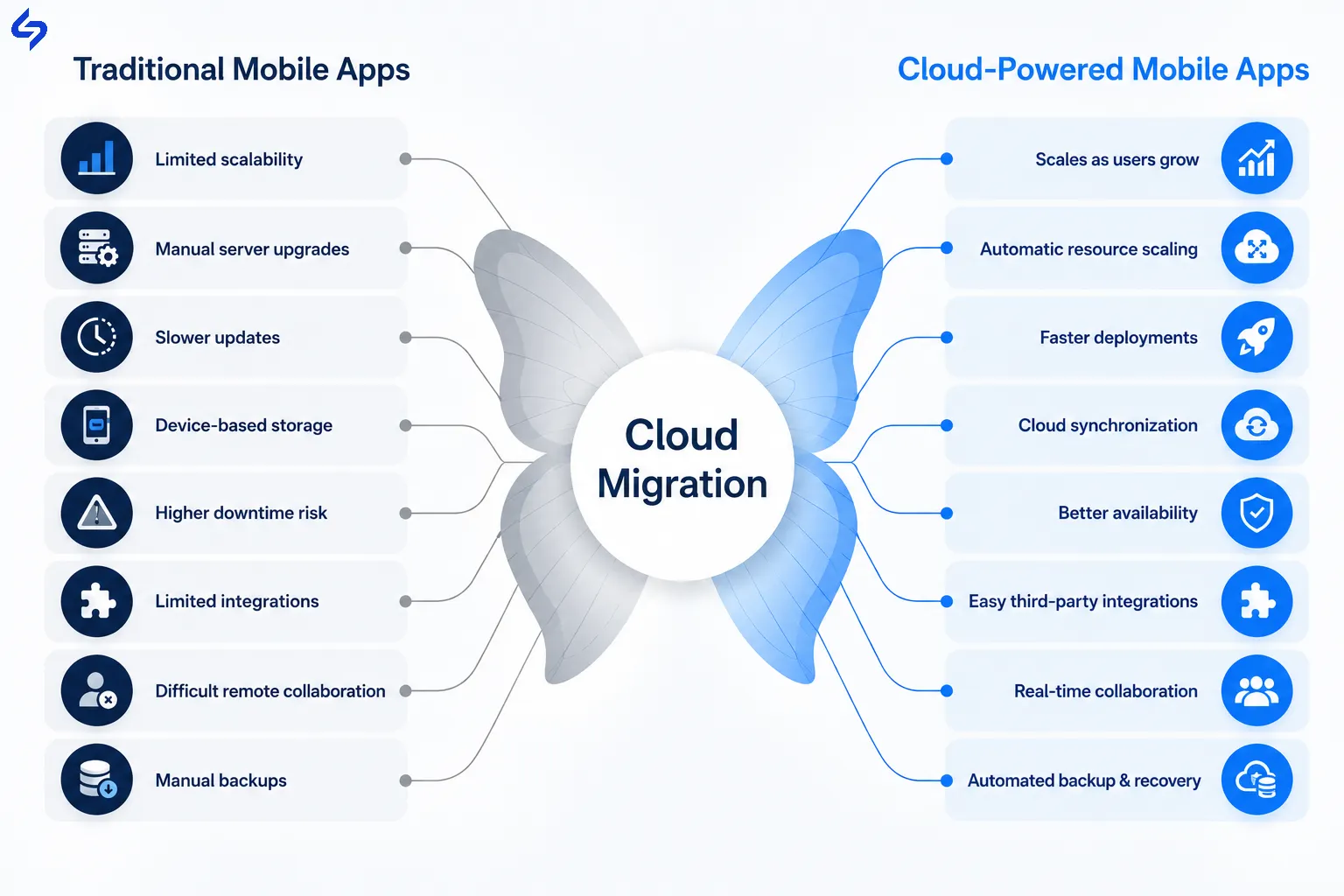
In a traditional setup, a business rents or owns a server with a defined capacity. If 10,000 people use the app at once, the server either handles it or it doesn't. Adding capacity means manually upgrading hardware or migrating to bigger servers, which usually takes days or weeks of planning.
In a cloud-powered setup, the app connects to cloud infrastructure that adjusts capacity automatically. If usage spikes to 50,000 users during a sale, the system allocates more resources to handle that spike. When usage drops back down overnight, the resources scale back too, and the business isn't paying for peak capacity around the clock.
The practical difference for a business owner isn't technical elegance. It's that growth in users doesn't require an emergency infrastructure project.
At a business level, a cloud-powered mobile app has a few connected parts working together:
The mobile app is what the customer sees and interacts with on their phone.
Cloud infrastructure runs the backend logic, processes requests, and handles the heavy lifting behind the scenes.
The database stores customer data, transactions, and app content in a way that can be accessed reliably from anywhere.
APIs act as the connectors that let the app talk to the database, to third-party services, and to other business systems.
Real-time synchronization keeps data consistent across every device a customer uses, so an update made on a phone shows up correctly on a tablet or web dashboard a moment later.
None of these pieces are unique to cloud computing on their own. What changes is that cloud infrastructure lets each piece scale independently, so a spike in one area (say, database reads during a promotion) doesn't require rebuilding the entire system.
The reasons businesses move toward Cloud App Development are rarely about the technology itself. They're about what the technology allows the business to do.
Cloud infrastructure can add capacity automatically when traffic increases and reduce it when traffic drops. A business doesn't need to predict exact growth months in advance or over-buy hardware "just in case." Mobile App Scalability becomes a background capability instead of a recurring emergency project.
Cloud providers operate data centers in multiple regions. Content and processing can happen closer to where the user actually is, which reduces load times. This matters more as a user base spreads across cities, states, or countries.
Because data lives in the cloud rather than on a single physical server in one office, employees and customers can access accurate, current data from any location, on any approved device, without needing a direct connection to a specific piece of hardware.
Cloud-based backends typically support independent deployment of different parts of the system. A team can update the payment module without redeploying the entire app, which shortens the time between building a feature and getting it in front of users.
If a single physical server fails in a traditional setup, the app can go down until someone fixes or replaces it. Cloud infrastructure is built with redundancy, meaning the same data and processing capability often exists in more than one location, so a single point of failure doesn't necessarily take the whole app offline.
Reputable cloud providers invest heavily in security infrastructure, including encryption, access controls, and automated backups, at a level most individual businesses would find expensive to replicate on their own hardware. This doesn't remove the business's own security responsibilities, but it raises the baseline.
Instead of a business hiring staff to maintain physical servers, apply patches, and manage hardware failures, cloud providers handle much of that maintenance as part of the service. The business's technical team can spend more time on the app itself and less time on keeping servers alive.
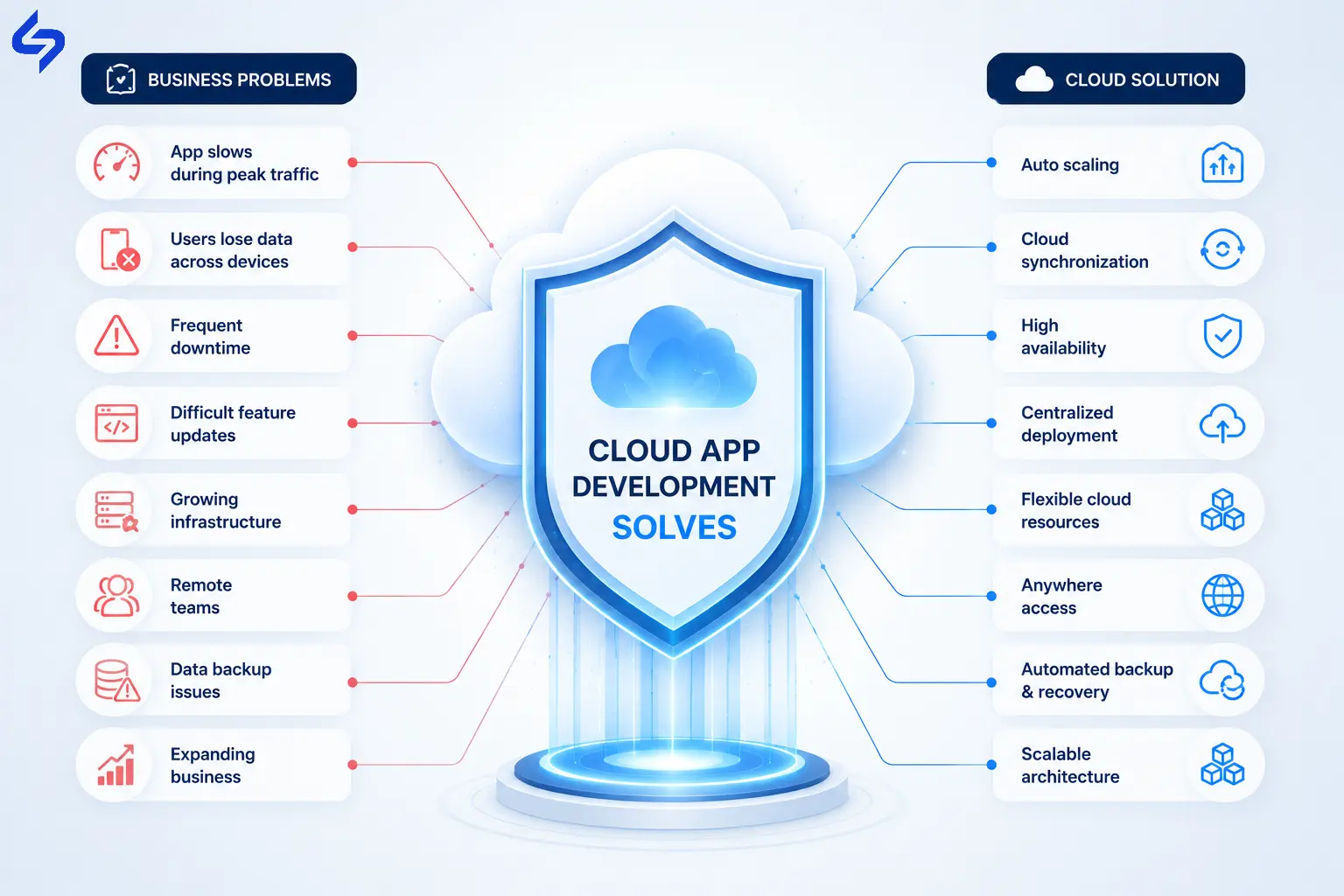
Cloud architecture isn't valuable in the abstract. It's valuable because it addresses specific, recognizable problems that show up as a business grows:
Slow app performance caused by a fixed server struggling under more simultaneous requests than it was configured to handle.
Frequent downtime because there's no backup system to take over when the primary server has an issue.
Difficult scaling where every growth milestone requires a manual infrastructure project instead of a configuration change.
Data synchronization issues where a customer sees different information on their phone than on their tablet or the web dashboard.
Remote workforce challenges, since teams working from different locations need reliable, consistent access to the same live data.
Growing infrastructure costs from paying for peak-capacity hardware that sits idle most of the time.
Limited system integrations, where connecting new tools (a CRM, a payment provider, an analytics platform) becomes harder as the backend ages and wasn't designed for outside connections.
Poor collaboration between departments or partner companies that need shared, real-time visibility into the same data.
Modernize your app with cloud architecture that supports scalability, performance, and reliability.
Talk to Our ExpertsThe value of Cloud Architecture looks different depending on the industry, because the operational pressure points are different.
Healthcare apps often need to sync patient records, appointment schedules, and lab results across clinics in real time, while meeting strict data protection requirements. Cloud infrastructure supports this by keeping records centrally accessible and consistently backed up, rather than isolated on individual clinic servers.
Retail apps deal with unpredictable spikes, a flash sale or a viral product can multiply traffic within minutes. Cloud-based mobile apps can absorb that spike automatically instead of the app slowing down or crashing at the exact moment sales are highest.
Logistics companies rely on live location tracking, route updates, and delivery status changes that need to reach drivers, dispatchers, and customers at the same time. Real-time synchronization through the cloud keeps all three in agreement.
Banking and finance apps require high availability and strict security, since even short downtime affects customer trust and transactions. Cloud infrastructure's redundancy and backup capabilities directly support the uptime these apps are expected to maintain.
Manufacturing businesses increasingly connect mobile apps to factory floor sensors and equipment. Cloud Computing for Mobile Apps supports the constant, high-volume data flow this generates without requiring the company to build and maintain its own data center.
Education platforms need to support thousands of students accessing the same content simultaneously, particularly during exam periods or live sessions, which is a predictable but sharp demand spike that cloud infrastructure is well suited to absorb.
Field Service
Field service apps depend on technicians working in areas with unreliable connectivity, syncing job updates, photos, and forms the moment a signal is available. Cloud-based backends support this offline-to-online synchronization more reliably than fixed, single-location servers.
Certain app features depend heavily on the backend they run on. These tend to perform noticeably better on Cloud Architecture:
Real-time synchronization across devices, so data stays consistent whether a user is on their phone, tablet, or a web dashboard.
Push notifications sent reliably to large numbers of users at once, without delays caused by server overload.
Multi-device access, letting the same account work correctly across phones, tablets, and desktops.
Cloud storage for photos, documents, and files, without the app relying on limited device storage.
AI-powered features, such as recommendations or fraud detection, which typically require processing power beyond what a phone or a single fixed server can provide. If your roadmap includes conversational AI, intelligent assistants, or content generation, it's worth understanding when to integrate an LLM into your mobile app before selecting the underlying architecture.
IoT connectivity, where the app needs to receive and process constant data streams from connected devices or sensors.
File sharing between users or teams, particularly at larger file sizes or higher frequency.
Live dashboards showing current data (sales, inventory, tracking) that updates continuously rather than on a fixed refresh schedule.
Offline sync, where the app captures data without a connection and reconciles it with the central system once one is available.
Implement cloud-ready features that keep your app fast, connected, and future-ready.
Discuss Your App RequirementsFactor | Traditional Mobile Apps | Cloud-Powered Mobile Apps |
|---|---|---|
Scalability | Limited by fixed server capacity; growth requires manual upgrades | Capacity adjusts automatically based on demand |
Performance | Can slow down under unexpected traffic spikes | Distributed infrastructure helps maintain speed under variable load |
Updates | Often require redeploying the whole app or system | Individual components can typically be updated independently |
Storage | Limited by the physical server or device | Expands as data grows, without a hard physical ceiling |
Collaboration | Harder across multiple locations or remote teams | Built for simultaneous, real-time access from anywhere |
Security | Depends entirely on the business's own setup and diligence | Benefits from the provider's security infrastructure, in addition to the business's own practices |
Maintenance | Requires in-house or contracted server management | Much of the underlying maintenance is handled by the cloud provider |
Disaster Recovery | Single point of failure unless separately built | Redundancy is typically built into the infrastructure |
Integration | Often harder to connect with modern third-party tools | Generally designed with APIs that support easier integration |
Long-term Growth | Growth creates recurring infrastructure projects | Growth is largely absorbed by adjusting cloud resources |
It's worth being direct about the trade-off here: cloud architecture isn't automatically better in every category for every business. Traditional setups can still be cheaper and simpler for apps that genuinely have low, stable demand and don't need to scale. The comparison above describes tendencies, not guarantees, since a poorly configured cloud setup can still underperform a well-managed traditional one.
Not every app needs this. Cloud infrastructure solves growth and reliability problems, but if those problems don't exist yet, the investment doesn't pay for itself in the same way.
Your business expects growth in users, data, or transaction volume over the next one to three years.
Multiple users or teams need access to shared, live data at the same time.
The app depends on real-time updates, such as tracking, live status changes, or instant notifications.
AI or IoT features in mobile apps are planned, since both typically require processing capacity beyond a single fixed server.
The business operates from multiple locations or has a remote or distributed workforce.
The app is an internal utility used by a small, fixed number of employees.
The user base is very small and isn't expected to grow significantly.
The app mostly displays static information that rarely changes.
Data processing needs are minimal.
There's no planned expansion into new markets, features, or user segments.
Cloud App Development solves real problems, but it introduces its own set of considerations that shouldn't be ignored during planning.
Cloud-powered apps rely on a stable internet connection for most core functions. Offline capability can be built in, but it has to be planned deliberately rather than assumed.
Cloud infrastructure is usually billed based on usage, which can be more cost-efficient than fixed hardware, but it also means costs can rise unpredictably if usage spikes or if the system isn't configured with cost controls.
Moving data to the cloud shifts some responsibilities to the provider, but it doesn't remove the business's own responsibility for access controls, encryption practices, and monitoring.
Industries like healthcare and finance have specific rules about where data can be stored and how it must be protected. Businesses need to confirm that their chosen cloud provider and configuration meet the relevant requirements for their industry and region.
Relying on a specific cloud provider creates a dependency. Switching providers later, if ever needed, can require real technical effort, so the initial choice of provider and architecture deserves careful thought.
Moving an existing traditional app to the cloud isn't just a hosting change. Data structures, integrations, and workflows may need to be adjusted, and migration should be planned as its own project rather than treated as a quick switch.
Before committing to a cloud-based rebuild or migration, it helps to have honest answers to a short set of questions:
How many users do we expect over the next few years, realistically rather than optimistically?
Will our app need real-time data synchronization across devices, teams, or locations?
Are we planning AI or IoT features that would require heavier backend processing?
How important is business continuity if a server or region goes down?
Do employees or customers work or operate remotely, across multiple locations?
Can our current infrastructure actually scale with expected future growth, or is it already close to its limits?
Will cloud architecture meaningfully reduce our long-term operational effort, or would it just add cost without solving a real problem we have?
A few directions are shaping where Cloud Architecture is heading for mobile apps:
AI-driven cloud services are making it easier to add features like recommendations, fraud detection, and personalization without building that processing capability from scratch.
Edge computing is bringing some processing physically closer to the user's device, reducing delay for time-sensitive features like live tracking or gaming.
Serverless architecture lets teams run backend logic without managing the underlying servers at all, which can reduce operational overhead further.
Multi-cloud strategies are becoming more common, where businesses use more than one cloud provider to reduce dependency on a single vendor.
Real-time business applications are becoming standard rather than a premium feature, particularly in logistics, finance, and healthcare.
Cloud, AI, and IoT working together is increasingly the norm rather than the exception, especially in manufacturing, retail, and field service industries.
The decision to move toward Cloud App Development isn't about following what other companies are doing. It's about matching your app's architecture to where the business is actually headed.
An app built for 500 users doesn't automatically fail at 50,000, but it usually needs a different foundation to handle that scale reliably. Cloud Architecture gives that foundation room to expand without forcing a rebuild every time the business grows.
The right choice still depends on your specific situation: expected growth, the number of people who need shared access to data, how much real-time functionality your app requires, and how costly downtime would actually be for your business. Answering those questions honestly matters more than choosing the architecture that sounds more advanced.
Get expert advice to choose the right cloud architecture for your business and growth plans.
Talk to Our Cloud App ExpertsIt's a mobile app whose backend runs on cloud infrastructure instead of a single fixed server, allowing processing power, storage, and capacity to adjust automatically based on real demand.
Traditional app development typically connects the app to fixed server capacity that has to be manually upgraded as demand grows. Cloud app development connects the app to infrastructure that scales automatically and is distributed across multiple locations for reliability.
Yes, though migration is a project in its own right. It usually involves restructuring how data is stored, updating integrations, and testing thoroughly to confirm the app behaves the same way, or better, after the move.
They can be, since major cloud providers invest heavily in security infrastructure like encryption and access controls. That said, security also depends on how the business configures access, permissions, and monitoring, so moving to the cloud doesn't remove the need for good security practices.
Offline functionality has to be built in deliberately, usually through offline data storage on the device that syncs once a connection is available. Cloud infrastructure doesn't automatically make an app work offline by itself.
Costs are usually usage-based rather than a large upfront hardware purchase, which can make cloud infrastructure more cost-efficient over time for apps with variable or growing demand. Costs can still rise if usage isn't monitored, so cost planning should be part of the initial architecture decisions.
Businesses expecting user growth, needing real-time data across devices or locations, planning AI or IoT features, or operating with remote or distributed teams tend to benefit the most. Businesses with small, stable, low-complexity apps may not see the same return.
Amazon Web Services (AWS), Microsoft Azure, and Google Cloud Platform are the most widely used providers for mobile app backends, each offering similar core capabilities with differences in pricing, regional availability, and specific service features.
No. Apps with small, stable user bases, static content, and minimal data processing needs can often run well on traditional architecture. Cloud architecture earns its cost when growth, real-time features, or multi-location access are actually part of the picture.
AI features often require far more computing power and storage than a smartphone can provide. Cloud architecture processes AI models, analyzes large datasets, and delivers intelligent responses back to the app in real time. IoT features rely on the cloud to collect, process, and synchronize continuous data from thousands of connected devices, ensuring reliable communication and real-time monitoring. Cloud infrastructure also supports predictive analytics, enabling mobile apps to analyze user behavior and deliver more personalized experiences at scale.

Mobile healthcare apps improve patient care by enabling remote monitoring, timely reminders, secure data access, better communication, and cost-efficient healthcare services through mHealth technology.
B2B apps help businesses streamline operations, enable on-the-go access to data, improve client engagement, support omnichannel sales, and drive scalable revenue by simplifying complex business workflows.
We are more than just developers and consultants—we are your partners in navigating the digital landscape. Let us be the engine behind your next big success while you focus on your core vision.
Explore Opportunities!