How Predictive Analytics Helps Mobile Apps Personalize User Experiences
Open any two phones and you'll likely see two completely different versions of the same app. One person's food delivery home screen is full of dinner combos from their last order. Another sees a discount on a cuisine they haven't tried in months. Neither screen was built by a designer sitting down and guessing. Both were generated by a system that looked at behavior of the user and made a calculated bet on what comes next.
That calculated bet is what predictive analytics does inside a mobile app. It's not a buzzword feature bolted onto an app to sound modern. It's a working layer of data science that decides what a user sees, when they see it, and why. This blog helps you understand what predictive analytics does in mobile apps, how it works, where it gives business value, and where it's simply not worth the investment yet.
If you already have a mobile app and you're trying to figure out whether personalization is your next feature or a distraction from more pressing problems, this should give you a clear answer by the end.
A few years ago, personalization meant showing a user's first name in a push notification. That bar has moved considerably. Users now expect an app to already know what they want before they ask for it, largely because a handful of large platforms trained that expectation into everyone.
The practical effect on business metrics is direct. A generic app experience, the same home screen, same offers, same notifications for every single user, tends to underperform on engagement and retention compared to apps that adjust based on actual usage patterns. Users don't articulate this as "I want personalization." They simply notice when an app feels like it understands them, and they notice faster when it doesn't.
This shift matters most for businesses running on thin engagement margins, where a user who doesn't find something relevant in their first few sessions simply doesn't come back. Predictive analytics is one of the few technical investments that directly targets that drop-off point.
Predictive analytics is the practice of using historical and real-time data to estimate what is likely to happen next. Inside a mobile app, this usually means estimating things like: what a user is likely to buy, whether they're likely to stop using the app, what content they're likely to engage with, or what time they're most likely to open a notification. Just like your Instagram serve your feed by tracking your activity.
Predictive analytics answers "what's likely to happen." It produces a probability or a ranked list of outcomes, such as which product a user is most likely to purchase in the next seven days.
Machine learning is one of the primary methods used to build the models that generate those predictions. Not all predictive analytics requires machine learning, some early implementations rely on statistical rules, but most modern personalization systems do use it.
Descriptive analytics, by contrast, only tells you what already happened, like a dashboard showing last month's churn rate.
The distinction matters for a business decision because "we have analytics" and "we have predictive analytics" are not the same investment, and they don't deliver the same outcome.
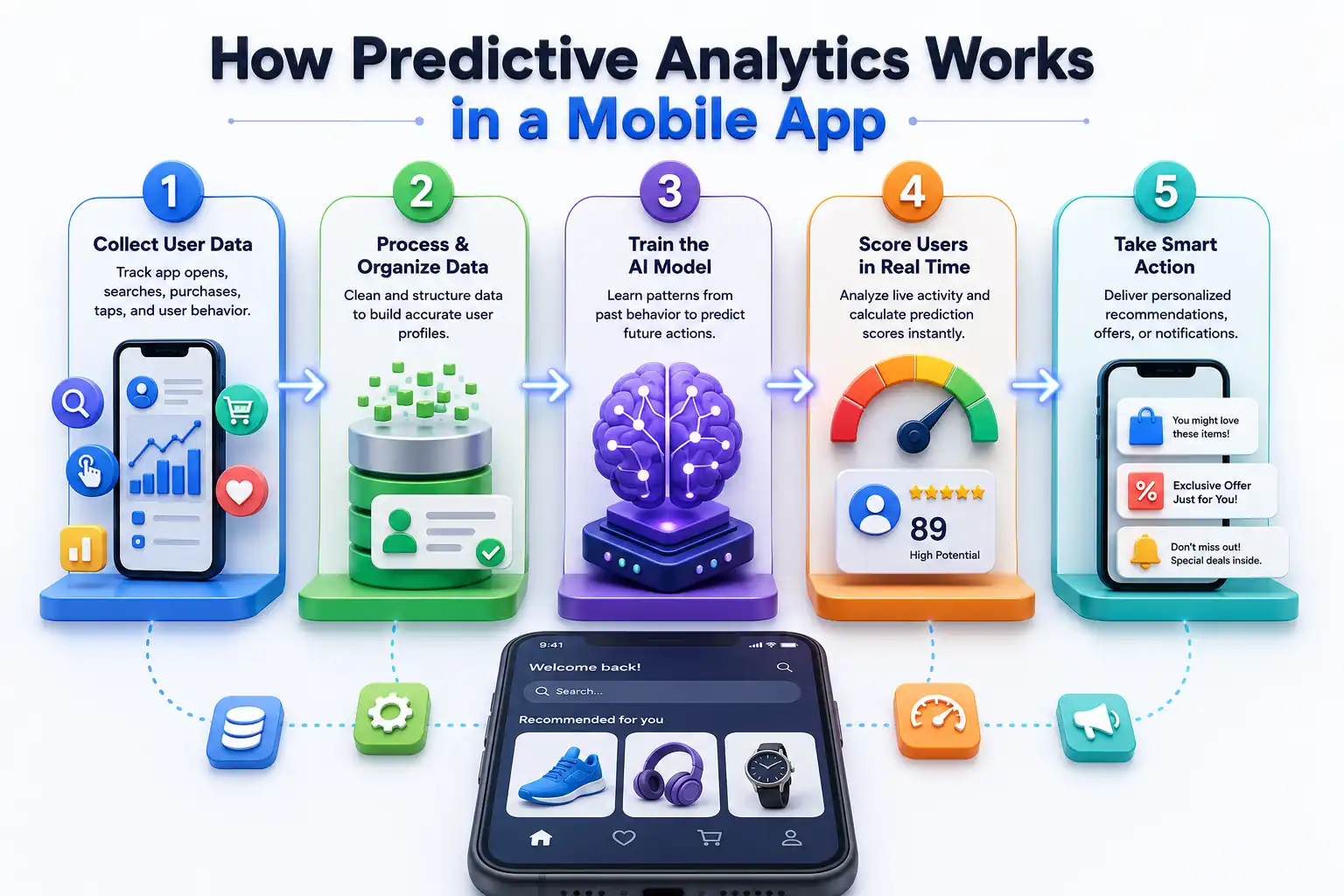
At a technical level, predictive analytics inside a mobile app follows a repeatable pipeline, even though the visible result is just a smarter-feeling app.
The app records behavioral signals: screens viewed, time spent, taps, purchases, searches, cart abandonment, app opens, and session frequency. This is often called behavioral analytics or user behavior analytics, and it's the raw material everything else depends on.
Raw event data is messy. It gets cleaned, structured, and mapped to a user profile. This step is where a lot of predictive analytics projects quietly fail, because the model is only as good as the data feeding it.
A predictive model is trained on historical data to recognize patterns, for example, the sequence of actions that usually precedes a user cancelling a subscription. This is where machine learning comes in, often using models suited to classification (will this user churn, yes or no) or ranking (which five products should appear first).
Once trained, the model scores live user behavior against what it has learned. A user browsing running shoes for the third time this week gets scored differently than a first-time visitor.
The prediction has to translate into something the user actually experiences: a reordered product list, a specific push notification, a personalized banner, or a retention offer triggered at the right moment.
The part businesses often underestimate is step five. A highly accurate prediction that never reaches the user interface in a useful way produces zero business value. The model and the product experience have to be built together, not handed off separately.
The practical effect of this pipeline is that the app stops treating every user identically and starts adjusting to context. A returning customer who buys groceries every Friday sees their usual list ready to reorder. A user who's opened the app five times without completing checkout gets a small incentive at the right moment instead of a generic blast. A fitness app notices a user's workout streak dropping and adjusts its reminder timing instead of sending the same 7am notification regardless of whether that user ever opens it.
This is the core value proposition: not more data, but more relevant decisions made from that data. A recommendation engine built on predictive models is the most visible form of this, but it extends well beyond product suggestions into notification timing, content ordering, pricing sensitivity, and support prioritization.
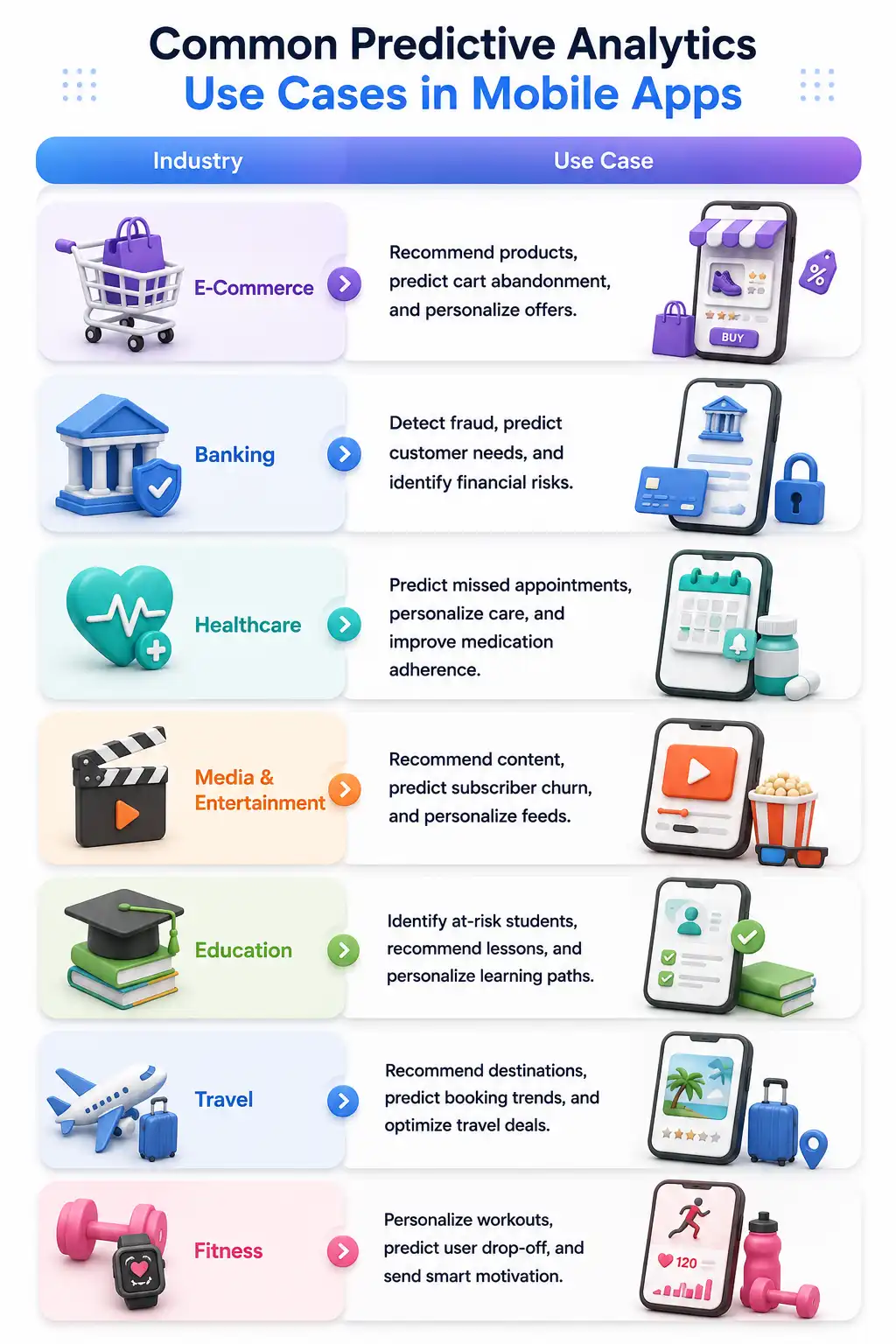
Product recommendations based on browsing and purchase history, dynamic homepage sorting, cart abandonment prediction, and personalized discount timing based on a user's actual price sensitivity rather than a blanket promotion sent to everyone.
Fraud pattern detection, predicting which customers are likely to need a specific financial product (like a credit line increase) before they ask, and flagging customers showing early signs of financial stress so support teams can intervene proactively.
Predicting appointment no-shows so clinics can send targeted reminders, personalizing health content based on a patient's condition and engagement history, and flagging medication adherence risks based on usage patterns in connected apps.
Content recommendation based on viewing or listening history, predicting when a subscriber is at risk of cancelling, and adjusting content discovery feeds in real time based on session behavior rather than static genre tags.
Identifying students likely to disengage from a course based on activity patterns, recommending the next learning module based on performance, and personalizing difficulty levels dynamically instead of using one fixed curriculum path.
Predicting the best time to show a flight or hotel deal based on a user's past booking behavior, personalizing destination suggestions, and forecasting demand spikes that affect pricing and availability.
Adjusting workout recommendations based on completion patterns, predicting drop-off points in a training program, and personalizing motivational nudges based on what has actually worked for that specific user before.
Most businesses don't approach predictive analytics because it sounds advanced. They approach it because a specific, measurable problem has become expensive to ignore.
Low user engagement - users open the app less frequently because nothing inside it changes based on their behavior.
Poor customer retention - users leave quietly, often without any clear complaint, because the experience never adapted to their needs.
Generic experiences - every user sees the identical app regardless of how differently they actually behave inside it.
High churn - the business notices cancellations after they happen instead of spotting the warning signs weeks earlier.
Ineffective notifications - blanket notifications sent at fixed times get ignored or, worse, cause uninstalls.
Low conversion rates - users browse but don't purchase because the offer or content they see isn't relevant to what they're actually looking for.
Missed upsell opportunities - a business has data suggesting a customer is ready for a related product but no system acts on it.
Information overload - showing users everything the app has instead of what's relevant to them creates friction, not choice.
Slow decision-making - teams are still waiting on last month's reports to understand what's happening this week.
Each of these is a symptom predictive analytics is specifically designed to reduce, not eliminate. It rarely solves a business problem completely on its own, but it removes the guesswork from how a business responds to user behavior.
Discover how predictive analytics can improve engagement, retention, and conversions in your mobile app.
Talk to Our Experts
Benefit | What Actually Changes |
Better customer experience | The app reflects individual behavior instead of a one-size-fits-all layout |
Higher engagement | Content and offers match what users are actually interested in, increasing session frequency |
Improved retention | Early churn signals allow intervention before a user disengages completely |
Smarter recommendations | Suggestions are based on actual behavior patterns, not fixed rules like "customers also bought" |
Increased conversions | Offers and content reach users at the point they're most likely to act |
Better use of customer data | Data that was previously just stored gets turned into decisions |
Faster business decisions | Teams get forward-looking signals instead of only historical reports |
Higher customer satisfaction | Users experience less friction and fewer irrelevant interruptions |
Create experiences that adapt to user behavior and deliver measurable business outcomes.
Discuss Your App StrategyPredictive analytics is not a plug-and-play feature, and treating it that way is where most implementations underdeliver.
A model trained on incomplete, inconsistent, or poorly tagged behavioral data will make confident but wrong predictions. This is the single most common reason predictive features underperform after launch.
Behavioral tracking sits under regulations like GDPR and various regional data protection laws. Businesses need clear consent flows and transparent data usage, not just technical capability.
A predictive model estimates probability, not certainty. Some recommendations will miss, and the system needs to be designed to tolerate that without damaging user trust.
A model trained once and left alone degrades as user behavior shifts. Predictive analytics is an ongoing operational commitment, not a one-time build.
Building a real predictive pipeline, data infrastructure, model training, and the interface layer to act on predictions, requires real investment. It needs to be weighed against the specific business metric it's meant to move.
Not every prediction is worth building. A business chasing every possible personalization angle at once usually ends up with a slower, more complex app and no clear return on any single feature.
No, and this is where a lot of businesses waste budget chasing a feature that doesn't fit their product yet.
A large enough user base to generate statistically meaningful behavioral patterns
A meaningful volume of customer behavior data already being collected
A product where personalized experiences genuinely change user decisions, like shopping, content, or subscription apps
Customer retention is a stated business priority, not just a nice-to-have metric
Static apps where content or functionality rarely changes between users
Simple utility apps, like a unit converter or a basic scheduling tool, where personalization adds complexity without adding value
Small informational apps with limited user interaction to learn from
Rule-based workflows where the logic is already fixed and predictable, such as compliance or approval processes
A useful gut check: if you can't clearly name the business metric predictive analytics would move, and by roughly how much, it's premature to build it.
Our experts can help you evaluate where predictive analytics will create real business value.
Talk to Our Mobile App Experts
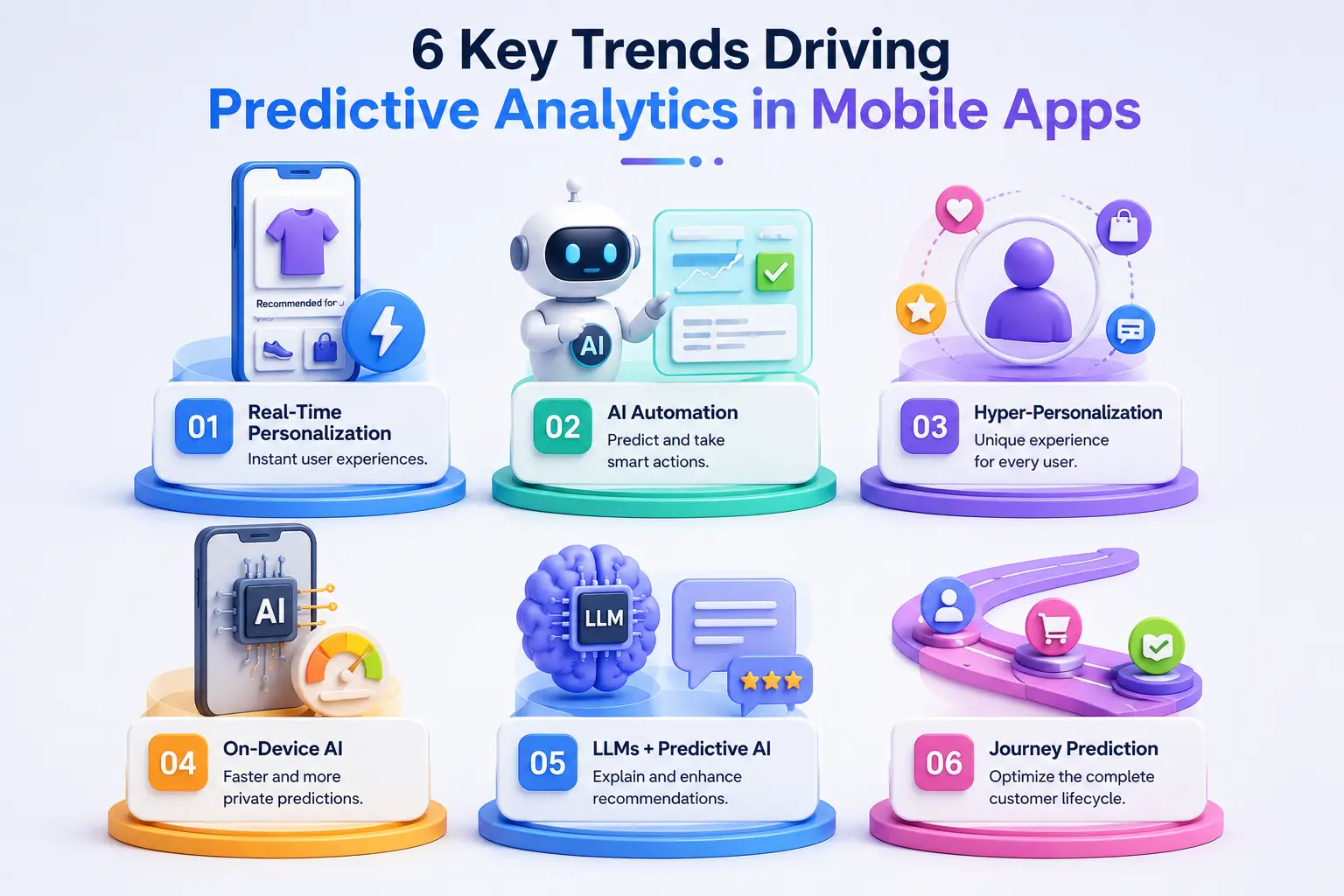
The direction this technology is heading changes what "personalization" will mean in the next few years.
Real-time personalization is moving from near-instant to truly instant, where the app adjusts within the same session rather than the next one.
AI agents using predictive analytics are starting to act on predictions autonomously, not just surface a recommendation but complete a small action on the user's behalf.
Hyper-personalized experiences are becoming granular enough that two users on the identical subscription tier can have functionally different app layouts.
Better recommendation engines are combining multiple data types, behavioral, contextual, and even device-level signals, instead of relying on purchase history alone.
On-device AI is reducing the need to send every signal to a server, which improves both speed and privacy.
Predictive customer journeys are extending beyond single interactions to model an entire relationship with a user across weeks or months.
And the most significant shift is combining predictive analytics with LLMs and NLP, where a model doesn't just predict what a user wants, it explains the reasoning in natural language or lets the user ask questions about their own recommendations.
None of this replaces the fundamentals covered above. It builds on the same data pipeline, just with faster, more contextual decision-making layered on top.
Predictive analytics turns a mobile app from a static product into something that responds to the person actually using it. The technology behind it, behavioral data, model training, real-time scoring, and an action layer that acts on the prediction, isn't complicated to explain, but it is a genuine engineering investment that needs the right data foundation and a clear business reason before it's built.
For apps with an active, sizable user base and a retention or conversion problem worth solving, it's one of the more measurable AI investments a business can make. For simple, static, or low-interaction apps, it's usually not the right first move. The honest answer to "should we add predictive analytics" depends less on what competitors are doing and more on whether your app already generates the behavioral data needed to make it work.
It's the use of historical and real-time user behavior data to estimate future actions, like what a user will buy, whether they'll stop using the app, or what content they're likely to engage with, so the app can adjust the experience accordingly.
Predictive analytics is the outcome, an estimate of what's likely to happen. Machine learning is one of the main methods used to produce that estimate. Not all predictive analytics requires machine learning, but most modern implementations use it.
Yes. It doesn't require rebuilding the app from scratch. It typically requires reviewing existing data collection, filling gaps in behavioral tracking, and adding a model layer plus an interface layer that acts on the predictions.
E-commerce, banking, media and entertainment, and subscription-based apps tend to see the clearest returns, largely because they have high transaction or engagement frequency, which gives predictive models enough data to work with.
Not strictly. Simple statistical models can produce basic predictions. But most effective, scalable implementations today rely on machine learning because it handles complex, shifting patterns better than fixed statistical rules.
There's no fixed number, but the model needs enough historical behavior per user segment to identify a reliable pattern. Apps with a small or very new user base often don't have enough data yet for predictions to be meaningfully accurate.
It can be, but the return needs to justify the investment. A small business with a highly engaged, data-rich user base can benefit. A small business with a small, low-interaction user base usually gets more value from simpler personalization first.
Accuracy depends entirely on data quality and volume. Predictions are probabilities, not guarantees, and models need ongoing evaluation and retraining as user behavior shifts over time.
Increasingly, yes. Many modern implementations score user behavior and adjust the experience within the same session, though some use cases, like churn prediction, work just as effectively on a daily or weekly cycle depending on the business need.

Mobile healthcare apps improve patient care by enabling remote monitoring, timely reminders, secure data access, better communication, and cost-efficient healthcare services through mHealth technology.
B2B apps help businesses streamline operations, enable on-the-go access to data, improve client engagement, support omnichannel sales, and drive scalable revenue by simplifying complex business workflows.
We are more than just developers and consultants—we are your partners in navigating the digital landscape. Let us be the engine behind your next big success while you focus on your core vision.
Explore Opportunities!