Mobile App Security Standards: What Every Business Owner Should Know
Quick Summary: Mobile app security standards fall into six categories: required for publishing, required by law, industry-specific, enterprise best practice, recommended, and nice to have. Which ones apply to you depends on your app type, your users' location, and the data you collect. This guide walks through each standard, shows you which apps need which rules, and gives you two checklists to use before you sign a development contract. |
If you are about to build a mobile app, here is a question most business owners never ask until it is too late: who is responsible when a user's data leaks, a payment gets intercepted, or Apple rejects your app three days before launch?
Most founders assume security is something the developer "handles in the background." This means it rarely gets discussed in the sales call, the proposal, or the contract. Then, months into development, the app fails an App Store review or worse, it launches successfully and a security weakness is discovered after real users have already trusted it with their data.
This guide explains the security, privacy and compliance standards that matter for mobile apps, in plain business language. No jargon walls. No implementation detail you do not need. Just what each standard is, who needs it, and what happens if you skip it.
A mobile app is not just a screen with buttons. Even a simple booking, shopping, or healthcare app collects information, stores it, exchanges data with servers, and often connects to payment gateways or third-party services.
Security is not a feature you bolt on after the app is built. It is a set of decisions about how data moves, who can access it, and what happens if something goes wrong. Those decisions shape the database structure, authentication approach, API design, and even which cloud provider makes the most sense. Early security planning also influences the application's architecture, API design, user authentication, and data storage strategy, making later changes significantly more difficult. Changing them after launch is far more expensive than planning for them at the start.
This is also why the cheapest development quote is not always the best deal. A developer who skips security testing, encryption planning, or compliance review can build your app faster and cheaper on paper. However, the cost shows up later, in App Store rejections, data breaches, legal penalties, or a total rebuild.
Read Also: Mobile App Development Process
Before looking at specific standards, it helps to understand the building blocks they are designed to protect. Business owners often think of it as one thing. In reality, it is a collection of separate concerns that a development team has to plan for individually.
Authentication confirms who a user is, usually through a password, OTP, or biometric login.
Authorization controls what a logged-in user is allowed to see or do inside the app.
Encryption scrambles data so it is unreadable if intercepted, both while it travels (in transit) and while it sits in storage (at rest).
Data collection and storage decisions determine what personal information you gather and how long you keep it.
Permission management governs what your app can access on a user's phone, such as the camera, contacts, or location.
Secure APIs are the connection points between your app and other systems. If they are poorly secured, they become the most common entry point for attackers.
Payment security protects card details and transaction data, usually by never letting your app touch raw card numbers directly.
Third-party SDK risk comes from external code libraries (analytics tools, ad networks, chat widgets) that run inside your app but are built by someone else.
Finding Problems Early
Vulnerability and penetration testing involves identifying weaknesses and safely attempting to exploit them before attackers do.
Logging and monitoring keep a record of what happens inside the app so unusual activity can be caught early.
User consent means clearly telling users what data you collect and getting their permission before you collect it.
Every standard covered below is really just a formal rulebook built around these same concerns, written for a specific audience: app stores, governments, industries, or enterprises.
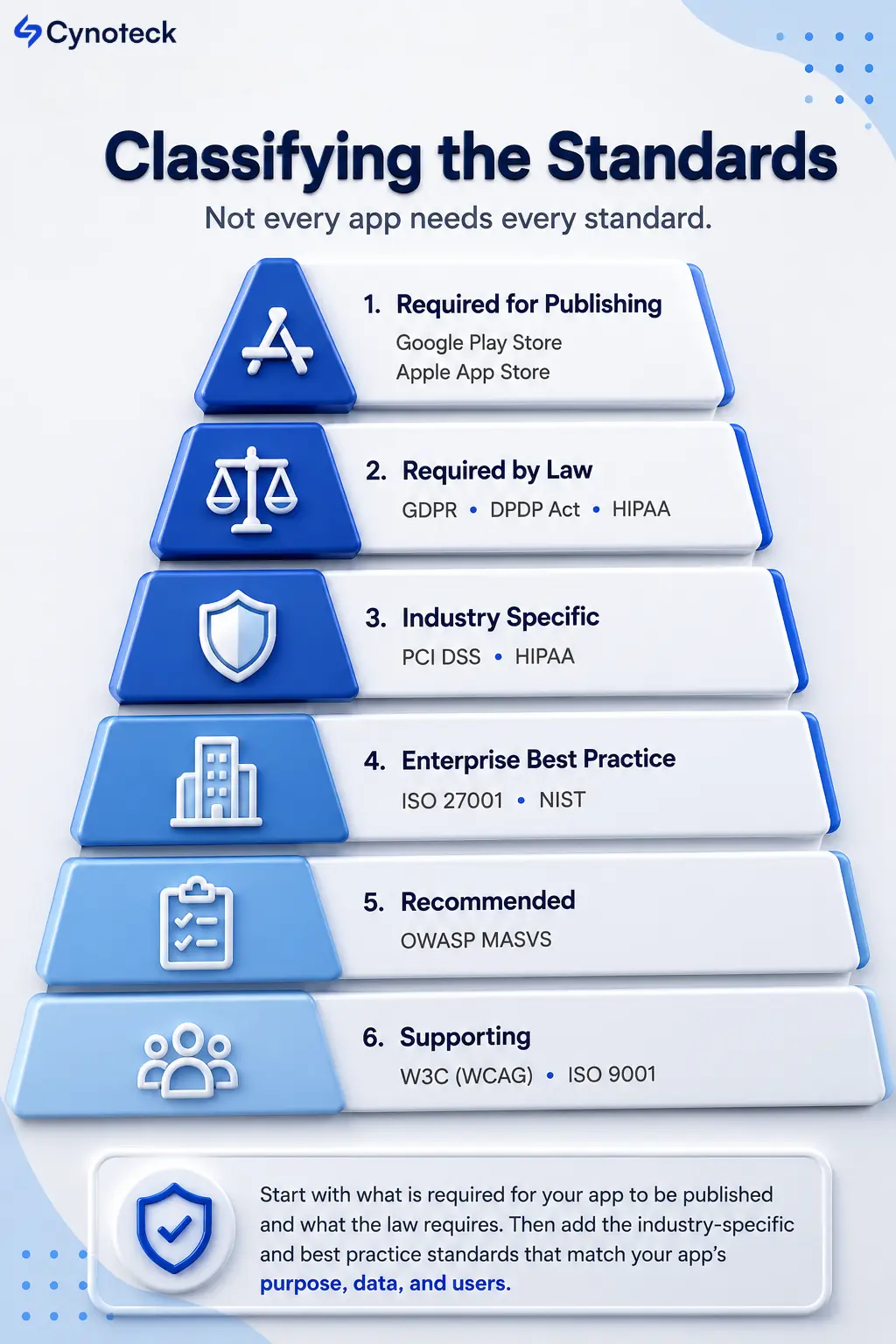
One mistake business owners make is treating every standard as equally urgent. They are not. Some are mandatory the day you submit your app. Others only apply if you serve certain countries or industries. Here is how they break down.
Category | What It Means | Example Standards |
|---|---|---|
Required for Publishing | You cannot list your app without meeting this | Google Play Store Guidelines, Apple App Store Guidelines |
Required by Law | Legal penalties apply if you ignore it | GDPR, India DPDP Act, HIPAA |
Industry Specific | Only applies to certain sectors | HIPAA (healthcare), PCI DSS |
Enterprise Best Practice | Expected by large clients and investors, not legally forced | ISO 27001, NIST Cybersecurity Framework |
Recommended | Improves quality and reduces risk, widely followed | OWASP Mobile Security, ISO 9001:2015 |
Nice to Have | Useful in specific contexts, not urgent for most apps | W3C Standards (mainly relevant if your app has a companion web platform) |
Google's publishing policies that determine whether an Android app can be listed and remain available on the Play Store. They cover areas such as data safety disclosures, permissions, content policies, and how your app handles user data.
If your app breaks these rules, Google can reject it, suspend it, or remove it after launch, even if the app already has active users.
Every business publishing an Android app.
Mandatory for publishing on Android.
A fitness app that collects location data without disclosing it in the Play Store's Data Safety section may be removed from the store after Google identifies the mismatch during review or through ongoing policy enforcement.
Apple's review standards for iOS apps, covering privacy disclosures, app functionality, in-app purchases, data handling, and user experience requirements.
Apple's review process is stricter than Google's in several areas, particularly around user privacy disclosures and login requirements (Apple has stricter privacy and account requirements than many platforms. For example, apps that use certain third-party sign-in options may also be required to support Sign in with Apple.).
Every business publishing an iOS app.
Mandatory for publishing on the App Store.
A food delivery app that requests continuous location access without clearly explaining why may be rejected during App Store review until the issue is resolved.
OWASP (Open Worldwide Application Security Project) publishes widely used mobile application security guidance, including the Mobile Application Security Verification Standard (MASVS) and resources that help developers identify and prevent common security weaknesses.
This is not a legal requirement, but it is the closest thing the industry has to a shared checklist of "the mistakes that get apps hacked." Asking mobile app development company whether they follow OWASP guidance, such as MASVS or security testing best practices, is one of the quickest ways to understand how seriously they approach mobile app security.
Every app, but especially apps handling logins, payments, or personal data.
Recommended, not legally required, but treated as an industry baseline.
A banking app with weak session handling (where a login token never expires) is exactly the kind of flaw OWASP's list is built to catch before launch.
A framework published by the U.S. National Institute of Standards and Technology. This means it is a structured way to think about security across five functions: identify, protect, detect, respond, and recover.
Many large enterprises and government agencies use the NIST Cybersecurity Framework as a benchmark when evaluating vendors, even if it is not a legal requirement for your app.
Enterprise software, government-facing apps, and any business selling into the U.S. public sector.
Enterprise best practice. It may become a contractual requirement for certain government projects or organizations with strict cybersecurity requirements.
A logistics company building an internal driver-tracking app for a government client may be asked to prove NIST alignment as part of the vendor contract.
The World Wide Web Consortium (W3C) develops standards that help keep websites and web applications consistent, accessible, and interoperable across browsers and devices. One of its best-known standards is the Web Content Accessibility Guidelines (WCAG).
These standards are less about securing your mobile app and more about ensuring that any connected web experience is accessible and works consistently for all users.
Apps with a connected web platform, or apps serving government, education, or enterprise clients where accessibility is a contract requirement.
Generally optional for standalone consumer apps, but often expected—or contractually required—for government, education, and many enterprise projects with web-based components.
A school app with a parent-facing web portal that fails basic accessibility standards can lose contracts with public school districts that require WCAG compliance.
An international standard for information security management. This means it certifies that a company, not just an app, has documented processes for protecting data across its entire operation.
If you are pitching enterprise clients or investors, working with an ISO 27001-certified mobile app development partner, or obtaining certification for your own organization as you grow, shows that information security is managed through documented company-wide processes rather than handled project by project.
Enterprise software vendors, healthcare and finance-adjacent apps, and any business where clients specifically ask for it during procurement.
Enterprise best practice, not legally mandatory.
A SaaS company selling workforce management software to hospitals may lose the deal at the procurement stage if their development partner cannot demonstrate ISO 27001 certification or equivalent information security controls required during procurement.
An international standard for quality management systems. It focuses on consistent, documented processes across an organization rather than security itself. While ISO 9001 is not a security standard, it is often considered during enterprise vendor evaluations because mature quality processes help reduce development mistakes, including those that can affect security.
It is less about data protection and more about whether your development partner has repeatable, documented processes. A team without a quality system tends to produce inconsistent results project to project.
Enterprises evaluating a long-term development partner for multiple projects.
Useful for vendor evaluation, particularly in enterprise procurement, but not a security requirement.
An enterprise choosing between two development agencies for a multi-year mobile app development roadmap may weigh ISO 9001:2015 certification as a tiebreaker for consistency.
The General Data Protection Regulation is the European Union's data privacy law. It governs how personal data of EU residents is collected, stored, and used, regardless of where your company is based.
If your app collects or processes the personal data of people in the EU, GDPR may apply even if your business has no physical presence in Europe. Serious violations can result in penalties of up to 4% of a company's worldwide annual turnover.
Any app that could have European users, including ecommerce, social, and SaaS apps with open sign-up.
Required by law if you serve EU users.
An ecommerce app based in the US that ships to European customers still needs a GDPR-compliant privacy policy, consent flow, and data deletion process.
The Digital Personal Data Protection (DPDP) rules, 2025 were notified in November 2025. The law is being implemented in phases, with organizations expected to achieve full compliance by May 2027.
Once fully enforced, organizations that fail to implement reasonable security safeguards may face penalties of up to ₹250 crore (approximately USD 30 million) for this category of non-compliance under the DPDP Act. Organizations are using the phased implementation period to update consent flows, privacy notices, and security practices before full compliance is expected in 2027.
Any app processing personal data of individuals in India, even if the business itself is based elsewhere.
Required by law, with penalties phasing in through 2027.
An edtech app collecting student data from Indian users will need verifiable consent flows and breach notification processes in place well before the May 2027 enforcement deadline, not after.
The Health Insurance Portability and Accountability Act is a U.S. law governing the privacy and security of health information.
HIPAA violations carry both civil and criminal penalties, and healthcare partners (hospitals, clinics, insurers) will not work with an app that is not HIPAA compliant, regardless of how good the app is otherwise.
Apps that create, receive, store, or transmit protected health information (PHI) for healthcare providers, health plans, insurers, or their business associates in the United States
Required by law for covered healthcare apps in the U.S.
A telemedicine app that lets doctors send patient notes through an unencrypted chat feature is a direct HIPAA violation, regardless of whether the feature is popular with users.
The Payment Card Industry Data Security Standard (PCI DSS) is a security standard for organizations that store, process, or transmit payment card information. Most mobile apps reduce their compliance burden by using certified payment providers such as Stripe or Razorpay instead of handling card details themselves.
Storing raw card numbers on your own servers, even briefly, creates massive liability if breached. Most apps avoid this entirely by design.
Ecommerce, marketplace, food delivery, and any app accepting in-app payments.
Required by payment brands, acquiring banks, and payment processors through contractual requirements. While PCI DSS is not a law, many businesses must comply with it to accept card payments.
A marketplace app that tries to build its own card storage system instead of using a certified payment gateway takes on compliance costs and breach liability it does not need.
Every app has different security and compliance requirements. Work with a team that plans security from the beginning, not just before launch.
Talk to Our Mobile App ExpertsDifferent apps carry different risks. A fitness tracker and a banking app are both "mobile apps," but they need very different levels of security investment.
App Type | Important Security Focus | Key Standards & Requirements | Example |
Healthcare / Telemedicine | Encrypted patient data, secure messaging | HIPAA, ISO 27001, OWASP | Telemedicine consultation app |
Ecommerce / Marketplace | Payment security, fraud detection | PCI-aligned practices, GDPR, Play/App Store | Multi-vendor shopping app |
Banking / Investment / Wallet | Strong authentication, encryption, fraud monitoring | PCI DSS, OWASP, NIST (where applicable), and applicable financial regulations | Digital wallet app |
Social Media | Content moderation, child safety, data minimization | GDPR, DPDP Act, Play/App Store | Photo-sharing app |
Education / School | Child data protection, accessibility | DPDP Act, GDPR, W3C (WCAG) | Parent-teacher communication app |
Government | Strict access control, audit logging | NIST, ISO 27001 | Citizen services app |
IoT / Connected Device | Device authentication, firmware security | OWASP, NIST | Smart home control app |
Enterprise Internal | Role-based access, single sign-on (SSO), audit logging, and device management | ISO 27001, NIST | Field service management app |
Most apps do not need every standard discussed in this guide. The right combination depends on the data you collect, the users you serve, and the industries or regions your app operates in.
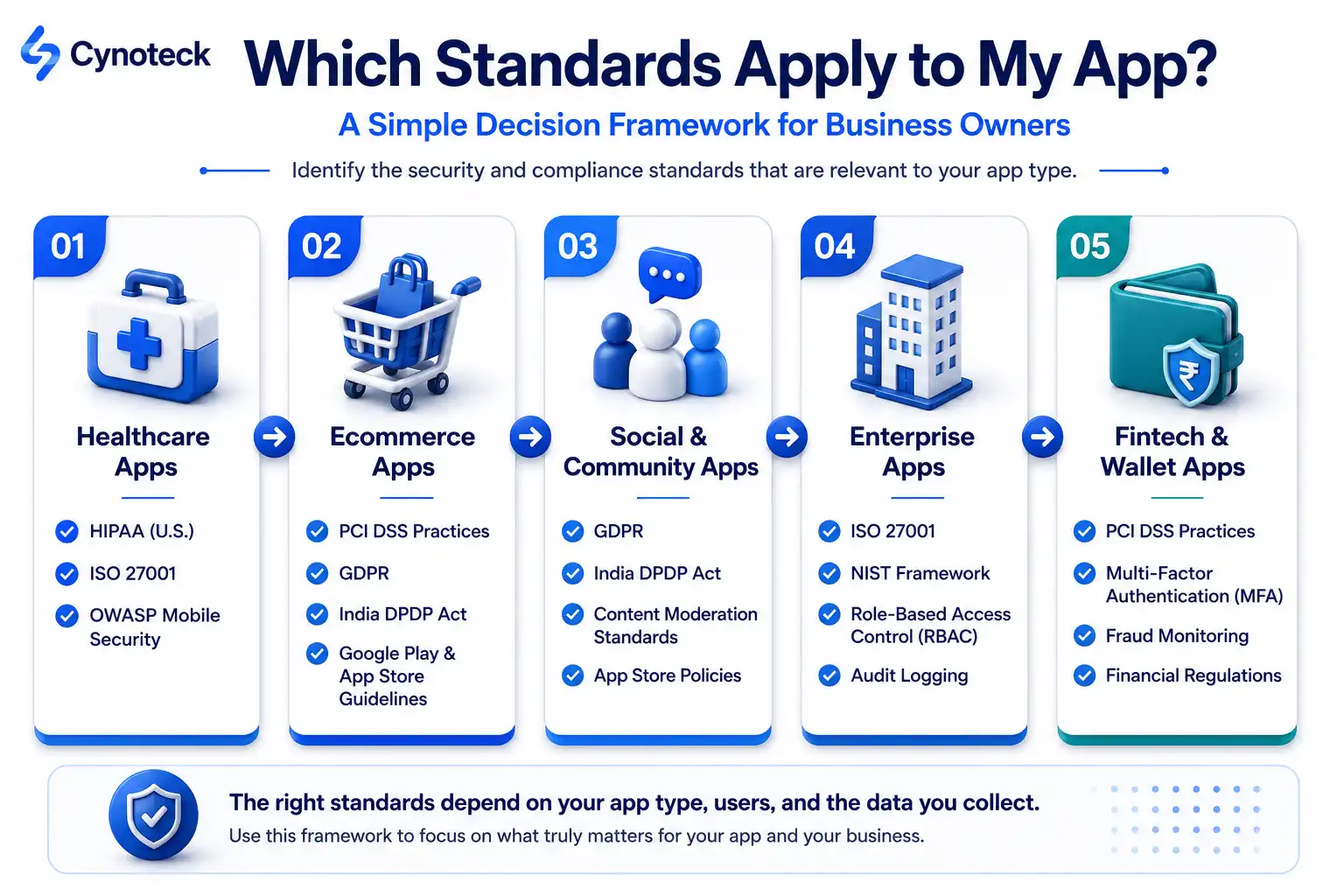
If you are unsure where to start, work backward from what your app is and who uses it.
HIPAA compliance is required if you operate in the U.S. You should also follow recognized security practices such as ISO 27001 and OWASP Mobile Security guidance. Together, these help protect patient information and meet the security expectations of healthcare organizations.
Prioritize PCI DSS-aligned payment practices and use a trusted payment processor rather than storing card details yourself. GDPR applies if you process personal data of users in the EU, while the DPDP Act applies if you serve users in India. Your app should also meet Google Play Store and Apple App Store publishing requirements.
Plan for GDPR and the DPDP Act if they apply to your users. Strong content moderation, child safety measures, and compliance with Google Play Store and Apple App Store policies are also important, as these are closely reviewed for consumer-facing platforms.
ISO 27001 provides a strong foundation for information security management. If you work with government agencies or large enterprises, aligning with the NIST Cybersecurity Framework may also be expected. Strong authentication, role-based access control, and audit logging should be part of the overall security approach.
PCI DSS-aligned payment practices, strong authentication (such as biometrics or multi-factor authentication), and fraud monitoring are essential. You should also understand the financial regulations and data protection requirements that apply in every country where your app operates.
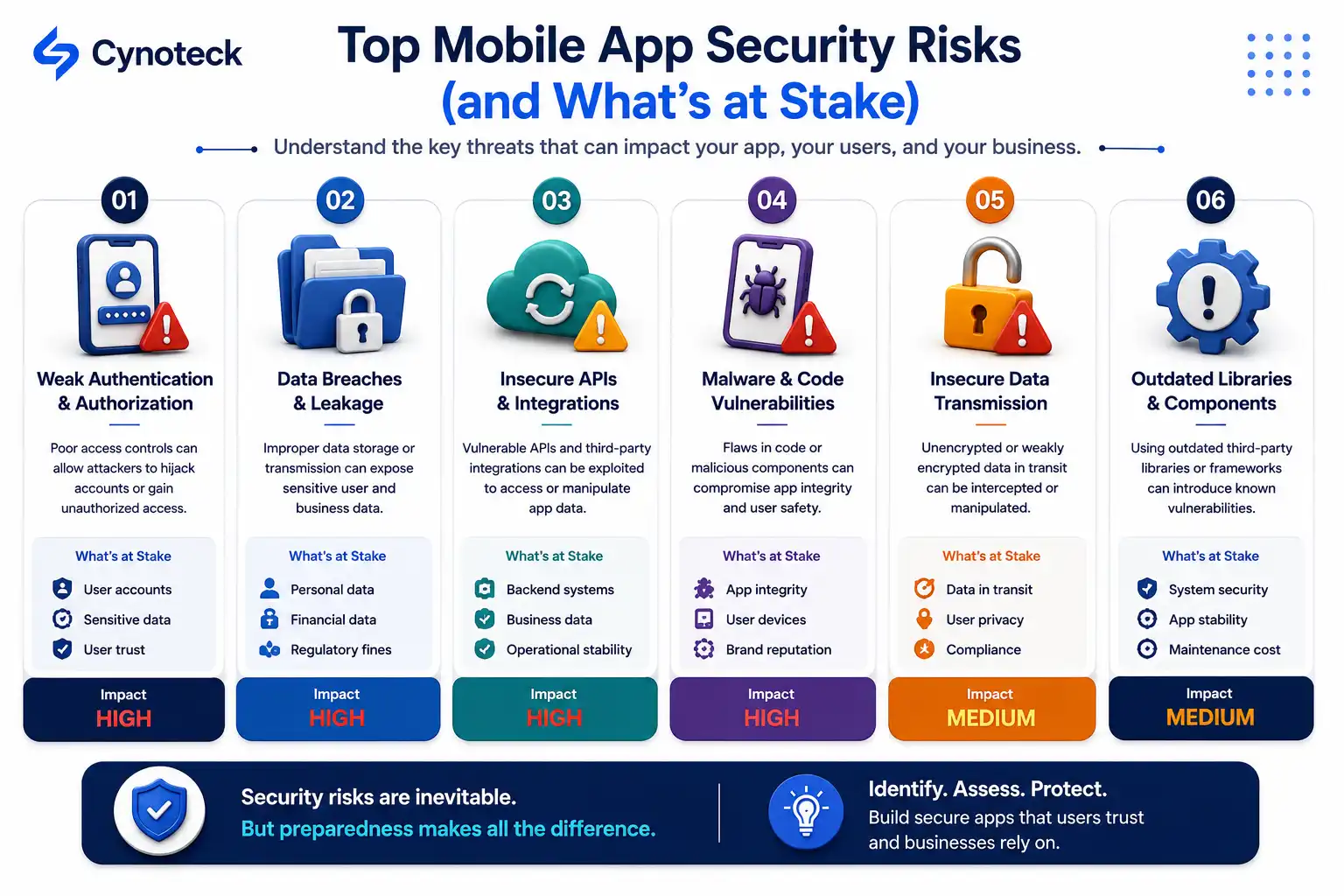
The consequences of skipping security planning are not abstract. They show up in specific, measurable ways.
Exposed personal data, financial loss, and loss of trust in your brand.
Emergency rebuild costs, loss of customers, and damaged relationships with partners or investors.
Apps that violate Play Store or App Store data policies can be delisted, cutting off your primary distribution channel overnight.
Fines under GDPR, the DPDP Act, or HIPAA, and potential lawsuits from affected users.
Fixing a security weakness after launch is often far more expensive than addressing it during development, as it may require redesigning the authentication system, database, or application architecture instead of updating a single feature.
A public data breach can quickly damage customer confidence and brand reputation, often taking far longer to rebuild than it did to earn.
Security shortcuts taken early can limit future growth, as enterprise clients, partners, and payment providers often require security reviews before agreeing to integrate or do business.
Pro Tip: Ask your development partner how they would respond if a critical security vulnerability were discovered after launch. They should be able to explain how they investigate the issue, communicate with affected users if necessary, release security updates, and prevent similar problems in the future. If they cannot describe a clear incident response process, treat it as a warning sign rather than a minor gap.
Use this checklist during your first conversation with any app development company, before signing a contract. Clear, specific answers to these questions can reveal how seriously a team approaches security, privacy, and long-term maintenance.
How will user passwords be stored and protected?
Which authentication methods will the app support (password, OTP, biometric authentication, or multi-factor authentication)?
How is access to the app's backend and admin panel restricted for your internal team?
Will data be encrypted both in transit and at rest?
Will the app comply with GDPR if we have users in the European Union?
How will the app meet the requirements of India's DPDP Act if we serve users in India?
If this is a healthcare app, how will HIPAA requirements be addressed?
How will user consent be collected, managed, and recorded?
What happens to our users' data if we decide to end our contract with your team?
How will payment information be protected, and will payments be processed through a PCI DSS-compliant payment provider such as Stripe or Razorpay?
How will the app be tested for security vulnerabilities throughout development?
Will an independent penetration test be performed before launch? If so, who conducts it?
How are third-party SDKs evaluated before being added to the app?
What logging and monitoring will be in place after launch?
What is your process for responding to a security vulnerability discovered after the app goes live?
How will security be maintained during future app updates?
Can you describe how your team has handled a real-world security incident or critical vulnerability in a previous project, without sharing confidential client information?
How are backups managed, and how often is the recovery process tested?
What permissions will the app request from users, and why?
How will the app meet current Google Play Store and Apple App Store data safety and privacy requirements?
Note: If a development company cannot answer most of these questions clearly—or only provides vague, generic responses—treat that as valuable information. Security should be planned, documented, and discussed from the beginning of a project, not treated as an afterthought.
Before signing a contract, review the proposal carefully to make sure these security, privacy, and support commitments are clearly documented. If anything is missing, ask for it to be added in writing before development begins.
Security testing scope and timeline
Encryption approach for data in transit and at rest
API security approach
Authentication approach (password, OTP, biometrics, or multi-factor authentication)
Authorization and role-based access design
Backup policy and recovery testing schedule
Responsibility for preparing or reviewing the privacy policy
Consent management approach
Applicable compliance requirements (GDPR, DPDP Act, HIPAA, PCI DSS, or others relevant to your app)
Incident response process for security vulnerabilities
Ongoing security monitoring after launch
Post-launch maintenance and security update policy
Ownership of source code, infrastructure credentials, and project documentation after handover
Checklist Tip: Keep this checklist with you during every proposal review—not just for your first app. It helps you compare development partners consistently and ensures important security commitments are documented before work begins.
From security planning and compliance to development, testing, deployment, and ongoing support, we help businesses build mobile apps with security in mind at every stage.
Start Your Mobile App ProjectSecurity is not just a technical responsibility for your mobile app development partner. It is a business decision that affects your legal exposure, your app store approval, your user trust, and your ability to scale.
You do not need to become a security expert. You need to know which standards apply to your specific app, ask the right questions before you hire anyone, and make sure the answers show up in writing in your contract. That single habit can help prevent many costly security and compliance issues before development begins.
If you'd like to revisit the key concepts through diagrams, decision frameworks, and practical examples, check out our Mobile App Security Standards presentation on SlideShare. It provides a visual summary of the standards, compliance frameworks, industry-specific requirements, and security planning considerations covered in this guide.
Click Here👉 Mobile App Security Standards
GDPR generally applies if your app collects or processes the personal data of people in the European Union, even if your business is based elsewhere. If your app has open sign-up and no country restriction, you likely need GDPR-compliant consent and data handling.
The DPDP Rules were notified in November 2025, and the law is being enforced in phases, with full enforcement and penalties beginning May 13, 2027. Businesses serving Indian users are expected to use 2026 to prepare, rather than waiting until the deadline.
No. ISO 27001 is not required by Google or Apple. It is a company-level certification that enterprise clients often ask for when choosing a development partner, not a publishing requirement.
OWASP is a technical checklist for finding and fixing security weaknesses in the app itself. GDPR is a legal requirement about how personal data is handled. A secure app under OWASP can still violate GDPR if it collects data without proper consent.
It depends on what the app handles. An app with logins, payments, or personal health data benefits from at least a basic vulnerability scan before launch, even on a limited budget. A simple informational app with no user accounts carries far less risk.
Liability depends on the contract, the applicable laws, and the circumstances of the breach. This is why responsibilities for security, incident response, and post-launch support should be clearly documented before development begins.

Mobile healthcare apps improve patient care by enabling remote monitoring, timely reminders, secure data access, better communication, and cost-efficient healthcare services through mHealth technology.
B2B apps help businesses streamline operations, enable on-the-go access to data, improve client engagement, support omnichannel sales, and drive scalable revenue by simplifying complex business workflows.
We are more than just developers and consultants—we are your partners in navigating the digital landscape. Let us be the engine behind your next big success while you focus on your core vision.
Explore Opportunities!