How Does Salesforce Agentforce Work? The Atlas Reasoning Engine Explained

Summary: This guide walks through exactly what happens inside Salesforce Agentforce when an agent handles a real task, including what happens when it gets stuck. |
Most explanations of Agentforce stop at "it uses AI to complete tasks." That's true, but it skips the part that matters. If you're deciding whether to build one, you need to see it in action first.
What happens, step by step, when a real customer request hits an agent? And just as important, what happens when things don't go as planned? This guide walks through both.
The clearest way to understand how Agentforce works is to follow a single request from start to finish, rather than reading a list of features.
Say a customer emails a support inbox: "My order from last week hasn't arrived, and I need it by Friday."
Here's what happens inside the agent, one step at a time.
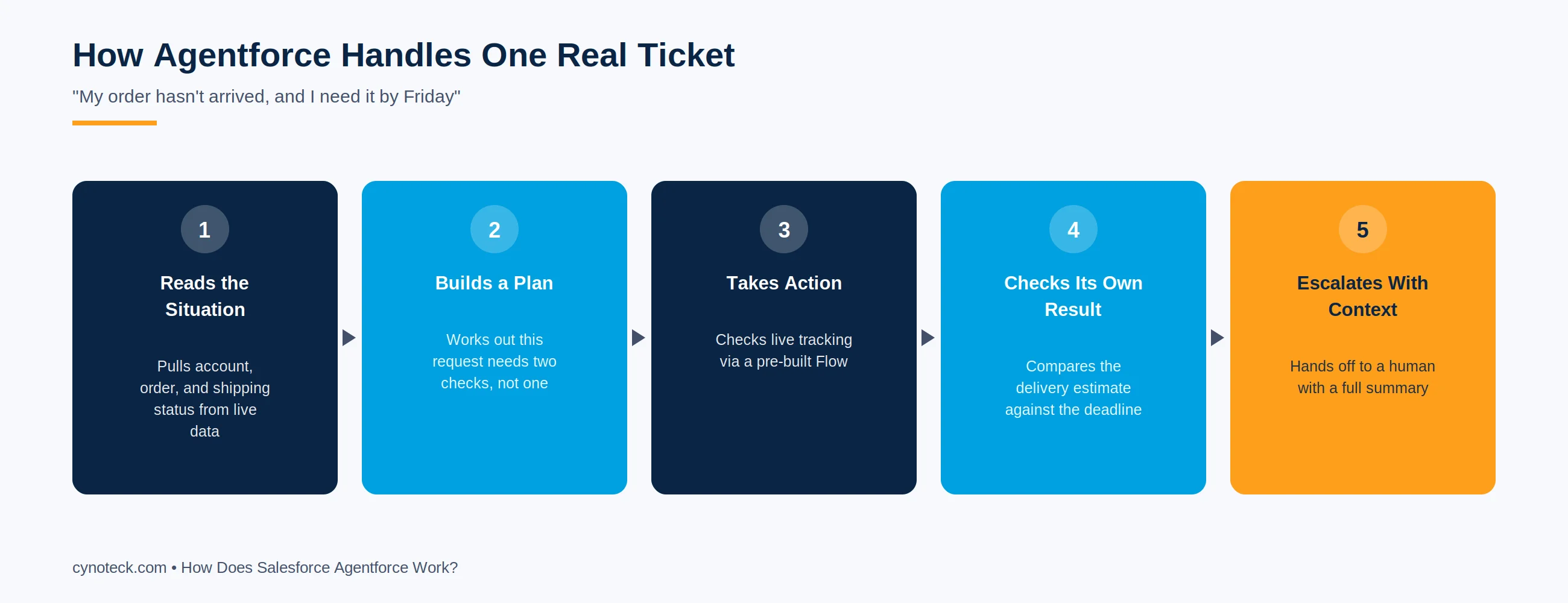
It reads the situation: The agent pulls the customer's account, the order in question, and its current shipping status. All of this comes from live Salesforce data, not a cached snapshot from earlier.
It builds a plan: This isn't a fixed script. The agent determines that this request requires two things. It has to confirm the shipping delay, then check whether a Friday deadline is realistic given the carrier's current status.
It takes action: Using a pre-built Flow connected to the shipping carrier's API, the agent checks the live tracking status. It finds the package is delayed by two days.
It checks its own result: The agent compares the new delivery estimate against the customer's Friday deadline. In this case, the delay means Friday isn't realistic.
It escalates with context: A delivery promise now needs a human judgment call. The agent hands the case to a support rep, along with a full summary of what it already checked, not just the original email.
Note: That last step is the one most people miss when they picture Agentforce. It doesn't just fail silently or guess. It hands off with everything a human needs to finish the job in seconds, not minutes. |
Also, Read: What Is Salesforce Agentforce? A Complete Guide
Discover how Salesforce Agentforce combines data, reasoning, and actions to automate complex business tasks while keeping humans involved when needed.
Book a Free ConsultationReasoning means the agent builds a fresh plan for each situation rather than following a fixed path every time.
This is the real difference between Agentforce and older automation. A traditional workflow tool runs the exact same steps regardless of the details of a specific case. Agentforce's Atlas Reasoning Engine first looks at what's happening, then decides which steps apply.
In the ticket above, a request that just said "where's my order?" with no deadline would have taken a shorter path. No urgency check needed, no escalation.
Just a status update sent back directly. The agent didn't run extra steps because a rule told it to. It ran them because this specific request needed them.
Pro Tip: When you're scoping your first agent, resist the urge to map out every possible path in advance. Atlas is designed to handle variation on its own. Over-scripting an agent's logic tends to fight against the reasoning engine rather than support it. |
Salesforce describes every agent as needing three things: data, reasoning, and actions. Here's what each one means in practice.
Data: The agent needs real-time access to the records relevant to the task, pulled live rather than from a stale export. This is what Data 360 provides.
Reasoning: The decision-making layer that plans, evaluates, and adjusts. This is the Atlas Reasoning Engine's job.
Actions: The actual work getting done, whether that's updating a record, sending an email, or calling an external system. Actions run on Flow, Apex, or API connections that already exist in your org.
Miss any one of these three, and the agent can't function. An agent with reasoning but no real data access just guesses. An agent with data but no actions can only describe what should happen, not do it.
An agent that can't complete a task doesn't fail quietly. It stops and hands off with everything it's already learned.
This is one of the least-understood parts of Agentforce and one of the most important for anyone evaluating it seriously.
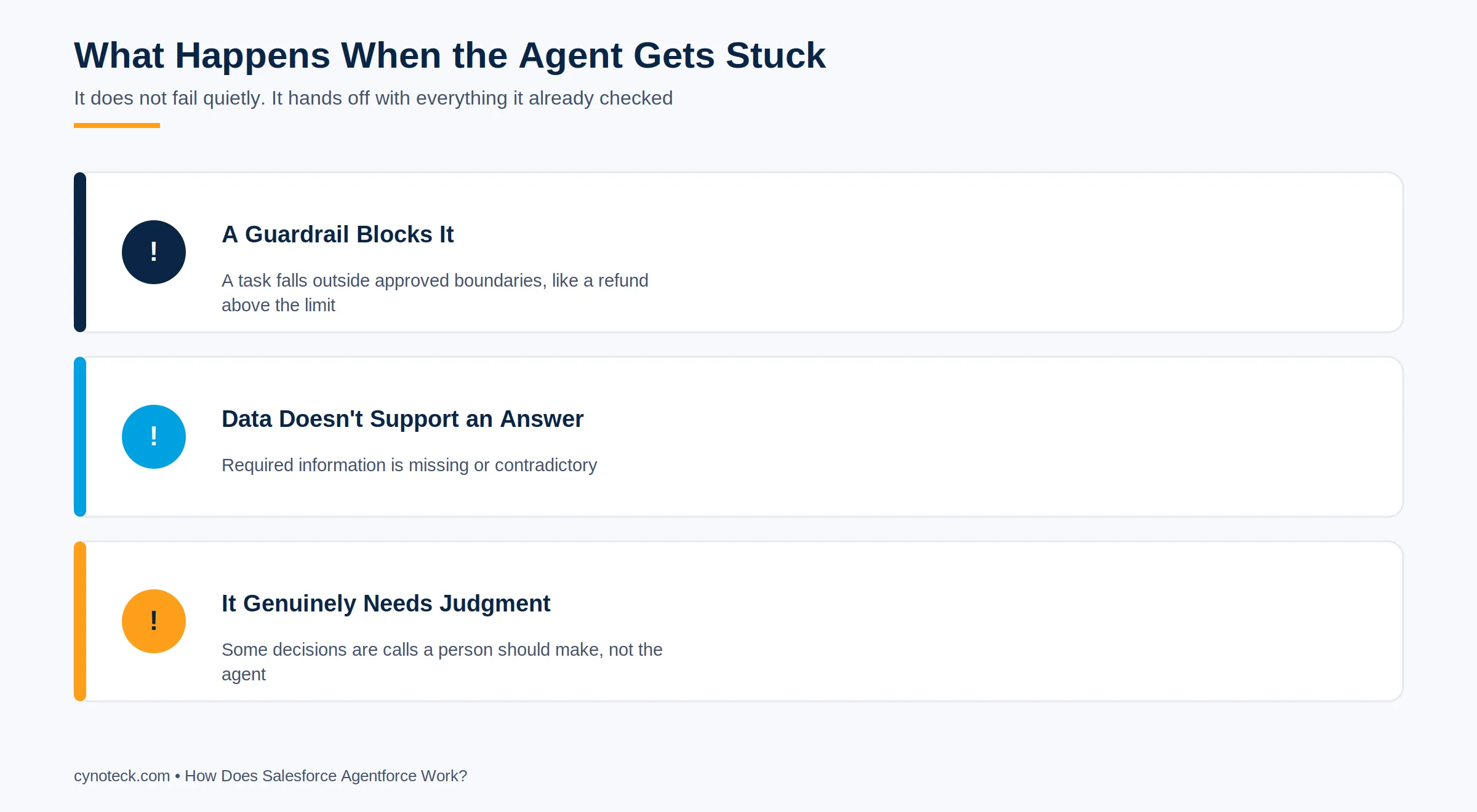
A guardrail blocks the action: Some tasks fall outside the agent's defined boundaries, such as issuing a refund above an approved limit. When that happens, the agent stops rather than proceeding anyway.
The data doesn't support a confident answer: If required information is missing or contradictory, the agent escalates instead of guessing at a resolution.
The task genuinely needs human judgment: Some decisions, like the delivery deadline example above, aren't about missing data. They're calls a person should make.
In each of these cases, the handoff includes a summary of what the agent has already checked and ruled out. A human picking up the case isn't starting from zero.
Note: This behavior is configured, not automatic. An agent built with vague or overly broad guardrails will escalate too often, or worse, not often enough. Getting this right is what most separates a reliable agent from a frustrating one. |
These three settings, configured in Agent Builder, shape how an agent behaves.
Topics define the scope of what an agent handles. A "shipping inquiries" topic won't attempt to answer a billing question, even if it's asked in the same conversation.
Actions are the specific things an agent can do within a topic, such as checking a tracking number or updating a case status. Each action is built on an existing Flow, Apex class, or API connection; nothing gets created from scratch inside Agent Builder itself.
Guardrails set the limits on what an agent can do without a person reviewing it first, such as a dollar cap on refunds it can approve independently.
In Salesforce's own setup screens, adding an action to a topic is simple. You select it from a list of what your org already supports. From there, you connect it to the right reference, whether that's a Flow, an Apex class, or a MuleSoft API endpoint.
Pro Tip: Start with a narrow topic and a short list of actions for your first agent. Expanding scope later is much easier than narrowing down an agent that was given too much freedom on day one. |
Also, Read: Agentforce vs Custom AI Agents
Design a Salesforce Agentforce solution with the right topics, actions, and guardrails to improve accuracy, efficiency, and customer experiences from day one.
Schedule a Free ConsultationFlow runs the same steps every time. Agentforce decides which steps apply based on what it finds.
Factor | Salesforce Flow | Agentforce |
Logic | Fixed, pre-built path | Built fresh for each situation |
Handles variation | Poorly, needs a new branch for each case | Naturally, as part of normal operation |
Decision-making | Follows rules set in advance | Evaluates the specific request |
When it can't finish | Often just stops or errors | Escalates with a summary of what it tried |
Built using | Flow Builder | Agent Builder, often calling existing Flows |
This isn't really a competition between the two. These agents frequently call existing Flows as their actions. Flow handles the fixed, repeatable execution step, while the reasoning layer decides which steps to run and in what order.
Four systems work together behind the scenes, and it helps to know what each one is responsible for.
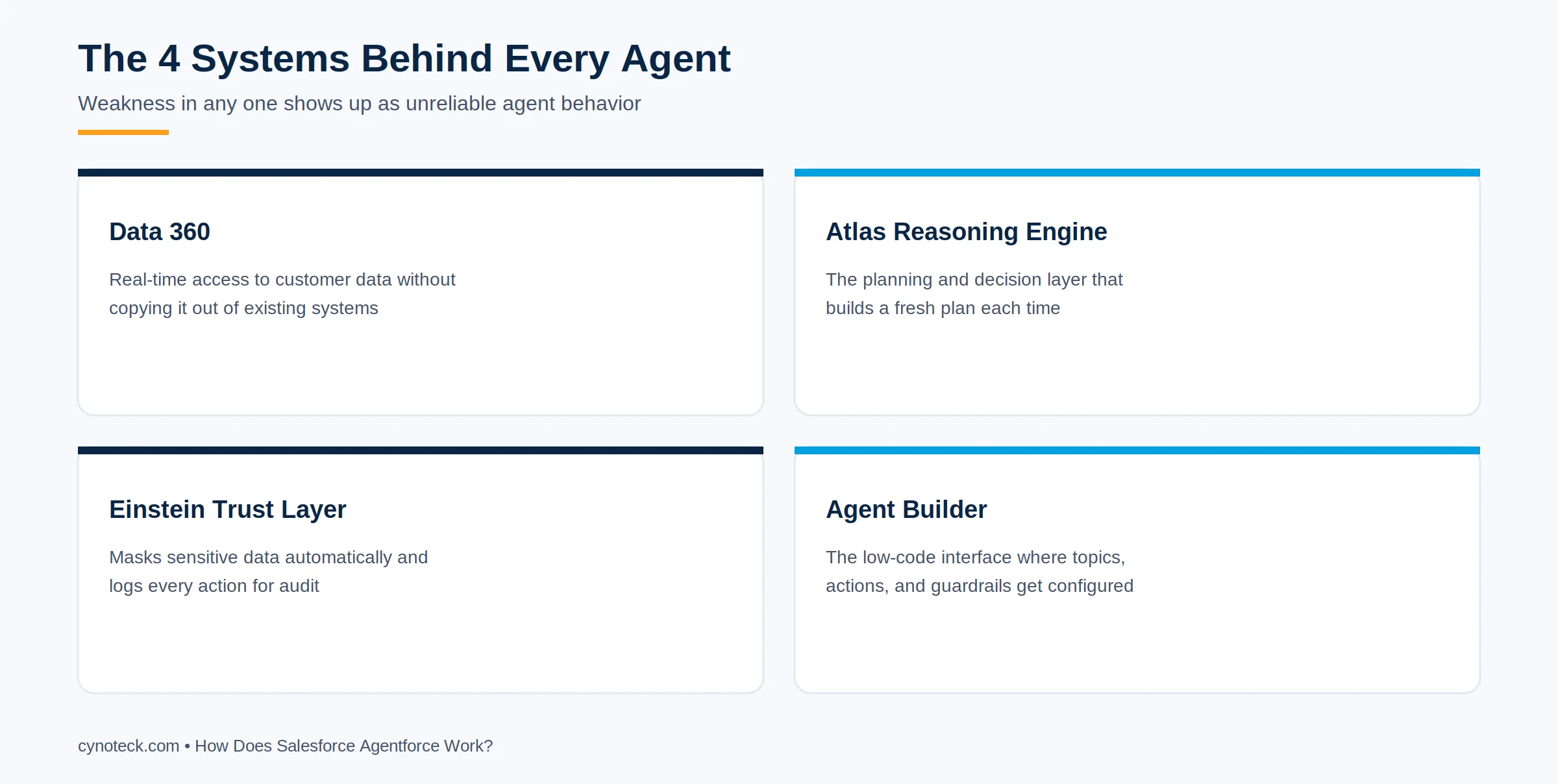
Data 360: Gives the agent real-time access to customer data without copying it out of your existing systems.
Atlas Reasoning Engine: The planning and decision layer covered above.
Einstein Trust Layer: Masks sensitive data automatically and logs every action an agent takes, for audit purposes.
Agent Builder: The low-code interface where topics, actions, and guardrails get configured.
None of these operate in isolation. A well-built agent depends on clean data flowing through Data 360, sound reasoning from Atlas, and safe boundaries from the Trust Layer.
It also needs a properly scoped configuration in Agent Builder. Weakness in any one of the four shows up as unreliable agent behavior, even if the other three are solid.
Most Agentforce problems trace back to one of the four systems above being rushed, not to the technology itself.
Cynoteck's certified Agentforce team starts every engagement with a data and org readiness review before any topic is configured. That's the same discipline that took a recent water treatment client's support agent from concept to live in six weeks. Calls reaching a human dropped by 80%.
Data readiness: Confirming Data 360 has clean, accurate records before an agent ever queries them.
Scoped configuration: Narrow topics and actions first, expanded only once real usage confirms they're working.
Guardrails that match your risk tolerance: Not a generic template copied from another client's org.
Explore Cynoteck's Agentforce Implementation services to see how a readiness-first approach plays out on a real project.
The fastest way to know how it would handle your specific workflows is to walk through one real scenario with a certified team.
Talk to Our Agentforce ExpertsAns: No. A guardrail may block an action, or data may be missing, or the decision may genuinely need human judgment. In any of these cases, the agent hands off to a person with a full summary of what it already checked.
Ans: It's the decision-making layer that builds a fresh plan for each request, rather than following one fixed script every time.
Ans: No. Actions typically run on Flow, Apex, or API connections that already exist in your Salesforce org. Agent Builder connects to them rather than replacing them.
Ans: A chatbot answers a question and stops. This system reads the situation, decides what to do, takes the action, and checks the result. It then either finishes the task or escalates with context.
Ans: No. Actions are tied to specific topics and built on existing Flows, Apex, or APIs. An agent cannot invent a new capability outside what's been configured for it.
Ans: Messy or incomplete data is the most common cause, followed by topics and actions that were scoped too broadly on the first attempt.
What is Artificial Intelligence? Artificial intelligence (AI) is intelligence demonstrated by machines, which makes it possible for machines to learn from experience, adjust to new inputs and perform human-like tasks.
We are more than just developers and consultants—we are your partners in navigating the digital landscape. Let us be the engine behind your next big success while you focus on your core vision.
Explore Opportunities!

 What Al Services Does a Business Actually Need in 2026.webp)