What does Dynamics 365 Offer for the Healthcare Industry?
Healthcare organizations today operate in one of the most demanding environments in any industry. They must deliver high-quality patient care while managing rising operational costs, maintaining strict regulatory compliance, and navigating the rapid shift toward digital health services. At the same time, data fragmentation, outdated legacy systems, and disconnected workflows continue to slow down clinical and administrative teams alike.
Microsoft Dynamics 365 for healthcare offers a powerful answer to these challenges. As a unified suite of intelligent business applications, Dynamics 365 brings together CRM (Customer Relationship Management) and ERP (Enterprise Resource Planning) capabilities on a single cloud platform. For healthcare providers — from large hospital networks to specialty clinics and home care agencies — Dynamics 365 makes it possible to unify patient data, automate workflows, achieve compliance, and gain real-time insights from a single, secure system.
At Cynoteck Technology Solutions, we specialize in Dynamics 365 development services and Dynamics 365 consulting services. We help healthcare organizations across the globe design, implement, and optimize Microsoft Dynamics 365 solutions that are tailored to the unique needs of the health sector. This guide covers everything you need to know about Dynamics 365 for healthcare — from the core challenges it solves, to its key modules, features, integration capabilities, compliance advantages, and how Cynoteck helps you get the most out of your investment.
Talk to our Dynamics 365 experts and discover a tailored solution for your organization.
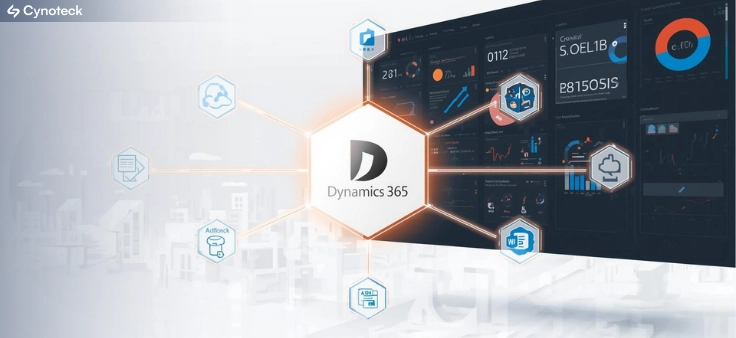
Book a Free ConsultationMicrosoft Dynamics 365 for healthcare is the application of Microsoft's Dynamics 365 suite including Dynamics 365 Customer Service, Sales, Field Service, Finance, and Business Central — to the needs of healthcare organizations. It is further extended by Microsoft Cloud for Healthcare, which layers healthcare-specific capabilities on top of the core Dynamics 365 platform.
Together, these solutions give healthcare providers a 360-degree view of every patient, caregiver, and operational process across the organization. Rather than managing patient engagement in one system, billing in another, and staff scheduling in a third, Dynamics 365 consolidates everything into a single, connected platform built on the Microsoft Azure cloud.
Unlike traditional healthcare IT systems, Dynamics 365 is highly configurable and extensible. With the Microsoft Power Platform — including Power Apps, Power Automate, and Power BI — healthcare organizations can build custom workflows, automate repetitive tasks, and visualize real-time performance data without writing a single line of code.
Know more about Dynamics 365: What is Dynamics 365?
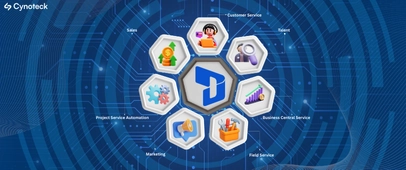
Dynamics 365 Customer Service: Powers patient contact centers, case management, and multi-channel patient engagement.
Dynamics 365 Sales: Supports healthcare sales teams, referral management, and provider relationship management.
Dynamics 365 Field Service: Manages home health visits, medical device maintenance, and mobile care teams.
Dynamics 365 Finance: Automates billing, claims processing, financial reporting, and revenue cycle management.
Dynamics 365 Business Central: Provides an all-in-one ERP solution ideal for mid-sized healthcare organizations.
Microsoft Cloud for Healthcare: Adds FHIR-based data models, patient engagement tools, virtual care, and care management on top of Dynamics 365.
Power Platform: Enables custom apps, automated workflows, and analytics dashboards — all without heavy development effort.
Before exploring what Dynamics 365 offers, it is important to understand the specific pain points that healthcare organizations deal with every day. These challenges are exactly what Cynoteck's Dynamics 365 consulting services are designed to address.
Most healthcare organizations rely on a patchwork of systems — separate EHR platforms, billing software, appointment schedulers, and communication tools — that do not talk to one another. This fragmentation means that a physician, a billing specialist, and a care coordinator may each see a different, incomplete picture of the same patient. Errors, delays, and gaps in care are the predictable result.
Healthcare is one of the most heavily regulated industries in the world. In the United States, organizations must comply with HIPAA and HITECH regulations. In other regions, equivalent frameworks govern how patient data can be stored, accessed, and shared. Failing to comply can result in significant financial penalties and reputational damage. Many legacy systems struggle to maintain the audit trails, access controls, and encryption standards required by modern regulations.
Patient engagement is a major challenge. Without automated reminders, self-service portals, and personalized outreach, appointment no-show rates remain high, patients disengage from their care plans, and healthcare providers lose revenue. Many organizations lack the digital tools to proactively communicate with patients across email, SMS, and online channels.
Administrative workloads continue to increase. Clinical staff spend enormous amounts of time on manual data entry, chasing referrals, managing authorizations, and coordinating care. This administrative burden contributes directly to staff burnout — one of the most pressing workforce challenges in healthcare today. Automation and streamlined workflows are essential to giving clinical teams back the time they need to focus on patient care.
Healthcare billing and revenue cycle management is complex. Manual claims processing, slow insurance verification, and fragmented financial data create delays in reimbursement, increase error rates, and create cash flow problems. Many organizations lack real-time visibility into their financial performance, making it difficult to identify and address revenue leakage.
Referral leakage — when patients referred to specialists within a health network follow up with outside providers — is a significant source of revenue loss. Without systems that actively track, manage, and follow up on referrals, healthcare organizations lose both revenue and continuity of care. Dynamics 365 helps close this gap by giving care coordinators real-time visibility into referral status and automating follow-up outreach.
Many healthcare organizations struggle to turn their data into actionable insights. Data is spread across multiple systems, and generating meaningful reports often requires manual effort from IT teams. Without real-time analytics, clinical and operational leaders cannot easily identify trends, spot problems early, or measure the impact of improvement initiatives.
Integrating new technology with existing Electronic Health Record (EHR) and Electronic Medical Record (EMR) systems — such as Epic, Cerner, and Athena — is one of the most complex challenges in healthcare IT. Poor interoperability limits the value of new digital tools and forces clinicians to switch between multiple platforms, reducing efficiency and increasing the risk of data errors.
The explosive growth of telehealth and remote patient monitoring, accelerated by the COVID-19 pandemic, has created new operational demands. Healthcare providers need platforms that can support virtual consultations, remote monitoring data, and digital care coordination — all while maintaining security and compliance. Many traditional systems were not built for this reality.
Managing the healthcare supply chain — from medical devices and consumables to pharmaceuticals and equipment maintenance — is a complex operational challenge. Poor visibility into inventory, equipment status, and supplier relationships leads to shortages, waste, and unnecessary cost.
Speak with our specialists to explore the right implementation strategy.
Book a Free ConsultationMicrosoft Dynamics 365 addresses every one of the challenges listed above through a combination of built-in CRM and ERP capabilities, AI-powered tools, and seamless integration with the broader Microsoft ecosystem. Here is how specific Dynamics 365 features map to the most critical healthcare problems:
Dynamics 365 breaks down data silos by consolidating patient information from multiple sources into a single, centralized platform. Clinicians, care coordinators, and administrative staff all work from the same real-time view of the patient — including medical history, appointments, communications, care plans, billing records, and more. This unified view reduces errors, improves care coordination, and ensures that every member of the care team has the information they need.
Microsoft has made compliance a foundational element of Dynamics 365. The platform supports HIPAA-compliant data handling, and Dynamics 365 Contact Center has recently achieved HITRUST r2 certification — one of the most rigorous standards for healthcare data security in cloud environments. Role-based access controls, end-to-end encryption, comprehensive audit logs, and Microsoft Azure's enterprise-grade security infrastructure give healthcare organizations the confidence to manage Protected Health Information (PHI) securely and remain audit-ready at all times.
Dynamics 365 Customer Service and Marketing enable healthcare organizations to automate multi-channel patient communications across email, SMS, and patient portals. Automated appointment reminders dramatically reduce no-show rates. Personalized outreach helps patients stay engaged with their care plans and follow-up appointments. AI-powered tools can identify at-risk patients and trigger proactive interventions before conditions deteriorate.
Power Automate, integrated with Dynamics 365, enables healthcare organizations to automate hundreds of repetitive administrative tasks — from patient intake and referral routing to prior authorization requests and discharge follow-ups. By eliminating manual work from these processes, clinical staff can redirect their time to patient care. Automation also reduces human error and ensures consistent, standardized workflows across the organization.
Dynamics 365 Finance automates billing, claims processing, insurance verification, and financial reporting. Healthcare organizations gain real-time visibility into their revenue cycle, making it easier to identify and close revenue leakage, accelerate reimbursement timelines, and maintain accurate financial records. Automated workflows eliminate manual claims entry, reducing errors and speeding up the billing cycle.
Dynamics 365 gives care coordinators real-time visibility into referral status, enabling them to actively track, manage, and follow up on referrals before patients seek care outside the network. Automated alerts notify coordinators when a referral has not been acted upon, and workflow automation can trigger follow-up communications automatically. This directly addresses referral leakage and improves both revenue retention and continuity of care.
Power BI, deeply integrated with Dynamics 365, gives healthcare leaders real-time access to clinical, operational, and financial performance data through intuitive dashboards and visualizations. From patient outcomes and appointment utilization to financial KPIs and staff productivity metrics, leadership teams can make data-driven decisions faster and with greater confidence. Predictive analytics capabilities help identify trends and risks before they become problems. Know more about Power BI.
Microsoft Cloud for Healthcare uses the Fast Healthcare Interoperability Resources (FHIR) data standard to enable seamless integration between Dynamics 365 and leading EHR and EMR systems, including Epic, Cerner, and Athena. This interoperability means that patient data flows between clinical and operational systems without manual re-entry, reducing errors and giving the entire care team a consistent, up-to-date view of each patient.
Dynamics 365, in combination with Microsoft Teams and Microsoft Cloud for Healthcare, enables healthcare organizations to deliver fully integrated virtual care experiences. Patients can schedule and join video appointments directly from a patient portal, and care teams can collaborate securely within the same platform. Clinical notes from virtual visits are automatically captured and associated with the patient record in the system.
Dynamics 365 Field Service and Supply Chain Management give healthcare organizations real-time visibility into medical device status, maintenance schedules, and supply chain performance. Automated maintenance alerts prevent unexpected equipment downtime. Inventory tracking ensures that critical supplies are always available when needed, while procurement workflows reduce waste and control costs.
We provide CRM, AI, and App Solutions that deliver growth from day one.
Book a Free ConsultationAt its core, Dynamics 365 functions as a healthcare CRM that manages every aspect of the patient relationship — from first contact and onboarding through ongoing care, follow-up, and long-term engagement. Patient profiles store comprehensive information including demographics, medical history, communication preferences, care plans, and interaction history. Care teams can use this data to deliver personalized, proactive care rather than reactive treatment.
Dynamics 365 streamlines appointment scheduling with tools that allow patients to self-schedule via online portals while giving staff full visibility into appointment calendars across departments and care teams. Automated reminder sequences — combining email, SMS, and portal notifications — ensure patients arrive prepared for their appointments, reducing no-show rates and improving departmental efficiency.
Microsoft Cloud for Healthcare includes dedicated care management capabilities that allow care coordinators to build, assign, and monitor personalized care plans for individual patients. Care plans can include tasks, goals, observations, and follow-up actions, all of which are tracked in real time within the platform. Care teams across different locations and specialties can collaborate on a patient's care plan without confusion or duplication.
Dynamics 365 Contact Center gives healthcare organizations an AI-powered, omnichannel patient contact solution. Patients can reach the contact center via voice, chat, email, or SMS, and the system automatically routes them to the appropriate team or agent based on the nature of their inquiry. AI-powered virtual agents handle routine inquiries — such as appointment confirmations, prescription refill requests, and general information — freeing human agents to focus on complex cases. With HITRUST certification, the contact center meets the highest standards for healthcare data security.
Dynamics 365 Field Service enables healthcare organizations to coordinate and manage home health visits, remote patient monitoring programs, and mobile care teams. Caregivers access patient records, care plans, and documentation tools from mobile devices in the field, and updates sync in real time with the central system. Supervisors and care managers can monitor visit completion, patient status, and field team performance from a central dashboard.
Intelligent scheduling tools within Dynamics 365 Field Service optimize staff assignments based on patient needs, caregiver skills, geographic location, and availability. By reducing scheduling conflicts and ensuring the right care team member is assigned to each patient, healthcare organizations can improve care quality while reducing overtime and burnout.
Dynamics 365 Field Service manages the full lifecycle of medical equipment — from procurement and installation to routine maintenance, servicing, and end-of-life replacement. Automated maintenance alerts are triggered based on usage data and manufacturer schedules, ensuring that equipment is always in optimal condition. Maintenance history is logged for every device, providing a complete audit trail.
Dynamics 365 Finance delivers comprehensive revenue cycle management for healthcare organizations. The platform automates the entire billing and claims workflow — from charge capture and claim submission to payment posting and denial management. Financial dashboards provide real-time visibility into revenue performance, outstanding balances, and key financial KPIs. Budget planning and forecasting tools help healthcare finance teams plan proactively.
Microsoft Copilot is now integrated throughout Dynamics 365, providing AI-powered assistance to healthcare staff across every function. Copilot can summarize patient histories, draft communications, suggest next best actions for care teams, generate reports from natural language prompts, and flag anomalies in clinical or financial data. These AI capabilities reduce the cognitive load on staff and help healthcare organizations operate more intelligently at scale.
Dynamics 365 supports remote nursing education and professional development programs by providing a platform for delivering, tracking, and certifying training modules. HR teams can assign training, monitor completion, and automatically update certification records. Clinical quality teams can analyze training outcomes and identify areas where additional education is needed to improve patient care standards.
Connect with Cynoteck to build a secure and scalable Dynamics 365 solution.
Book a Free ConsultationMicrosoft Cloud for Healthcare is the most comprehensive expression of Microsoft's commitment to the health sector. It extends the capabilities of Dynamics 365 with purpose-built healthcare solutions, all built on the secure foundation of Microsoft Azure.
Patient engagement tools including intelligent outreach, virtual appointments, and patient self-service portals
Care management capabilities including care planning, care team coordination, and remote patient monitoring
Health data services including a FHIR-based data model for healthcare interoperability
Clinical analytics and AI-powered insights built on Azure Health Data Services
Integration with Microsoft Teams for care team collaboration and virtual care delivery
Compliance and security capabilities including HIPAA support and HITRUST certification for specific services
One of the most significant capabilities of Microsoft Cloud for Healthcare is its use of the FHIR (Fast Healthcare Interoperability Resources) standard for healthcare data exchange. FHIR enables Dynamics 365 to connect with EHR and EMR systems, medical devices, health information exchanges, and other clinical platforms — creating a longitudinal patient record that spans the entire care journey. For healthcare organizations struggling with data silos and interoperability challenges, FHIR-based integration is a transformative capability.
This module is the foundation of patient relationship management in Dynamics 365. It manages all patient interactions, case management, appointment coordination, and multi-channel communication. Healthcare contact centers built on Dynamics 365 Customer Service can handle thousands of patient interactions daily, routing inquiries intelligently and ensuring consistent, high-quality responses.
Healthcare is not immune to commercial pressures. Hospital networks, pharmaceutical companies, medical device manufacturers, and healthcare services businesses all need effective tools to manage provider relationships, referral pipelines, and business development activities. Dynamics 365 Sales gives healthcare sales and business development teams a complete view of every relationship, opportunity, and pipeline stage.
For organizations that deliver care in the field — home health agencies, community health organizations, medical device companies — Dynamics 365 Field Service is an essential tool. It manages mobile care teams, optimizes scheduling, tracks equipment and supplies, and enables real-time coordination between field staff and central operations.
Healthcare finance is complex. Dynamics 365 Finance addresses every dimension of that complexity — from multi-entity financial consolidation and cost center accounting to claims management, billing automation, and regulatory reporting. Healthcare CFOs and finance teams gain real-time visibility and tighter control over financial performance.
For mid-sized healthcare organizations — specialty clinics, diagnostic centers, rehabilitation facilities, and similar organizations — Dynamics 365 Business Central offers a comprehensive, all-in-one ERP solution that combines financials, operations, purchasing, inventory, and patient service management in a single platform that is easier to implement and manage than the enterprise-tier Dynamics 365 modules.
Get expert guidance from our Dynamics 365 consultants.
Book a Free ConsultationOne of the most powerful aspects of Dynamics 365 for healthcare is its ability to integrate with the broader ecosystem of healthcare technology. Cynoteck's Dynamics 365 development services include building and managing these integrations.
Dynamics 365 integrates with major EHR and EMR platforms including Epic, Cerner, and Athena Health using FHIR-based APIs. This integration creates a bidirectional flow of patient data between the clinical record and the operational CRM/ERP, eliminating data re-entry and ensuring consistency across systems.
Azure IoT Hub connects medical devices and remote monitoring equipment to Dynamics 365, enabling healthcare organizations to capture real-time patient vital signs, device usage data, and alerts directly within the patient record. This is particularly valuable for remote patient monitoring programs and post-discharge care management.
The deep integration between Dynamics 365 and Microsoft Teams enables care teams to collaborate, consult, and coordinate directly within the platform — without switching to a separate communication tool. Virtual appointments can be launched from within a patient record, and meeting notes can be automatically captured and associated with the patient's file.
Power BI connects to Dynamics 365 data to create real-time clinical, operational, and financial dashboards. Healthcare leadership teams gain instant visibility into performance metrics across departments, facilities, and care programs — enabling faster, more confident decision-making.
Dynamics 365's open API architecture and extensive connector library make it easy to integrate with a wide range of third-party healthcare applications — from laboratory information systems and radiology platforms to insurance portals and health information exchanges.
Let our team help you create a smarter patient-centered ecosystem.
Book a Free ConsultationFor healthcare organizations, compliance is not optional. Dynamics 365 and Microsoft Azure are built with a compliance-first architecture that gives healthcare organizations the tools and documentation needed to meet regulatory requirements across multiple jurisdictions.
Microsoft offers a Business Associate Agreement (BAA) for Dynamics 365 services, making the platform suitable for handling Protected Health Information (PHI) under HIPAA. Role-based access controls ensure that only authorized personnel can access sensitive patient data. Comprehensive audit logs track every data access and modification event for compliance and investigation purposes.
Dynamics 365 Contact Center has achieved HITRUST r2 certification, one of the most rigorous healthcare data security standards in the industry. This certification covers AI-powered interactions, multi-channel patient communications, and human agent escalations — giving healthcare organizations confidence that their patient contact operations meet the highest security standards.
In addition to healthcare-specific certifications, Microsoft Dynamics 365 is covered by a comprehensive portfolio of security and compliance certifications including ISO 27001, SOC 1, SOC 2, and FedRAMP — providing a strong foundation for healthcare organizations operating across different regulatory environments.
Microsoft Azure's global cloud infrastructure gives healthcare organizations the ability to store and process data in specific geographic regions, supporting data residency requirements in the European Union, United Kingdom, Australia, and other regulated markets.
The impact of Dynamics 365 in healthcare is best understood through real-world examples of organizations that have transformed their operations with the platform.
This UK hospital, which manages over 300,000 outpatient appointments annually, deployed Microsoft Power Platform and Microsoft Teams to create an integrated virtual consultation system. The hospital eliminated the need for rekeying patient information between systems, reduced administrative burden significantly, and improved both patient and clinician satisfaction with the quality of remote consultations.
One of only 31 freestanding children's hospitals in the United States, Dayton Children's implemented Dynamics 365 Customer Insights to unify 150,000 patient profiles and millions of call log interactions into a HIPAA-compliant data foundation. The result was a dramatically improved 360-degree view of each patient, enabling more personalized care coordination and marketing outreach.
This Canadian healthcare company used Microsoft Power Platform and Dynamics 365 to build a cloud-based platform for managing low-back pain care pathways. The result was an 80% reduction in patient wait times for specialist appointments and dramatically improved access to local care for thousands of patients across Ontario.
FNHA, which provides community health services to over 200 First Nations communities across British Columbia, implemented Dynamics 365 Customer Service and Power Platform to automate crisis support and health benefits operations. The solution enabled real-time data capture, improved care coordination for remote communities, and achieved high user satisfaction across the organization.
Implementing Dynamics 365 in a healthcare environment is not simply a technology project, it is a complex business transformation that requires deep knowledge of both the Microsoft platform and the specific operational, clinical, and regulatory requirements of the healthcare sector. Cynoteck Technology Solutions brings both.
Cynoteck is a dedicated Microsoft Dynamics 365 solution partner with years of experience delivering Dynamics 365 development and consulting services across industries. Our certified Dynamics 365 consultants understand every module of the platform — from Customer Service and Field Service to Finance and Business Central — and know how to configure, customize, and extend them to meet healthcare-specific requirements.
Our Dynamics 365 consultants for the healthcare industry bring domain expertise that goes beyond the technology. We understand the patient journey, the operational pressures on clinical and administrative teams, the complexity of healthcare billing and compliance, and the interoperability challenges that come with integrating new platforms alongside existing EHR and EMR systems. This industry knowledge shapes every recommendation and implementation decision we make.
Cynoteck's Dynamics 365 development services cover the complete implementation lifecycle — from initial discovery and requirements analysis through design, development, testing, training, go-live support, and ongoing optimization. We build custom Dynamics 365 solutions tailored to the specific needs of each healthcare organization, including custom workflows, integrations, Power Apps, and Power BI dashboards.
Integrating Dynamics 365 with existing clinical systems is one of the most technically challenging aspects of any healthcare implementation. Cynoteck has the development expertise to build and manage FHIR-based integrations between Dynamics 365 and major EHR/EMR platforms including Epic, Cerner, and Athena, as well as custom integrations with proprietary clinical systems.
Cynoteck's healthcare implementations are designed with compliance as a foundational requirement, not an afterthought. We configure Dynamics 365 with the access controls, audit logging, data encryption, and security policies required to support HIPAA compliance and other applicable regulatory frameworks from day one.
The relationship with Cynoteck does not end at go-live. We provide ongoing support, system optimization, and continuous improvement services to ensure that your Dynamics 365 healthcare solution keeps pace with your organization's growth, evolving requirements, and new Microsoft platform capabilities.
Dynamics 365 healthcare implementation and configuration
Dynamics 365 CRM consulting for patient engagement and care coordination
Dynamics 365 Finance implementation for healthcare revenue cycle management
Dynamics 365 Field Service for home healthcare and medical device management
Microsoft Cloud for Healthcare deployment and customization
FHIR-based EHR/EMR integration development
Power Platform development (Power Apps, Power Automate, Power BI) for healthcare
Healthcare data migration and legacy system consolidation
Dynamics 365 upgrade and modernization services
Ongoing Dynamics 365 managed support services for healthcare organizations
Start your transformation journey today.
Book a Free ConsultationInvesting in Dynamics 365 for healthcare delivers measurable returns across multiple dimensions of organizational performance. Here is a summary of the key ROI drivers that Cynoteck helps healthcare organizations achieve:
Reduced No-Show Rates: Automated appointment reminders and patient outreach significantly reduce appointment no-shows, recovering revenue and improving care continuity.
Improved Staff Productivity: Workflow automation and AI-powered tools reduce administrative burden, enabling clinical and operational staff to focus on higher-value activities.
Faster Revenue Cycle: Automated billing, claims management, and insurance verification accelerate reimbursement timelines and reduce accounts receivable days.
Lower IT Costs: Consolidating multiple point solutions onto a single Microsoft platform reduces licensing costs, integration complexity, and IT maintenance burden.
Better Clinical Outcomes: 360-degree patient visibility, automated care plan management, and proactive patient engagement contribute to better adherence and improved health outcomes.
Regulatory Risk Reduction: Built-in compliance tools, audit logging, and Microsoft's comprehensive certification portfolio reduce the risk of regulatory penalties.
Scalable Growth: Microsoft Azure's cloud infrastructure scales with the organization — whether expanding to new facilities, adding new care programs, or growing patient volumes.
A successful Dynamics 365 healthcare implementation requires careful planning, stakeholder alignment, and phased execution. Here is the approach Cynoteck follows with healthcare clients:
We begin every engagement with a deep discovery process — understanding your organization's current technology landscape, operational challenges, compliance requirements, and strategic goals. We map existing workflows, identify integration requirements, and define the scope and success criteria for the implementation.
Based on the discovery findings, our Dynamics 365 healthcare consultants design a solution architecture that maps the right Dynamics 365 modules, configurations, and customizations to your specific requirements. We present a phased implementation roadmap that delivers value quickly while building toward the full solution.
Our Dynamics 365 development team builds and configures the solution — customizing the platform, building integrations, developing Power Apps and Power Automate workflows, and creating Power BI dashboards. All development work is tested rigorously in a dedicated sandbox environment before deployment.
We design and execute data migration plans to move patient, financial, and operational data from legacy systems into Dynamics 365 — ensuring data accuracy, completeness, and integrity throughout the migration process.
User adoption is critical to the success of any Dynamics 365 implementation. Cynoteck provides comprehensive training for all user roles — from clinical staff and care coordinators to finance teams and administrators — and supports change management activities to drive engagement and adoption.
We manage the go-live process carefully, providing hypercare support in the immediate post-launch period to resolve any issues quickly. After go-live, we transition to our ongoing managed support model, providing monitoring, optimization, and continuous improvement services.
Dynamics 365 for healthcare refers to the application of Microsoft's Dynamics 365 suite of business applications to the needs of healthcare organizations. It combines CRM capabilities for patient engagement and relationship management with ERP capabilities for financial management, supply chain, and operations. Extended by Microsoft Cloud for Healthcare, Dynamics 365 provides a comprehensive, cloud-based platform for managing the full patient journey and all healthcare operational processes.
Yes. Microsoft offers a Business Associate Agreement (BAA) for Dynamics 365 services, which is a requirement for HIPAA compliance when using cloud-based platforms to process or store Protected Health Information (PHI). Dynamics 365 includes the access controls, audit logging, encryption, and security features needed to support HIPAA compliance. Additionally, Dynamics 365 Contact Center has achieved HITRUST r2 certification.
Microsoft Cloud for Healthcare uses FHIR (Fast Healthcare Interoperability Resources) APIs to enable bidirectional data exchange between Dynamics 365 and major EHR/EMR systems including Epic, Cerner, and Athena. Cynoteck's Dynamics 365 development team also builds custom integrations using Azure API Management and Logic Apps for proprietary or legacy clinical systems.
Dynamics 365 is the core business application platform that includes modules for CRM, ERP, field service, and more. Microsoft Cloud for Healthcare is a purpose-built extension layer that adds healthcare-specific capabilities — such as care management, FHIR-based data models, virtual care tools, and patient engagement features — on top of the Dynamics 365 platform and the broader Microsoft cloud ecosystem.
Implementation timelines vary depending on the scope of the project, the number of modules being deployed, and the complexity of integrations required. A focused implementation of a single module — such as Dynamics 365 Customer Service for a patient contact center — can be completed in as little as eight to twelve weeks. A full enterprise implementation covering CRM, ERP, field service, and EHR integration may take six to eighteen months. Cynoteck uses a phased approach to deliver value incrementally throughout the implementation.
Cynoteck Technology Solutions provides end-to-end Dynamics 365 consulting and development services for healthcare organizations. We help with everything from initial strategy and solution design through implementation, integration, training, and ongoing support. Our Dynamics 365 consultants for the healthcare industry bring both deep platform expertise and healthcare domain knowledge to every engagement. Contact us to schedule a free consultation.
Referral leakage occurs when patients who are referred to specialists within a healthcare network seek care outside the network instead, resulting in revenue loss and fragmented care. Dynamics 365 addresses referral leakage by giving care coordinators real-time visibility into referral status, automating follow-up communications with patients who have not yet acted on referrals, and providing analytics that identify where and why leakage is occurring.
Absolutely. While large hospital networks and health systems benefit from the full enterprise capabilities of Dynamics 365, smaller healthcare organizations — including specialty clinics, rehabilitation centers, home health agencies, and diagnostic labs — can achieve significant benefits from Dynamics 365 Business Central or targeted deployments of Dynamics 365 Customer Service or Field Service. Microsoft's cloud-based licensing model means organizations only pay for what they use.
The healthcare industry is at a critical inflection point. Patient expectations are rising, operational pressures are intensifying, regulatory requirements are growing more complex, and the pace of digital transformation is accelerating. Healthcare organizations that continue to rely on fragmented, legacy systems will find it increasingly difficult to deliver the quality of care, operational efficiency, and financial performance they need to thrive.
Microsoft Dynamics 365 for healthcare offers a proven, comprehensive, and scalable platform for transforming every aspect of healthcare operations — from patient engagement and care management to revenue cycle, supply chain, and compliance. Built on the secure foundation of Microsoft Azure, and extended by Microsoft Cloud for Healthcare, Dynamics 365 gives healthcare organizations the tools they need to compete and excel in a rapidly changing environment.
At Cynoteck Technology Solutions, we combine deep Dynamics 365 platform expertise with healthcare industry knowledge to deliver implementations that create real, measurable value. Whether you are looking to improve patient engagement, streamline billing, integrate your EHR system, or build a modern healthcare contact center, our Dynamics 365 consultants for the healthcare industry are ready to help.
Ready to transform your healthcare organization with Dynamics 365? Contact Cynoteck today for a free consultation and let us show you what is possible.
About Cynoteck Technology Solutions
Cynoteck Technology Solutions is a leading Microsoft Soluiton Partner specializing in Dynamics 365 development services and Dynamics 365 consulting services. We help businesses across industries — including healthcare, manufacturing, retail, and professional services — design, implement, and optimize Microsoft Dynamics 365 solutions that drive measurable business value. Our certified Dynamics 365 consultants bring deep platform expertise and industry knowledge to every engagement, ensuring that your Dynamics 365 investment delivers lasting results.

Discover the top 10 benefits of custom CRM software development for modern businesses. Learn how tailored CRM solutions improve efficiency, enhance customer relationships, and drive business growth.

Microsoft Dynamics 365 vs Microsoft Power Apps. Explore their key differences, real-world use cases, pricing insights, and expert guidance from Cynoteck to help you choose the right Microsoft solution in 2026.
We are more than just developers and consultants—we are your partners in navigating the digital landscape. Let us be the engine behind your next big success while you focus on your core vision.
Explore Opportunities!