What is Microsoft Dynamics 365 CRM? A Brief Overview and Explanation
What’s in the ArticleMicrosoft Dynamics 365 is a cloud-based suite of CRM and ERP applications that helps businesses connect sales, customer service, finance, supply chain, operations, and other business processes. This comprehensive guide explains:
|
Microsoft Dynamics 365 is Microsoft's portfolio of connected CRM and ERP business applications. Instead of being one single software product, Dynamics 365 consists of multiple applications designed for specific business functions, including sales, customer service, finance, supply chain management, field service, commerce, and business management.
Organizations can deploy the applications independently or connect them to share data and business processes across departments. This makes Dynamics 365 suitable for organizations that want to manage customer relationships and back-office operations within a connected Microsoft ecosystem.
The name Dynamics 365 refers to Microsoft's broader family of business applications. The "Dynamics" product family historically included separate CRM and ERP products, while Dynamics 365 brings these capabilities together into a connected cloud application ecosystem.
In practical terms, Dynamics 365 can be thought of as a collection of applications that help a business manage two major areas:
CRM: Sales, customer service, marketing, customer engagement, and field service.
ERP: Finance, supply chain, commerce, operations, and other core business processes.
The applications can work independently or together, allowing organizations to build a Dynamics 365 environment around their particular business requirements.
Microsoft Dynamics 365 is both a CRM and an ERP platform. Its CRM applications support customer-facing processes such as sales and customer service, while its ERP applications manage areas such as finance, supply chain, and business operations.
For example, a company could use Dynamics 365 Sales to manage leads and opportunities while using Dynamics 365 Finance for financial operations. These applications can be connected so relevant business information can move between processes.
This is one of the major differences between Dynamics 365 and a standalone CRM: organizations can create a broader business platform instead of managing customer and operational systems completely separately.
Dynamics 365 works through a collection of connected cloud applications, business data, workflows, integrations, analytics, and AI capabilities.
A simplified model looks like this:
Business processes → Dynamics 365 applications → Shared business data → Automation and analytics → AI-powered insights and actions
A company might use Dynamics 365 Sales for its sales team, Customer Service for support representatives, and Finance or Supply Chain Management for back-office operations. These applications can be connected with other Microsoft technologies and existing business systems.
The modular approach means a business does not necessarily need to implement every Dynamics 365 application at once.
From licensing and solution design to customization, integration, data migration, and deployment, the right implementation strategy can make a significant difference. Connect with Cynoteck to discuss your Dynamics 365 implementation requirements and get guidance based on your business needs.
Book a Free ConsultationMicrosoft Dynamics 365 is used to manage customer relationships, sales, customer service, finance, supply chain, field operations, commerce, projects, and other business processes. Organizations can use separate applications for specific functions or connect several applications to create a broader business management environment.
Dynamics 365 Sales helps sales teams manage leads, accounts, contacts, opportunities, activities, pipelines, and customer interactions.
AI and automation can also assist sellers with tasks such as summarizing opportunities, providing insights, supporting communication, and identifying recommended actions.
Dynamics 365 Customer Service helps organizations manage customer cases, service interactions, knowledge, self-service, and customer support processes.
The platform also incorporates AI capabilities designed to help service representatives resolve issues and work more efficiently.
Dynamics 365 Finance is designed for financial management and related business operations.
Organizations can use it to manage financial processes, reporting, accounting operations, and other enterprise financial requirements. Microsoft also incorporates AI and agent capabilities into its finance and ERP strategy.
Dynamics 365 Supply Chain Management helps organizations manage supply chain processes such as inventory, procurement, planning, fulfillment, and related operations.
Its capabilities include AI and machine learning, demand planning, supply chain analytics, and agent-based capabilities in applicable plans.
Dynamics 365 Field Service is designed for organizations that send technicians or other frontline workers to customer locations.
It can support scheduling, work orders, service delivery, resource management, and field operations, with Microsoft incorporating generative AI, IoT, and mixed-reality capabilities into its broader field-service offering.
Dynamics 365 Customer Insights supports customer data and customer journey capabilities, helping organizations connect customer information with engagement activities.
Microsoft describes Customer Insights as a way to unify customer data and support real-time journeys and AI-assisted customer engagement.
Dynamics 365 Project Operations helps organizations manage project-based work, including project planning, resource management, project financials, and related operational processes.
For smaller and midsize organizations looking for broader business management capabilities, Dynamics 365 Business Central combines finance, sales, service, and operations in one solution.
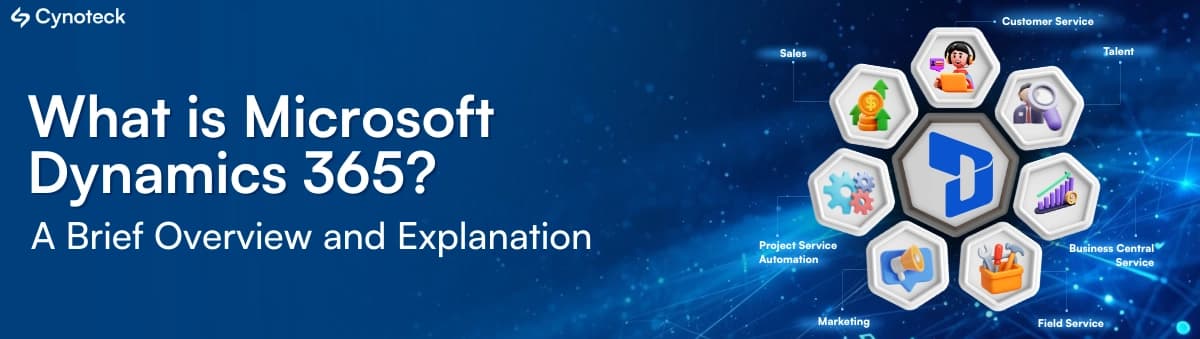
Microsoft Dynamics 365 includes multiple business applications, each designed for specific customer-facing or operational functions. Businesses can choose individual applications or combine several applications based on their requirements.
Dynamics 365 Sales: Dynamics 365 Sales is the CRM application for managing sales activities, customer relationships, opportunities, pipelines, and seller productivity. It also includes AI-powered capabilities and Microsoft 365 integration.
Dynamics 365 Customer Service: Dynamics 365 Customer Service helps organizations manage customer support, cases, knowledge, self-service, and service interactions, with AI capabilities designed to assist representatives and improve resolution processes.
Dynamics 365 Field Service: Dynamics 365 Field Service supports organizations that deliver services at customer locations. It helps coordinate field workers, scheduling, work orders, resources, and service operations.
Dynamics 365 Finance: Dynamics 365 Finance provides financial management capabilities for organizations that need to manage financial operations, accounting, reporting, and related enterprise processes.
Dynamics 365 Supply Chain Management: Dynamics 365 Supply Chain Management supports supply chain planning, inventory, procurement, fulfillment, and operational processes. It also incorporates AI and advanced planning capabilities.
Dynamics 365 Business Central: Dynamics 365 Business Central is Microsoft's business management solution aimed particularly at small and midsize businesses. It brings together finance, sales, service, operations, inventory, purchasing, projects, and other business management functions.
Dynamics 365 Commerce: Dynamics 365 Commerce supports retail and commerce operations, including customer engagement, retail processes, and connected commerce experiences. It is part of Microsoft's broader Dynamics 365 application ecosystem.
Dynamics 365 Project Operations: Dynamics 365 Project Operations supports project-based organizations with capabilities for managing projects, resources, project financials, and related business processes.
Dynamics 365 Human Resources: Dynamics 365 Human Resources supports employee and workforce-related processes, helping organizations manage HR information and related employee operations within the wider Dynamics ecosystem.
Whether you are evaluating Dynamics 365 for the first time, replacing an existing CRM or ERP, or looking to optimize your current system, Cynoteck Technology Solutions can help. Our Microsoft Dynamics 365 team provides consulting, implementation, customization, integration, migration, training, and ongoing support.
Talk to our Dynamics 365 experts today to discuss your requirements.The key features of Microsoft Dynamics 365 include CRM and ERP functionality, workflow automation, analytics, AI capabilities, business data integration, and connectivity with Microsoft's broader technology ecosystem.
Dynamics 365 provides capabilities for managing leads, opportunities, accounts, contacts, customer interactions, cases, service requests, and customer journeys.
ERP applications support financial management, supply chain, inventory, procurement, project operations, commerce, and other operational processes.
Organizations can automate repetitive business processes, approvals, notifications, assignments, and workflows. Power Platform technologies can also extend automation and low-code development capabilities around Dynamics 365.
Dynamics 365 connects business data with reporting, analytics, and AI-powered insights to help organizations understand performance and make data-informed decisions. Microsoft describes Dynamics 365 as an environment where connected data can support better decision-making across business functions.
AI is now a major component of Dynamics 365. Microsoft provides Copilot experiences, AI-powered capabilities, and agents across its CRM and ERP applications to help users analyze information, automate tasks, and make decisions.
Dynamics 365 is designed to work with other Microsoft technologies, including Microsoft 365 and Power Platform. This allows organizations to extend business applications, automate processes, create custom solutions, and connect data across systems.
AI in Microsoft Dynamics 365 combines Copilot experiences, built-in AI capabilities, and AI agents to analyze business information, assist employees, automate tasks, and support decision-making across CRM and ERP processes. Microsoft describes these capabilities as being integrated across Dynamics 365 applications rather than treating AI as a separate standalone feature.
Microsoft Copilot provides AI-assisted experiences within Dynamics 365 applications.
Depending on the application, Copilot can help users summarize information, generate content, analyze business data, provide recommendations, and assist with routine tasks.
For example, Dynamics 365 Sales includes capabilities such as opportunity summaries, natural-language insights, email and meeting assistance, and prebuilt sales agents in applicable plans.
AI can reduce the amount of manual work required from sales and service teams by bringing relevant information into the user's workflow.
For sales teams, this can include:
Opportunity summaries
Sales insights
Recommended actions
Email assistance
Data enrichment
Sales agents
For customer service teams, AI can support representatives with customer information, case management, knowledge, and service-related workflows.
Dynamics 365 AI agents are software agents designed to perform or assist with business tasks using AI, business data, and defined workflows.
Microsoft is expanding agent-based capabilities across Dynamics 365, with prebuilt agents available for specific scenarios and tools such as Copilot Studio available for creating custom agents.
The important distinction is that traditional automation generally follows predefined rules, while AI agents can interpret information and perform more complex, context-dependent tasks within defined business boundaries.
The main benefits of Microsoft Dynamics 365 are connected business processes, centralized access to business information, automation, AI-powered assistance, scalability, and integration with Microsoft's broader cloud ecosystem.
Connecting business applications can give teams better access to customer and operational information without requiring employees to work across completely disconnected systems.
Dynamics 365 can connect customer-facing processes with finance and operational workflows. For example, sales information can be connected with downstream financial and operational processes.
Organizations can automate repetitive processes, approvals, notifications, and workflows, reducing manual administrative work.
AI capabilities can analyze business information and provide summaries, recommendations, predictions, and other insights that help employees make faster decisions.
Dynamics 365 uses a modular model, meaning organizations can select the applications they need and expand their environment as requirements change.
Organizations already using Microsoft technologies can connect Dynamics 365 with products and services across the Microsoft ecosystem, including Microsoft 365, Power Platform, Azure, and related services.
Microsoft Dynamics 365 does not have one universal price because licensing varies by application, edition, user type, usage requirements, and additional capabilities. Implementation, customization, integrations, data migration, training, and ongoing support can also add to the total cost of a Dynamics 365 project.
Microsoft publishes separate pricing for individual Dynamics 365 applications rather than one single Dynamics 365 license.
The total cost can depend on:
Which Dynamics 365 application you need
Number and type of users
License edition
Required features
AI and Copilot usage
Additional agent or Copilot credits
Data and storage requirements
Customization
Third-party integrations
Data migration
Implementation services
Training
Ongoing support
For example, Microsoft currently lists separate plans for Dynamics 365 Sales, Customer Service, Finance, Supply Chain Management, and Business Central, with different capabilities and licensing models.
A common mistake is to consider only the software subscription when estimating the cost of Dynamics 365.
Licensing is the recurring software cost, while implementation covers the work required to configure, customize, integrate, migrate, test, deploy, and train users on the system.
For a complex implementation, services can therefore represent a significant part of the overall project investment.
Dynamics 365 can be more expensive and complex than a basic CRM because it can support sophisticated CRM, ERP, integration, automation, and enterprise business requirements. However, whether it is expensive depends on the applications selected, number of users, implementation scope, customization, and business value expected from the system.
For this reason, businesses should evaluate total cost of ownership and business requirements, rather than comparing only the monthly license price.
Microsoft Dynamics 365 competes with several CRM and ERP platforms, but the comparison depends heavily on what an organization needs from its business software.
Dynamics 365 and Salesforce are both major CRM platforms, but Dynamics 365 has a particularly strong connection to Microsoft's CRM, ERP, productivity, and cloud ecosystem.
Salesforce is widely focused on CRM and customer-facing applications, while Dynamics 365 can combine CRM applications with ERP applications such as Finance and Supply Chain Management.
The better choice depends on the organization's existing technology environment, CRM requirements, ERP requirements, integrations, customization needs, and implementation strategy.
Dynamics 365 generally targets more complex business processes and larger-scale CRM and ERP requirements, while HubSpot is known for an integrated CRM and marketing platform designed to be easier to adopt.
A business with relatively straightforward sales and marketing requirements may have different needs from an organization requiring complex finance, supply chain, field service, or enterprise integrations.
Dynamics 365 and SAP both provide enterprise business management capabilities, but they have different product ecosystems and implementation approaches.
Dynamics 365 can be particularly attractive to organizations already invested in Microsoft technologies, while SAP may be a stronger fit for organizations whose enterprise architecture and operational requirements are centered around SAP.
Business Central is itself a Microsoft Dynamics 365 application, not a separate competitor to Dynamics 365.
Business Central is designed primarily for small and midsize businesses and combines finance, sales, service, operations, inventory, projects, and other business management capabilities.
Larger organizations with more complex enterprise requirements may instead consider Dynamics 365 Finance, Supply Chain Management, and other enterprise applications.
Microsoft Dynamics 365 can be a strong fit for businesses that need connected CRM and ERP capabilities, complex workflow automation, Microsoft ecosystem integration, advanced customization, or a scalable business application environment.
However, it may not be necessary for organizations with very simple CRM requirements.
Dynamics 365 may be appropriate when your organization:
Needs CRM and ERP capabilities within a connected ecosystem
Has complex sales or customer service processes
Needs advanced financial or supply chain management
Already uses Microsoft 365, Azure, or Power Platform
Requires extensive customization and integration
Wants to introduce AI-assisted business processes
Needs a platform that can scale with business growth
Dynamics 365 may not be the best fit when:
You only need a basic CRM
Your business processes are very simple
You have limited customization requirements
You do not need extensive integrations
Your organization is not prepared for a structured implementation
The cost and complexity of an enterprise platform outweigh the expected benefits
The right decision should therefore be based on business requirements rather than the popularity of the platform alone.
Understanding Dynamics 365 is the first step. The next is determining which applications, integrations, and configurations fit your business. Talk to Cynoteck’s Microsoft Dynamics 365 experts to discuss your requirements and identify the right approach for your organization.
Book a Free ConsultationMicrosoft Dynamics 365 is a collection of CRM and ERP applications that helps businesses manage customers, sales, finance, operations, supply chains, service, and other business processes. Businesses can use individual applications or connect several applications together.
Yes. Dynamics 365 includes CRM applications such as Dynamics 365 Sales and Customer Service that help organizations manage customers, sales, service, and customer engagement.
Yes. Dynamics 365 also includes ERP applications such as Finance and Supply Chain Management, along with Business Central for small and midsize businesses.
Dynamics 365 is mainly used to manage customer relationships, sales, customer service, finance, supply chain, operations, field service, commerce, projects, and business management.
Yes. Dynamics 365 is primarily delivered as a cloud-based suite of business applications. Organizations can select the applications they need and connect them with other Microsoft and third-party systems.
Yes. Microsoft has integrated Copilot, AI capabilities, and AI agents across Dynamics 365 applications to assist with tasks, insights, automation, and decision-making.
Yes. Microsoft offers Dynamics 365 Business Central specifically for small and midsize businesses, while other Dynamics 365 applications can also be used depending on business requirements and scale.
There is no single Dynamics 365 price. Costs vary by application, license type, users, features, AI capabilities, implementation requirements, customization, integration, and support. Microsoft publishes separate pricing for individual Dynamics 365 applications.
There is no universal implementation timeline. A simple deployment can be considerably faster than a complex enterprise implementation involving multiple applications, customizations, integrations, data migration, testing, and user training.
The timeline should therefore be estimated after requirements and implementation scope have been defined.
Microsoft Dynamics 365 is a connected suite of CRM and ERP business applications that helps organizations manage customer relationships, sales, service, finance, supply chain, operations, and other core business processes. Its modular architecture allows businesses to select the applications they need while connecting data and workflows across departments.
The platform has also evolved beyond traditional CRM and ERP software by incorporating Copilot, AI-powered insights, automation, and AI agents into business processes.
For businesses already invested in the Microsoft ecosystem or organizations that need a scalable combination of CRM, ERP, automation, analytics, and AI—Dynamics 365 can provide a comprehensive foundation for managing and connecting business operations.

Discover the top 10 benefits of custom CRM software development for modern businesses. Learn how tailored CRM solutions improve efficiency, enhance customer relationships, and drive business growth.
We are more than just developers and consultants—we are your partners in navigating the digital landscape. Let us be the engine behind your next big success while you focus on your core vision.
Explore Opportunities! Dynamics 365 Sales Pricing, Features & Alternatives.webp)
.png)
 Microsoft Dynamics 365 Sales Professional vs Enterprise.webp)
 What Is the Sales Qualification Agent in Dynamics 365 Sales.webp)