Mobile App Development Cost by Country: USA vs India vs UAE (2026)
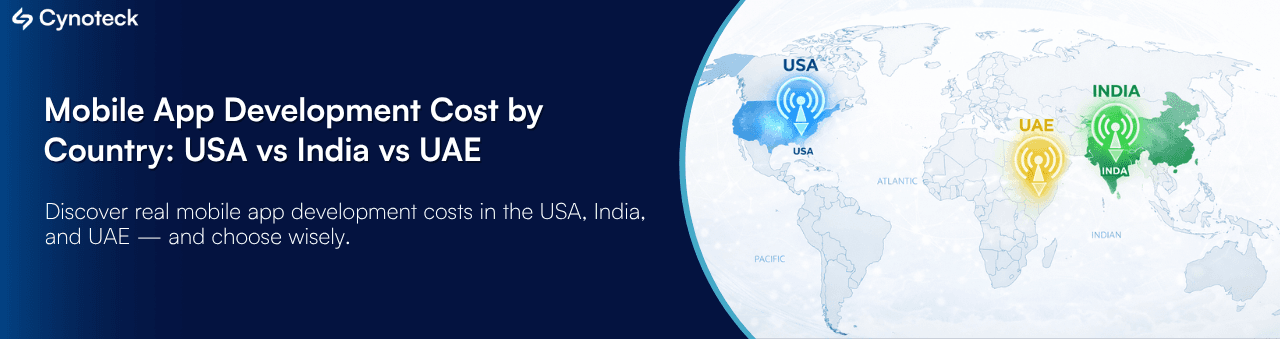
Trying to figure out where to build your mobile app — and how much it will actually cost? In this blog, we break down mobile app development costs across three major markets — the USA, India, and the UAE — so you can make a smarter, budget-aligned decision for your business in 2026.
You have a mobile app idea. You know you need developers. And then you check the first quote — and the number stops you cold.
Here is what most business owners discover quickly: the same app, built to the same standard, can cost three to five times more depending on which country builds it. Location is not just a logistics decision — it is one of the biggest financial decisions in your entire project.
Developing the same mobile app in the USA can cost three times more than building it in India, purely due to differences in labor costs and operating expenses. That gap is too large to ignore — and yet choosing solely on price often leads to regret.
This blog cuts through the confusion. We will look at what drives app development costs, compare the USA, India, and UAE side by side, and help you decide which market fits your specific situation. Let's now explore the full picture.
Before comparing countries, it helps to understand what actually drives the price tag — because location is only one piece of the equation.
In simple terms, your total mobile app development cost is a product of two things: how many hours your project requires, and what those hours cost per region. Everything else feeds into one of those two variables.
Here are the core factors that shape your budget:
App complexity — a basic informational app and an AI-powered fintech platform are not the same investment. Simple apps typically require 382–910 hours, mid-complexity apps need 555–1,310 hours, and advanced builds can exceed 2,100 hours.
Platform choice — building natively for both iOS and Android costs more than a cross-platform approach using Flutter or React Native
UI/UX design depth — custom animations, motion graphics, and complex visual systems add significant design hours
Backend infrastructure — apps requiring real-time data, cloud architecture, or third-party API integrations demand heavier backend work
Team structure — a full team of developers, designers, QA testers, and a project manager costs more than a small lean team
Post-launch maintenance — maintenance typically adds 15–25% of the original build cost annually, a figure many first-time app owners forget to budget for
Keep in mind that adding features late in development is expensive. Adding "just one more feature" late in the process often increases cost by two to five times due to rework. Scope discipline early is one of the most effective ways to control your final bill.
Every app is different — and so is every budget. If you want a clear, honest estimate based on your specific requirements, our team at Cynoteck can help you map out your scope and get a realistic number before you commit to anything.
Get a Free Cost EstimateBefore diving into each country in detail, here is a side-by-side snapshot to orient your thinking:
Factor | USA | India | UAE |
Average Hourly Rate | $100–$170 | $20–$60 | $60–$120 |
Simple App Cost | $50,000–$120,000 | $10,000–$35,000 | $30,000–$70,000 |
Mid-Complexity App | $120,000–$250,000 | $35,000–$80,000 | $60,000–$130,000 |
Complex / Enterprise App | $250,000–$500,000+ | $80,000–$150,000 | $130,000–$250,000 |
Talent Pool | Large, highly specialized | Very large, rapidly growing | Mid-sized, strong in fintech/AI |
Time Zone Convenience | Best for US-based clients | Overlaps with Europe & the Middle East | Bridges Asia, Europe & Middle East |
Communication | Native English | Strong English proficiency | Bilingual (English + Arabic) |
Regulatory Environment | CCPA, COPPA, HIPAA | DPDP Act (2026) | UAE PDPL, Smart Dubai initiatives |
Now, let's understand each market in detail.
The United States hosts the world's most mature app development ecosystem. From boutique agencies in Austin to large product studios in San Francisco and New York, the options are broad — and so is the pricing.
US mobile developer salaries have climbed steadily, with the average iOS/Android developer salary sitting at $142,000 annually as of early 2026. Senior developers in New York and San Francisco push past $200,000 with equity.
For project-based engagements, expect hourly rates in this range:
Experience Level | Hourly Rate (USD) |
Junior Developer | $80–$100 |
Mid-Level Developer | $100–$140 |
Senior Developer / Architect | $140–$170+ |
Agency Rate (Full Team) | $150–$200+ |
A US startup budgeting at $150 per hour might halve its development costs by partnering with a quality team in Eastern Europe or India while still maintaining high product quality. That comparison tells you something important: US rates are a genuine premium.
For context, the same app that costs $120,000 with a US agency may cost $45,000 to $70,000 with a strong offshore team in India — and that difference is not about quality; it is about hourly rates and operating costs.
Despite the higher cost, building in the USA has real advantages in specific situations:
Regulatory-sensitive industries — healthcare apps requiring HIPAA compliance, financial apps under SEC oversight, or children's apps navigating COPPA benefit from developers with deep, native knowledge of US regulations
Real-time collaboration — if your product team is US-based and needs daily standups, sprint reviews, and instant communication, a local team eliminates friction
IP and legal protection — US contracts, IP ownership frameworks, and NDAs are among the most enforceable in the world
Enterprise sales cycles — some enterprise buyers prefer vendors domiciled in the US for procurement and compliance reasons
You pay a premium — but you get local expertise, regulatory fluency, and seamless collaboration. For budget-conscious projects, the USA is rarely the most cost-effective choice.
India's rise in mobile app development is not a trend — it is a structural reality. India graduates over 1.5 million engineering professionals annually and hosts 13.2 million developers on GitHub, second only to the United States' 20 million.
That talent depth, combined with one of the lowest cost structures in the world, is why businesses from Silicon Valley startups to Fortune 500 enterprises route their app projects through Indian development teams.
Indian app developers typically charge 70% less than North American or Western European counterparts while maintaining equivalent quality standards. In 2026, that cost advantage has only strengthened as US and European developer salaries continue rising.
Experience Level | Hourly Rate (USD) |
Junior Developer | $20–$35 |
Mid-Level Developer | $35–$50 |
Senior Developer / Architect | $50–$80 |
Agency Rate (Full Team) | $25–$60 |
For full projects, here is what businesses typically budget when building in India:
App Type | Estimated Cost (India) |
Simple App (MVP) | $10,000–$35,000 |
Mid-Complexity App | $35,000–$80,000 |
Complex / Enterprise App | $80,000–$150,000+ |
The "India is cheap but risky" narrative is outdated. In 2026, top-tier Indian firms adhere to rigorous international standards — most established companies hold ISO 9001 (Quality Management) and ISO 27001 (Information Security) certifications — and Indian developers are now experts in building GDPR- and CCPA-compliant architectures following the full implementation of India's Digital Personal Data Protection Act.
Moreover, India now accounts for approximately 16% of the world's AI workforce, with Indian developers at the forefront of the AI-first development era — integrating on-device AI, generative AI, and conversational interfaces into mobile applications.
India's development hubs have also matured significantly. Bangalore has evolved into a genuine innovation center rivaling Silicon Valley. Mumbai's financial services expertise supports complex fintech development. Chennai is known for disciplined product engineering, while Hyderabad's deep-tech ecosystem attracts AI-intensive projects.
India offers outstanding value — but success depends on how you choose and manage your partner:
Vet rigorously — the Indian market is large, and quality varies widely across agencies. Always review portfolios, client references, and live apps before committing
Time zone gaps — a 9–12 hour difference from the US East Coast requires deliberate communication planning, though most Indian agencies now operate extended hours to accommodate Western clients
IP protection — use well-structured contracts with clear IP ownership clauses before development begins
For businesses seeking the best balance of cost, talent, and technical capability, India remains the strongest value proposition in 2026 — especially for startups, SMBs, and mid-market businesses with defined requirements.
Cynoteck's India-based mobile app development team has built mobile apps across industries — from fintech and healthcare to retail and logistics. You get senior-level talent, transparent communication, and delivery you can count on — at a cost that makes sense for your business.
Talk to Our Development TeamThe UAE — and Dubai in particular — occupies a different space in the global app development landscape. It is neither the cheapest nor the most expensive market. What it offers is something more nuanced: a digitally advanced, business-friendly environment with strong regional expertise and a rapidly maturing tech ecosystem.
The UAE targets 19.4% of GDP from the digital economy, and its internet penetration is among the highest globally at 99%. This is a market where digital investment is a government priority, not just a business trend.
The hourly rate for developers in the UAE ranges from $60 to $100 per hour, depending on expertise, with Dubai investing heavily in smart city initiatives, AI adoption, and fintech, which increases demand for skilled app developers.
Experience Level | Hourly Rate (USD) |
Junior Developer | $40–$60 |
Mid-Level Developer | $60–$90 |
Senior Developer / Architect | $90–$130 |
Agency Rate (Full Team) | $60–$120 |
For full project budgets in the UAE:
App Type | Estimated Cost (UAE) |
Simple App (MVP) | $30,000–$70,000 |
Mid-Complexity App | $60,000–$130,000 |
Complex / Enterprise App | $130,000–$250,000+ |
The UAE brings specific advantages that go beyond just cost:
Regional market expertise — for businesses targeting GCC and Middle East markets, UAE developers understand local user behavior, Arabic UX requirements, and regional compliance frameworks that offshore teams simply may not
Tax-friendly business environment — the UAE's zero corporate tax policy on tech businesses and free zone structures offer financial benefits that partially offset higher development rates
Time zone bridging — the UAE sits between Asia and Europe, making it a natural collaboration point for businesses with teams spread across multiple regions
Regulatory alignment — for businesses operating under UAE law, working with local developers simplifies compliance with the UAE Personal Data Protection Law and industry-specific regulations
The UAE is the right choice when regional presence, Middle East market expertise, or business domicile in the Gulf matter more than pure cost efficiency.
Now, we will compare these three markets directly across the decisions that matter most.
Cost Efficiency
Winner: India
India's hourly rates are 60–70% lower than those in the USA and 30–50% lower than those in the UAE. For the same $80,000 budget, you can build a mid-complexity app in India versus a basic MVP in the USA. For pure cost efficiency, India wins decisively.
Technical Talent Depth
Winner: USA (specialist roles) / India (volume and breadth)
The USA leads in niche, cutting-edge specialisms — AR/VR, complex AI architecture, and enterprise-grade security. India leads in talent volume, framework breadth, and rapid team scaling. For most standard to complex app builds, India's talent pool is more than capable.
Communication and Collaboration
Winner: USA
Same time zone, native language, and cultural familiarity make US teams the easiest to work with in real time. However, India and the UAE both score well on English proficiency, and most experienced Indian agencies now operate with overlap hours specifically for Western clients.
Regional Market Knowledge
Winner: UAE (for Middle East) / India (for South & Southeast Asia)
If you are building for the GCC market, UAE developers understand the nuances of Arabic UX, Islamic finance compliance, and regional consumer behavior in a way offshore teams cannot replicate. For South Asian markets, India is unmatched.
Regulatory and Compliance Expertise
Winner: USA (for US-regulated industries)
HIPAA, CCPA, COPPA, and SEC regulations are second nature to US-based teams. The UAE is strong for regional compliance. India has matured significantly with DPDP Act compliance in 2026, but for highly regulated US industries, local teams carry less risk.
Time-to-Market
Winner: India
India's large talent pool means faster team assembly, more competitive pricing that allows for larger teams, and 24/7 development cycles through follow-the-sun models. For startups racing to launch an MVP, India typically delivers the fastest path from idea to app store.
There is no single right answer — the best market depends on your specific situation. Here is a practical framework to guide your decision:
You are in a heavily regulated US industry — healthcare, finance, or edtech — where native compliance knowledge reduces legal risk
Your product team needs real-time daily collaboration without time zone friction
IP protection and contractual enforceability are paramount to your stakeholders
Budget is secondary to speed of communication and local accountability
You are a startup, SMB, or mid-market business with a defined scope and a budget-conscious mandate
You want to maximize feature depth within a fixed budget — getting significantly more for the same spend
Your app does not have extreme regulatory sensitivity that requires on-the-ground US or UAE expertise
You are open to managing a remote team with structured communication cadences
Your target market is the GCC, Middle East, or North Africa, and local user experience, Arabic language support, or regional compliance is essential
You want a time zone that bridges your European headquarters and Asian development teams
Your business is domiciled in the UAE or operates under the UAE regulatory frameworks
You want a balance between cost efficiency and proximity — paying less than in the USA while staying closer to home than in India
You do not have to figure this out alone. Share your app idea with Cynoteck's team and we will walk you through the right approach — based on your budget, timeline, and business goals.
Book a Free ConsultationWherever your business is headquartered, choosing the right development partner matters more than choosing the right country.
A low hourly rate with poor project management, weak communication, and no post-launch support will cost you far more in rework and delays than a slightly higher rate with a disciplined, experienced team.
Cynoteck Technology is a global mobile app development company with delivery teams in the USA, UAE, and India. Whether you need an iOS app, an Android app, or a cross-platform solution built with Flutter or React Native, Cynoteck brings deep technical expertise, transparent pricing, and a structured delivery process that keeps your project on time and on budget.
From MVP builds for startups to enterprise-grade mobile solutions for large organizations, Cynoteck's team aligns every decision to your business goals — not just your feature list.
Mobile app development costs vary significantly by country — and in 2026, that gap is wider than ever. The USA offers premium expertise and seamless collaboration at a premium price. The UAE provides regional market knowledge and a business-friendly environment at mid-range rates. India delivers strong technical talent, scale, and the best cost efficiency of the three.
For most businesses — especially startups, growing SMBs, and companies building their first or second mobile product — India offers the most compelling case. You get more features, more development hours, and a larger team for the same budget. The key is not which country is cheapest, but which partner within that country is the right fit for your requirements.
Whether you are building your first MVP or scaling an existing mobile product, Cynoteck brings the technical depth and project discipline to deliver on time and within budget — from day one to launch day and beyond.
Start Your App Project With CynoteckIf you are planning a mobile app and want a development partner that combines technical depth with transparent pricing and a proven track record of delivery, Cynoteck Technology is ready to help. With teams across the USA, UAE, and India, Cynoteck delivers the right balance of quality, cost, and accountability — from the first wireframe to app store launch and beyond. Reach out to the Cynoteck team today to get a detailed estimate for your project.
Ans. Mobile app development in the USA typically costs between $50,000 and $120,000 for a simple app, $120,000 to $250,000 for a mid-complexity app, and $250,000 or more for advanced enterprise applications. These figures reflect the high hourly rates of US developers, which range from $100 to $170 per hour depending on experience. US-based development is best suited for regulated industries or teams requiring real-time collaboration.
Ans. In India, a simple mobile app typically costs between $10,000 and $35,000, a mid-complexity app ranges from $35,000 to $80,000, and advanced enterprise apps can reach $80,000 to $150,000 or more. Indian developers charge $20 to $60 per hour on average — roughly 60 to 70% less than US rates. India offers the strongest value proposition for businesses looking to maximize quality within a controlled budget.
Ans. UAE development costs fall between India and the USA — typically $60 to $120 per hour, with full project budgets ranging from $30,000 for a simple app to $250,000 or more for complex enterprise solutions. The UAE is not the most cost-efficient market. Still, it offers strong regional expertise, a tax-friendly business environment, and a strategic time zone, making it ideal for businesses targeting the Middle East.
Ans. For most businesses in 2026, India offers the best quality-to-cost ratio. Indian development agencies deliver internationally certified, technically strong mobile apps at a fraction of the cost of US or UAE teams. The key is vetting your partner carefully — reviewing portfolios, client references, and live app examples before committing to any agency.
Ans. Beyond the core development cost, plan for UI/UX design (typically 20–25% of total project cost), backend infrastructure and cloud hosting, third-party API and integration fees, app store developer account fees, and post-launch maintenance, which typically runs 15 to 20% of the original development cost annually. Ignoring these costs is one of the most common budgeting mistakes businesses make.
Ans. Yes — many businesses use a hybrid model in which product strategy, architecture decisions, and client-facing project management stay close to home (in the USA or the UAE). At the same time, implementation and development are handled by a team in India. This approach balances cost efficiency with oversight and accountability, and is increasingly common among mid-market and enterprise businesses in 2026.

Mobile healthcare apps improve patient care by enabling remote monitoring, timely reminders, secure data access, better communication, and cost-efficient healthcare services through mHealth technology.
B2B apps help businesses streamline operations, enable on-the-go access to data, improve client engagement, support omnichannel sales, and drive scalable revenue by simplifying complex business workflows.
We are more than just developers and consultants—we are your partners in navigating the digital landscape. Let us be the engine behind your next big success while you focus on your core vision.
Explore Opportunities!