AI in CRM: Features, Benefits, Use Cases & Top Software in 2026
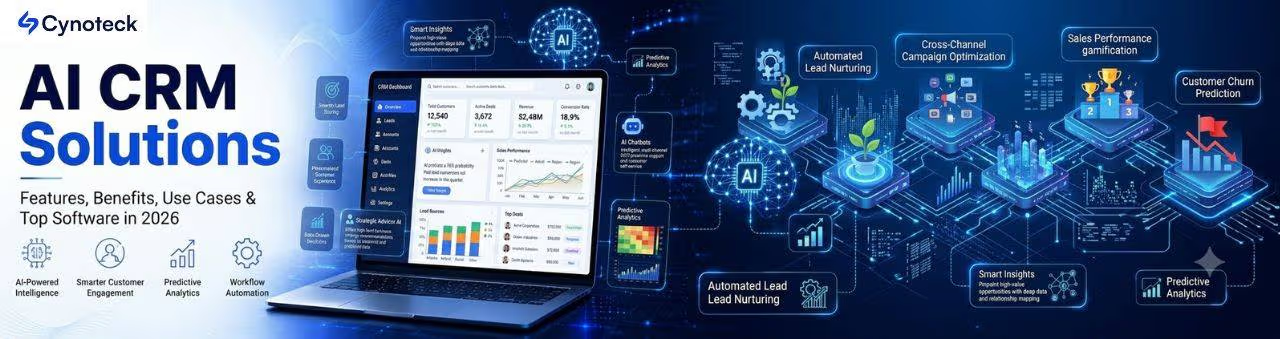
Artificial intelligence (AI) in customer relationship management (CRM) helps businesses automate routine tasks, analyze customer data, and manage customer information more efficiently. By combining AI with CRM systems, organizations can gain actionable insights, improve customer interactions, personalize experiences, and help sales and support teams work more effectively.
In the modern digital economy, data has transitioned from a passive record to an active corporate asset. For decades, customer relationship management (CRM) architectures functioned primarily as structured software databases—digital filing cabinets requiring continuous human input to maintain any systemic utility. Modern enterprise strategy, however, has fundamentally dismantled this model. The integration of Artificial Intelligence (AI) into CRM frameworks marks a core shift from historical administrative records to predictive, automated operational systems.
Instead of simply cataloging transactions, an AI-powered CRM autonomously synthesizes telemetry across every customer touchpoint. It extracts conversational meaning from emails, forecasts sales trajectories with high statistical probability, dynamically creates hyper-personalized marketing content, and handles routine administrative work. This transition completely alters how enterprises manage client lifecycles, moving operations from historical analysis to proactive customer management.
Key Enterprise Metric: Operational research from global data firms indicates that enterprise organisations embedding deep learning and predictive frameworks into their core CRM workflows realise up to a 33% increase in sales velocity alongside a 40% reduction in customer service resolution times. AI is no longer a peripheral feature; it is the core architecture of modern business scale. |
To build a scalable intelligence strategy, enterprises must understand the three distinct technical frameworks that power modern customer ecosystems. These layers do not work in isolation; they integrate to form a comprehensive system that listens, reasons, and acts.
Predictive AI acts as the analytical foundation of the modern enterprise. By applying regression models, machine learning algorithms, and pattern recognition to historical data, predictive engines eliminate human guesswork from business forecasting.
• Predictive Scoring. * Lead and Opportunity Scoring: Algorithms analyze hundreds of demographic and behavioral data points—such as website downloads, email clicks, and job titles—to assign an exact conversion probability score to every incoming lead.
• Churn Prediction. * Churn Mitigation and Account Health: By tracking negative changes in usage, drop-offs in communication, or open support tickets, the CRM flags accounts at risk of leaving before they cancel, prompting account managers to take early action.
• Pipeline Forecasting. * Pipeline and Revenue Forecasting: Instead of relying on optimistic sales reps, predictive CRM systems evaluate historical win rates, sales cycle duration, and macro-trends to deliver accurate revenue projections to financial leadership.
Generative AI introduces creative execution to structural workflows. Using Large Language Models (LLMs) tuned on corporate communication histories, generative systems produce highly contextual customer facing text and deep business intelligence summaries instantly.
• Automated Communications. * Contextual Email Generation: Generative CRM engines draft personalized outreach and follow-up emails that adapt to the prospect's industry, company size, and specific product interests, shifting reps from writing to reviewing.
• Contextual Summaries. * Conversational Case Summarization: When a customer account passes from marketing to sales, or from sales to customer support, generative layers instantly compress hours of call logs and long email threads into a bulleted briefing.
• Asset Generation. * Dynamic Marketing Copywriting: Marketers use generative tools to rapidly build thousands of variations of ad copy, landing page text, and nurture paths, optimizing them continuously through automated testing.
Conversational AI acts as the active communication front-end of the CRM system. Using advanced Natural Language Processing (NLP) and Automatic Speech Recognition (ASR), these interfaces understand the underlying intent behind human speech and text.
• Intelligent Virtual Agents. * Intent-Driven Customer Self-Service: Unlike old, rule-based chatbots that frustrate users, modern virtual agents understand conversational nuance, answer complex product questions, and complete secure account actions without human intervention.
• Live Voice Coaching. * Real-Time Speech Analytics and Transcription: During live phone calls, conversational engines transcribe the discussion in real time, run automated sentiment analysis, and instantly surface helpful scripts or documentation to the agent's screen.
The true value of an AI-driven CRM shows when it connects separate company departments into a single, unified workflow. This alignment creates a seamless, data-driven cycle across sales, marketing, and support.
Operational Vector | Legacy Database CRM (Manual Model) | Autonomous Intelligent CRM (AI-Driven) |
Data Entry & Hygiene | Requires sales reps to manually log every call, email, and meeting, leading to empty fields and stale data. | Autonomously tracks, logs, and cleans all customer interactions in real-time without requiring human data entry. |
Lead Management | Relies on basic, rules-based logic or sorting by creation date, creating long delays for top-tier prospects. | Uses predictive scoring to immediately route high-value opportunities to the right account executives instantly. |
Content & Outbound | Forces reps to manually copy, paste, and alter generic email templates, resulting in low response rates. | Generates deeply personalized, context-aware emails instantly, customized to the prospect's explicit pain points. |
Customer Care | Routs all issues into generic queues, causing long wait times, repetitive explanations, and agent burnout. | Resolves routine requests instantly via virtual agents and provides live human support with automated script recommendations. |
For sales organizations, AI dramatically reduces administrative burden while increasing total deal velocity. Instead of spending hours updating contact records or guessing which prospect to call next, sales executives rely on guided execution.
When an opportunity enters the pipeline, the CRM analyzes the account's historical interactions against successful closed-won deals in similar sectors. The system then prompts the rep with a Next Best Action card, recommending a specific case study to send or an exact pricing model to present. Automated voice intelligence platforms listen to sales calls, evaluating buyer sentiment and conversational objections so managers can provide targeted, objective coaching.
Modern marketing requires highly relevant positioning at significant operational scale. AI removes guesswork from campaign design, enabling teams to build deeply personalized multi-channel customer journeys automatically.
By analyzing full customer datasets, the CRM automatically creates micro-segmented audiences based on exact intent signals, browsing habits, and purchase history. Rather than blasting a generic newsletter to an entire database, the generative marketing engine serves customized ad creatives, specific landing page layouts, and tailored email copy to individual decision-makers. AI continuously runs multi-variant optimization models across these assets, shifting budgets dynamically toward the highest-performing variations.
Customer retention is anchored on speed and first-contact resolution. AI-driven service systems turn support desks from reactive call centers into proactive retention engines.
When a customer reaches out via web chat, phone, or email, NLP engines read the issue and instantly understand the sentiment. If the request is a standard procedural task—like updating billing records or resetting API keys—the system processes it instantly via conversational AI. For complex technical problems, the ticket is routed directly to the most qualified engineer, while a generative engine loads a concise summary of the issue along with step-by-step troubleshooting suggestions directly into their workspace.
Selecting the appropriate AI-fueled CRM framework requires a deep assessment of technical compatibility, operational requirements, and ecosystem dependencies. The global market is led by three clear structural approaches:
Microsoft Dynamics 365 stands out as the premium option for enterprises requiring native integration with the Microsoft ecosystem, including Azure, Office 365, and Power Platform. Powered by Microsoft Copilot, this platform excels at turning business-wide data into real-time operational value.
• Core Enterprise Strengths. * Native Azure Data Security: Dynamics 365 provides high-tier data protection, isolation, and global regulatory compliance by leveraging Microsoft's enterprise Azure infrastructure.
• Seamless Ecosystem Integration. * Cross-Application Workspace Unity: Copilot extracts context directly from Outlook, Teams, and Excel, updating the core CRM and generating client emails without requiring users to switch applications.
• Advanced Agent Customization. * Power Platform Customization: IT teams can use Copilot Studio to easily build, test, and deploy complex autonomous AI agents across unique corporate workflows.
Salesforce remains a dominant industry force, known for its extensive cloud data structures and flexible custom layouts. The platform delivers deep customer intelligence through its Einstein 1 architecture and Agentforce capabilities.
• Comprehensive Data Engine. * Unified Data Cloud Foundation: Salesforce excels at pulling structured and unstructured data from disparate external software systems into a single operational profile.
• Cross-Functional Capabilities. * Multi-Cloud AI Strategy: Provides tailored, out-of-the-box AI tools built explicitly for distinct business departments via Sales Cloud, Marketing Cloud, and Commerce Cloud.
• Scalable Digital Workers. * Agentforce Autonomous Execution: Enables companies to deploy autonomous digital agents that handle complex business processes independently while staying within secure operational guardrails.
For organizations prioritizing rapid deployment, clear pricing, and ease of use over complex custom setups, mid-market platforms offer powerful, built-in AI alternatives.
• HubSpot Breeze AI. * HubSpot CRM (Breeze AI): Focuses on simplicity and ease of use, providing intuitive tools for instant content generation, automated lead grading, and rapid sales workflow optimization.
• Zoho Zia. * Zoho CRM (Zia Assistant): Provides an accessible conversational assistant that handles direct voice commands, catches pipeline anomalies, and calculates optimal email delivery times.
• Freshsales Freddy AI. * Freshworks Freshsales (Freddy AI): Emphasizes streamlined user onboarding, using predictive models to deliver clear deal insights and automate repetitive contact management work.
Deploying customer-facing AI models introduces real operational risks that enterprise technology leaders must actively manage. Building trust requires strict adherence to modern data standards and clear system safety measures.
• Retrieval-Augmented Generation (RAG). * Preventing Hallucinations and Errors: To stop generative engines from inventing incorrect facts or bad pricing data, enterprises isolate language models using RAG architecture, forcing the AI to only pull answers from approved internal knowledge repositories.
• Compliance Integrity. * Strict Data Privacy and Sovereign Governance: Customer data must be rigorously scrubbed of Personally Identifiable Information (PII) before it is processed by external LLMs. Organizations must ensure full compliance with regional privacy laws like GDPR and CCPA.
• Bias Auditing. * Mitigating Bias and Ensuring Ethical Transparency: If training datasets contain historical human biases, predictive scoring models will replicate those errors. Enterprise teams must continuously audit their training data to maintain ethical, objective scoring models.
The next major frontier in enterprise technology is the shift from simple co-pilots to fully autonomous Agentic AI. Current systems operate reactively, waiting for a human worker to click a button, ask a prompt, or trigger a macro before executing an action.
True agentic workflows, by contrast, possess real operational independence. Given a high-level corporate objective—such as 'reduce customer churn within the European enterprise segment by 5% over the next quarter'—an agentic CRM evaluates the full customer data cloud, identifies accounts showing high churn risk, and designs a customized retention campaign. It independently creates custom feature documentation, schedules personalized check-in calls, and changes account pricing models within safe boundaries, checking in with human teams only for final approvals.
As these systems mature, CRMs will stop looking like traditional software tools. They will become dynamic, self-managing networks of digital workers, allowing enterprise businesses to scale personalized customer relationships to heights that were previously impossible.
Strategic Research Note: This analysis is compiled based on modern enterprise software architectures and structural platform documentations available in 2026. Global organizational implementation strategies should adapt continuously to changing regulatory and technological models.

Discover the top 10 benefits of custom CRM software development for modern businesses. Learn how tailored CRM solutions improve efficiency, enhance customer relationships, and drive business growth.
We are more than just developers and consultants—we are your partners in navigating the digital landscape. Let us be the engine behind your next big success while you focus on your core vision.
Explore Opportunities! Dynamics 365 Sales Pricing, Features & Alternatives.webp)
.png)
 Microsoft Dynamics 365 Sales Professional vs Enterprise.webp)
 What Is the Sales Qualification Agent in Dynamics 365 Sales.webp)