What Caused Microsoft's 24-Hour Outage, and What Is "Code Red"?
TL;DR
The outage lasted about 24 hours and Microsoft's own executives called it historic. Jason Henderson, president of Microsoft 365 Core, described it as the most customer-impacting incident in Exchange Online's history, according to Reuters. Responders exchanged more than 11,000 messages across 11 Teams chats while diagnostic data sat in scattered systems, which corporate vice president Amanda Silver called a " fog of war." Executive vice president Charles Lamanna said the failed component had absorbed "roughly ten years' worth of acceptable failures." Microsoft has not said when it expects to meet the one-hour target.
- Henderson wrote that Microsoft is not there yet on the one-hour goal, per Reuters.
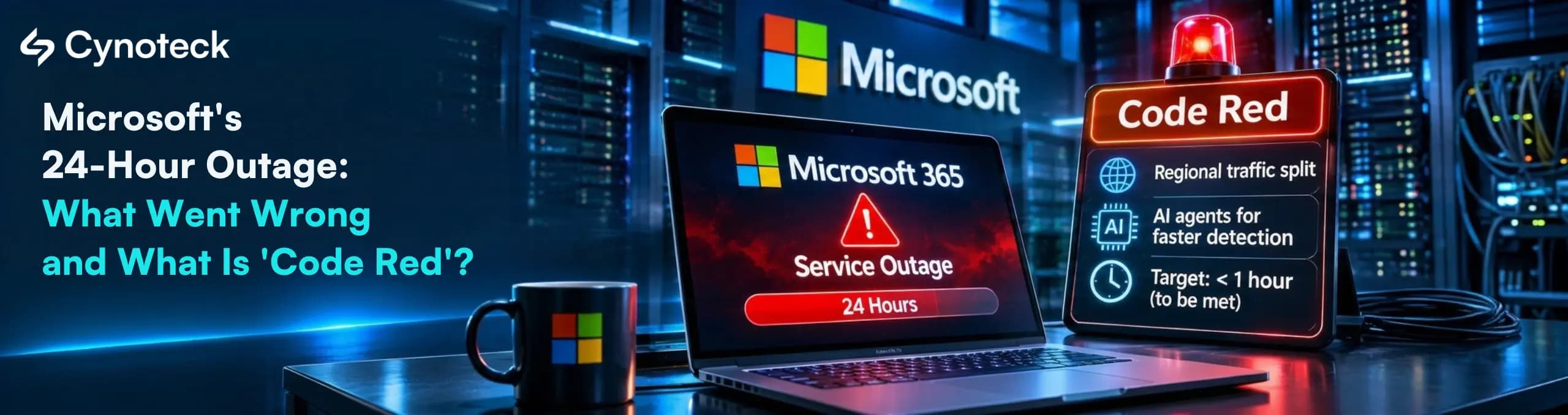
- Microsoft's planned fixes reportedly include dividing traffic by region and AI agents that scan system data to find problems faster.
Microsoft says its November 12-13 outage was caused by a dormant defect it introduced in July, not by hackers or AI agents. According to coverage of Microsoft's November 20 post-incident report, a latent Windows scalability defect in a software change enabled on Microsoft 365 networking gateway servers triggered lock contention, and a Teams traffic failover then pushed extra load onto infrastructure already under stress. A Reuters exclusive on November 24, citing internal memos, says Microsoft has declared a "Code Red," its most urgent internal alert, to overhaul how it prevents and handles outages. Its goal is to move critical fixes from detection to worldwide deployment within one hour, when recent urgent fixes took five to six days.
What Are the Key Facts?
Here is what Reuters, Ars Technica, and others report:
Item | Detail |
|---|---|
Outage | November 12 to 13, 2026, about 24 hours |
Services hit | Exchange Online, Outlook, Teams, Copilot and other Microsoft 365 products |
Cause given by Microsoft | Undetected Windows scalability defect in a July change to networking gateway servers |
Mechanism | Lock contention in gateway processes, worsened by a Teams traffic failover |
Ruled out | Cyber activity and AI agents |
Code Red | Declared internally, per Reuters; Microsoft's most severe alert level |
New target | Detection to global deployment of critical fixes within one hour |
Current reality | Urgent fixes recently took five to six days to reach everyone |
Impact | Governments from Australia and Japan to the US, trading firms and airline communications, per Reuters |
What Actually Caused the Outage?
A hidden flaw that only showed up under load. In simple terms, a change made in July left a weakness in the servers that route Microsoft 365 traffic, called gateways. As traffic grew, parts of the software began competing for the same resource at once, which engineers call lock contention, and the gateways slowed or failed. A Teams traffic failover then moved extra load onto infrastructure that was already struggling. The flaw sat unnoticed for roughly four months, according to Yahoo Finance. Microsoft said the incident was not related to a cyberattack or AI tools. These details come from coverage of the post-incident report, which this article did not review directly.
Ready To Integrate AI Into Your Business?
We helped organizations choose the right AI platform, integrate, and scale AI solutions that drive real business impact and track measurable results.
Book a Free ConsultationWhat Is "Code Red," and What Changes?
It is Microsoft's top-priority internal alarm. Reuters reports it signals highest-priority work across engineering and operations. According to the reporting, the plan includes:
A one-hour goal to get critical fixes from detection to worldwide deployment, set in a memo by Henderson, who added, "we aren't here yet"
Dividing traffic by region, so trouble in one area does not spread everywhere
AI agents that comb through system data to find problems faster
Daily meetings with leaders of the Substrate team and weekly reviews of corrective work, per Lamanna
What Went Wrong in the Response?
Information was scattered. Silver's November 23 memo says engineers worked through a "fog of war," sending more than 11,000 messages across 11 Teams chats while struggling to keep a single picture, because diagnostic data lived in separate tracking systems. The memo also relayed Lamanna's remark that the failed component had absorbed about ten years' worth of acceptable failures, a sign the weakness had been building. Ars Technica reports Microsoft has not said when it will meet the new targets or how future responses will avoid the same fragmentation.
How Bad Was It Against Microsoft's Uptime Promise?
Far outside it, by Yahoo Finance's math. Microsoft promises business customers 99.9% uptime, which allows about 44 minutes of downtime a month. By Yahoo Finance's calculation, one 24-hour outage used up nearly three years of that allowance, though not every customer was down that long. Credits are not automatic, as we explained in our guide to claiming Microsoft 365 outage credits.
Why Is Speed a Double-Edged Sword?
Because faster patching can also break things. Yahoo Finance links the code red to what analyst Ben Emons calls a "Patchpocalypse," a flood of newly found software flaws, many discovered by AI, with a record of almost 17,500 newly reported flaws in October. Cisco's Jeetu Patel said the time between a flaw going public and an attack is shrinking to minutes, and Mandiant estimates attacks began about a week before patches were available in 2025. Emons warned that "every patch is a chance for something to break." That tension is why the one-hour goal is hard, and it echoes the pressure we covered when OpenAI's Astra reached a critical cyber rating.
What Should IT Teams Do?
Assume your vendors will have outages, and plan for them.
Limit the blast radius. Ask vendors how they stage rollouts and divide traffic
Keep out-of-band communication that does not depend on Microsoft 365
Document your own impact for SLA claims, and read how to claim credits
Centralize incident data so responders are not working from 11 chats
Review fallbacks for AI tools such as Copilot that depend on the same cloud
For the original timeline and affected services, see our first report on the outage. Our agentic AI development and AI services & solutions teams can help you build incident-response and monitoring workflows, including AI-assisted diagnosis, with human oversight and clear fallbacks.
Frequently Asked Questions
What caused the Microsoft 365 outage in November 2026?
Microsoft says a dormant Windows scalability defect introduced in July caused the outage. According to coverage of its November 20 post-incident report, the flaw was in a software change enabled on Microsoft 365 networking gateway servers and caused lock contention. A Teams traffic failover added load to infrastructure already under stress. Microsoft says cyber activity and AI agents were not involved.
What does Microsoft's "Code Red" mean?
It is Microsoft's most severe and urgent internal alert. Reuters reports, citing internal memos, that Microsoft declared it to overhaul how it prevents and responds to major outages after the 24-hour incident. It is an internal measure, not a new disruption, and Microsoft has not publicly detailed the full plan.
What is Microsoft's one-hour fix goal?
It is a goal to get a critical fix from detection to safe worldwide deployment within one hour. A Henderson memo reviewed by Reuters says urgent production fixes previously took five to six days to reach everyone and adds, "we aren't here yet." Microsoft has not said when it expects to meet the goal, according to Ars Technica.
Was the Microsoft outage a cyberattack or caused by AI?
No, according to Microsoft. It says the outage was not related to cyber activity or AI agents and traces it to an undetected Windows scalability defect introduced in July. The company's explanation comes from its post-incident report as relayed by Reuters and other outlets. This article did not review the report itself.
How long did the outage last, and who was affected?
About 24 hours, on November 12 and 13, 2026. It disrupted Exchange Online, Outlook, Teams, and Copilot. Reuters reports that it affected governments from Australia and Japan to the United States, delayed trading firms, and disrupted airline communications. Henderson called it the most customer-impacting incident in Exchange Online's history.
Can I get money back for the outage?
Possibly, but you must request it. Microsoft's SLA offers service credits when uptime falls below its guarantee, and credits are not automatic. They depend on the services affected and the duration of the outage. Claims go through the Microsoft 365 admin center, and IBRS says the deadline is the end of December 2026.
What should businesses do after this outage?
Plan for vendor outages. Ask about staged rollouts and traffic separation, keep communication channels outside Microsoft 365, record your own downtime for service credit claims, centralize incident data, and prepare fallbacks for AI tools. This is general guidance, and each organization should follow its own continuity plan.
Explore comprehensive blogs, best practices, and insights from our technology experts.
 Cynoteck Recognized as a Clutch Global Leader for Spring 2024.png)

.png)
Cynoteck Technology Solutions Wins ET Leadership Excellence Award 2025 for Excellence in IT Consulting and Solutions
Cynoteck wins the ET Leadership Excellence Award 2025 for excellence in IT consulting, recognizing its business-focused, scalable, and high-impact technology solutions.

 Inside Microsoft's 24-Hour Outage Root Cause and 'Code Red' Explained.webp)
Turning expertise into action for your business.
We are more than just developers and consultants—we are your partners in navigating the digital landscape. Let us be the engine behind your next big success while you focus on your core vision.
Explore Opportunities!