Which AI Model Is Best Right Now, According to the Latest Leaderboards?
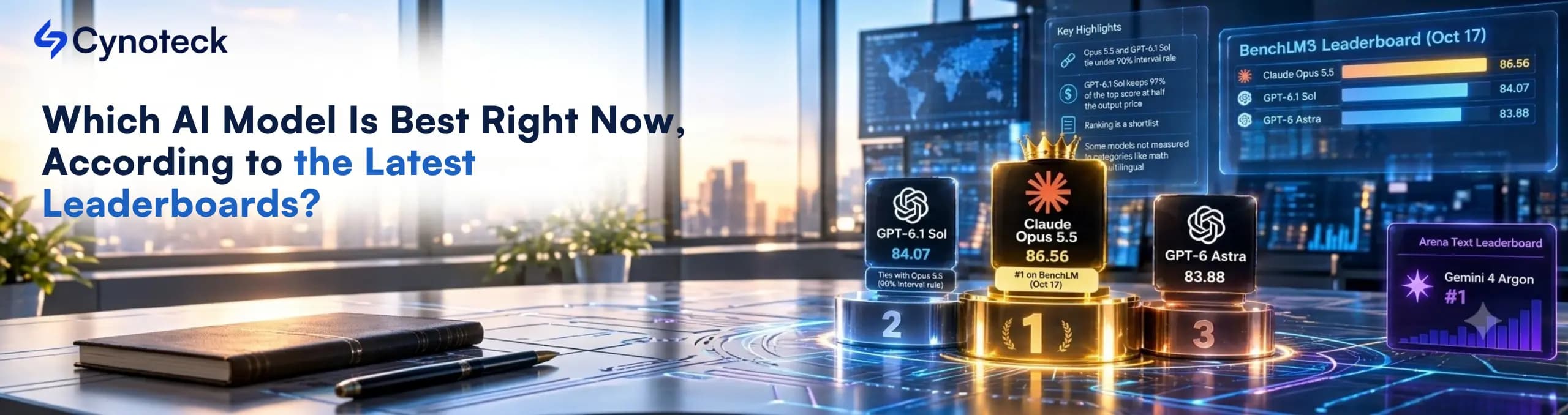
On October 17, BenchLM ranked Claude Opus 5.5 at the top with a score of 86.56, just ahead of GPT-6.1 Sol and GPT-6 Astra. However, BenchLM points out that Opus 5.5 and GPT-6.1 Sol are effectively tied because their scores overlap once you account for uncertainty. The overall score relies most on agentic and coding tests, where Opus 5.5 does best, while OpenAI's models lead in reasoning. Artificial Analysis gives Opus 5.5 a bigger lead, but Arena's text leaderboard puts Gemini 4 Argon first.
If you check three different AI leaderboards, you will likely see three different models at the top. BenchLM, which tracks 224 models, lists Claude Opus 5.5 as the leader as of October 17, but notes it is tied with GPT-6.1 Sol when you factor in uncertainty. Arena's text leaderboard puts Gemini 4 Argon in first place. For businesses trying to choose a model, these differences are what matter most.
BenchLM tracks a large number of models 954 in total across 639 benchmarks, but only ranks 224 of them. The top models are close in score, and each comes with its own API pricing per million tokens.
Rank | Model | BenchLM score | Price (in / out) |
|---|---|---|---|
1 | Claude Opus 5.5 (Anthropic) | 86.56 | $4 / $20 |
2 | GPT-6.1 Sol (OpenAI) | 84.07 | $2 / $10 |
3 | GPT-6 Astra (OpenAI) | 83.88 | $10 / $50 |
4 | Claude Fable 5.1 (Anthropic) | 83.18 | $10 / $50 |
5 | Claude Sonnet 5.5 (Anthropic) | 82.18 | $2 / $10 |
7 | Gemini 4 Argon (Google) | 80.97 | $2 / $10 |
BenchLM also highlights Xiaomi's MiMo-V2.6-Pro as the best open-weight model, with a score of 73.57. In October alone, it tracked 43 new model releases. For provider averages, Anthropic comes out on top, followed by OpenAI and Google.
The top models are so close because their score ranges overlap. For example, Opus 5.5 has a 90% score range from 81.7 to 91.4, and GPT-6.1 Sol ranges from 80.1 to 88.0. The 2.5-point difference between them falls within these intervals. There is also missing data: Opus 5.5 lacks scores for multilingual, instruction-following, and math, while GPT-6.1 Sol is missing a multimodal score. BenchLM fills these gaps with estimates, which adds more uncertainty to the rankings.
We helped organizations choose the right AI platform, integrate, and scale AI solutions that drive real business impact and track measurable results.
Book a Free ConsultationBenchLM's scoring puts the most weight on agentic and coding tasks—together, these make up 42% of the total. Opus 5.5 scores highest in these areas, while OpenAI's models do better in reasoning. If the weights were different, the rankings could change. This is based on BenchLM's own published numbers.
Each leaderboard uses its own method, so the top model changes depending on where you look. Artificial Analysis, for example, gives Opus 5.5 a higher score than GPT-6.1 Sol on its Intelligence Index, especially at maximum effort. Opus 5.5 leads on some tests, while GPT-6.1 Sol is faster to respond and does better on others. Arena's text leaderboard, as reported by BenchLM and Fello AI, puts Gemini 4 Argon first and Opus 5.5 second.
When choosing a model, focus on your workload and budget instead of just the rankings. BenchLM's recommendations and the pricing details point to a few practical options:
Hardest agentic and coding work: Opus 5.5 leads on BenchLM and Artificial Analysis
High-volume work on a budget: GPT-6.1 Sol, which BenchLM names the best near-frontier value at $10 per million output tokens
Very long documents: GPT-6.1 Sol lists a 1.05 million token context window, against 1 million for Opus 5.5
Cheapest capable tier: Claude Haiku 5.5 is listed at $0.10 / $0.50
Self-hosting: open-weight options such as MiMo-V2.6-Pro and Qwen3.8 Max
If you want to know more about how these prices were set, you can read our coverage of the Claude Opus 5.5 and GPT-6 price changes and the GPT-6 Astra launch.
Treat any leaderboard as a starting point, not a final answer. There are a few things to keep in mind. First, overall scores can hide important trade-offs, so look at the categories that matter for your work. Second, each ranking uses its own method, so a model might be first on one board and lower on another. Third, BenchLM is an independent site that takes advertising and sponsorships, and it shows vendor results separately from its rankings. No matter what the leaderboard says, always test models on your own data before making a decision.
Our generative AI services team can help you benchmark models on your own tasks, so your choice rests on your results, not a headline ranking.
It depends on the leaderboard. BenchLM ranks Claude Opus 5.5 first (86.56) as of October 17, but says it ties with GPT-6.1 Sol within its error range. Artificial Analysis also puts Opus 5.5 ahead. Arena's text ranking leads with Gemini 4 Argon. No single model wins every method, so the best choice depends on your task and budget.
No. BenchLM states that Opus 5.5 and GPT-6.1 Sol tie under its 90% interval rule, because their score ranges overlap (81.7 to 91.4 and 80.1 to 88.0). Opus 5.5's 2.5-point lead is inside that uncertainty. BenchLM also advises opening the evidence before choosing, and calls a ranking a shortlist, not a decision.
It uses a normalized weighted average of eight categories: agentic 22%, coding 20%, reasoning 17%, multimodal 12%, knowledge 12%, multilingual 7%, instruction following 5% and math 5%. The current method, BenchAlign v5.8, uses 60 ranking benchmarks and keeps vendor-run numbers out of the rank. Missing data is handled with disclosed priors, which adds uncertainty.
BenchLM names GPT-6.1 Sol its best near-frontier value: it keeps 97% of the top score with an output price 50% lower ($10 versus $20 per million tokens). Claude Sonnet 5.5 and Gemini 4 Argon are also listed at $2 / $10, and Claude Haiku 5.5 at $0.10 / $0.50. Value depends on how often a cheaper model reaches your required quality.
BenchLM's pick is Xiaomi's MiMo-V2.6-Pro at 73.57, listed at about $0.43 / $0.87 per million tokens and marked "Estimated," which means wider uncertainty. Alibaba's Qwen3.8 Max is another open-weight entry near the top 20. Open-weight models trail the leading closed models on BenchLM's score but can suit teams that need to self-host.
They measure different things. BenchLM combines many public benchmarks with category weights. Artificial Analysis runs its own index of tests. Arena ranks models by human preference votes on chat answers. A model strong at agentic coding can rank differently from one preferred in everyday conversation, so disagreement is expected, not a sign one board is wrong.
Treat them as claims to verify. BenchLM shows vendor-run results but keeps them out of its ranking, and marks models with thin independent evidence as Estimated. Independent evaluators run the same tests across models, which makes comparisons fairer. Even then, public benchmarks may not match your workload, so run your own tests before committing.
Define the task, shortlist two or three models from independent leaderboards, and test them on your own data for quality, cost per task, speed and context needs. Include a cheaper model, since it may be good enough. Revisit the choice regularly, because rankings and prices have changed repeatedly this year.
.png)
Cynoteck wins the ET Leadership Excellence Award 2025 for excellence in IT consulting, recognizing its business-focused, scalable, and high-impact technology solutions.
We are more than just developers and consultants—we are your partners in navigating the digital landscape. Let us be the engine behind your next big success while you focus on your core vision.
Explore Opportunities! Cynoteck Recognized as a Clutch Global Leader for Spring 2024.png)
 Which AI Model Is Best Right Now, According to the Latest Leaderboards.webp)