American Workers Are 43% More Skeptical of AI Than the Global Average. Here Is What Leaders Need to Fix.
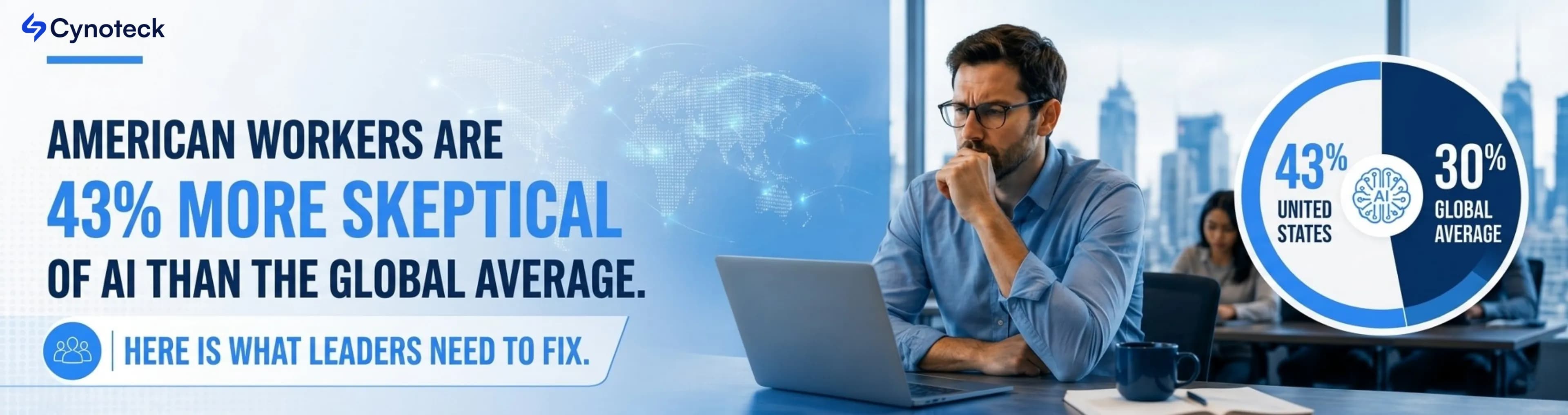
A new Salesforce study published May 28, 2026, surveyed more than 1,500 desk workers across 14 countries. The standout finding for US business leaders: American workers are 43% more likely than the average global worker to describe themselves as AI skeptics.
For any leader who has rolled out an AI tool and watched their team quietly ignore it, this study explains exactly why.
The Global Divide Is Wider Than Most Expect
When Salesforce asked workers directly whether they considered themselves AI skeptics or advocates, the gap between countries was striking:
53% of workers in the US, UK, and France said they were skeptics
Just 15% in Saudi Arabia said the same
Only 26% in Mexico identified as skeptics
Countries with higher skepticism also showed measurably lower AI adoption in daily work. The two trends move together.
Ready To Integrate AI Into Your Business?
We helped organizations choose the right AI platform, integrate, and scale AI solutions that drive real business impact and track measurable results.
Book Your Free ConsultationTwo independent studies add important context. Stanford's 2026 AI Index found that in 2025, workplace AI usage exceeded 80% in India, China, Nigeria, the UAE, Egypt, and Saudi Arabia, while the global average sat at 58%. Stanford also found that 64% of Americans expect AI to lead to fewer jobs over the next 20 years, a fear that directly shapes worker engagement.
The KPMG and University of Melbourne Global AI Study 2025, which surveyed 48,000 people across 47 countries, found that in most emerging economies over 90% of people want to learn more about AI, compared to much lower figures in advanced economies. Workers who are curious rather than fearful engage with tools in a completely different way.
This means the same tool, the same training, and the same rollout plan will land differently depending on what your team believes AI means for their future. That belief is the real variable to manage.
Why US AI Pilots Keep Stalling
Job security is part of the concern, but not the main reason. When American workers were asked why their AI experiments failed, the top three answers were:
Generic outputs — results too broad to be useful for their specific role
Insufficient training — access to the tool with no real guidance on how to use it
Low trust in the results — not confident enough in AI outputs to act on them
There is a counterintuitive finding here. Workers in the highest-AI-adoption markets globally were more likely to have experienced failed AI pilots than US workers. Teams that run more experiments, including unsuccessful ones, build confidence faster. US workers who avoid early experiments miss that learning curve entirely. As Salesforce's Q1 FY27 results showed, 3.8 billion Agentic Work Units were delivered in a single quarter — a scale only possible when human adoption is working alongside the technology.
What the Workers Who Got It Right Did Differently
Salesforce identified over 500 workers who successfully moved past experimentation and now use AI daily. They share four things: role-specific training, AI embedded in tools they already use, secure, context-aware AI they can trust, and tools customizable to their specific job.
The outcome: 76% became active AI advocates and 63% use AI every single day.
This matters directly for teams deploying tools like Salesforce Agentforce Operations, where adoption depends as much on team readiness as on technical setup. The same applies across platforms. Microsoft Copilot Cowork faces identical dynamics inside Microsoft 365 environments.
The Practical Takeaway for Leaders
Do not launch an AI tool and expect adoption to follow. Launch a conversation about what the tool does for the individual using it. Role-specific training, honest early experiments, and AI embedded into existing workflows are the conditions that turn skeptics into daily users.
The technology is ready. The question for the rest of 2026 is whether your people are prepared to use it.
Explore comprehensive blogs, best practices, and insights from our technology experts.
 Cynoteck Recognized as a Clutch Global Leader for Spring 2024.png)

.png)
Cynoteck Technology Solutions Wins ET Leadership Excellence Award 2025 for Excellence in IT Consulting and Solutions
Cynoteck wins the ET Leadership Excellence Award 2025 for excellence in IT consulting, recognizing its business-focused, scalable, and high-impact technology solutions.

 Is the Airbnb CEO’s AI Warning New, or Resurfacing.webp)
Turning expertise into action for your business.
We are more than just developers and consultants—we are your partners in navigating the digital landscape. Let us be the engine behind your next big success while you focus on your core vision.
Explore Opportunities!