Back-Office Chaos Is Slowing Your Business Down. Here Is How Agentforce Operations Fixes It.
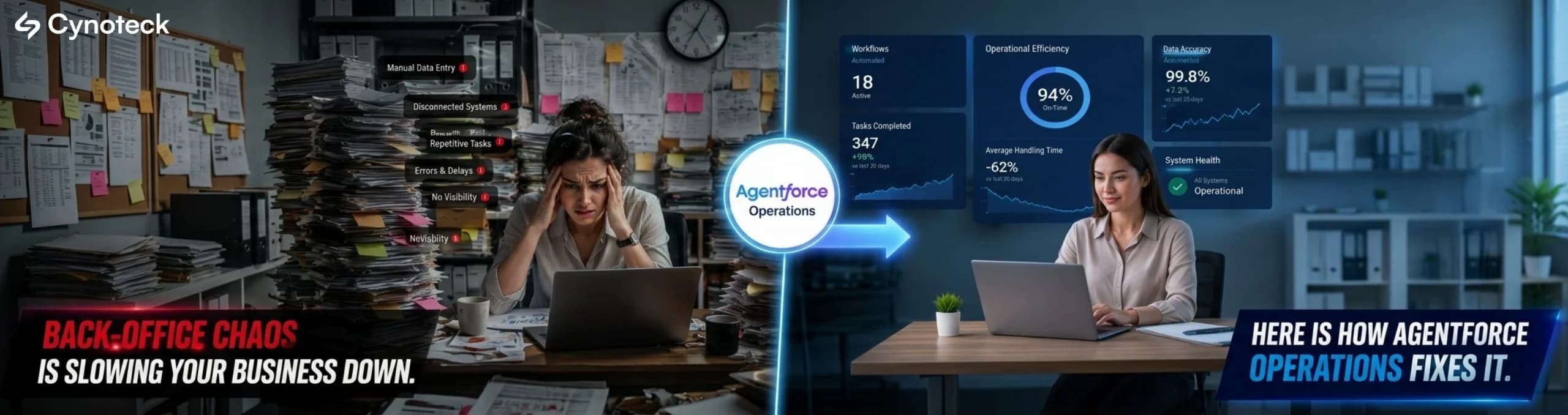
Every business has the same problem. The customer-facing side runs well. The back office does not. Employees switch between systems, paste data into spreadsheets, chase approvals over email, and wait days for tasks that should take hours. Salesforce launched Agentforce Operations on April 29, 2026, to fix exactly that.
The Problem Every Operations Team Knows Too Well
According to Salesforce's official announcement, companies use agents to make their customer and employee experiences faster and more personalized. But when those fast, modern experiences hit a web of outdated, manual back-office processes, everything stops. Employees are stuck switching between systems, pasting data into spreadsheets, and hunting for updates in email. What should take hours takes days or weeks, slowing productivity, delaying revenue, raising costs, and putting commitments at risk.
That is not a technology problem. It is a process problem. Most businesses have accepted it as normal. Agentforce Operations was built on the premise that it does not have to be.
This is also part of the same shift happening across enterprise AI platforms. Microsoft's Dynamics 365 Wave 1 is tackling the same back-office bottleneck in 2026 through agentic ERP agents.
Ready To Integrate AI Into Your Business?
We helped organizations choose the right AI platform, integrate, and scale AI solutions that drive real business impact and track measurable results.
Book Your Free ConsultationWhat Salesforce Actually Built
Agentforce Operations takes outdated, manual back-office processes and turns them into a clear set of tasks that specialized agents can handle. Those tasks include process coordination, data verification, compliance clearance, approval routing, and more.
The product is built on technology from Regrello, a supply chain automation company that Salesforce acquired. Regrello had already deployed its platform across some of the most complex manufacturing and logistics operations worldwide. That foundation gives Agentforce Operations a strong starting point for industries with high process complexity.
The tool digitizes existing business process blueprints from documents such as Lucidchart diagrams or Word files, converting them into multi-step workflows that agents can handle automatically. You do not need to rebuild your processes from scratch. You bring what you already have, and the system takes it from there.
The Numbers Behind the Claims
Salesforce states that Agentforce Operations can reduce cycle times by up to 70% and cut manual data entry by 80%. Human oversight is maintained throughout, with audit trails and natural-language updates keeping teams informed about what agents are doing and why.
Real customer results back those numbers. Andrew Allan, Chief of Global Finance Operations and Technology at Siemens Digital Industries Software, described the impact directly: "Following a decade of growth, our primary challenge was the collection of legacy systems that kept our teams and customer data isolated. With the Agentforce 360 Platform, we have been able to leverage a unified, real-time view of customer profiles across front-end and back-end systems. Thanks to the power of AI agents and automation, we are giving our teams the time back to focus on more strategic, high-value work."
That quote tells you something important. The value of Agentforce Operations is not just speed. It is freeing up people for the work that actually requires human judgment.
How It Fits Into Your Existing Systems
One of the most common concerns with any new automation tool is integration. Agentforce Operations was designed with that concern in mind.
The product is generally available today and works across email, ERP, and collaboration tools without replacing existing systems. Ecosystem integration features, including the ability to auto-sync data and trigger actions with Salesforce Flow, are expected to enter beta in May 2026.
Salesforce Flow is the company's no-code automation tool, already used by thousands of businesses. Connecting Agentforce Operations to Flow means teams can extend agent automation into workflows they have already built, without starting over. This integration-first approach mirrors how agentic AI is being deployed successfully; the same principle behind why only 11% of companies are running agents in production right now.
Five Points Your Team Should Know
Agentforce Operations launched on April 29, 2026, and is now generally available across the financial services, insurance, healthcare, and supply chain industries.
It reduces cycle times by up to 70% and manual data entry by 80%, according to Salesforce's official launch data.
The product is built on Regrello's supply chain automation technology, providing a proven foundation for complex, high-volume operational environments.
Human oversight is built into every workflow through audit trails and natural language progress updates.
Salesforce Flow integration enters beta in May 2026, extending agent automation into existing no-code workflows without additional development.
What Salesforce Plans to Add Next
Broader ecosystem integration, including the ability to auto-synchronize data and trigger actions with Salesforce Flow, is expected to enter beta during May 2026. PwC has already confirmed a partnership to help clients deploy Agentforce Operations, transforming manual operations into intelligent workflows across AI-powered contact centers, automated onboarding, and compliance.
For businesses running Salesforce today, Agentforce Operations is the clearest path to extending AI beyond the CRM and into the processes that determine how quickly work actually gets done. The right starting point is one high-volume, repetitive workflow in your operations team. Measure the before. Deploy the agent. Measure the after. If you are also evaluating Microsoft's AI tools alongside Salesforce, Microsoft Copilot Cowork takes a similar approach to autonomous workflow execution inside Microsoft 365.
Explore comprehensive blogs, best practices, and insights from our technology experts.
 Cynoteck Recognized as a Clutch Global Leader for Spring 2024.png)

.png)
Cynoteck Technology Solutions Wins ET Leadership Excellence Award 2025 for Excellence in IT Consulting and Solutions
Cynoteck wins the ET Leadership Excellence Award 2025 for excellence in IT consulting, recognizing its business-focused, scalable, and high-impact technology solutions.

 Is the Airbnb CEO’s AI Warning New, or Resurfacing.webp)
Turning expertise into action for your business.
We are more than just developers and consultants—we are your partners in navigating the digital landscape. Let us be the engine behind your next big success while you focus on your core vision.
Explore Opportunities!