Top Apps and Companies That Use Python – and 7 Reasons You Should Too

Python is a programming language that first appeared around February 1990, 30 years ago, and was designed by a Dutch programmer, Guido Van Rossum. It was created with the idea that code should be easy to read, short, and written in a way that closely resembles plain English.
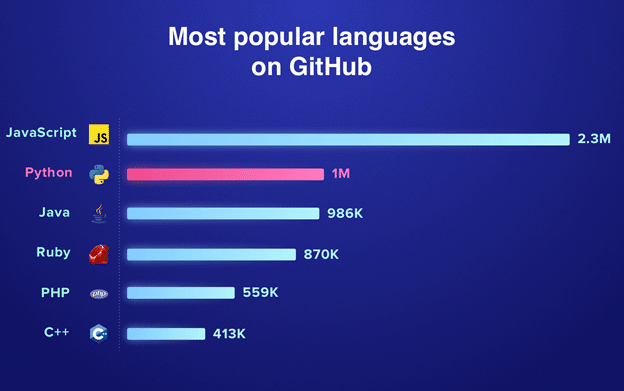
Today, Python is one of the two most popular programming languages in the world. It is widely used by beginners, professional software companies, researchers, and artificial intelligence experts.
High level
General-purpose
High memory management
Easy syntax
Dynamic semantics
Object-oriented
Let’s decode them one by one to understand why Python is such a popular and most sought-after programming language compared to all the other programming languages out there.
Python uses simple and readable code that is close to normal English. This makes it easier for beginners to learn and helps developers write programs faster with fewer lines of code. It can be used across the board, from accountants to scientists, data analysts, mathematicians, and even young kids.
Unlike C++, C, or Java, in Python, you do not need to define the data type of a variable manually. This flexibility makes coding quicker and allows developers to focus more on logic rather than technical details.
Python supports object-oriented programming, which helps organize code into reusable objects and classes. This makes large projects easier to manage, update, and maintain.
Python automatically manages memory using a built-in garbage collection system. Developers do not need to manually free memory, which reduces errors and improves efficiency.
Python has a huge ecosystem of libraries and frameworks for web development, data science, AI, automation, and more. These tools save time and simplify complex tasks.
Python is widely used to automate repetitive tasks such as file handling, data processing, and system operations. This increases productivity and reduces manual work.
Python is one of the most popular languages for machine learning and artificial intelligence because of libraries like TensorFlow, PyTorch, and Scikit-learn.
Python is powerful enough to support large-scale applications and platforms used by millions of people worldwide. Many popular companies rely on Python for their backend systems.
Did you know?
In GitHub’s “The State of the Octoverse Report,” released in 2021, Python ranked as the second most popular programming language.
Owing to Python’s popularity, several websites and applications have adopted them for dynamic web and mobile app development and various other features. Here are some of the most well-known examples.
Instagram, a popular social media platform with around 2 billion active users, uses Python as their programming language and is deployed on Django, a high-level Python web framework that helps develop secure and easily maintainable websites. Recently, Instagram migrated from Python 2 to Python 3.0.
With such a large user base, the main priority for Instagram was efficiency, simplicity, and practicality, and the Django framework helped them maximize their service efficiency with ease.
Google needs no introduction and has been using Python since the beginning, where they inculcated a policy of “Python wherever we can and C++ wherever we must.“
Python is one of Google’s side server languages, including C++, Java, and Go. Another interesting fact that you must know is that Python’s designer, Guido Van Rossum, himself worked in Google from 2005 to 2012; now you know how important Python is to Google!
Python is used in Google App Engine, YouTube, Google Ads, and Google even uses Python for its search engines, machine learning, artificial intelligence, and robotics projects.
Its flexibility, excellent performance, scalability, and rapid development features are why Python is extensively used at Google.
Dropbox is a cloud-based file hosting service to store all your photos, videos, documents, and files, and its entire tech stack was written on Python.
In 2012, Dropbox convinced Rossum, the inventor of Python, to join Dropbox, who then guided them in working there as an engineer and helped them allocate datastores. It can be shared with the members of the Dropbox community.
Since a lot of Dropbox’s libraries aren’t open-source, it is difficult to analyze their level of dependence on Python, but it is noted from many of the interviews with their engineers that a majority of their code on the server-side is written in Python.
Reddit is home to over 100,000 communities worldwide, and in 2021, Redditors created around 366 million posts, a 19% increase from the previous year. The software that supports Reddit is Python.
Originally coded in Lisp, its founders recoded the site in Python six months after Reddit’s launch, owing to development flexibility, ease of use, readability, and the wide range of libraries available.
Web.py, the web framework that originally powered the site, is now an open-source project.
Spotify uses Python extensively for data analysis, backend services, and its recommendation engine. The team relies heavily on Python's data science libraries to process billions of streaming events and generate personalized playlists for over 600 million users.
Netflix uses Python across its security automation, data engineering pipelines, and machine learning systems. Their Chaos Engineering tools and recommendation algorithms are Python-driven, helping serve over 260 million subscribers globally.
Netflix’s success is also closely tied to the evolution of connected entertainment platforms and Smart TV ecosystems. Read more about how Smart TV integration is transforming the media and entertainment industry.
Uber uses Python for geospatial services, surge pricing calculations, and internal tooling. Their engineering team has published extensively about using Python to build high-throughput systems that handle millions of trips per day.
Pinterest was built on Django from the very beginning and scaled to hundreds of millions of users without switching away from Python. It remains one of the clearest examples of Python's capacity for large-scale web application development.
NASA uses Python for scientific computing, data visualization, and mission-critical data processing. The Astropy project — a Python library for astronomy — is a community-wide effort that many NASA teams contribute to and rely on.
Major financial institutions use Python heavily for quantitative analysis, algorithmic trading, and risk modeling. JPMorgan's Athena platform and Goldman Sachs' Marquee platform are both Python-powered — reflecting Python's strong foothold in enterprise finance.
Beyond the popular companies names, Python is the language of choice across hundreds of technology companies. A few more worth knowing:
🔵 Facebook / Meta
🟠 Amazon (AWS)
🟢 Quora
🔴 YouTube
🟡 Disqus
🟣 Mozilla
⚪ Palantir
🔵 Stripe
🟠 Square
🟢 Robinhood
🔴 Twilio
🟡 Eventbrite
One of the most common questions from developers evaluating Python is: what kind of apps can you actually make with it? The answer is broader than most people expect.
Web Applications
Full-stack and backend web apps using Django, Flask, or FastAPI
Mobile Apps
Cross-platform apps via Kivy, BeeWare, or backend APIs
Desktop Applications
GUI apps with Tkinter, PyQt, or wxPython
AI & Machine Learning
Models and pipelines with TensorFlow, PyTorch, scikit-learn
Data Science & Analytics
Analysis and visualization with Pandas, NumPy, Matplotlib
Automation & Scripting
Task automation, web scraping, CI/CD tooling
Cybersecurity Tools
Penetration testing, vulnerability scanning, forensics
APIs & Microservices
RESTful APIs and microservice backends with FastAPI or Flask
Games
2D games and prototypes using Pygame
Scientific Computing
Research, simulations, and engineering tools with SciPy
IoT & Embedded Systems
Raspberry Pi, MicroPython for embedded environments
Algorithmic Trading
Real-time trading bots and financial models
Python isn't confined to Silicon Valley tech companies. Its versatility makes it the language of choice across a remarkably wide range of industries.
Healthcare & MedTech
Banking & Finance
EdTech & Research
E-commerce & Retail
Automotive
iGaming & Betting
Cybersecurity
Aerospace
Energy & Utilities
Logistics & Supply Chain
Media & Entertainment
Real Estate Tech
HR & Workforce Tech
Biotech & Pharma
In healthcare, Python powers medical imaging analysis and patient outcome prediction. In finance, it drives algorithmic trading systems and fraud detection. In retail, it runs demand forecasting and inventory optimization. Whatever sector you're in, there's a proven Python use case for it.
Choosing the right framework is one of the most important architectural decisions in Python app development. Here's an honest comparison of the most widely used ones.
Framework | Best For | Key Strengths | Learning Curve |
|---|---|---|---|
Django | Full-featured web apps, CMSes | Batteries-included, ORM, admin panel, security | Moderate |
Flask | Microservices, APIs, small apps | Lightweight, flexible, easy to learn | Low |
FastAPI | High-performance APIs, async services | Auto-docs, async support, type hints | Low–Moderate |
Pyramid | Large, complex applications | Highly configurable, URL routing control | Moderate–High |
Tornado | Real-time apps, WebSockets | Non-blocking I/O, high concurrency | Moderate |
Streamlit | Data apps, ML dashboards | Rapid prototyping, no frontend knowledge needed | Very Low |
Kivy / BeeWare | Mobile and desktop apps | Cross-platform, native-look UI | Moderate |
For enterprise-grade web applications, Django remains the go-to choice. For APIs and microservices, FastAPI has rapidly become the preferred option due to its performance and automatic documentation. For quick data-driven tools, Streamlit lets non-frontend developers publish apps in hours.
This is one of the most frequently asked questions about Python — and the answer is yes, though with some important nuances.
Python is not the default choice for native mobile development the way Swift (iOS) or Kotlin (Android) are. However, it's entirely viable for mobile through several approaches:
Open-source Python framework for cross-platform apps
Deploys to Android, iOS, Windows, macOS, Linux
Best for touch-based and multi-touch UIs
Active community and good documentation
Write Python, deploy natively on all platforms
Aims for genuinely native look-and-feel
Backed by the Python Software Foundation
Still maturing but increasingly production-ready
The most common enterprise approach
Python powers the API / backend logic
React Native or Flutter handles the UI
Best performance and native experience
Python for embedded and IoT devices
Runs on microcontrollers like Raspberry Pi Pico
Ideal for hardware projects and prototyping
Subset of standard Python
For most businesses building mobile apps today, the practical recommendation is to build your business logic, AI, and backend infrastructure in Python while using a dedicated mobile framework (React Native, Flutter) for the user interface — giving you the best of both worlds.

Python offers a large collection of powerful frameworks and libraries that make development faster and easier. Its package index, known as PyPI, contains more than 500,000 packages for different purposes such as web development, data science, artificial intelligence, automation, and more. Popular frameworks like Django, Flask, FastAPI, Pyramid, and Web2Py help developers build websites and web applications efficiently by providing ready-made tools for tasks such as database access, URL routing, HTTP requests, and responses.
Similarly, libraries such as NumPy and Pandas are widely used in data science, while TensorFlow and PyTorch are popular for machine learning and AI projects. These frameworks and libraries act like toolboxes that save time and reduce the need to build everything from scratch, making Python development simpler, faster, and more productive.
Python frameworks handle many low-level programming tasks automatically, so developers do not need to spend time understanding every small technical detail. Features such as database handling, server management, routing, and security are already built into many Python frameworks, making development easier and more efficient. This allows developers to focus more on creating useful features and improving the application. Because of its simplicity, flexibility, and powerful frameworks, Python has become one of the most popular languages for web and application development.
Python frameworks like Django provide strong built-in security features that help protect web applications from common cyber threats such as SQL injection, XSS, CSRF, and clickjacking. Since many of these protections are enabled by default, developers can focus more on building useful features instead of creating security systems from scratch. These frameworks also support easy scalability, allowing websites and applications to grow smoothly as new features and users are added. This saves developers time and effort while providing a secure, efficient, and reliable development environment. Because of these advantages, Python is widely trusted in important industries such as finance, healthcare, and enterprise software development.
Python is a free and open-source programming language supported by the Python Software Foundation and a large global community of developers. Millions of programmers contribute by creating libraries, writing tutorials, answering questions, and fixing bugs, which helps Python continue to grow and improve. Because of this active community, developers can easily find solutions to coding problems through online discussions, GitHub projects, and platforms like Stack Overflow. This strong community support makes learning and working with Python easier, faster, and more reliable for both beginners and professionals.
Python is the most widely used programming language for Artificial Intelligence (AI) and Machine Learning (ML) development. Popular libraries such as TensorFlow, PyTorch, Scikit-learn, Keras, and Hugging Face Transformers provide powerful tools for building intelligent applications, recommendation systems, prediction models, and natural language processing systems. As a high-level programming language, Python makes complex AI and data processing tasks easier to understand and implement. Its ready-made libraries and strong community support help developers save time and build advanced AI solutions more efficiently.
Python is considered a developer-friendly programming language because of its simple and clean syntax. Unlike many other programming languages, Python avoids the heavy use of complex symbols and brackets, and instead uses meaningful whitespace to organize code. This makes programs easier to read, write, and understand. As a result, developers can code faster, review code more efficiently, and maintain projects more easily over time. Python’s readability also helps new developers learn quickly and makes teamwork smoother in large enterprise environments.
Python helps developers build websites and mobile application faster because it offers a wide range of ready-made libraries and frameworks. These tools handle many common programming tasks automatically, allowing developers to focus more on building features instead of managing small technical details. Python also requires fewer lines of code compared to languages like Java or C++, which speeds up the development process even further.
In addition, Python has a large and supportive developer community that helps solve coding problems quickly through tutorials, forums, and shared solutions. This combination of simple syntax, powerful frameworks, and community support makes Python a time-saving choice for both small projects and large business applications.
Developers often weigh Python against other major languages. Here's an honest comparison for the most common decisions.
Python: faster prototyping, cleaner syntax, better for AI/ML
Java: stricter typing, better Android-native support
Python is easier to learn and quicker to write
Java has performance advantages in JVM-optimized workloads
Verdict: Python for rapid development and data work; Java for Android or strict enterprise environments
Python: backend, data science, AI/ML; runs on server
JavaScript: frontend + backend (Node.js), browser-native
Python has superior scientific computing libraries
JavaScript is essential for frontend interactivity
Verdict: Use both — Python backend, JavaScript frontend is a common winning combo
Python: general-purpose, production-ready ML pipelines
R: statistical analysis, academic research, visualizations
Python has broader applicability beyond data science
R has some superior statistical packages for research
Verdict: Python for production data products; R for statistical research
Python: fast development, readable code, great for prototyping
C++: raw performance, systems programming, gaming engines
Many Python ML libraries are backed by C++ under the hood
Python is used alongside C++ at Google, not instead of it
Verdict: Python for app logic; C++ for performance-critical internals
If you're ready to build your first Python application — or evaluating whether to adopt it for a business project — here's a practical starting path.
Are you building a web app, an API, a data pipeline, or an AI-powered product? The app type determines which Python framework is right for you. Clarity here saves significant time downstream.
Use Django for full-featured web apps, FastAPI for high-performance APIs, Flask for lightweight microservices, or Kivy/BeeWare for mobile. Don't over-engineer — pick what fits your use case, not the trendiest option.
Install Python (latest stable version), create a virtual environment with venv or use Anaconda for data science workflows, and choose an IDE (VS Code and PyCharm are the most popular). Install dependencies with pip.
Python's rapid development cycle means you can ship a working prototype quickly, gather feedback, and iterate. Use pytest for testing, GitHub for version control, and Docker for consistent deployment environments.
Python applications deploy easily to AWS (Elastic Beanstalk, Lambda), Google Cloud Platform, Azure, or platforms like Railway and Render. All major cloud providers have strong Python support, including serverless functions and managed databases.
The powerful libraries, frameworks, and easy integration with AI and Machine Learning allow for rapid deployment of websites and applications, as well as secure and maintainable websites and applications.
Python is the language of choice for most top companies and applications due to its ease of use, flexibility, and developer friendliness, and it is unquestionably the best choice if you are planning to develop a website or an application.
Get expert guidance on choosing the right Python frameworks and architecture for secure, scalable, and future-ready applications.
Get a Free Python ConsultationThe top companies that use Python include:
Dropbox
NASA
Netflix
Uber
Companies or developers choose Python for its combination of developer productivity, a massive library ecosystem, strong AI/ML support, and proven scalability. It reduces time to market, lowers the barrier to hiring (Python has one of the largest developer communities), and integrates seamlessly with modern cloud infrastructure.
Yes. Python is used at enterprise scale by companies like Google, Netflix, and Instagram. With the right architecture — proper async handling, caching, horizontal scaling, and a mature framework like Django — Python handles enterprise workloads reliably. Its readability also makes it easier for large engineering teams to collaborate and maintain code over time.
Python has the TensorFlow, PyTorch, and scikit-learn libraries that help in making it a go-to language for AI and machine learning applications.
Yes, though with caveats. Frameworks like Kivy and BeeWare allow you to write Python that deploys to Android and iOS. The more common enterprise approach is to use Python for the backend and API layer while using React Native or Flutter for the mobile frontend — combining the strengths of both.
A: the Django framework. It's one of the largest Django deployments in the world and a prominent example of Python's ability to scale to billions of users.
Yes. Dropbox was originally built almost entirely on Python, and its founder even hired Python's creator Guido van Rossum as an engineer. While some components have been rewritten in other languages for performance, Python remains central to their infrastructure.
Python is the programming language itself. Anaconda is a distribution of Python designed specifically for data science and machine learning work. It bundles Python with over 250 pre-installed packages (NumPy, Pandas, Jupyter, etc.) and includes the Conda package manager, making it easier to manage data science environments without manually installing each library.
Technology, finance, healthcare, e-commerce, media/entertainment, education, aerospace, and cybersecurity are the industries with the heaviest Python adoption. In recent years, iGaming and biotech have also seen significant growth in Python use, particularly for data analysis and AI-driven features.

Mobile healthcare apps improve patient care by enabling remote monitoring, timely reminders, secure data access, better communication, and cost-efficient healthcare services through mHealth technology.
We are more than just developers and consultants—we are your partners in navigating the digital landscape. Let us be the engine behind your next big success while you focus on your core vision.
Explore Opportunities!