Mobile App Development in Media and Entertainment Industry: Benefits, Features & Cost
Summary: This guide covers why media and entertainment businesses are investing in mobile apps, the benefits split by who they help, which features to build first, how the major app categories compare, and what it costs to build one. |
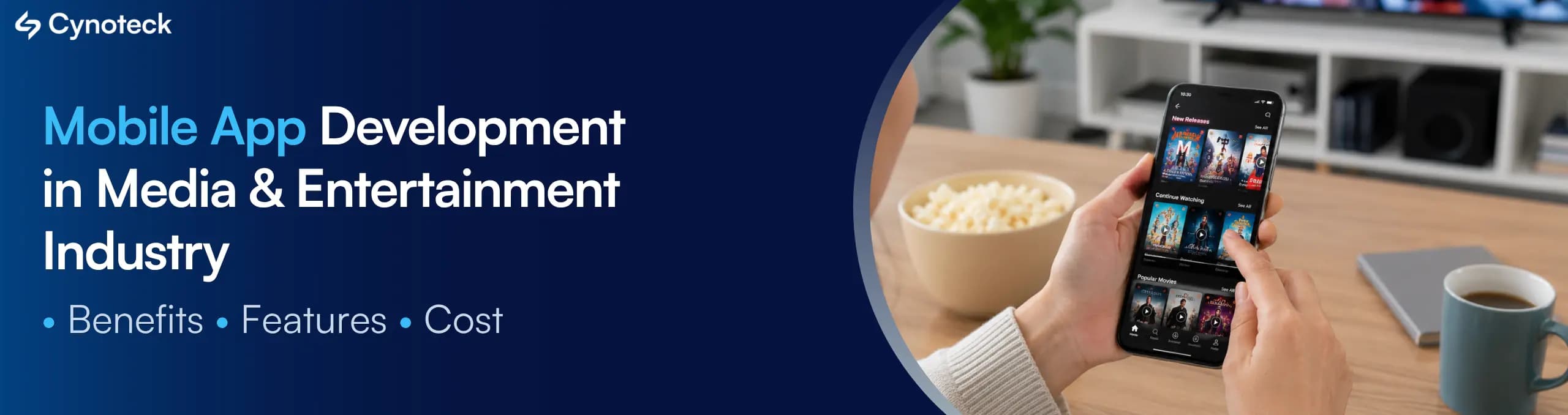
Mobile apps have become an important part of the media and entertainment industry. People now use their smartphones to stream movies and shows, buy tickets, listen to podcasts, read content, and discover daily new entertainment. Instead of depending on traditional channels such as television, radio, or physical ticket counters, businesses use mobile apps to deliver these services directly to users and make them available anytime, anywhere.
Mobile apps let media and entertainment businesses reach audiences directly and monetize that relationship through subscriptions, advertising, ticketing, or in-app purchases. The businesses that win pick the right category and features for their specific audience, rather than copying a competitor's app feature by feature.
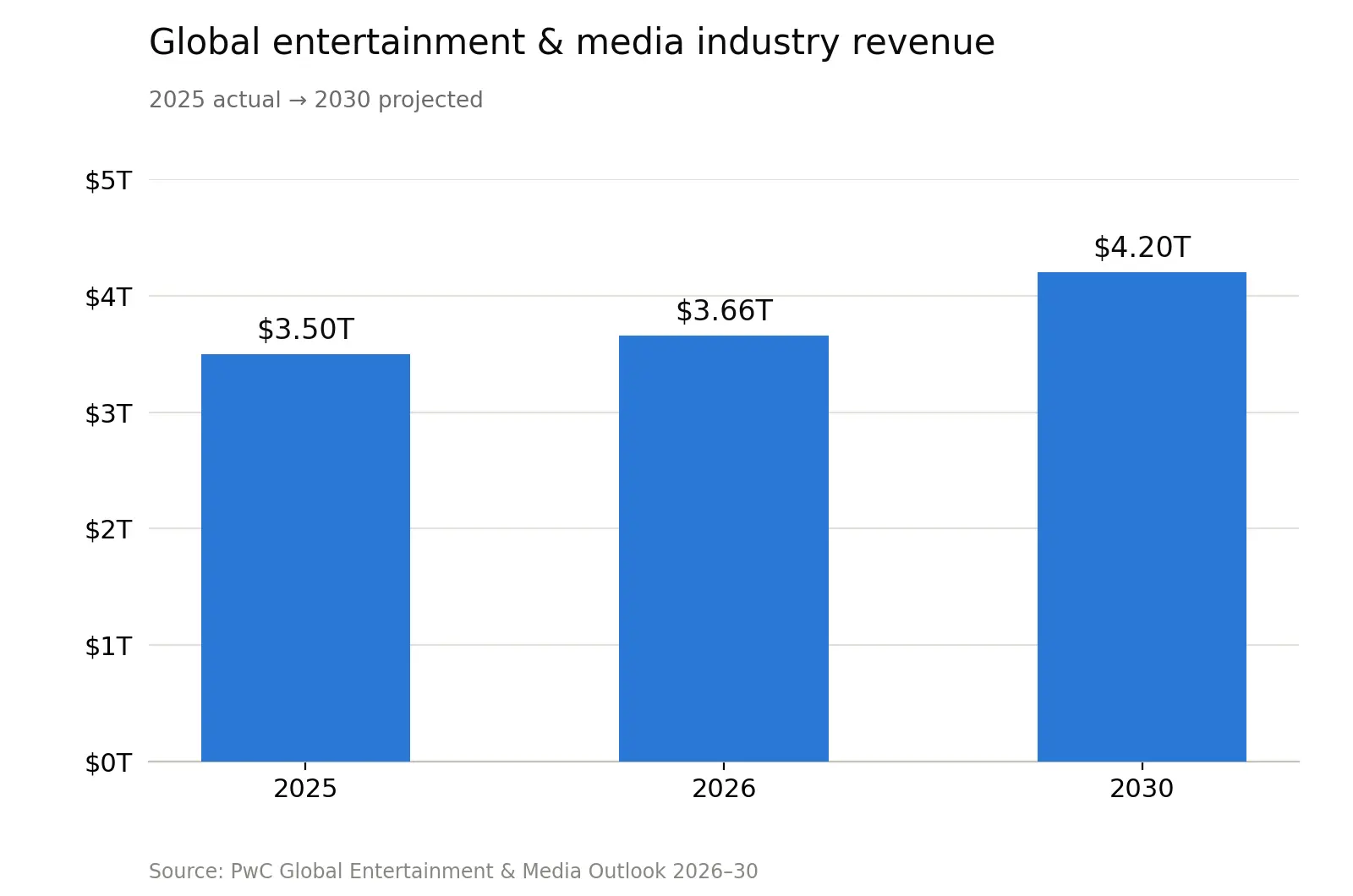
The global Entertainment & Media is massive market and it is still growing. In 2025, the industry generated $3.5 trillion in revenue from advertising, connectivity, and consumer spending, marking 5.3% growth over the previous year.
PwC expects the global Media and Entertainment industry to grow from $3.5 trillion in 2025 to $4.2 trillion by 2030, with an average annual growth of 3.4%.
See Detailed Report Here: PwC Global E&M Outlook 2026-30 |
That represents roughly $600 billion in additional annual revenue compared with today.
The growth of the industry is also attracting more investment from businesses. Existing companies are expanding their digital offerings, while new players are entering the market with their own content platforms, streaming services, apps, and digital entertainment products.
Major platforms report billions in quarterly revenue tied directly to their apps, and smaller entrants are proving the same model works at a regional scale too.
Netflix reported $12.25 billion in Q1 2026 revenue, per its official shareholder letter.
Disney+ and Hulu combined generated $5.346 billion in SVOD revenue in one quarter, per Disney's official Q1 FY2026 release.
Amazon reported $13.427 billion in quarterly subscription revenue, per its official Q1 2026 release.
ViX, a Spanish-language app, is projected as the fastest-growing streaming service in the Americas by Ampere Analysis, by serving an underserved audience instead of out-spending Netflix.
Runn TV, which our team built as India's first FAST streaming app, proves the same model works outside the biggest global players.
For the Business | For the Audience |
Owns the direct relationship with users | Gets instant access, no schedule or queue |
Runs subscriptions, ads, or pay-per-use in one channel | Sees content personalized to their habits |
Collects first-party data to guide decisions | Picks up exactly where they left off, on any device |
Reaches users through push notifications directly | Gets real-time updates for live events or releases |
Every media app needs reliable performance, one clear monetization model, and basic personalization at launch. Advanced features like AI recommendations, offline downloads, or Smart TV apps can wait until the core experience is proven.
Must-have features:
Reliable, fast core performance, since this costs more trust than any missing feature
One clear monetization model, chosen deliberately rather than added later
Basic personalization, even simple "continue watching" or history-based suggestions
Push notifications for releases, events, or relevant updates
Add once the core feature works:
Deeper AI-driven recommendations
Offline downloads, especially for non-live categories
Social sharing and community features
Smart TV and connected device apps
Pro Tip: Resist launching with a long feature list. The strongest apps prove one thing works extremely well before adding the next layer.
Media and entertainment apps generally fall into six categories, each with a different dominant monetization model and standout feature.
Category | Best Monetization | Standout Feature | Example |
Video streaming / OTT | Subscription or ad-hybrid | Personalization, adaptive playback | Netflix, Disney+ Hotstar |
Music and audio | Subscription with free tier | Discovery and playlists | Spotify-style platforms |
News and publishing | Subscription or advertising | Push alerts, fast loading | Digital news apps |
Gaming | In-app purchases, ads | Engagement mechanics | Mobile games |
Live events and ticketing | Pay-per-use | Real-time inventory, secure payment | Ticketing apps |
Podcasts | Mostly free, paid bonus tiers | Offline listening, speed control | Podcast platforms |
Match the category to what you already produce: video points to streaming, audio points to music or podcasts, and physical or virtual events point to ticketing. Copying another category's feature list rarely works, since each one solves a different core problem.
App Tier | Estimated Cost | Typical Features |
Basic content app | $40,000 – $80,000 | Browsing, playback, one monetization model |
Mid-range platform | $80,000 – $200,000 | Personalization, multiple monetization options |
Enterprise platform | $200,000 – $500,000+ | Live streaming, ticketing, AI recommendations |
Content delivery, payment processing, and licensing or DRM (Digital Rights Management) are the most common costs beyond development itself, since they scale with usage rather than being one-time.
Launching with too many monetization models at once, before knowing what the audience prefers
Underestimating content delivery costs, which scale directly with usage
Ignoring personalization until later, when audiences decide to stay within their first few sessions
Building for one device first, when audiences expect mobile, TV, and web from day one
Look for a partner with real experience in your specific media category, a clear plan for content or transaction infrastructure, and the flexibility to support multiple devices from the start.
Ask for concrete examples in your specific category, since streaming, gaming, and ticketing all demand different technical skills
Look for flexibility to adjust monetization models as your app grows
Cynoteck's mobile app development team built the scheduling engine and Electronic Program Guide behind Runn TV, one of India's first FAST platforms.
Every category of media app is solving a different problem for a different audience, which is why no single feature list works for all of them. Match your app to what you produce and who you serve, then build the features that matter most for that audience first.
Turn your entertainment idea into a scalable mobile app with the right features, technology, and monetization strategy.
Start Your App ProjectAns: Audiences reach for their phones first, and a business without a direct app depends on third parties to reach its own audience.
Ans: Reliable performance, one clear monetization model, basic personalization, and push notifications. Everything else can come later.
Ans: Match it to what you already produce: video to streaming, audio to music or podcasts, events to ticketing.
Ans: From $40,000 for a basic content app to $500,000 or more for an enterprise platform with live streaming or ticketing.
Ans: Roughly 4 to 6 months for a basic app, 6 to 10 months mid-range, and 10 to 14 months or more for an enterprise platform.

Mobile healthcare apps improve patient care by enabling remote monitoring, timely reminders, secure data access, better communication, and cost-efficient healthcare services through mHealth technology.
B2B apps help businesses streamline operations, enable on-the-go access to data, improve client engagement, support omnichannel sales, and drive scalable revenue by simplifying complex business workflows.
We are more than just developers and consultants—we are your partners in navigating the digital landscape. Let us be the engine behind your next big success while you focus on your core vision.
Explore Opportunities!