Mobile App Development in the Healthcare Industry: Benefits, Features, Use Cases & HIPAA Compliance
Summary: This guide covers why mobile apps have become essential for the healthcare industry, the role HIPAA compliance plays once you build one, the features and use cases shaping healthcare apps today, and what to tell your developer before starting. |
Mobile apps have changed how almost every industry operates, and healthcare is no exception. Patients now expect to book appointments, message their doctor, and check reports from their phone instead of waiting on hold or visiting in person. Once a healthcare business builds an app to offer this, HIPAA-compliant healthcare mobile app development becomes the natural next step, since any app handling patient data in the US has to meet these standards.
Mobile apps have become a vital part of healthcare because they make routine tasks faster for both patients and doctors, from booking appointments to accessing reports, which is why adoption across the industry has grown so quickly.
A vital role today – Appointment booking, prescription refills, and report access now happen primarily through apps, not front desks or phone calls.
Easier for patients – Patients check reports, message providers, and manage medications without visiting in person for routine matters.
Easier for doctors – Doctors access patient history, update records, and coordinate care from a phone between appointments instead of a fixed desktop.
Why the shift is so fast – Both sides save time. Patients avoid waiting rooms and phone queues, and doctors avoid repetitive admin work.
Why business owners need one – A healthcare business without an app is competing against others that already offer faster, more personalized service. An app lets a practice offer 24/7 booking, automated reminders, and direct communication, which builds loyalty and reduces missed appointments.
Once a healthcare app stores or transmits patient information, HIPAA compliance is not optional. It is a legal requirement that protects patient data through encryption, access controls, and strict handling rules, and it applies from the first line of code, not as a final step before launch.
Why it matters – Patient data such as names, diagnoses, and treatment history is legally protected. Mishandling it carries real financial and legal consequences.
When it applies – Any app that creates, stores, or shares patient health information on behalf of a healthcare provider needs to follow HIPAA.
How it fits into development – Compliance needs to shape decisions on encryption, login security, and data storage from the earliest design stage, not get added right before launch.
Note: HIPAA compliance itself is a detailed, technical subject with its own set of rules and safeguards. Our dedicated guide on what HIPAA compliance means for your business covers this in full, including the specific rules, safeguards, and requirements involved. |
Faster access to care – Patients reach providers and book appointments without delays.
Better patient engagement – Reminders, health tips, and direct messaging keep patients involved in their own care.
Reduced administrative work – Automated scheduling and digital records cut down manual, repetitive tasks for staff.
Improved accuracy – Digital records reduce errors compared to paper-based systems.
Remote monitoring – Doctors track chronic conditions and vitals without requiring an in-person visit every time.
Stronger patient loyalty – A smooth digital experience keeps patients with the same provider instead of switching.
Appointment scheduling – Patients book, reschedule, or cancel visits without calling the front desk.
Secure messaging – Encrypted chat between patients and providers for quick questions and follow-ups.
Telehealth video visits – Video consultations for routine or follow-up care.
Health records access – Patients view lab results, prescriptions, and visit history in one place.
Medication and appointment reminders – Automated push notifications reduce missed doses and no-shows.
E-prescriptions – Prescriptions sent digitally straight to a pharmacy.
Wearable and device integration – Syncing with fitness trackers or medical devices for real-time health data.
Billing and payments – In-app payment for consultations and services.
Patient portal apps – Give patients a single place to manage appointments, records, and communication.
Telehealth apps – Connect patients and doctors remotely through video and chat.
Remote patient monitoring apps – Track chronic conditions like diabetes or hypertension using connected devices.
EHR/EMR-integrated apps – Sync directly with a hospital's electronic health record system.
Mental health and therapy apps – Support therapy sessions, mood tracking, and guided programs.
Pharmacy and medication management apps – Handle refills, reminders, and delivery tracking.
Treating compliance as an afterthought – Adding HIPAA safeguards after development is harder and more expensive than designing them in from the start.
Overcomplicating the interface – Patients and older users need a simple, clear layout, not a feature-packed screen.
Ignoring offline or low-signal use – Healthcare apps need to work reliably in hospitals and rural areas with weak connectivity.
Skipping integration planning – Many healthcare apps eventually need to connect to an EHR system. Planning for this early avoids a costly rebuild later.
Underestimating ongoing maintenance – Healthcare apps need regular updates to stay compliant as regulations and OS requirements change.
Proven healthcare experience – Ask for real examples of compliant apps they have built before, not just general mobile development work.
Willingness to sign a BAA – Any partner handling patient data during development must sign a Business Associate Agreement.
Clear security explanation – They should be able to explain their encryption and access control approach in plain terms.
Platform guidance – A good partner explains whether native iOS, native Android, or a cross-platform build using React Native or Flutter fits your specific app, instead of defaulting to one option.
Cynoteck's healthcare IT services team has built HIPAA-compliant apps for patient symptom tracking, appointment management, and doctor-patient coordination.
Who your users are – Patients, doctors, administrative staff, or all three, since each group needs a different experience.
What data the app will handle – Be specific about whether it touches patient records, so HIPAA requirements are scoped correctly from day one.
Which systems it needs to connect to – Existing EHR, billing, or scheduling systems the app needs to sync with.
Your compliance requirements – HIPAA, and any other regional regulations your patients or business fall under.
Your growth plans – Whether the app needs to support more locations, providers, or features later, so the architecture can scale.
Only apps that create, store, or share patient health information on behalf of a healthcare provider. A general wellness app without patient data usually does not need to comply.
Treating compliance and security as something to add right before launch, rather than designing it into the app from the start.
Start with what your patients and staff struggle with today, such as appointment delays or manual records, and prioritize features that solve those specific problems first.
Conclusion
Mobile apps have become essential to how healthcare businesses serve patients, from booking to ongoing care. Once an app handles patient data, HIPAA compliance becomes part of building it correctly, not a separate concern. If you are planning a healthcare app and want compliance built in from the start, our team can walk through your specific requirements with you.
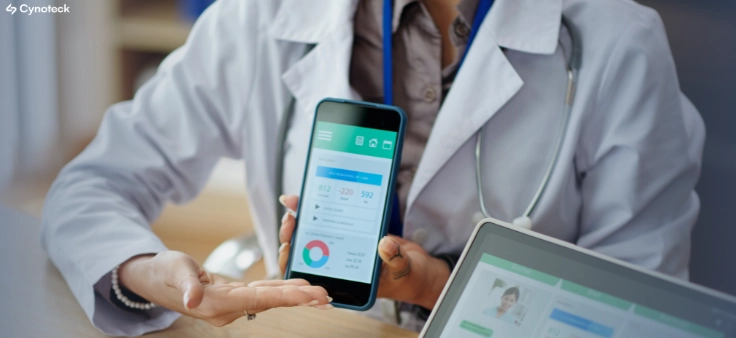
Mobile healthcare apps improve patient care by enabling remote monitoring, timely reminders, secure data access, better communication, and cost-efficient healthcare services through mHealth technology.
B2B apps help businesses streamline operations, enable on-the-go access to data, improve client engagement, support omnichannel sales, and drive scalable revenue by simplifying complex business workflows.
How LLMs, computer vision, predictive analytics, and AI agents are reshaping mobile apps — plus the business problems they solve, industry use cases, and how to choose the right tech for your app.
We are more than just developers and consultants—we are your partners in navigating the digital landscape. Let us be the engine behind your next big success while you focus on your core vision.
Explore Opportunities!