How Mobile Technology is Changing The Healthcare Industry
Today modern life is completely dependent on technology and its achievements. The effects of the mobile revolution have impacted every sector of the economy. There is no exception in healthcare.
Healthcare professionals and providers are continuously looking for new ways to redefine outcomes and to take patient care outside of the exam room and into patients' homes and places of employment.
Multiple fascinating mobile applications are available for the healthcare and fitness sectors. The main question now is how mobile technology is changing healthcare.
Since mobile technology can enhance communication and improve the integration of care operations, its role in the healthcare sector has grown in importance. There are two main paths for mobile technology in healthcare:
Technology, tools, apps, and services for patient treatment and care
Systems and tools for tracking adherence to a fit and healthy lifestyle
Areas with a large population and widespread mobile phone usage are increasingly adopting mHealth as a highly effective solution. By successfully integrating mHealth applications, healthcare professionals can optimize hospital workflows, manage patient conditions round-the-clock, and deliver more personalized care. These advancements clearly highlight the benefits of mobile healthcare apps in improving overall patient care.
Healthcare and the practice of medicine are being transformed by digital technologies. Medical treatment has been significantly improved by digital technology. This transformation has had a positive impact on both patients and healthcare workers.
Below are the key ways mobile technology is reinventing the healthcare industry and improving the overall consumer experience.
The advent of precision medicine brings healthcare one step closer to providing personalized, accurate, and effective treatment.
Drug companies collaborate with hospitals, clinics, and medical specialists to develop specialized medical devices and medications.
Based on blood sugar measurements and other specific characteristics, personalized treatment offers customized recommendations for exercise, diet, and illness management.
Growing understanding of genetics enables better disease prevention, safer drug prescriptions, and more effective treatments for conditions such as cancer, arthritis, and heart disease.
Digital health is becoming increasingly integrated into daily life.
Electronic health records allow a patient’s complete medical history to be merged across clinics and specialists, enabling better healthcare decisions.
Digital records also reduce human error in medication interpretation and improve overall patient care. Stored personal information includes contact details, blood type, medical history, vaccination records, and more.
Mobile technology enables quick and secure management of patient data across departments. Paper-based documentation makes organization difficult and increases the chances of error.
With tablets, smartphones, and digital systems, hospitals and clinics can maintain accurate records and focus more on patient care rather than administrative tasks.
Telemedicine bridges the gap between patients and healthcare providers. It allows real-time communication and supports early prevention of medical emergencies.
Key benefits of telemedicine include convenience, improved access for rural patients, reduced travel time, and lower healthcare costs.
Telemedicine is expected to further reduce physician workload and improve accessibility to specialized care.
Mobile technology allows continuous monitoring of patients during recovery from illness or surgery.
Doctors track patient progress using wearable devices that record activity, heart rate, sleep patterns, caloric intake, and physical movement.
Remote patient monitoring expands the reach of healthcare systems and enables timely medical intervention.
Machine learning and artificial intelligence support medical diagnosis and treatment planning.
AI helps healthcare professionals provide more accurate diagnoses and proactive care by analysing patient data.
Healthcare applications powered by AI help individuals adopt healthier habits and take control of their well-being.
AI also helps healthcare providers understand patient behaviour patterns and provide better guidance.
Mobile technology improves communication among healthcare professionals including doctors, nurses, and physician assistants.
Medical professionals can access patient data from any location.
Intranet systems, teleconferencing, and social platforms make it easier to share medical knowledge and collaborate across geographic boundaries.
Virtual reality is changing the delivery of behavioural and mental healthcare. VR is used for medical training, diagnostics, rehabilitation, and therapy.
Patients can improve mental health remotely, while healthcare professionals use VR to enhance treatment programs and capacity training.
Big data refers to large volumes of structured and unstructured information analysed to identify trends and patterns.
Healthcare providers use big data to enhance decision-making, improve patient outcomes, and reduce healthcare costs.
Digital technologies allow faster data collection from diverse populations for clinical trials, research, and epidemiological studies.
Mobile healthcare represents the future of healthcare delivery. Healthcare providers are increasingly offering services through mobile applications and devices.
Mobile health improves accessibility, effectiveness, and quality of care while supporting global health objectives.
Patients gain the ability to access medical information, track health data, and receive personalized treatment and lifestyle recommendations.
Empowering patients through mobile technology is central to the future of healthcare. Artificial intelligence will continue to play a growing role as it advances in understanding human behaviour and language.
Mobile health, or mHealth, enables users to access healthcare services using smartphones, tablets, and portable devices.
It offers better patient care, improved access to records, enhanced treatment control, and better healthcare quality.
Mobile health improves patient outcomes by offering better access, fewer hospital visits, reduced costs, and improved communication.
Healthcare providers benefit from increased patient satisfaction, lower expenses, new revenue opportunities, and reduced infection risks.
Additional advantages include:
Integration with IoT and mobile health applications
Streamlined operational procedures
Improved treatment compliance
Remote patient monitoring
Accurate diagnosis and enhanced patient safety
Faster access to healthcare professionals
Digital healthcare enables better collaboration, faster diagnostics, improved patient care, and streamlined administrative processes. Healthcare organizations can reduce costs while improving efficiency and patient trust through data-driven insights.
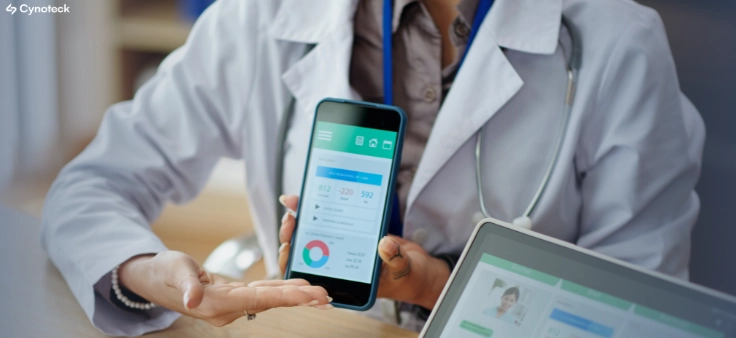
Mobile healthcare apps improve patient care by enabling remote monitoring, timely reminders, secure data access, better communication, and cost-efficient healthcare services through mHealth technology.
B2B apps help businesses streamline operations, enable on-the-go access to data, improve client engagement, support omnichannel sales, and drive scalable revenue by simplifying complex business workflows.
We are more than just developers and consultants—we are your partners in navigating the digital landscape. Let us be the engine behind your next big success while you focus on your core vision.
Explore Opportunities!