AI CRM Solutions: Features, Benefits, Use Cases & Top Software in 2026
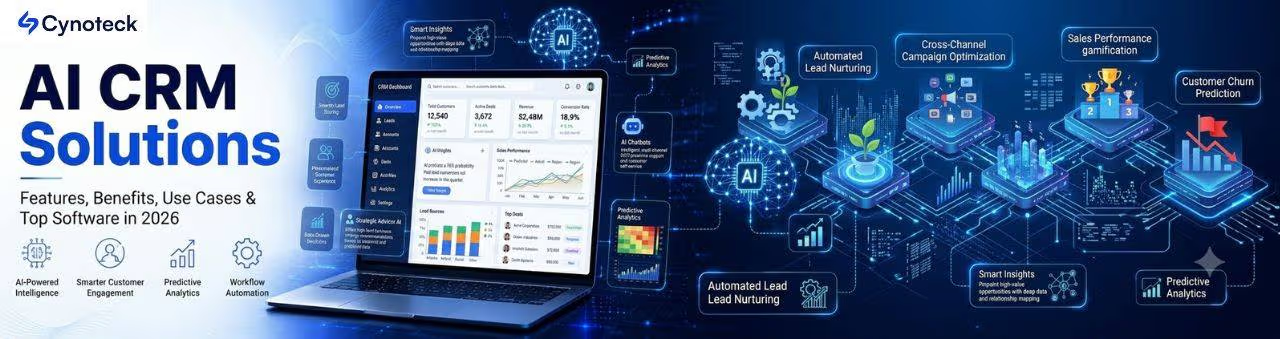
CRM software has changed more in the last three years than in the previous two decades. What used to be a system for storing contact details and tracking deals has turned into something much smarter.
Today's CRM platforms can read a customer's mood in an email, predict which deal is about to fall through, write a follow-up message on their own, and tell a sales rep exactly what to do next. This is what people mean when they talk about AI CRM.
Generative AI, agentic AI, and copilot-style assistants are now built directly into the CRM tools businesses already use, including Microsoft Dynamics 365 and Salesforce.
According to recent industry surveys, more than 80% of sales and service organizations are either using AI in their CRM already or plan to add it within the next year.
That is not a small trend. It is a shift in how customer relationships are managed at every stage, from the first lead to long-term retention.
In this guide, you'll learn what a cloud-based AI CRM is, how it works behind the scenes, the key features and business benefits it offers, real-world use cases across departments and industries, a comparison of the top cloud-based AI CRM software in 2026, and practical tips for choosing and implementing the right solution for your business.
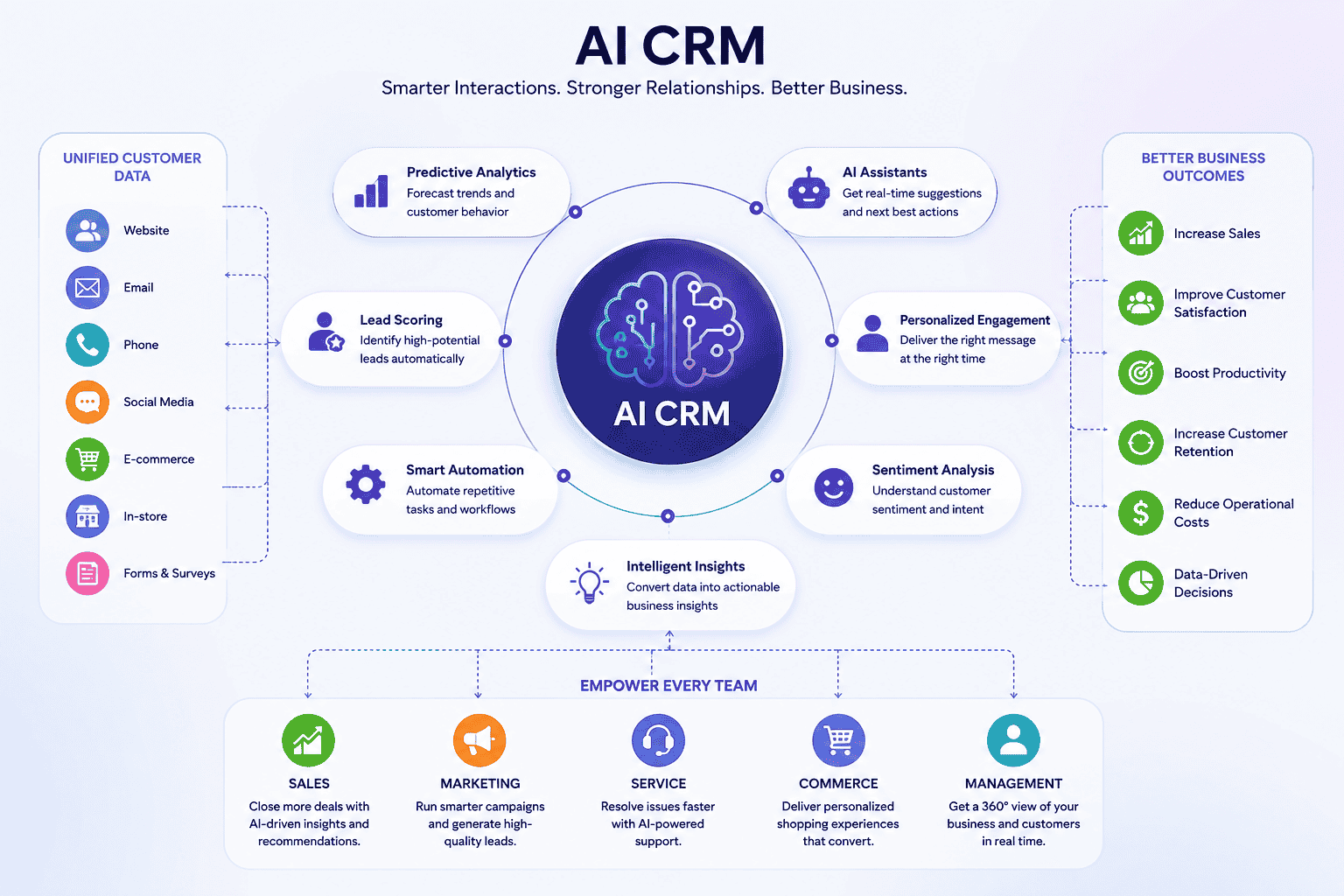
AI CRM is a customer relationship management system that uses artificial intelligence, machine learning, and generative AI to automate tasks, generate insights, and support smarter decisions across sales, marketing, and customer service.
Instead of simply storing customer data, an AI CRM studies that data continuously and turns it into recommendations, forecasts, and automated actions.
Contact our CRM experts today for a free consultation.
Book a Free ConsultationA traditional CRM is mostly a record keeping tool. Sales reps log calls, update deal stages, and pull reports manually. The system waits for a human to tell it what to do.
An AI CRM behaves more like an assistant that works alongside the team. It scores leads automatically based on likelihood to convert.
It drafts emails in the right tone for each customer. It flags deals that are at risk before a rep even notices a problem. It summarizes long call recordings into a few useful lines. In short, traditional CRM stores information, while AI CRM acts on it.
Modern AI CRM platforms combine several technologies working together:
Machine learning studies historical data such as past deals, customer behavior, and support tickets to find patterns and make predictions like which leads are most likely to close.
Generative AI creates content on demand, including emails, proposal text, call summaries, and product descriptions, based on the context of a specific customer or deal.
Predictive analytics uses statistical models to forecast outcomes such as revenue for the next quarter, churn risk, or the best time to reach out to a prospect.
Together, these pieces form what most vendors now describe as an AI CRM architecture: customer data flows in from every touchpoint, gets analyzed by AI models, and comes back out as recommendations, automated tasks, or generated content that a person can review and act on.
A few forces are pushing companies toward AI powered CRM faster than expected.
Rising customer expectations. Customers now expect fast, personal responses regardless of channel. A generic mass email no longer cuts it. People expect a business to remember their history and respond accordingly.
Need for automation. Sales and service teams are being asked to do more with the same headcount. Manual data entry, follow up scheduling, and report building eat up hours that could go toward actual selling or problem solving.
Personalized experiences. Segmenting customers by broad categories like age or region is not enough anymore. AI can personalize offers and messaging down to the individual, based on real behavior.
Remote and hybrid sales teams. With teams spread across locations, managers need visibility into pipeline health without sitting in on every call. AI generated summaries and dashboards fill that gap.
Data explosion. Businesses now collect data from email, chat, social media, support tickets, website visits, and more. No human team can manually review all of it. AI is the only practical way to make sense of that volume.
Faster decision making. Waiting until the end of the month to find out a forecast was wrong is expensive. AI CRM gives leaders real time visibility so they can adjust course early.
Feature | Benefit |
|---|---|
AI Lead Scoring | Better conversion by focusing effort on leads most likely to buy |
Predictive Analytics | More accurate sales and demand forecasting |
AI Sales Assistant | Higher productivity through guided next steps |
Email Generation | Faster, more consistent customer communication |
Call Summaries | Time savings on note taking and follow up |
Sentiment Analysis | Better engagement by catching frustration early |
Customer Segmentation | Personalization at scale across campaigns |
Chatbots | Round the clock support without added staff |
Workflow Automation | Reduced manual, repetitive work |
Opportunity Intelligence | Revenue growth through smarter deal prioritization |
AI Forecasting | Better planning across sales and finance |
Next Best Action | Smarter, data backed recommendations for reps |
At a high level, an AI CRM follows a simple loop that repeats continuously:
Customer data comes in from emails, calls, web forms, purchase history, and support tickets.
AI analyzes the data, looking for patterns across thousands of similar interactions.
Pattern detection identifies signals such as buying intent, churn risk, or complaint trends.
Predictive insights turn those patterns into forecasts and scores, like a lead score or a deal risk rating.
Automation kicks in for repetitive tasks such as sending a follow up email or updating a record.
Sales recommendations are surfaced to the rep, such as the best time to call or the next best offer.
Customer engagement happens with better timing, better content, and less manual effort from the team.
This cycle runs constantly in the background, which means the CRM gets smarter the longer it is used.
A customized AI CRM offers several benefits, including workflow automation, personalized customer experiences, improved sales productivity, predictive insights, better decision-making, higher customer retention, and increased business efficiency.
Better lead qualification. AI reviews behavior, demographics, and engagement history to rank leads by how likely they are to convert, so reps stop chasing dead ends.
Faster sales cycles. Automated follow ups, instant answers, and AI drafted proposals shorten the time between first contact and closed deal.
Improved customer experience. Faster responses and more relevant offers make customers feel understood rather than processed.
Personalized marketing. Campaigns can be tailored to individual behavior instead of broad segments, improving open and click rates.
Increased productivity. Reps spend less time on admin work like data entry and note taking, and more time actually selling or helping customers.
Better forecast accuracy. Predictive models pull in real signals rather than relying on gut feeling, which leads to forecasts leadership can trust.
Higher customer retention. Early warning signs of churn let teams step in before a customer leaves, instead of finding out after the fact.
Reduced manual work. Routine tasks such as updating records, assigning leads, or scheduling follow ups happen automatically.
Improved ROI. With less wasted effort and better targeting, the same team and budget produce more closed revenue and happier customers.
Get in touch with our team to discuss your AI CRM requirements.
Book a Free ConsultationSales teams use AI CRM for lead scoring that ranks prospects automatically, opportunity management that flags stalled or at risk deals, AI assisted email writing that drafts outreach in seconds, and pipeline forecasting that updates in real time as deals move.
Marketing teams rely on AI CRM for campaign optimization that adjusts spend toward what is working, customer segmentation built from actual behavior rather than guesswork, personalized recommendations for products or content, and journey automation that moves leads through nurture sequences without manual triggers.
Support teams use AI chatbots to handle common questions instantly, ticket routing that sends issues to the right agent automatically, knowledge recommendations that surface the right help article mid conversation, and case summaries that save agents from reading long ticket histories.
Leadership teams get value from revenue forecasting that updates continuously, dashboards that pull data from every department into one view, predictive insights that flag risks and opportunities early, and business intelligence that turns raw CRM data into strategic decisions.
Manufacturing. AI CRM helps track distributor relationships, predict equipment reorder timing, and manage long, multi stage sales cycles involving several decision makers.
Healthcare. Providers use AI CRM to manage patient outreach, appointment reminders, and referral tracking while keeping data secure and compliant.
Financial Services. Banks and advisory firms use AI to score leads for loans or investment products and to flag clients who may be at risk of leaving.
Retail. Retailers use AI CRM for personalized product recommendations, loyalty program management, and predicting which customers are about to churn.
Real Estate. Agents use AI to score buyer leads, automate follow up on property inquiries, and predict which listings match a client's stated preferences.
Professional Services. Firms use AI CRM to track proposal pipelines, automate client check ins, and forecast utilization and revenue.
Education. Institutions use AI CRM to manage student inquiries, automate admissions follow up, and predict enrollment likelihood.
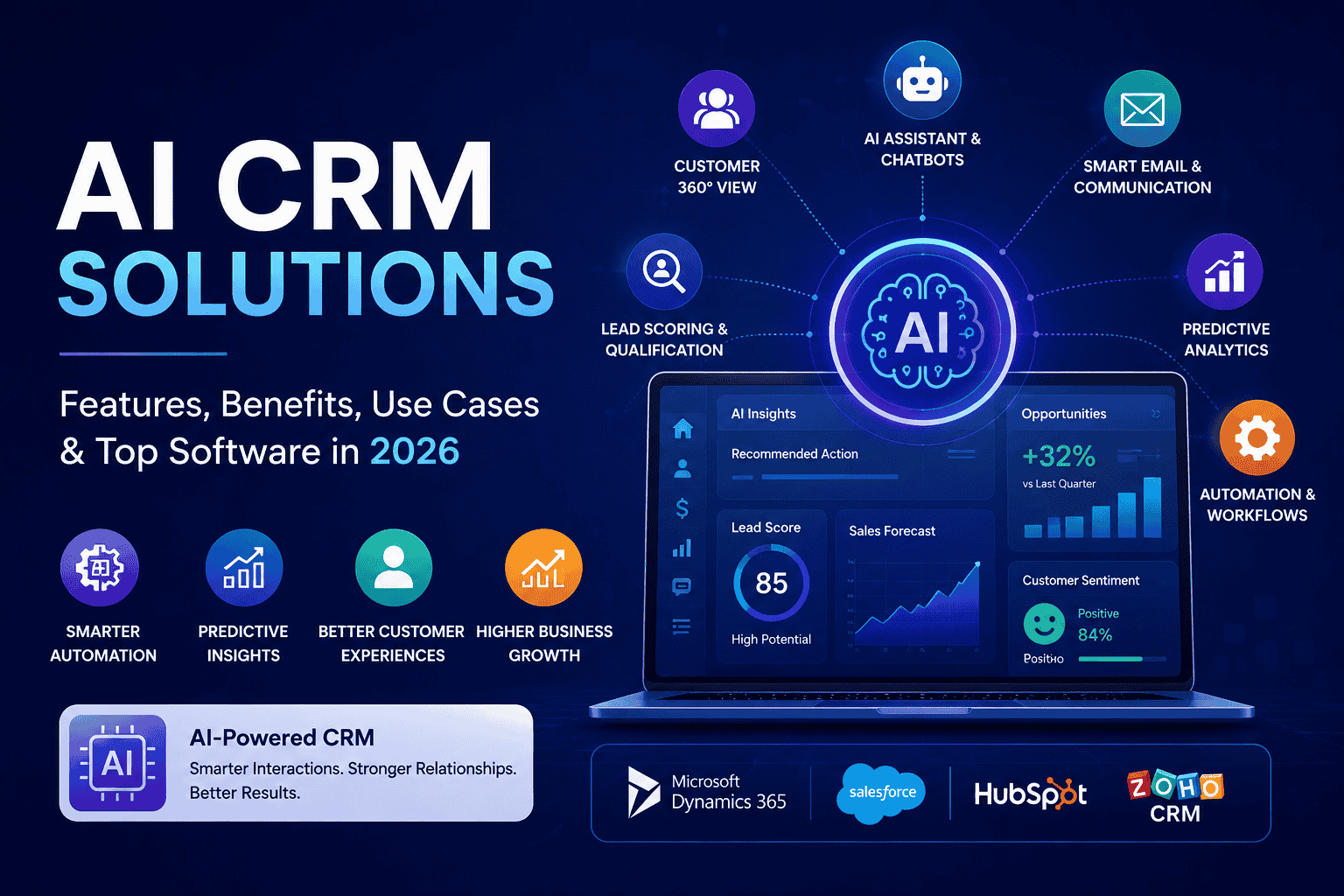
AI CRM software is transforming how businesses manage customer relationships through automation, predictive insights, and intelligent assistance. Here are some of the leading AI CRM platforms in 2026, along with their key features and best-fit use cases.
Software | Best For | AI Features |
|---|---|---|
Microsoft Dynamics 365 | Enterprise businesses | Copilot, Sales AI, Customer Insights |
Salesforce | Large businesses | Agentforce, Einstein AI |
HubSpot CRM | Small and mid size businesses | AI content generation, AI email tools |
Zoho CRM | Small and mid size businesses | Zia AI assistant |
Creatio | Workflow automation | AI native, low code CRM |
Freshworks CRM | Sales focused teams | Freddy AI |
Pipedrive | Small business sales teams | AI sales assistant |
Today's cloud-based AI CRM platforms combine artificial intelligence, automation, and scalable cloud infrastructure to help businesses improve sales, marketing, and customer service. While every solution offers AI-powered capabilities, they differ in features, pricing, customization, integrations, and ideal use cases. The comparison below highlights the top AI CRM software in 2026, making it easier to choose the right platform for your business needs.
Microsoft Dynamics 365 Pros: deep integration with Microsoft 365 and Power Platform, strong enterprise scalability, Copilot built directly into workflows. Cons: can require more setup and licensing planning for smaller teams. Best for: mid size to large enterprises already using Microsoft tools. Pricing: starts around $65 to $95 per user per month depending on the module.
Salesforce Pros: mature AI ecosystem with Agentforce and Einstein, large app marketplace. Cons: pricing and customization can get expensive as needs grow. Best for: large sales organizations with complex processes. Pricing: starts around $25 per user per month for basic tiers, rising significantly for AI add ons.
HubSpot CRM Pros: easy to use, strong free tier, good AI content tools for marketing. Cons: advanced AI features are mostly in higher paid tiers. Best for: small and mid size businesses starting out with CRM. Pricing: free tier available, paid plans start around $20 per user per month.
Zoho CRM Pros: affordable, Zia AI assistant included in many plans, wide feature set. Cons: interface can feel dense for new users. Best for: budget conscious small and mid size businesses. Pricing: starts around $14 per user per month.
Creatio Pros: strong no code and low code workflow builder, AI native design. Cons: smaller market presence than Salesforce or Microsoft. Best for: teams that want heavy process automation. Pricing: custom quotes, generally mid range.
Freshworks CRM Pros: Freddy AI offers solid lead scoring and forecasting at a reasonable price. Cons: fewer enterprise scale integrations than Dynamics 365 or Salesforce. Best for: growing sales teams. Pricing: starts around $9 to $29 per user per month.
Pipedrive Pros: simple, visual pipeline, AI sales assistant for small teams. Cons: limited depth for complex marketing or service needs. Best for: small sales focused businesses. Pricing: starts around $14 per user per month.
Each of these platforms has real strengths, and the right choice depends on company size, budget, and existing technology stack. That said, Microsoft Dynamics 365 stands out for organizations that need enterprise grade AI features tied into a broader productivity ecosystem, which is why it remains one of the most widely adopted AI CRM platforms among mid size and large businesses today.
Dynamics 365 has become one of the leading examples of what a modern AI CRM can do, largely because Microsoft has built AI into nearly every part of the platform rather than adding it as a separate tool.
Microsoft Copilot sits inside Dynamics 365 and helps users draft emails, summarize records, and answer questions about customer accounts in plain language, right where the work happens.
AI Sales capabilities score leads and opportunities, surface relationship health signals, and recommend next steps based on similar past deals.
AI Customer Service tools summarize cases, suggest responses to agents, and route tickets automatically based on content and urgency.
AI Marketing features help segment audiences, personalize journeys, and optimize send times and content based on engagement data.
Customer Insights brings together data from every touchpoint into a single customer profile, giving teams a complete view instead of scattered records.
Predictive analytics built into Dynamics 365 forecasts revenue, churn, and demand using historical patterns.
Power Platform integration lets businesses build custom apps, automate workflows with Power Automate, and create dashboards with Power BI, all connected to the same CRM data.
Microsoft Fabric integration allows businesses to bring in data from across the organization, not just the CRM, for a broader view when building AI models and reports.
Talk to our Dynamics 365 consulting experts and start your AI transformation today.
Book a Free ConsultationBecause Dynamics 365 connects naturally with Outlook, Teams, Excel, and the rest of the Microsoft ecosystem, many organizations find it easier to get adoption from staff who already use these tools daily. That familiarity, combined with strong AI capability, is a big part of why Dynamics 365 is considered one of the best enterprise AI CRM solutions available today.
Before picking a platform, walk through this checklist:
Business size and how the CRM will scale as you grow
Budget, including licensing, implementation, and training costs
AI capabilities that actually match your use case, not just marketing claims
Level of automation available for your specific workflows
Integrations with tools you already use, such as email, ERP, or marketing platforms
Scalability for future growth and additional users
Security and compliance features, especially for regulated industries
Ease of use for the team who will actually work in the system daily
Mobile support for reps who work outside the office
Vendor support quality, including onboarding help and ongoing service
Define business goals. Know what success looks like before you start, whether that is faster response times, higher conversion rates, or better forecasting accuracy.
Clean CRM data. AI is only as good as the data behind it. Duplicate records, missing fields, and outdated contacts will weaken every prediction the system makes.
Integrate systems. Connect your CRM with email, marketing tools, finance systems, and any other software holding customer data, so the AI has a full picture.
Train users. Even the smartest AI tool fails if the team does not know how to use it or does not trust its recommendations.
Start with high value workflows. Rather than turning on every AI feature at once, begin with the one or two areas that will show the clearest results, such as lead scoring or email drafting.
Monitor KPIs. Track metrics like conversion rate, response time, and forecast accuracy before and after rollout so you can measure real impact.
Optimize continuously. AI models improve with more data and feedback. Review performance regularly and adjust workflows as needed.
Poor data quality. Incomplete or inconsistent data leads to weak predictions. The fix is a proper data cleanup and governance process before and during rollout.
User adoption. Teams sometimes resist new tools, especially if they do not see immediate value. Clear training and quick wins help build trust.
AI bias. Models trained on historical data can carry forward past biases. Regular review of AI recommendations helps catch and correct this.
Integration issues. Disconnected systems limit what AI can see and do. Working with an experienced implementation partner reduces this risk significantly.
Privacy concerns. Customers are more aware than ever of how their data is used. Being transparent about data use and following regulations like GDPR builds trust.
Cost. AI features can add to licensing costs. A phased rollout focused on high impact areas first helps manage budget while proving value.
Change management. Shifting from manual processes to AI assisted ones is a culture change, not just a software change. Strong communication from leadership makes the transition smoother.
Looking ahead, a few trends are shaping where AI CRM is headed next.
Agentic AI is moving beyond suggestions toward systems that can actually complete multi step tasks on their own, such as researching a lead and drafting a full outreach sequence without waiting for instructions at each step.
Autonomous sales agents will handle routine parts of the sales process, like initial outreach and qualification, freeing human reps to focus on complex conversations and closing.
Voice AI is being built into CRM to transcribe, summarize, and even respond to calls in real time.
Hyper personalization will go deeper than segments, tailoring messaging and offers to individual behavior patterns in real time.
Predictive customer journeys will map out the most likely path a customer will take and adjust marketing and sales touchpoints accordingly.
Conversational CRM will let users simply ask the system questions in plain language, such as asking which deals need attention this week, instead of building reports manually.
AI copilots will continue expanding across every role in the CRM, not just sales, but also marketing, service, and operations.
AI generated dashboards will build themselves based on what a user typically needs to see, rather than requiring manual report design.
Multi agent CRM systems will have several specialized AI agents working together, one focused on lead qualification, another on scheduling, another on customer support, all coordinated within the same platform.
Autonomous workflow automation will extend further into back office processes, connecting CRM actions directly to finance, inventory, and operations systems.
Even the best AI CRM platform will underperform without proper setup. A consulting partner brings value across every stage of the process.
Strategy. A good partner helps define what success looks like and which AI features will actually move the needle for your specific business.
Implementation. Setting up a CRM correctly the first time avoids costly rework later, especially when AI features are layered on top of core workflows.
Customization. Every business has unique processes. A partner tailors the CRM and its AI features to match how your teams actually work.
Data migration. Moving data from old systems into a new AI CRM safely, without losing history or introducing errors, takes real expertise.
AI configuration. AI models need to be trained and tuned on your business data to give useful, accurate recommendations rather than generic ones.
User training. Getting teams comfortable and confident with new AI tools is often the difference between a system that gets used and one that gets ignored.
Ongoing support. AI CRM is not a one time setup. Systems need monitoring, adjustment, and updates as your business and data grow.
Cynoteck is an experienced Dynamics 365 Consulting service provide that has helped organizations across industries plan, implement, and get real value from AI powered CRM solutions built around their specific needs. From initial strategy through data migration, AI configuration, and long term support, Cynoteck works alongside businesses to make sure their CRM investment actually pays off.
AI CRM is customer relationship management software that uses artificial intelligence and machine learning to automate tasks, generate content, and provide predictive insights, going beyond simple data storage to actively support sales, marketing, and service teams.
It collects customer data from every touchpoint, analyzes it using machine learning and generative AI, detects patterns, and turns those patterns into predictions, automated actions, and recommendations for the team.
Traditional CRM stores and organizes customer data for manual review. AI CRM analyzes that same data automatically and takes action, such as scoring leads, drafting emails, or forecasting revenue, without waiting for a person to run the analysis.
There is no single best option for every business. Microsoft Dynamics 365 and Salesforce lead for enterprise needs, while HubSpot, Zoho, Freshworks, and Pipedrive suit small and mid size businesses depending on budget and required features.
Yes. Dynamics 365 includes Microsoft Copilot along with AI powered sales, marketing, and customer service tools, plus predictive analytics and integration with Power Platform and Microsoft Fabric.
Yes. Salesforce offers AI capabilities through Einstein AI and Agentforce, covering lead scoring, forecasting, and generative content across its CRM modules.
Yes. Many platforms, including HubSpot, Zoho, and Freshworks, offer AI features at price points built for small teams, so businesses do not need enterprise budgets to benefit from AI in their CRM.
Pricing varies widely, from around $10 to $15 per user per month for basic small business plans up to $90 or more per user per month for full enterprise platforms with advanced AI included.
No. AI CRM handles repetitive tasks like data entry, follow up scheduling, and initial lead scoring, but relationship building, negotiation, and complex problem solving still depend on human judgment and connection.
Timelines depend on business size and complexity, but most implementations take anywhere from a few weeks for small businesses with simple needs to several months for enterprise rollouts involving data migration and custom AI configuration.
AI CRM is changing customer relationship management from a system that simply records what already happened into a platform that helps predict and shape what happens next.
From lead scoring and forecasting to automated emails and real time dashboards, the benefits touch every department, sales, marketing, service, and leadership alike.
Choosing the right platform matters, but so does the implementation behind it. Clean data, clear goals, proper training, and ongoing optimization are what separate businesses that get real value from AI CRM from those that just add another tool to the stack.
Working with an experienced partner like Cynoteck can help your business move from a traditional CRM setup to a proactive, intelligent AI powered platform built around how your teams actually work, so the investment pays off from day one.
Schedule a free consultation and discover the right AI CRM solution for your business.
Book a Free Consultation
Discover the top 10 benefits of custom CRM software development for modern businesses. Learn how tailored CRM solutions improve efficiency, enhance customer relationships, and drive business growth.
We are more than just developers and consultants—we are your partners in navigating the digital landscape. Let us be the engine behind your next big success while you focus on your core vision.
Explore Opportunities!.png)
 Power BI vs Excel (1).webp)
 Top 10 Cloud Based CRM Platforms Compared (Features, Pricing & Pros).webp)