Did Trump and Xi Actually Agree on Any AI Safety Rules?
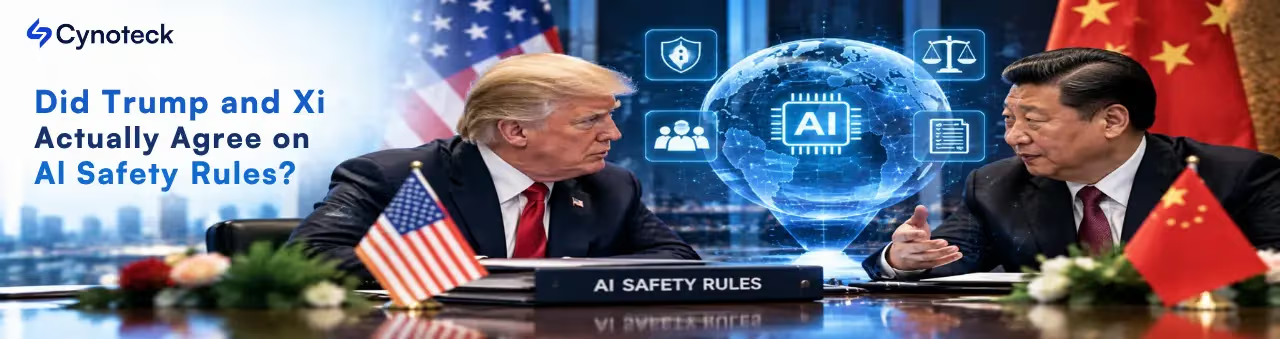
Two leaders who agree on almost nothing found one thing to agree on this week: neither wants to slow down AI. President Trump and China's Xi Jinping met Thursday in Washington, Xi's first US state visit in more than a decade, with AI safety sitting on the same agenda as trade. The summit produced plenty of symbolism and almost no specifics. That gap between the two is the actual story.
Cooperation, not competition, was the official message. Trump and Xi both acknowledged their intense rivalry in AI development, but publicly agreed the technology should become a source of shared economic growth, not conflict between the two countries. Neither leader committed to any binding safety standard. Trump has previously dismissed AI safety warnings as overblown, and this summit didn't change that stance; he continued using the phrase "Super Intelligence" rather than artificial intelligence in his own posts about the visit.
We helped organizations choose the right AI platform, integrate, and scale AI solutions that drive real business impact and track measurable results.
Book a Free ConsultationSmaller than the name suggests. Ahead of the summit, Bessent proposed a channel for the US and China to alert each other when an AI-related incident rises to a national security level, essentially a way to flag serious problems before they escalate into something worse. It wouldn't stop either country from building more advanced systems. It wouldn't ease US restrictions on sensitive technology exports. One expert compared the ambition level to the Cold War-era Moscow-Washington hotline, though far less developed. Even that comparison may be generous: past US-China crisis communication lines have reportedly gone unanswered during real emergencies.
Not really, and that's worth saying plainly. The summit ended without any announcement confirming whether the notification system was formally adopted, or even raised directly between Trump and Xi themselves. One trade truce, capping tariffs at roughly 20%, was extended before the summit even began, which cleared space for the AI conversation but didn't resolve it. Follow-up talks are expected in Shenzhen in November under a broader US-China AI Dialogue, where real details might finally take shape, or might not.
If your company relies on AI vendors, infrastructure, or partners tied to either country, don't expect clarity soon.
Treat this summit as a signal of intent, not a rulebook; nothing here changes your compliance obligations today
Watch the November Shenzhen talks closely; that's the actual venue where specifics might emerge
If you operate globally, expect US and Chinese AI governance to keep diverging rather than converging; planning around one unified global standard remains premature
Our AI services team can help you track how this still-forming US-China AI relationship might affect your vendor choices and compliance planning over the coming months.
No. The summit produced statements of shared interest but no confirmed, binding agreement on AI safety standards or incident reporting.
It would create a channel for the US and China to alert each other about AI incidents serious enough to threaten national security, nothing more; it wouldn't restrict either country's AI development.
Yes. Xi has proposed a World AI Cooperation Organization, positioning China as a parallel rule-setter rather than simply adopting a Western-led framework.
.png)
Cynoteck wins the ET Leadership Excellence Award 2025 for excellence in IT consulting, recognizing its business-focused, scalable, and high-impact technology solutions.
We are more than just developers and consultants—we are your partners in navigating the digital landscape. Let us be the engine behind your next big success while you focus on your core vision.
Explore Opportunities! Did Trump and Xi Actually Agree on Al Safety Rules.webp)
 Cynoteck Recognized as a Clutch Global Leader for Spring 2024.png)

 Why Did Australia's PM Confront OpenAI's CEO at the UN.webp)