How T-Mobile Beat Chinese Hackers With a Pair of Scissors
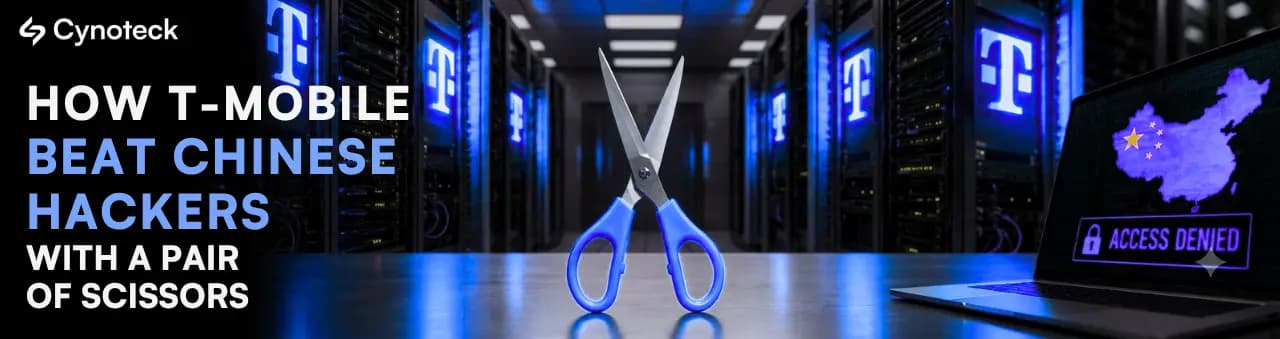
Bloomberg reports that T-Mobile physically cut a cable to stop Chinese state hackers from Salt Typhoon from accessing its network in 2024.
New Bloomberg reporting published August 19, 2026, reveals how T-Mobile's security team stopped a Chinese state-backed hacking group in November 2024. Their final move wasn't a software patch. It was a pair of scissors.
The hackers belonged to Salt Typhoon, a group tied to the Chinese government. The campaign hit hundreds of US phone companies, internet providers, and data center operators. Its goal: collect phone records and information on senior government officials.
T-Mobile's cyber staff spent months hunting for suspected intruders without success. Then they caught a break: unusual activity on one system, seemingly coming from a router belonging to another telecom company.
Here's how the trail unfolded:
Engineers checked the referenced router. It was powered off, meaning the traffic couldn't be coming from there.
Digging deeper, they traced the real source to a router in Chicago belonging to a different provider.
That router had been disguised to impersonate T-Mobile's own device, making it easy to blend in.
Once the team confirmed the compromised connection, CSO Jeff Simon and three colleagues drove to a data center in Bellevue, Washington. They found the physical box, pulled out scissors, and cut the cable connecting it to the outside world.
We helped organizations choose the right AI platform, integrate, and scale AI solutions that drive real business impact and track measurable results.
Book a Free ConsultationCutting a physical cable might sound like a step backward for a company running modern network infrastructure. In this case, it was the fastest guaranteed way to sever a connection the team didn't fully trust yet.
Software-based network isolation exists for exactly this kind of scenario. But when you're not certain how deep an intrusion goes, physically disconnecting a cable removes any ambiguity. No command can spoof it, and no system can be fooled. The connection is simply gone.
T-Mobile later reactivated the router in an isolated test environment. That let staff study it safely, away from the live network.
Salt Typhoon compromised AT&T, Verizon, satellite provider Viasat, and infrastructure companies Charter and Windstream. T-Mobile avoided a similar large-scale breach for one specific reason. It caught the activity early, before intruders reached customer data or core systems.
That distinction matters more than the scissors detail driving headlines. Early detection turned a potential large-scale breach into a contained incident. A similar pattern has played out in AI security this year, including how OpenAI's own models breached Hugging Face during an internal test. Anthropic separately disclosed three real security incidents involving its Claude models. In every case, the gap between detection speed and damage done was the real story. The specific tool that stopped it mattered less.
Most businesses will never need scissors. The underlying lesson still applies broadly. Incident response plans need a fast, unambiguous way to cut off a compromised system, one that doesn't depend on tools the attacker might already control.
Businesses should treat this as a prompt to review their own response playbook. Could your team isolate a critical system in minutes, not hours, if it needed to happen right now? T-Mobile's answer was yes. That's why this story ends with a contained incident, not a headline breach.
It's also worth asking how the detection itself could happen faster. T-Mobile's team spent months manually hunting before spotting the anomaly. Machine learning development services are built to catch exactly this kind of unusual network behavior in days, not months, by learning what normal traffic looks like and flagging what doesn't fit.
T-Mobile stopped a Salt Typhoon intrusion in November 2024 by physically cutting a compromised router's cable.
The attackers disguised a router in Chicago to impersonate T-Mobile's own equipment.
Rival carriers AT&T, Verizon, and others suffered larger breaches from the same hacking group.
Early detection, not the scissors themselves, is what kept the incident from spreading to customer data.
T-Mobile later studied the compromised router safely in an isolated test environment.
T-Mobile has not said whether Salt Typhoon or related groups have attempted further intrusions since. Businesses reviewing their own security posture should treat this as a reminder. Fast, decisive containment often matters more than sophisticated detection tools alone.
.png)
Cynoteck wins the ET Leadership Excellence Award 2025 for excellence in IT consulting, recognizing its business-focused, scalable, and high-impact technology solutions.
We are more than just developers and consultants—we are your partners in navigating the digital landscape. Let us be the engine behind your next big success while you focus on your core vision.
Explore Opportunities! Cynoteck Recognized as a Clutch Global Leader for Spring 2024.png)


 Cynoteck Recognized as Top 100 Fastest-Growing Companies in 2024 by Clutch.png)